Predeceased by her brother John together with parents Edward and Maureen; Ms Bourke passed away unexpectedly, while in the excellent care of the team at Beechfield Manor, Shankill, Dublin.
Her passing is most deeply regretted and will be lovingly remembered by her brothers Richard and Edward; sisters-in-law Nora, Theresa and Anne; nieces; nephews; extended relatives and friends.
Funeral Arrangements
The earthly remains of Ms Bourke will arrive at Holycross Abbey, Thurles, on Saturday afternoon next, May 11th, at 2:30pm, for Requiem Mass at 3:00pm, followed by interment immediately afterwards in the adjoining cemetery.
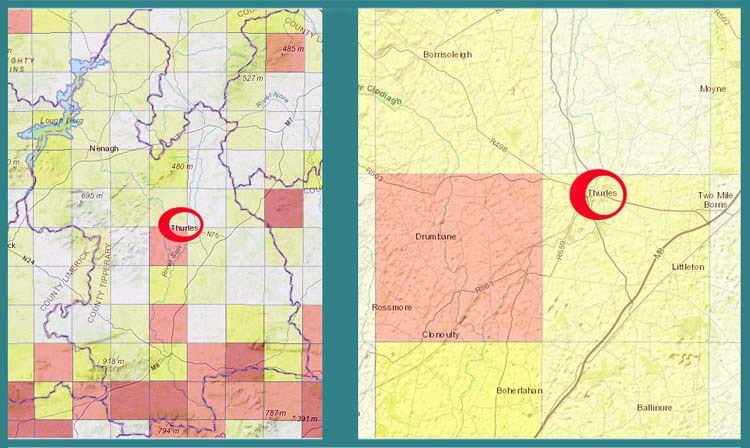
New radiation protection legislation now requires all employers, in high radon areas, to test their workplace for the radioactive gas ‘Radon‘. Where levels are above the national reference level of 300 Becquerel per metre cubed, employers are then required to carry out work to ensure the reduction of these levels.
The above Radon Map (Click Here To View In More Detail) has five categories: less than 1%, 1 to 5%, 5 to 10%, 10 to 20% and greater than 20%. If you live in an area designated as ‘greater than 20%’, this means that more than 20%(1 in 5) homes in that grid square are likely to have radon concentrations above the Reference Level.
At today’s National Radon Forum, attendees heard from the Environmental Protection Agency (EPA) and the Health and Safety Authority (HSA) about the requirements of this new legislation.
Details on protocol for measurement of Radon in homes & workplaces can be downloaded HERE
Speaking at today’s National Radon Forum Ms Laura Burke, (EPA Director General), said: “In Ireland, up to 300 cases of lung cancer each year are linked to Radon, which is a serious public health hazard. Employers now have responsibility to ensure that their employees are protected from exposure to this radioactive gas. Radon testing in workplaces is simple and inexpensive and, where necessary, reducing high radon levels in a building is also straightforward. The EPA and the HSA are working in partnership to support employers in implementing this legislation.”
Yvonne Mullooly, (Assistant Chief Executive, from the Health & Safety Authority) welcomed the new legislation stating: “In addition to the existing general duties on employers to address radioactive hazards, this new legislation provides employers with clear testing requirements for radon gas in their workplaces. The Authority looks forward to continued collaboration with the EPA in highlighting radon gas exposure in workplaces and supporting the ongoing work of the National Radon Control Strategy Co-ordination Group. Our inspectors will continue to raise awareness during their inspections of the potential for radon gas exposures and the need for appropriate risk assessments. We will continue to support employers by providing information and through our on-line risk assessment tool BeSMART www.BeSMART.ie, which includes radon as a hazard.”
Phase two of the National Radon Control Strategy is also being launched today at the 15th National Radon Forum in Dublin. Attendees will hear about the Government’s Strategy to tackle radon over the next 5 years and the research that is needed to support this work.
The EPA radon team are available to answer your queries at Email: radon@epa.ie or Tel: 1800 300 600.
Predeceased by her brothers Dan and Eddie and sister Eileen; Mrs O’Keeffe passed away peacefully at Northampton General Hospital, England.
Her passing is most deeply regretted by her daughter Natalie and Natalie’s partner John; sisters Josephine, Margaret, Kathleen and Norah; brothers Joseph and Paddy; sisters-in-law; brothers-in-law; three grandchildren; nephews; nieces; cousins; extended relatives; neighbours and friends.
Mrs O’Connor passed away peacefully at home while in the loving care of her daughter Janet (Ryan), son-in-law T.J. and her granddaughter Christine.
Her passing is most deeply regretted by her son Kevin; daughters Janet, Marion and Eileen; grandchildren; great-grandchildren; sons-in-law; daughter-in-law; nephews; nieces; extended relatives; neighbours and many friends.
Funeral Arrangements
The earthly remains of Mrs O’Connor will lie in repose at Kennedy’s Funeral Home, Borrisoleigh, on Thursday evening next, May 9th, from 5:00pm to 7:00pm.
Removal will take place on Friday morning, May 10th, to the Sacred Heart Church, Borrisoleigh, for Requiem Mass at 11:00am, followed by interment immediately afterwards in the nearby St. Brigid’s Cemetery, Borrisoleigh, Thurles, Co. Tipperary.
The Environmental Protection Agency (EPA) report on 2017 emission levels for the five main air pollutants.
These figures show that ammonia emissions increased by 2% cent in 2017. The trend in increasing ammonia emissions is projected to continue out to 2030. Emissions of non-methane volatile organic compounds also increased. Ireland is projected to exceed the 2030 emission ceiling for this pollutant. While emissions of nitrogen oxides decreased in 2017, emissions are projected to be non-compliant with national limits in 2030. Emissions of two other air pollutants; sulphur dioxide and particulate matter, decreased in 2017. These pollutants are projected to remain compliant with national limits, provided planned measures are implemented.
The EPA today published figures for emissions of five key air pollutants. These pollutants impact environment and health contributing to respiratory problems and pollution of soil, surface water and vegetation. These pollutants are: ammonia, non-methane volatile organic compounds, sulphur dioxide, nitrogen oxides and particulate matter.
This latest information from the EPA shows that ammonia emissions increased by 2% in 2017, which followed a 5% increase in 2016. Agriculture dominates emissions of ammonia, which arise from the decomposition of animal manures and the application of fertiliser. This trend in increasing emissions is projected to continue out to 2030.
In addition, emissions of non-methane volatile organic compounds showed an increase in 2017. These pollutants arise from the food and beverage industry and the storage and handling of animal manures and synthetic fertilisers. Non-methane volatile organic compound emissions are projected to increase slightly to 2030 as the gains from switching to less polluting sources are outweighed by increased economic activity and population growth. Ireland is therefore projected to exceed the more challenging 2030 non-methane volatile organic compounds emission ceiling, despite being in compliance for 2020.
Dr Eimear Cotter, (Director of Office of Environmental Sustainability) said: “Our figures show that ammonia levels are on an upward trend, in tandem with increased agricultural production, and that they breached national limits in 2016 and 2017. This has implications for air and water quality.The National Air Pollution and Control Programme, currently out for public consultation, will need to address these emissions particularly as they are projected to increase further to 2030. The underlying driver for these emissions is the application of more animal manure to soils — mostly as an organic fertiliser — and the increase in the use of inorganic fertilisers. Options to increase efficiencies and reduce fertiliser use will need to be implemented at farm level.”
Emissions of other air pollutants – sulphur dioxide, nitrogen oxides and particulate matter – decreased in 2017. This reflects a general downward trend in emissions since 1990 reflecting the impact of fuel switching from coal and peat to natural gas, penetration of renewables and technology improvements. Looking to the future, however, while sulphur dioxide and particulate emissions are projected to remain compliant with substantially lower national limits in 2030, provided planned measures are implemented, this is not envisaged to be the case for nitrogen oxide emissions. Nitrogen oxide emissions are projected to be non-compliant with national limits in 2030, with the transport sector projected to continue to be a key source of emissions.
Stephen Treacy, (EPA Senior Manager) said: “We have seen the positive impact of a range of policy measures and regulatory interventions since 1990 which are particularly evident in declining sulphur dioxide and particulate emissions. Fuel switching and the move to more renewables has brought dividends in terms of cleaner air, with effective regulatory intervention from the EPA also playing a role. It is important that this good work is not reversed in the context of a growing economy. Further measures are needed to meet national limits in the period from now to 2030, particularly for the pollutants ammonia, nitrogen oxides and non-methane volatile organic compounds”.
For further detail on these figures, see the EPA web published report “Ireland’s Air Pollutant Emissions 1990-2030” available HERE
This website uses cookies to improve your experience. We'll assume you're ok with this, but you can opt-out if you wish.AcceptRead More
Privacy & Cookies Policy
Privacy Overview
This website uses cookies to improve your experience while you navigate through the website. Out of these, the cookies that are categorized as necessary are stored on your browser as they are essential for the working of basic functionalities of the website. We also use third-party cookies that help us analyze and understand how you use this website. These cookies will be stored in your browser only with your consent. You also have the option to opt-out of these cookies. But opting out of some of these cookies may affect your browsing experience.
Necessary cookies are absolutely essential for the website to function properly. This category only includes cookies that ensures basic functionalities and security features of the website. These cookies do not store any personal information.
Any cookies that may not be particularly necessary for the website to function and is used specifically to collect user personal data via analytics, ads, other embedded contents are termed as non-necessary cookies. It is mandatory to procure user consent prior to running these cookies on your website.






Recent Comments