It’s confirmed, they have vanished into thin air as if by magic. Yes, all five gates guarding the entrance to St. Patrick’s cemetery have disappeared.
Making solid metal objects vanish has never failed to spark a sense of wonder in the hearts of simple rural dwellers.
Where did they go? Were they stolen by Dublin criminals, to be carted back to the nation’s capital, using high speed cars pulling flat trailers; to be sold off by the thief, anxious to fund his next heroin fix? Should local Thurles Gardaí be notified?
St. Patrick’s cemetery was first consecrated on May 11th, 1928, by Most Reverend Dr. J.W. Harty, Roman Catholic Archbishop of Cashel & Emly. (See history link HERE.) Since that date, some 91 years later, the gates to this cemetery have received no more than one coat of paint, adequately reflecting the current overall attitude that exists within Thurles, under the current governance of Templemore / Thurles Municipal District Council and their officials.
Hold on a second; is there a chance here that perhaps Thurles Municipal District Council officials may have demanded their removal; same mortified and red faced, in the knowledge that €90.00 is now required for planning permission to currently erect a headstone on previously purchased graves?
One wonders why recently elected local town councillors haven’t been busy on Facebook in search of credits or did perhaps officials fail to inform them of the removal?
Speaking of Facebook, we did note that one councillor was “calling” for a “Sensory Garden” for the town at their last meeting. Sure wouldn’t St. Patrick’s cemetery make a lovely Sensory Garden, now that the gates are gone hopefully for repair or for scrap and eventual replacement!
The Government has been given just 21 days to stop misusing Public Services Cards and the Data Protection Commission (DPC) are demanding that data held on more than 3.2 million such cards be now deleted within 21 days.
Public Services Cards were first introduced as a pilot scheme in 2011, primarily as a means of preventing social welfare fraud. Initially, it was to be an identification card of sorts, containing simply the personal details of the holder e.g. their name, photo, PPS Number etc, that could be presented by individuals identifying themselves when claiming social welfare benefits.
However, to many including Digital Rights Ireland; the Irish Council for Civil Liberties; the UN’s Special Rapporteur on Extreme Poverty and Age Action, this same introduction was seen as an attempt to introduce a National ID card by stealth.
Some cynics, distrustful of current government sincerity or integrity, suggested, (tongue in cheek), that PPS Numbers should be tattooed on peoples left arms, latter the method of identification used to identify inmates in German concentration camps, like Auschwitz and Birkenau in Poland.
Public Services Cards went on to grant not just access to Social Welfare Services but access toChild Benefit and Treatment Benefits; first time adult passport applicants within the State; citizenship applications; driver theory test applications and access to personal online public services, e.g. Social Welfare and Revenue services, via MyGovId.
In recent years the Irish populace, particularly the elderly, were being persistently contacted by the Department of Social Protection, latter who were insisting that Public Services Cards were mandatory. The Minister for Social Welfare, Regina Doherty, stated back in 2017, that this PSC card was, quote; “mandatory but not compulsory” and yet “no more compulsory than having a driving license”, after a woman in her 70’s revealed she had not received her pension for 18 months, because she had refused to register for the card.
The department will now have six weeks in total to submit new plans to the Data Protection Commission (DPC), (latter the national independent authority responsible for upholding the fundamental right of the individual within the EU to have their personal data protected), outlining how it will bring this Public Services Card scheme into full compliance with current existing data protection legislation.
The amount of taxpayers money that has been wasted by this government on this project is estimated at €54.6 million; with some €9.5 million being incurred so far this year and card production alone costing €20.9 million according to the Irish Times newspaper.
A 12-year-old girl from the Thurles area, who was on a day visit to
the Rock of Cashel here in Co Tipperary this afternoon, has been
airlifted to hospital after been injured in a fall.
It is understood that the girl was playing near the national landmark
at around 1.20pm, when she slipped and became lodged under a bench.
Emergency services removed the bench in order to free the girl, who
may have suffered back injuries. She was immediately airlifted to
University Hospital Limerick by an Air Corps helicopter, latter which
was already in the vicinity at the time of the accident and who quickly
responded to the emergency call.
Thankfully the young girl’s condition is not believed to be life-threatening.
The scene was immediately cordoned off by attending Gardaí from Cashel.
Yesterday, (14/08/2019), a male in his 30’s was arrested by Gardaí after they discovered cannabis herb worth €40,000 and cocaine worth €70,000, in a motor vehicle driven by the accused.
Following a search, the arrest took place on the R503 close to the Limerick border, in the vicinity of Garracummer, Kilcommon, Thurles, Co. Tipperary.
The arrested man remains detained at Tipperary Town Garda Station; held there under Section 2 of the Drug Trafficking Act.
Further investigations are continuing into the incident.
Back in October 2018 it was reported that the remains of 796 children, buried in an unmarked mass grave at a former Bon Secours Mother and Baby Home in Tuam, Co. Galway, were to be exhumed as part of a major forensic investigation.
The story emerged from research undertaken by Irish amateur historian Mrs Catherine Corless. The latter had decided to write an article about this mother and baby institution, based on her own childhood memories of the said institution; having gained an interest in local history, through her attendance at evening history courses.
A slow news day saw national and international media take up the story, likening same to Rwandan genocide, Ireland’s own Holocaust and the Srebrenica massacre of the mid 1990’s. Leading members of our Irish Parliament, the Irish Senate and the Northern Ireland Parliament, latter despite supposedly being well educated, were unaware of Ireland’s past history and now all spent valuable hours in debate, many strongly condemning Roman Catholic church authorities regarding this issue.
But all of Irish society remained defined by its very silence and its total complicity in what was accomplished, in an effort to cover up what we must regarded today as the most shameful of chapters in our Irish history and a crime against Irish women and children.
Since then, the current Fine Gael Minister for Children, Ms Katherine Zappone has confirmed that it is the current governments intention to exhume and if possible, to identify remains. The Minister has further ratified the costs of this project at being between €6m and €13m. The Roman Catholic religious congregation of the Sisters of Bon Secours have offered “a voluntary contribution” of €2.5m.
Thurles & Dublin Foundling’s Hospital
The Dublin Foundling’s Hospital(today the St. James’s Hospital campus and sometime in the future to become part of the new National Children’s Hospital at a cost in excess of €1.4bn) was first established in the early part of the 18th century (1702), with Dean Jonathan Swift and Arthur Guinness being amongst those who served on the Board of Governors. Its purpose was to prevent the deaths, brought about through neglect; malnourishment; climate exposure and murder, all caused due to severe poverty. The Dublin Foundling’s hospital also had one other aim; to educate and rear the children taken into charge, in the Reformed or Protestant Faith, and thereby to strengthen and promote the Protestant Interest in Ireland.
Foundling
A foundling refers to an infant child that has been abandoned by one or both parents at birth. Same is brought about usually due to the mother feeling unable to care for her infant, usually for reasons of poverty, or quite often due to pressures both from family and society in general, latter being unable to accept the existence of an infant born “outside the blanket” or outside of wedlock.
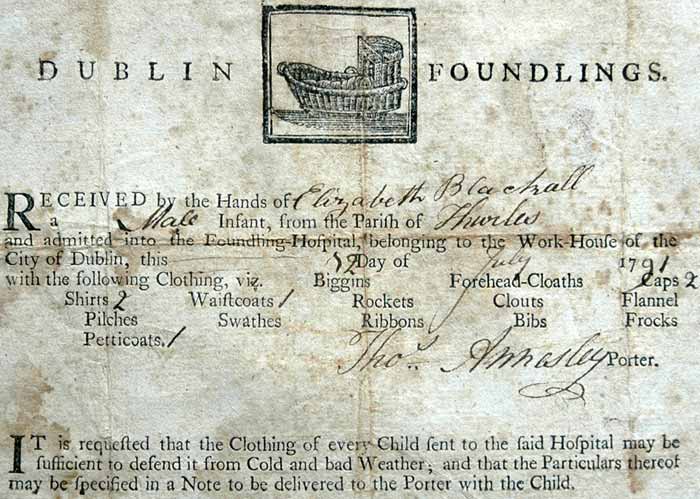
You will note from the picture show above of a billet (A billet in today’s language means a ‘ticket’ or a ‘receipt’ in French, but it originally meant a ‘short note’), that a male child “by the hands of Elizabeth Blackall” from the Church of Ireland parish of Thurles, was admitted to the Dublin Foundlings Hospital on July 12th 1791. The Porter’s name is shown as Thomas Annesley.
Note from the billet, shown above, certain of the clothing names no longer in use today. Biggins – A bonnet tied behind the neck and made of wool or linen. Clouts – Diapers or nappies. Flannel – A square of fabric wrapped around a child over the diaper or a long undergarment. Forehead Clothes – Strip of cloth tied across the forehead to behind the ears for added warmth. Pilches – Layers of cloth tied around the diaper in an effort to prevent leakage. Swathes – Strips of cloth, usually of wool, wrapped around an infant’s body for warmth and to put pressure on the navel. Parents will be aware of the term Swaddling.
Foundling hospital’s turning wheel appliance.
A levy, of £5 per year, would have been imposed on the parish from which the child was sent.
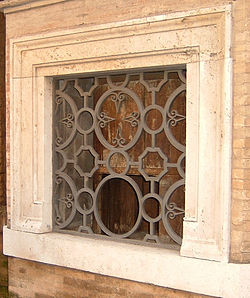
A feature of most foundling hospitals was a turning-wheel type mechanism set in a wall near the building’s main entrance. This particular system was so designed as to encourage mothers to bring their unwanted children anonymously to the hospital building, rather than to abandon them on doorsteps or in other out-of-the-way areas.
The hospital’s turning wheel appliance allowed for a basket to be attached, into which an infant could be placed at any time, day or night. A bell was attached to attract the attention of the hospital porter then on duty. The porter would then rotate the wheel mechanism, thus bringing the infant into the building’s interior. Such porters were instructed to take in all infants left in the basket / cradle and not to have any direct conversation with the individuals who had lodged a child.
Child abandonment due to poverty and illegitimacy has always been a problem in the past, and viewed in private by governments as the unacceptable face of unnecessary expense on state coffers. In medieval times babies were often abandoned in church or monastery doorways, in the hope that the religious, of all denominations, would take on the task of providing sustenance. After all, did not Jesus Christ insist, in the Gospel according to St. Matthew (Chapter 19 – Verse 14), that Christians should – “Suffer little children, and forbid them not, to come unto me: for of such is the kingdom of heaven”.
Once an infant was taken in charge, it was assumed that a mother gave up all future control. Mothers whose circumstances changed and who tried to contact their child, risked having it ‘exchanged’. This was undertaken by transferring infants to a sister institution in Cork in exchange for any Cork infants, who were also considered by authorities to be in similar danger of being re-contaminated by Papist parents.
Death Rates
In the year 1752, of the 691 children taken in charge by the Dublin Foundling’s Hospital, 365 children were dead by the end of that particular year. In 1757, burial of these children was described as being chucked, naked into a hole, some eight or ten infants at a time.
A report ordered by the Irish House of Commons regarding child mortality over the previous twelve years, ending in June 1796; same would reveal that of the 25,000 admitted more than 17,000 had died. Worse facts would be revealed in the five-year period between 1791 to 1796. Here, of the 5,016 infants sent to the Dublin Foundling’s Hospital infirmary, only one solitary child had survived.
The Select Committee to inquire into the Irish Miscellaneous estimates, published in 1829, recommended that no further financial assistance should now be given to the hospital. It stated the Dublin Foundling’s Hospital had not preserved life or and had failed to educate those placed in their care. Overall it found that the mortality rate amongst the foundlings were almost 4 death to every 5 infants taken in charge, while the total expenditure to the state was £10,000 per year. It was eventually shut down in 1838, by Charles Grant, 1st Baron Glenelg (Lord Glenelg then Irish Secretary) to be later used to accommodate South Co. Dublin Union Workhouse inmates.
The Modern-Day Solution to Ireland’s Unwanted Children In our modern-day Ireland; supported by numerous politicians, currently both in government and in opposition, we have now found a new solution to this age-old problem. With effect from May 25th 2018, the Irish people to everyone’s shame, voted by 66.4% to 33.6%, to kill all unwanted infants, but this time while still in the womb.
Today, such wilful murder must be seen as an abuse of children once again funded by the Irish state, without the full consent of Irish taxpayers.
This website uses cookies to improve your experience. We'll assume you're ok with this, but you can opt-out if you wish.AcceptRead More
Privacy & Cookies Policy
Privacy Overview
This website uses cookies to improve your experience while you navigate through the website. Out of these, the cookies that are categorized as necessary are stored on your browser as they are essential for the working of basic functionalities of the website. We also use third-party cookies that help us analyze and understand how you use this website. These cookies will be stored in your browser only with your consent. You also have the option to opt-out of these cookies. But opting out of some of these cookies may affect your browsing experience.
Necessary cookies are absolutely essential for the website to function properly. This category only includes cookies that ensures basic functionalities and security features of the website. These cookies do not store any personal information.
Any cookies that may not be particularly necessary for the website to function and is used specifically to collect user personal data via analytics, ads, other embedded contents are termed as non-necessary cookies. It is mandatory to procure user consent prior to running these cookies on your website.






Recent Comments