The Irish Prison Service has launched its 2026 recruitment campaign for Prison Officer positions.
This is an opportunity to build a meaningful public-service career while helping to keep communities safe and supporting individuals through rehabilitation and positive change.
The role is demanding and challenging, but it is also highly rewarding. Prison Officers play an essential part in maintaining safe and secure prisons, while encouraging those in custody to make positive changes in their lives.
If you are responsible, resilient and motivated to make a difference, this could be the career for you.
Applications are being managed through Irish Prison Service and must be submitted by October 8th 2026.
Allergens in specific batches of Lidl’s Crownfield Musli Riegel bars not labelled in English.
Alert Summary Thursday, 3rd September 2026.
Allergy Alert Notification: 2026.A26. Allergens: Please see table below. Product Identification: Please see table below. Batch Code: Please see table below for batch number and expiry date. Country Of Origin: Poland.
Message: The ingredients on the below batches of Crownfield Müsli-Riegel bars are not labelled in English. The implicated batch of Crownfield Müsli-Riegel Schoko contains peanut, milk and cereals containing gluten (wheat, oats and barley). There may also be an unintentional presence of rye, nuts (hazelnuts, almonds, walnuts, cashew nuts, Brazil nuts, pecan nuts, pistachios, macadamia nuts, soya, sesame, mustard and lupins). This may make the batches unsafe for consumers who are allergic to or intolerant of peanut, milk, cereals containing gluten, nuts, soya, sesame, mustard and/or lupins, and therefore, these consumers should not eat the implicated batches.
Carbon Dioxide: What It Is and How We Can Reduce It.
Firstly, Carbon dioxide, known as CO₂, is a colourless and odourless gas. It consists of one carbon atom and two oxygen atoms.
CO₂ occurs naturally. People and animals breathe it out, plants use it to grow, and decaying vegetation also releases it. At normal outdoor levels, it is not poisonous. CO₂ also helps keep Earth warm by trapping some heat in the atmosphere. The problem is that human activity is now releasing far more CO₂ than nature can absorb. This strengthens the greenhouse effect and causes global warming. Most additional CO₂ comes from burning coal, oil and natural gas for electricity, heating, transport and industry. Cement production and cutting down forests are also major sources.
We cannot, and do not need to stop producing all CO₂. Natural emissions are part of life. Instead, we must reduce the extra CO₂ created by human activity.
CO₂. One carbon atom + two oxygen atoms.
We can do this by:
replacing fossil fuels with wind, solar, nuclear and other low-carbon energy;
using electric vehicles and public transport;
insulating buildings and using heat pumps;
making factories and machinery more efficient;
protecting and restoring forests, peatlands and wetlands;
repairing, reusing and recycling more materials;
reducing unnecessary energy and material consumption.
Some industries, including cement and chemicals, are difficult to make completely carbon-free. Projects such as Greensand may capture their remaining CO₂ and store it underground.
Carbon storage can help, but it should support, not replace cleaner energy and direct emission reductions. The main goal is to reduce human-made emissions as close to zero as possible and safely store only those that cannot yet be avoided.
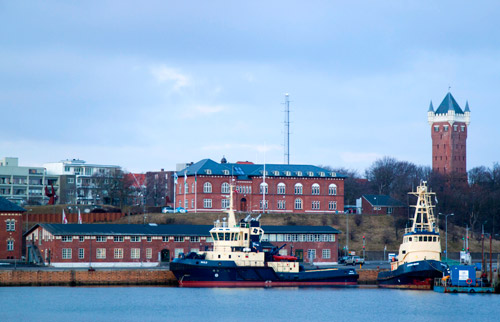
Burying Carbon Beneath the North Sea. To this end, a specially built ship called Carbon Destroyer 1 is preparing to carry liquefied carbon dioxide from the Danish port of Esbjerg to the Nini West oil field in the North Sea. There, the CO₂ will be pumped into porous rock about 1,800 metres beneath the seabed. This operation is part of Project Greensand, led by INEOS Energy with Harbour Energy and the Danish state company Nordsøfonden. Commercial storage is expected to begin around mid-2026.
The idea appears simple:– Instead of allowing carbon dioxide from biogas plants and other industries to enter the atmosphere, it is captured, purified and cooled until it becomes liquid. It is then transported to Esbjerg, a city in Denmark and stored temporarily in tanks and loaded onto Carbon Destroyer 1.
Esbjerg Harbour, Denmark.
The ship can carry approximately 5,000 tonnes of liquid CO₂ on each voyage, although some reports describe a full load of about 5,300 tonnes. It will sail to the offshore platform, connect to the injection system and pump the CO₂ through a well into the depleted oil reservoir.
The carbon dioxide is not stored in a large underground cave. It spreads through tiny spaces inside porous sandstone. A layer of solid, impermeable rock above the reservoir is intended to prevent it from escaping.
Project Greensand completed a smaller trial in 2023. Its first commercial phase aims to store about 400,000 tonnes of CO₂ each year. Eventually, the operators hope to expand capacity to between four million and eight million tonnes annually. Achieving that target would require more ships, wells and capture facilities. Supporters describe ships such as Carbon Destroyer 1 as “virtual pipelines.” They could collect carbon dioxide from industries in different countries and take it to suitable offshore storage sites without constructing pipelines across the whole of Europe.
However, the operation is not free from danger. Carbon dioxide does not burn, but a large leak can push oxygen out of the surrounding air. Because CO₂ is colourless, odourless and heavier than air, it can collect in low or enclosed spaces. A serious release at a port, aboard a ship or on an offshore platform could cause suffocation. Gas detectors, ventilation, emergency shutdown systems and restricted safety areas are therefore essential. There is also a risk of a pipe or transfer hose breaking while the ship is connected to the platform. Rough seas, equipment failure or loss of the ship’s position could increase this danger. Carbon Destroyer 1 has a redundant dynamic-positioning system to hold it in place, while emergency valves and breakaway connections are intended to stop the flow if something goes wrong.
Underground storage creates longer-term questions. CO₂ might escape through a damaged injection well, an old oil well, a fault or a weakness in the sealing rock. Excessive injection pressure could also damage the reservoir. Operators must therefore inspect old wells, limit pressure and monitor the movement of the stored CO₂ for many years. Project Greensand is subject to Danish and European licensing, environmental assessment and monitoring requirements. The Danish Energy Agency says geological storage must be shown to be safe and environmentally suitable.
Finally, carbon storage should not be treated as permission to continue all existing emissions. Capturing, cooling, transporting and injecting CO₂ uses energy and produces some emissions of its own. The technology is likely to be most valuable for industries such as cement and chemicals, where emissions are especially difficult to remove.
Project Greensand could become an important new way of dealing with industrial carbon emissions. But its success must be judged by transparent monitoring, verified permanent storage, honest reporting of accidents and leakage, and the amount of carbon it prevents from reaching the atmosphere; not simply by how many shiploads disappear beneath the North Sea.
Pre-deceased by his parents Larry and Margaret; the passing of Fr Ward, is most deeply regretted, sadly missed and lovingly remembered by his sorrowing family; loving sisters Maura and Veronica, brother-in-law Patrick (Maguire), nieces, nephews, grandnieces, grandnephews, cousins, Pallottine Community, neighbours and friends.
Requiescat in Pace.
Funeral Arrangements.
The earthly remains of Fr Ward will repose at the Pallottine College, Kickham Street, Thurles, (Eircode E41 A271), on tomorrow afternoon, Friday September 4th from 3.00pm until 5:00pm, before being received into the Pallottine College Chapel. Requiem Mass for Fr. Ward will be offered on Saturday, September 5th at 12:00 noon, followed by interment, immediately afterwards, in the Pallottine Cemetery, Cabra, Thurles, Co. Tipperary.
The extended Ward family wish to express their appreciation for your understanding at this difficult time, and have made arrangements for those persons wishing to send messages of condolence, to use the link shown HERE.
The cheerful online mischief-makers (View “Meanwhile in Ireland” Here), Ireland’s digital equivalent of a lad leaning over a pub counter saying, “I’m only telling you what everyone else is thinking”, have declared Thurles “a quiet railway town that feels dead on non-match days.”
This is precisely the sort of reckless investigative journalism we feared. For generations, the people of Thurles have worked tirelessly to create the impression that absolutely nothing happens here. It is one of Ireland’s most successful covert operations, surpassed only by the mystery of where county councils store road signs before deploying eleven thousand of them around a tiny pothole.
Now meanwhile in Ireland, that lovable online hornet with a laptop, has come dangerously close to exposing the entire scheme. Yes, Thurles looks quiet. That is the point. The objective is simple: keep excessive tourism at bay.
We have seen what happens when a perfectly pleasant Irish town is discovered by lifestyle journalists. First come the travel bloggers. Then come the ring lights. Before long, somebody is charging €19 for avocado on a roofing slate and describing Liberty Square as “Thurles’s answer to Montmartre*.” [*Montmartre, for the benefit of “Meanwhile in Ireland” website, is a historic hilltop neighbourhood in northern Paris known for its steep cobblestone streets, artistic heritage, and the iconic Sacré-Cœur Basilica.]
We cannot allow this. Every resident therefore receives extensive anti-tourism training. When an unfamiliar car enters town, locals are instructed to look mildly inconvenienced. Anyone asked, “Is there much to do around here?”, must stare thoughtfully into the middle distance and reply: “Depends what you’d call doing.” This is not rudeness. It is perimeter security.
The Traffic Is a Defensive Installation. “Meanwhile in Ireland” website; our nation’s premier supplier of lists designed to start arguments in family WhatsApp groups, also mentions traffic congestion and poor road surfaces. Again, allow me to inform you this is deliberate. Those cars are not stuck. They have been strategically positioned by the Thurles Tourism Deterrence Unit. The road surfaces, meanwhile, are calibrated to shake loose anyone carrying a selfie stick, a drone or a notebook containing the phrase “ten authentic experiences.” If your suspension survives Liberty Square, you may proceed, but you will be monitored. The cleverest part of the operation is that nobody can prove the congestion was planned, because even the people allegedly planning it, have been trapped in the traffic since 2017.
“Dull and Dated,” Says “Meanwhile in Ireland” Correct. Absolutely. Please tell everyone. Do not notice that Liberty Square has witnessed centuries of Irish life. Ignore Hayes’ Hotel, where the GAA was founded in 1884. Pay no attention to the architecture, history or independent businesses. Most importantly, do not enter the building containing the official Thurles visitor-information point. That would only give you ideas.
The apparently vacant buildings are decoys. Behind one of them are six musicians, a retired county hurler, two women organising a fundraiser, a committee discussing another committee and a man capable of explaining the entire history of Tipperary politics without even drawing breath. We cannot disclose which building. National security.
“Meanwhile in Ireland” website, having peered briefly over the digital hedge with all the forensic rigour of a man reviewing a pub through its letterbox; has declared the place empty. Excellent. The camouflage is working.
“Nothing to Do After Dark” This is our favourite accusation. Yes, there is allegedly nothing to do after dark, apart from theatre, comedy, music, dance, cinema and exhibitions at The Source Arts Centre, which describes itself as Tipperary’s cultural and entertainment venue. But apart from all the entertainment, there is no entertainment.There are also pubs, restaurants, community events, racing and the occasional conversation that begins with the weather and ends four hours later with a frame-by-frame analysis of the 2001 Munster hurling championship. If you hear laughter coming from a crowded pub, it is probably a recording. If you see people leaving a performance, they are actors portraying an audience. If thousands turn up for the Liberty Music Festival, kindly assume they are commuters whose train has been severely delayed. “Meanwhile in Ireland” may be Ireland’s cheekiest electronic parish newsletter, but even it cannot expect us to believe several thousand people accidentally wandered into a music festival.
Cold and Unwelcoming? Naturally, Thurles people are exceptionally friendly, which is precisely why they must sometimes pretend otherwise. A genuinely warm welcome could trigger a catastrophic chain reaction: A visitor enjoys Thurles. The visitor tells friends. The friends arrive. A travel magazine publishes “Ten Secret Irish Towns You Must Visit.” Liberty Square acquires an oat-milk queue visible from space.
Consequently, friendliness must be rationed.
A local may give you directions, recommend somewhere to eat, explain the history of the GAA and ask who your people are, but this should not be mistaken for hospitality. They are gathering intelligence. If somebody buys you a pint, you have penetrated the inner defences. Do not mention it to “Meanwhile in Ireland”. They will turn it into “Ten Irish Towns Where Strangers Recklessly Purchase Beverages.”
Semple Stadium: The Approved Distraction We admit that maintaining the dead-town illusion becomes difficult on match days, when Semple Stadium fills and Thurles temporarily produces enough noise to alter migratory bird patterns. That is why outsiders are encouraged to believe the stadium is our only attraction. While everyone is watching the hurling, residents quietly enjoy everything else: the River Suir, local walks, cafés, shops, arts, history and the reassuring absence of tour guides waving umbrellas. There is even Lár na Páirce, the museum of Gaelic games, in the town where the GAA began. Naturally, we tell tourists it is merely a sophisticated warehouse for elderly sliotars.
The wider tourism authorities describe Thurles as a town blending sporting heritage, culture, scenery and history. But what would they know? They have presumably never assembled a slideshow entitled Ireland’s Most Miserable Places while rubbing their hands together like cartoon landlords.
A Warning About the Surrounding Area. Under no circumstances should visitors use Thurles as a base for exploring Holycross Abbey, Cabragh Wetlands or the wider Tipperary countryside. The scenery is terribly scenic. The history is excessively historic. The wetlands contain birds that refuse to perform on demand and have shown no interest whatsoever in becoming Instagram influencers. You would hate it.
Our Official Response to Meanwhile in Ireland So, to our friends at website “Meanwhile in Ireland” that delightful digital gobshite, forever throwing verbal fireworks into quiet towns and running away giggling we say this:- You are completely correct. Thurles is miserable. There is nothing here. Please encourage your readers to continue directly to somewhere with a souvenir leprechaun every nine metres. Do not stop for coffee. Do not attend a show. Do not explore the town. Do not enter a good pub. Above all, do not ask a local about hurling unless you have cleared the remainder of your afternoon and possibly the following morning. And definitely do not discover that Thurles is a warm, lively, historic and deeply characterful Irish town that simply has no interest in dressing itself up like a theme park for anyone’s approval. Nothing to see here. Move along for God’s sake now; before somebody offers you a pint.
This website uses cookies to improve your experience. We'll assume you're ok with this, but you can opt-out if you wish.AcceptRead More
Privacy & Cookies Policy
Privacy Overview
This website uses cookies to improve your experience while you navigate through the website. Out of these, the cookies that are categorized as necessary are stored on your browser as they are essential for the working of basic functionalities of the website. We also use third-party cookies that help us analyze and understand how you use this website. These cookies will be stored in your browser only with your consent. You also have the option to opt-out of these cookies. But opting out of some of these cookies may affect your browsing experience.
Necessary cookies are absolutely essential for the website to function properly. This category only includes cookies that ensures basic functionalities and security features of the website. These cookies do not store any personal information.
Any cookies that may not be particularly necessary for the website to function and is used specifically to collect user personal data via analytics, ads, other embedded contents are termed as non-necessary cookies. It is mandatory to procure user consent prior to running these cookies on your website.







Recent Comments