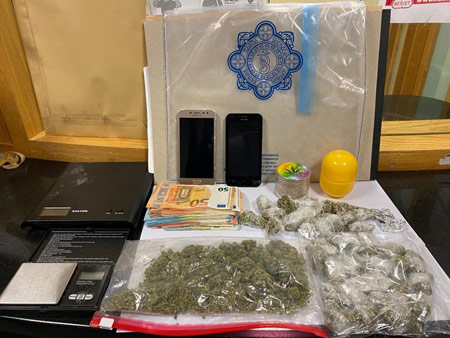
Tipperary Gardaí continue war on the peddlers of misery. Picture courtesy An Garda Síochána
Gardaí seize suspected drugs and cash valued at €13,500 in Co. Tipperary yesterday evening.
Shortly before 7:00pm Gardaí from the Detective Branch in Carrick-on-Suir and the Clonmel District Drugs Unit; assisted by the Southern Region Dog Unit, carried out a search of an address at Main Street, Carrick-on-Suir.
Items located included cash, together with some 3,300 suspected addictive Alprazolam tablets and suspected cannabis herb with a value of approximately €10,000 was seized during the course of the search.
A man, understood to be aged in his 30’s, was arrested at the scene and is currently detained at Clonmel Garda Station.
At around 11:00pm a further search was carried out at an address at Kickham Place, Mullinahone, Thurles, Co. Tipperary by the same Gardaí.
Here, suspected cannabis herb, amphetamines and cash to the value of €3,500, were seized, along with a weighing scales and mobile phones. No arrests were made during the last search but Gardaí are following a definite line of enquiry.
Mr Revell passed away suddenly at his family residence.
His passing is most deeply regretted by his loving wife Linda; his daughter Louise; son Andrew; son-in-law Christy; daughter-in-law Julie; grandchildren Amy, Claire and Liam; extended relatives; neighbours and friends.
Requiescat in Pace.
Funeral Arrangements.
In keeping with government guidelines and HSE advice on public gatherings in relation to the Covid-19 virus; a private, family funeral will now take place, followed by private cremation in Shannon Crematorium, Illaunmanagh, Shannon, Co. Clare, on Saturday.
The extended Revell family wish to express their appreciation for your understanding at this difficult time and have made arrangements for those wishing to send messages of condolence, to use the link shown HERE.
Face masks are most likely to become mandatory for all persons using public transport, to assist travel operators in allowing commuters numbers to increase as people return to work.
The proposals are set to be discussed at a government cabinet meeting today with the wearing of masks now understood to become more important as Ireland further loosens restrictions, leaving the current lock-down situation.
As is apparent, the two metre social distancing rule cannot be applied to best satisfactorily on public transport and as a result this would now allow operators to operate transport at 50% capacity, while also protecting staff members.
The government are expected to recommend that regulations be changed to enforce this expected new rule; which os expected to come into effect in the weeks ahead.
Meanwhile, the National Public Health Emergency Team will meet today to discuss phase three of the roadmap for easing restrictions, expected to come into effect from next Monday, June 29th.
The total number of Covid-19 virus cases confirmed here in Co. Tipperary; as of midnight on Monday, June 22th, is 543, with 2 further cases identified over the previous 24-hour period.
This evening, the Department of Health has confirmed that 6 further deaths have sadly been caused by Covid-19 in Ireland over the last 24 hours. These latest figures leave the total number of deaths caused by this pandemic currently at 1,726.
This evening, it has also been confirmed that an additional 5 new cases of the virus have been identified, bringing the total since conception, here in the Republic of Ireland, to 25,396.
Some 92% of all confirmed cases confirmed to date are estimated to have recovered from the disease.
Chief Medical Officer Dr. Tony Holohan has stated that through all of our collective actions during this pandemic, we have moved in the right direction in our fight against widespread community transmission; but warned that as we go forward, the behaviour and progression of this disease is in all of our hands.
The turnaround time from referral for a test for the virus to obtaining contact tracing results, is now just 1.7 days.
Dublin City University this month has launched the Irish COVID-19 Oral History Project. Same focuses on orally archiving the Irish lived experience of the COVID-19 pandemic, for historical purposes.
Led by Ms Caitriona Ni Cassaithe and Professor Ms Theo Lynn, the project is intended to curate a collection of oral histories, detailing the Irish experience of the COVID-19 pandemic and how Irish communities are living through it, both at home and abroad.
These findings are intended to be used by historians, researchers and policymakers in years to come to inform responses to future pandemics.
It was initially inspired by work being undertaken by Professor Jason Kelly (IUPUI) on the US-based COVID-19 Oral History Project, a partner project of ‘A Journal of the Plague Year’, and efforts are being coordinated with the IUPUI project.
All data will be stored in Ireland and managed by DCU, but will be shared with the wider research community, including IUPUI, over time on an open access basis.
The team behind the oral history project are asking the general public to go to the project website,View HERE, record their answers to the questions asked and upload them.
For those who cannot record their submission for whatever reason, there is an option to submit a written response on the website.
Caitríona Ní Cassaithe, from the School of STEM Education, Innovation & Global Studies, stated “History is experienced and viewed differently by the various people who shape it and are impacted by it. Our current moment in history is one that will be debated, discussed and contemplated for decades, if not centuries to come. Oral histories can be used to give a voice to the silent or neglected Irish communities – those people whose voices are not always heard in history.”
This website uses cookies to improve your experience. We'll assume you're ok with this, but you can opt-out if you wish.AcceptRead More
Privacy & Cookies Policy
Privacy Overview
This website uses cookies to improve your experience while you navigate through the website. Out of these, the cookies that are categorized as necessary are stored on your browser as they are essential for the working of basic functionalities of the website. We also use third-party cookies that help us analyze and understand how you use this website. These cookies will be stored in your browser only with your consent. You also have the option to opt-out of these cookies. But opting out of some of these cookies may affect your browsing experience.
Necessary cookies are absolutely essential for the website to function properly. This category only includes cookies that ensures basic functionalities and security features of the website. These cookies do not store any personal information.
Any cookies that may not be particularly necessary for the website to function and is used specifically to collect user personal data via analytics, ads, other embedded contents are termed as non-necessary cookies. It is mandatory to procure user consent prior to running these cookies on your website.







Recent Comments