At the current level of progress, Ireland will fail to meet the EU and national goal of restoring all waters to good or better status by 2027.
Excess nutrients from agriculture, urban wastewater and other human activities remains the biggest challenge, followed by changes to physical habitat conditions.
Just over half (52%) of our surface waters are in satisfactory ecological condition, which is a deterioration from the previous assessment for 2016-2021, where 54% of surface waterbodies met their water quality objectives.
There is evidence that nutrient levels are reducing in areas where actions are being targeted, which is very welcome. The scale and pace of implementation need to be increased.
The Environmental Protection Agency (EPA) has today published their flagship Water Quality in Ireland Report 2019-2024, which provides the latest, 3-yearly assessment of the quality of Ireland’s rivers, lakes, estuaries, coastal waters, canals and groundwaters. This assessment includes multiple water quality parameters that are monitored and assessed to give an integrated picture of the condition of our waters. The report shows that, despite improvements in some areas, water quality in Ireland is not as good as it should be and is continuing to decline overall:
River Suir, Thurles, Co. Tipperary Pic: G. Willoughby.
52% of rivers, lakes, estuaries and coastal waters are in a satisfactory ecological condition, which means in good or high ecological status. This is a decline since the 2016-2021 assessment when 54% of surface waters were satisfactory.
Transitional waters, including estuaries and coastal lagoons, are in the poorest condition of any waterbody type, with 70% in an unsatisfactory condition, up from 64% in the last assessment.
92% of groundwaters are in good status. Canals are also in relatively good condition with 87% achieving their water quality targets.
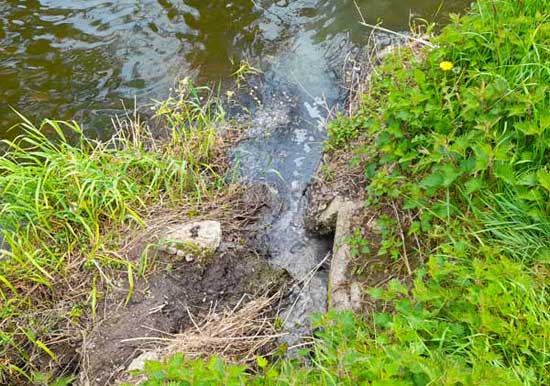
Sewage Pipe flows into River Suir in Thurles Town Centre. Pic: G. Willoughby.
Commenting on the report, Dr Eimear Cotter, Director of the EPA’s Office of Evidence and Assessment, said: “Our rivers, lakes and estuaries are the lifeblood of our landscape and support our ecosystems, and our health and wellbeing. But they are struggling. They do not have the resilience to cope with the challenges they face, now and in the future. Surface water quality overall has been in decline since before the first of these assessments was carried out by the EPA in the late 2000s. It is very disappointing to report that water quality is not improving despite the many actions that are underway, across all sectors. It’s clear the scale and pace of implementation needs to be increased and sustained.” The main pressures impacting on water quality are excess nutrients coming mainly from agriculture, urban wastewater discharges, and damage to the physical condition of water habitats from activities such as land and river drainage, forestry and urban development. The report highlights that there have been improvements in phosphorus levels in our surface waters in areas prioritised for action where the right measures are implemented in the right places to target interventions. There were also reductions in nitrogen levels in many river monitoring sites in recent years, which is welcome. Further reductions will be needed to reach levels that will support healthy ecosystems.
Dr Jenny Deakin, EPA Programme Manager added: “The decreases in phosphorus levels in areas prioritised for action are very welcome. While further reductions will be needed as well as reduction in nitrate levels, this report shines a light on the progress that can be made when actions are targeted. It is essential that better information is collected by all stakeholders, on when and where the actions are being implemented on the ground, to provide better information on how the progress can be accelerated.” Information about local water quality and the pressures impacting it is available at www.catchments.ie
Both men are also accused of stealing green diesel, petrol, kerosene, and other items worth over €180 from the Top Oil Service Station on Cashel Road, Cahir, on the same date.
Mr Caplice faces two further charges; that of causing criminal damage to a car at Cois na hAbhainn, Ballyporeen, and using a false registration plate at the Cahir service station.
When charged, both men denied all of the alleged. Garda Inspector Mr Alan Kissane requested both men be remanded in custody to appear before Clonmel District Court on Tuesday via video link. However, defence solicitor Mr David Burke sought that they attend in person, as family may assist with a bail application.
MrJustice John O’Leary remanded both the accused in custody overnight at Clonmel Garda Station to appear in person before Clonmel District Court on tomorrow, Tuesday October 14th 2005.
Pre-deceased by his parents Michael and Bridie; Mr Lahert passed away peacefully, while in the care of staff at Tipperary University Hospital Clonmel, Co. Tipperary. .
His passing is most deeply regretted, sadly missed and lovingly remembered by his sorrowing family; loving wife Margaret (Peg), daughter Ann-Marie and son-in-law Patrick Raleigh, sisters-in-law Mary Gaine, Eileen Frewen and Nancy O’Mullane, extended relatives, neighbours and friends.
Requiescat in Pace.
Funeral Arrangements.
The earthly remains of Mr Lahert will repose at Dermot Ronan’s Funeral Home, Ballingarry, Thurles on Wednesday afternoon, October 15th, from 5:00pm until 7:30pm same evening. His remains will be received into the Church of the Assumption, Ballingarry (SR), Thurles, on Thursday morning, October 16th, to further repose for Requiem Mass at 11:30am, followed by interment, immediately afterwards, in the adjoining graveyard.
Note Please: House private on Thursday morning. Family flowers only.
Pre-deceased by her beloved husband Muiris, her parents Vincent and Kate, sisters Nóra, Mary, Kathleen, Philomena and Bernadette, brothers Paddy, Frank, Danny, Bunny and Kieran; Mrs Uí Chléirigh passed away peacefully following a short illness, surrounded by her loving family.
Her passing is most deeply regretted, sadly missed and lovingly remembered by her sorrowing family; loving sons Muiris and Dónall, daughters Cáit and Bríd, grandchildren Conor, Brendan, Sorcha, Meadhbh, Ronin and River, daughters-in-law Diana and Virginia, sons-in-law Oliver and Larry, sisters-in-law Máirín and Treasa, extended relatives, former teaching colleagues, great neighbours and many friends.
For those persons who would wish to attend Requiem Mass for Mrs Uí Chléirigh, but for reasons cannot, same can be viewed streamed live online, HERE.
The extended Uí Chléirigh family wish to express their appreciation for your understanding at this difficult time, and have made arrangements for those persons wishing to send messages of condolence, to use the link shown HERE.
Oireachtas members from Clare and Limerick have given their backing to a three-tier plan to expand hospital capacity in the Mid-West, following publication of HIQA’s review of urgent and emergency care services in the region.
At a meeting in Limerick today, eight members of the Oireachtas agreed that all three options proposed by HIQA should be advanced in parallel, in order to relieve ongoing pressure at University Hospital Limerick (UHL).
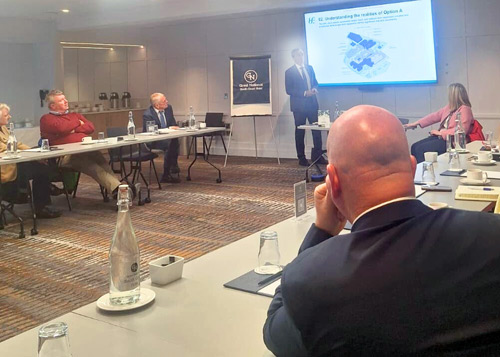
Oireachtas members from Clare and Limerick listen to a presentation by Dr Terry Hennessy, at a meeting held at the Great National South Court Hotel today.
Under the preferred approach, immediate investment would focus on expanding bed capacity on the existing UHL site at Dooradoyle. Medium-term development would see the establishment of a second UHL campus nearby comprising of out-patients department, diagnostics and adult mental health, with a longer-term goal of moving the maternity hospital and other acute services including a new Emergenct Department (ED) to the nearby site under shared governance. This would provide a high quality multi-generational and emergency care service for the Mid-West Region.
It was agreed that Option A combined with Option B will ultimately deliver Option C.
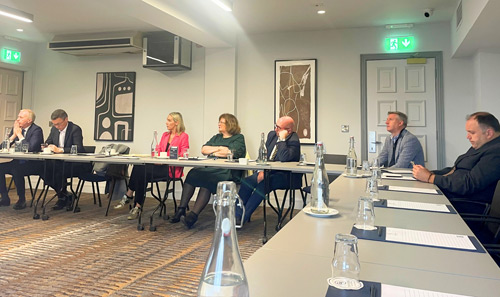
The meeting, held at the Great National South Court Hotel and convened by Clare TD Joe Cooney(Fine Gael), was attended by Minister Patrick O’Donovan(Fine Gael), Minister of State Timmy Dooley(Fianna Fáil), TDs Cathal Crowe and Willie O’Dea(Fianna Fáil), Senators Maria Byrne, Martin Conway and Dee Ryan, and Clare County Council Cathaoirleach Paul Murphy.
Oireachtas members from Clare and Limerick listen to a presentation by Dr Terry Hennessy, at a meeting held at the Great National South Court Hotel today.
Dr Terry Hennessy, the HSE’s Regional Clinical Lead for Strategy and Development, briefed members on the significant constraints to expansion of the UHL site at Dooradoyle, the lack of capacity for that site on its own to deliver for the long-term future needs of the area, along with the HSE Mid-West short, medium and long-term plans for implementing the HIQA recommendations.
Following a positive and very constructive meeting, members agreed to support the HSE Mid-West’s commitment to pursuing all three strands and to engage with the Department of Health to secure full Government backing. A follow-up meeting is planned for early November 2025 in Leinster House, with Health Minister Jennifer Carroll MacNeill and senior department officials to be invited.
This website uses cookies to improve your experience. We'll assume you're ok with this, but you can opt-out if you wish.AcceptRead More
Privacy & Cookies Policy
Privacy Overview
This website uses cookies to improve your experience while you navigate through the website. Out of these, the cookies that are categorized as necessary are stored on your browser as they are essential for the working of basic functionalities of the website. We also use third-party cookies that help us analyze and understand how you use this website. These cookies will be stored in your browser only with your consent. You also have the option to opt-out of these cookies. But opting out of some of these cookies may affect your browsing experience.
Necessary cookies are absolutely essential for the website to function properly. This category only includes cookies that ensures basic functionalities and security features of the website. These cookies do not store any personal information.
Any cookies that may not be particularly necessary for the website to function and is used specifically to collect user personal data via analytics, ads, other embedded contents are termed as non-necessary cookies. It is mandatory to procure user consent prior to running these cookies on your website.









Recent Comments