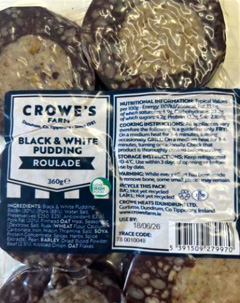
Recall of specific batches of Crowes Farm Black & White Pudding Roulade due to incorrect use-by dates.
Alert Summary dated Friday, 17 April 2026.
Category 1: For Action Alert Notification: 2026.15 Product Identification: Crowe’s Farm Black & White Pudding Roulade; pack size: 360g Country Of Origin: Ireland
Message: The below batches of Crowe’s Farm Black & White Pudding Roulade are being recalled due to incorrect use-by dates printed on the front of packs. The correct use-by dates are in the table below. Recall notices will be displayed at point-of-sale.
Batch codes:
Use-by date on pack:
Correct Use-by date:
78 0010049.
18/06/2026.
29/04/2026.
090.
06/07/2026.
13/05/2026.
Action Required:Consumers, Caterers & Retailers: Retailers: Same are requested to remove the implicated batches from sale and display recall notices at point-of-sale. Consumers: Consumers are advised not to eat the implicated batches after the correct use-by date.
Pre-deceased by her parents Jack and Ellen Murphy and sister Helen; Mrs Heffernan passed away peacefully at her place of ordinary residence, surrounded by her heartbroken family.
Her passing is most deeply regretted, sadly missed and lovingly remembered by her sorrowing family; loving husband Liam, sons Kevin, Declan and Brendan, daughter Maìre, grandchildren Liam and Ciara, son-in-law Robert (Meade), daughters-in-law Louise Dunne-Heffernan, Helena O’Brien-Heffernan and Louise Brennan-Heffernan, brothers John and Jimmy, sisters Margaret and Maura, brothers-in-law John Syron, Tom Dalton, Kevin, Tony, Paddy and Ger Heffernan. Nieces, nephews, extended relatives great neighbours, (especially the O’Meara family) and many friends.
For those persons who would wish to attend Requiem Mass for Mrs Heffernan, but for reasons cannot, same can be viewed streamed live online, HERE.
The extended Heffernan and Murphy families wish to express their appreciation for your understanding at this difficult time, and have made arrangements for those persons wishing to send messages of condolence, to use the link shown HERE.
“The Heffernan family would like to acknowledge the excellent care taken of Mrs Patricia Heffernan by Dr. Rory Glynn and his team and the Milford Palliative Care team, especially Margaret, Marie and Hillary.”
Note Please: Family flowers only. Donations in lieu, if desired, to the Milford Care Centre, in memory of Mrs Patricia (Patty) Heffernan (née Murphy).
Pre-deceased by her husband Danny, son Paul, parents Gerald (Pop) and Elizabeth, sister Kathleen, brothers Paddy and Frankie; Mrs Quinn passed away peacefully, surrounded by her loving family, while in the care of staff at Unit C, Community Hospital of the Assumption, Thurles, Co. Tipperary.
Her passing is most deeply regretted, sadly missed and lovingly remembered by her sorrowing family; loving daughter Susan, grandchildren Serena, Emma, Aisling and Brian, great-grandchildren Tristan, Robyn, Billy, Patrick, Jack, Seamie, Bonnie Mae and Georgie Grace, best friend Hannah, nieces, nephews, extended relatives, neighbours and friends.
For those persons who would wish to attend Requiem Mass for Mrs Quinn, but for reasons cannot, same can be viewed streamed live online, HERE.
The extended Quinn and Jordan families wish to express their appreciation for your understanding at this difficult time, and have made arrangements for those persons wishing to send messages of condolence, to use the link shown HERE.
Note Please: Donations, if desired, to the Alzheimer Society of Ireland in memory of Mrs Angela Quinn (née Jordan).
Ireland’s constitutional machinery has been set in motion in a way that is both rare and yet deeply significant. Following the passage of the International Protection Bill 2026 through the Oireachtas, President Mrs Catherine Connolly has taken the notable step of convening the Council of State to consider its constitutionality.
This development is more than procedural, it represents a critical checkpoint in Irish democracy, where law, rights, and constitutional safeguards intersect.
The Background: Controversial Reform. For those less familiar; the International Protection Bill 2026 is a major piece of Irish legislation designed to overhaul the State’s asylum system by aligning it with the EU Migration and Asylum Pact. It introduces faster, time-limited procedures for processing protection applications, while streamlining appeals through a new tribunal structure, thus strengthening border and return procedures, and revises rules such as family reunification, all with the aim of making decisions more efficient, while maintaining compliance with EU and human rights standards.
However, the Bill has not passed without controversy. Critics, including human rights bodies, have raised concerns about:
Expanded detention powers.
Reduced access to legal advice at early stages.
Restrictions on family reunification.
These concerns, coupled with the fast-tracked legislative process, have heightened fears that the law may face constitutional challenges.
The Irish President’s Intervention. After the Bill passed all stages in the Oireachtas, it was sent to the Irish President for signature. Instead of signing immediately, President Mrs Connolly has exercised her constitutional discretion by convening the Council of State.
This meeting, scheduled for Monday next at Áras an Uachtaráin, is specifically to consider whether the Bill should be referred to the Supreme Court under Article 26 of the Constitution.
This step is significant for two reasons: It signals serious constitutional concern about the legislation. It activates one of the most powerful, yet rarely used tools available to the President.
Understanding Article 26: A Powerful Constitutional Safeguard. Under Article 26, the President may refer a Bill to the Supreme Court before it becomes law to determine whether it is compatible with the Constitution. The process works as follows: Step 1: Consultation. The President consults the Council of State. This body, made up of senior political and legal figures, provides advice only, but it does not make the decision. Step 2: Presidential Decision. After hearing that advice, the President chooses between signing the Bill into law, or referring it to the Supreme Court. Step 3:Supreme Court Review(if referred). If referred, the Court conducts a full constitutional review.
The Possible Outcomes. If the President refers the Bill, two clear outcomes arise: (1) If the Bill is Constitutional, then the President must sign it into law. Crucially, the law becomes immune from any future constitutional challenges. This, in turn, gives the Government legal certainty and stability.(2) If the Bill is found unconstitutional, the Bill fails entirely and cannot be enacted in its current form and the Government must return to the legislative drawing board
Why This Matters. This moment is not just about one piece of legislation; it illustrates the checks and balances embedded in our Irish constitutional system. (1)A Brake on Legislative Power: Even after passing both Houses of the Oireachtas, a Bill is not guaranteed to become law. The President acts as a constitutional guardian. (2)Legal Certainty vs Legal Risk: An Article 26 reference presents a strategic trade-off; resulting in short-term delay and risk, versus long-term certainty and legal immunity. (3)Political and Legal Significance: The very act of convening the Council of State signals that the Bill raises serious constitutional questions: (A) The Government may face legal vulnerabilities. (B) The issue is of national importance.
Historical Context. Although rare, this process is not unprecedented. Previous Presidents have convened the Council of State to consider similar referrals. In some cases, Bills were signed without referral; in others, they were tested and upheld by the Supreme Court. What makes the current situation notable is that it is the first such move by President Mrs Connolly, and occurring in the context of a major and controversial reform of immigration law.
Conclusion: A Defining Constitutional Test. The coming days will determine whether the International Protection Bill proceeds directly into law or undergoes the most rigorous constitutional scrutiny available in Ireland. Either outcome will be significant and a referral could reshape or halt the legislation entirely, while a decision not to refer could allow the law to take effect, but with the possibility of future legal challenges. At its core, this episode demonstrates the strength of Ireland’s constitutional framework, where even the most politically urgent laws must ultimately withstand the test of constitutional validity.
In short, the President’s decision to consult the Council of State transforms this from a routine legislative step into a defining constitutional moment for the Irish State.
Pre-deceased by his beloved mother Marie, nephew Bobby and niece Briona; Mr Murphy passed away peacefully, following a short illness, while in the care of staff at Milford Care Centre, Limerick.
His passing is most deeply regretted, sadly missed and lovingly remembered by his sorrowing and heartbroken family; loving sons Darragh and Cian, daughter Grace, father Pat, sister Annmarie, brother-in-law Tos, uncles, aunts-in-law, nephews, nieces, cousins, extended relatives great neighbours and a large circle of friends.
The extended Murphy family wish to express their appreciation for your understanding at this difficult time, and have made arrangements for those persons wishing to send messages of condolence, to use the link shown HERE.
Note Please: House strictly private. Family flowers only. Donations in lieu, if desired, to Milford Care Centre in memory of Mr John Murphy.
This website uses cookies to improve your experience. We'll assume you're ok with this, but you can opt-out if you wish.AcceptRead More
Privacy & Cookies Policy
Privacy Overview
This website uses cookies to improve your experience while you navigate through the website. Out of these, the cookies that are categorized as necessary are stored on your browser as they are essential for the working of basic functionalities of the website. We also use third-party cookies that help us analyze and understand how you use this website. These cookies will be stored in your browser only with your consent. You also have the option to opt-out of these cookies. But opting out of some of these cookies may affect your browsing experience.
Necessary cookies are absolutely essential for the website to function properly. This category only includes cookies that ensures basic functionalities and security features of the website. These cookies do not store any personal information.
Any cookies that may not be particularly necessary for the website to function and is used specifically to collect user personal data via analytics, ads, other embedded contents are termed as non-necessary cookies. It is mandatory to procure user consent prior to running these cookies on your website.






Recent Comments