Today Thursday, July 8th, 534 new cases of Covid-19 have been confirmed in the Irish Republic.
In Northern Ireland, a further 627 new cases were reported bringing the total on the island of Ireland to 1,161 confirmed cases, over the past 24-hour period.
Here in the Republic, there are 58 Covid patients in our hospitals as a direct result this morning; with 17 patients in intensive care units.
There were 48 Covid patients in Northern Ireland hospitals, including 3 in intensive care units.
Chief Medical Officer, Dr. Tony Holohan, has warned that Covid-19 is still circulating in our community and as we arrive into this weekend, it is extremely important that we continue to adhere to well noted public health advice, thus insuring an eventual halt to the spread of this disease.
His advice comes as the CEO of the HSE Mr Paul Reid warned that the growth of the Delta variant of Covid-19 is likely to overtake and outmatch Ireland’s future supply of vaccines in the weeks ahead. To this end, hospital numbers are being monitored very closely, he stated, and in terms of planning, the HSE is looking at a range of scenarios, but it is difficult to predict what exactly may happen in the weeks ahead.
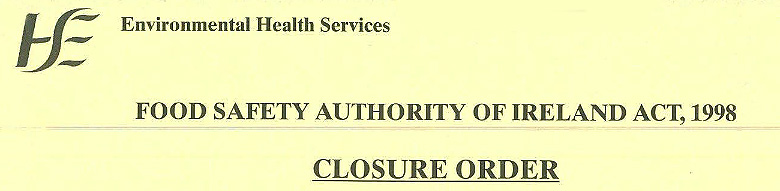
The Food Safety Authority of Ireland (FSAI) today reported that one of three ‘Closure Orders’ nationally was served on a food business in Co. Tipperary during the month of June last. Same was served following breaches of food safety legislation, pursuant to the FSAI Act, 1998 and the European Union (Official Controls in Relation to Food Legislation) Regulations, 2020.
The Tipperary ‘Closure Order’ were issued by an environmental health officer employed in the Health Service Executive (HSE).
The food business in question referred to Saffron Indian Cuisine, with an address at Wesley Square, Main Street, Cashel, Co. Tipperary.
The Enforcement Report filed on June 10th 2021, stated: Large amount of fresh rodent / rat droppings found in electrical room in the downstairs of the food business.
Food items and packaging stored on corridor outside electrical room. Outcome, closure order FSAI 1998.
Remedial action: (1) Pest control company to be called and all areas of the premises pest proofed, disinfected, baited and thoroughly cleaned. (2) All food items, stored in downstairs corridor, to be moved up to kitchen area.
Commenting, Dr. Pamela Byrne, (Chief Executive, FSAI), stated that all three ‘Closure Orders’ served last June highlight the importance of all food businesses operating to the highest standards of food safety as the country continues to face the public health pandemic.
To date, in the first six months of 2021, there have been 17 closure orders and 4 prohibition orders issued nationally here in the Irish Republic.
A ‘Closure Order’ is issued if in the opinion of the authorised officer, there is or there is likely to be a grave and immediate danger to public health at/or in the food premises. Closures Orders can refer to the immediate closure of all or part of the food premises, or all or some of its activities. The Orders may be lifted when the premises have improved to the satisfaction of the authorised officer. Failure to comply with an Improvement Order may also result in the issuing of a Closure Order.
Closure orders remain listed in the enforcement reports for a period of three months from the date the order was lifted.
A Prohibition Order is issued if the activities (handling, processing, disposal, manufacturing, storage, distribution or selling food) involve or are likely to involve a serious risk to public health from a particular product, class, batch or item of food. The effect is to prohibit the sale of the product, either temporarily or permanently.
Prohibition orders remain listed in the enforcement reports for a period of one month from the date the order was lifted.
The average Irish family will save €700 per year by taking simple steps to reduce their food waste.
Vegetables, fruit and salad are the foods that are thrown out most often in the home.
Ireland has committed to halving food waste by 2030.
Scientists estimate that food waste produces up to 10 per cent of all global carbon emissions.
Top Tips Include:
Store potatoes in a dry, dark place;
Keep tomatoes in the open air;
Store carrots loose in the bottom drawer of the fridge;
Keep strawberries in the fridge with their green tops on.
As the country prepares for an outdoor summer of picnics and barbeques, the Environmental Protection Agency (EPA) has launched a new campaign to encourage people to reduce their food waste, highlighting simple food storage steps to make their fresh food last longer. The EPA’s website has some great resources to support their ‘Stretch Out and Save‘ campaign and highlights the variety of ways in which different foods should be stored.
Findings from a 2020 EPA survey on food waste attitudes showed that around 40% of Irish people say they waste a lot of fruit and vegetables, and would like to make their fresh food last longer. Fresh fruit, vegetables and salads are Irish summer favourites – but also are the foods we waste the most.
Properly storing fresh fruit and vegetables can help both the environment and your budget, according to Mary Frances Rochford, [EPA Programme Manager]: “We are calling on everyone to support and share our Stretch Out and Save campaign on social media, and take a simple action to stop food waste. Irish households produce over 250,000 tonnes of food waste per year, at a cost of €700 per household. In addition, wasted food is a significant contributor to climate change – responsible for 8% to 10% of global greenhouse gas emissions. Cutting food waste reduces greenhouse gas emissions and also provides real savings to householders.”
The EPA’s Stop Food Waste top tips to stretch out and save your food this summer include:
Strawberries: Don’t put yourself in a jam; keep the strawberries in the fridge with the green tops intact. Washing strawberries in a mixture of water and vinegar (8 cups of water and 1 cup of white vinegar) will also keep them fresh by killing any spores on the fruit.
Tomatoes: Don’t see red when your tomatoes start to have mould spots; Store tomatoes in the open air to keep flavour and texture for longer. Did you know? Tomatoes are actually a fruit not a vegetable.
Potatoes An app-peeling staple in so many households, some people make the mistake of leaving the bag of potatoes out in the light. In fact, potatoes last longer when stored in a cool, dark and dry place. But don’t store them next to onions; the excess moisture in onions can result in potatoes sprouting faster.
Carrots: Keep carrots loose in the bottom drawer of the fridge to keep crisp. The most famous vegetable for improving your vision, ensure that you can see the carrots by removing them from plastic packaging. This avoids the ‘sweating’ that leads to mould formation. If your carrots come with the leaves intact, cut these off before storing. The leaves draw moisture out of the roots causing your carrots to become bendy much faster.
Environmental scientist with the EPA, Ms Odile Le Bolloch explains: “Summer is a time for enjoying lots of fresh produce and salads, but these are also the foods that we waste the most. With a few simple tips we can keep the food we buy that bit fresher for that bit longer. The Stop Food Waste A-Z of Foods is a useful online resource on how to best manage common foods at home to prevent food waste.”
As no two foods are the same, different produce will often have different storage requirements. Re-learning habits and implementing them as we put our shopping away will help to get the most out of groceries.
Find out how to store all of your favourite foods, learn about food date marking, and access resources to help reduce food waste in the home by visiting the EPA website.
Environmental scientist Ms Odile Le Bolloch is available for interview.
Further information: Ms Emily Williamson, (EPA Media Relations Office): Tel: 053-91 70770 (24 hours) and media@epa.ie
Pre-Deceased by his wife Mary (Neé Quinn) Clonoulty, Cashel, Co. Tipperary and brothers Eugene and Billy; Mr Brolly passed away peacefully at his home in the loving care of his family.
His passing is most deeply regretted by his son Declan, daughter Madeleine, granddaughter and best buddy Anna, sisters Maureen, Madeleine and Nuala, daughter-in-law Rachel, sisters-in-law, brothers-in-law, nieces, nephews, extended relatives, neighbours and a wide circle of friends.
Requiescat in Pace.
Funeral Arrangements.
The earthly remains of Mr Brolly will repose for Requiem Mass on Saturday morning, July 10th, in St. John the Baptist Church, Clonoulty, at 11:30am, followed by interment immediately afterwards in Clonoulty Cemetery.
For the many persons who would have liked to have attended the funeral service for Mr Brolly, but are unable to do so, due to current coronavirus pandemic restrictions; same can be viewed online HERE.
[NB: Due to Public Health Guidelines, regarding C-19 virus restrictions; those attending (limited to 50 mourners) will continue to observe strict adherence to social distancing, face covering and the refraining from handshaking.]
The extended Brolly family wish to express their appreciation for your understanding at this difficult time and have made arrangements for those wishing to send messages of condolence, to use the link shown HERE.
During our current Covid-19 pandemic the need to socially distance, has led people to take up a renewed interest in gardening here in Ireland. It has now been firmly proven; from health studies undertaken, that spending an hour or two, just three times a week, in our gardens will lead to better well-being and lower our stress levels.
This renewed interest in gardening has also shown up what are seen as ‘problems’ that previously had possibly gone unnoticed. Same brings us to the constantly asked question on social media, “How do we rid ourselves of unwanted ant populations?”.
First, we should remember that ants have been on our planet since the middle of the Cretaceous Period, same that lasted from about 145 to 66 million years ago. Their presence today means they have survived the mass extinction that eliminated our dinosaurs.
There are, at the very least, 14,000 different known species of ants that cover the terrestrial surface of our earth.
Down through the years humans have gathered an immense amount of knowledge about our ant populations, latter who remain the rivals of humans, as the dominant life form on our planet earth.
The Benefits of Ant Populations
Researchers down the years have discovered that ant insects greatly serve several key functions, which assists Mother Nature to prosper.
Ants aerate the soil digging widespread tunnels through the ground. These tunnels help moisture and air to work their way through the soil, thus assisting the roots of other plant life.
Ants help with pollination, as they travel about in their search for food, thus picking up pollens and thus inadvertently, pollinating plants.
Ants also fertilize plants, dragging decaying foliage to build their nests, thus adding nutrients to the soil.
But perhaps their biggest contribution to the environment is their ability to help control other insects. Since ants prefer to eat food, some like to prey on other insects. Their appetite has been known to help decrease the number of insects that wreak havoc on lawns and gardens. Being highly territorial, ants will fight off other insects and even animals who get too close to their established nests.
Ant Hill
By British-Canadian poet and writer Robert W. Service (Bard of the Yukon)
Black ants have made a musty mound My purple pine tree under, And I am often to be found, Regarding it with wonder. Yet as I watch, somehow it’s odd, Above their busy striving I feel like an ironic god Surveying human striving. Then one day came my serving maid, And just in time I caught her, For on each lusty arm she weighed A pail of boiling water. She said with glee: “When this I spill, Of life they’ll soon be lacking.” Said I: “If even one you kill, You bitch! I’ll send you packing.”
Just think – ten thousand eager lives In that toil-worn upcasting, Their homes, their babies and their wives Destroyed in one fell blasting! Imagine that swift-scalding hell! . . . And though, mayhap, it seems a Fantastic, far-fetched parallel – Remember . . . Hiroshima. END
Ants often invade private homes, through plaster cracks or other means, in their efforts to locate food, relying as they do on their perceptive sense of smell. Therefore to prevent ants infiltrating areas which contains food scraps, e.g. your kitchen, try wafting strong-smelling substances, like peppermint, eucalyptus or tea tree oils, all which are natural insect repellents. Ants are also repelled by cinnamon, black pepper and garlic, so storing the latter close to their points of entry, using perhaps small containers, will act as an invasion deterrent.
A common ant bait recipe is a combination of Borax (sodium borate widely used as a household cleaner) and sugar or peanut butter.
To set up the above mentioned bait, mix the stated ingredients together (one teaspoon of peanut butter or sugar to two teaspoons of borax) and place the mixture into a container which has a lid. Then punch several holes in the lid, and place the container, once again, near a visible ant trail, keeping in mind that it will take three to four days for the borax to work.
Do remember always to keep chemicals out of the reach of small children.
This website uses cookies to improve your experience. We'll assume you're ok with this, but you can opt-out if you wish.AcceptRead More
Privacy & Cookies Policy
Privacy Overview
This website uses cookies to improve your experience while you navigate through the website. Out of these, the cookies that are categorized as necessary are stored on your browser as they are essential for the working of basic functionalities of the website. We also use third-party cookies that help us analyze and understand how you use this website. These cookies will be stored in your browser only with your consent. You also have the option to opt-out of these cookies. But opting out of some of these cookies may affect your browsing experience.
Necessary cookies are absolutely essential for the website to function properly. This category only includes cookies that ensures basic functionalities and security features of the website. These cookies do not store any personal information.
Any cookies that may not be particularly necessary for the website to function and is used specifically to collect user personal data via analytics, ads, other embedded contents are termed as non-necessary cookies. It is mandatory to procure user consent prior to running these cookies on your website.









Recent Comments