County Tipperary Confirmed with 17 new Covid-19 cases.
This evening, figures from the Department of Health confirm that there have been zero new deaths caused by the Covid-19 pandemic; leaving the overall death toll here in the Republic of Ireland remaining at 1,777.
However, there are 217 new additional cases reported today, leaving the current total number of confirmed cases, since conception in the Irish Republic, at 29,025.
Of the 217 new cases notified today, 103 are men and 113 are women. 70% of these affected are under 45 years of age.
Seventeen of todays cases are in Co. Tipperary, with 103 in Dublin; 25 in Kildare; 17 in Limerick; 7 in Waterford; 7 in Wicklow; 6 in Clare; 5 in Louth, with the remaining 30 cases spread across Carlow; Cavan; Cork; Donegal; Galway; Kilkenny; Meath; Monaghan; Offaly; Roscommon; Westmeath and Wexford.
Restrictions on group activities will be with us for some time, according to the chair of NPHET’s Epidemiological Modeling Advisory Group, Professor Philip Nolan. Professor Nolan has stated that such restrictions must remain necessary if we are to protect the priorities of schools, work, healthcare and sport.
Face coverings are now mandatory for everyone in certain places including on public transport and in all retail outlets.
Meanwhile: Acting Chief Medical Officer Dr. Ronan Glynn has warned that the improper wearing of face coverings could actually increase the risk of contacting Covid-19. Dr Glynn stated that although the vast majority of people are wearing face coverings, when it is required to do so, some individuals are not wearing face coverings correctly. [Do please take the time to watch the World Health Organisations video, shown above.] While some 90% of people are wearing face coverings where appropriate, Dr. Glynn has warned that many people were wearing them under their chins or leaving their nasal areas fully exposed, thus failing to provide any protection whatsoever against Covid-19 and could be, in fact, increasing the risk of catching the virus.
Note: In the video shown above it is interesting to watch how hands are sanitised correctly, ensuring in particular that sanitiser gets under your nails, through rubbing your fingers tips in the centre of the palms of your hands. [I must admit I personally hadn’t fully grasped this concept previously.]
Please do stay safe by reducing social contacts; avoiding crowds; physically distancing; wearing face coverings and washing your hands regularly.
Nine staff have tested positive for the Covid-19 virus at ABP’s meat processing facility situated in Cahir, Co Tipperary. ABP has also confirmed that 2 confirmed cases have been confirmed at their plant in Clones, Co. Monaghan. A further 4 cases have also been confirmed at the Rosderra Irish Meats plant in Clara, Co. Offaly.
This evening, figures from the Department of Health confirm that there have been zero new deaths caused by the Covid-19 pandemic; leaving the overall death toll here in the Republic of Ireland remaining at 1,777.
However, there are 147 new additional cases reported today, leaving the current total number of confirmed cases, since conception in the Irish Republic, at 28,116.
With 1,354 cases confirmed over the past 14 days; 91 or 7% were in Tipperary; 457 (34%) were in Dublin; 327 (24%) in Kildare; 82 (6%) in Limerick; 38 (3%) in Meath, 36 (3%) Offaly, and 35 (3%) in Laois.
Meanwhile, today some schools have reopened in Northern Ireland for the first time since March last, after months of disruption due to the Covid-19 pandemic. Like the 26 county Republic; the government have confirmed that face coverings are not mandatory for routine use by pupils, and strict social distancing between children may be relaxed, where strict hygiene measures exist. There is now clear and unequivocal evidence that children are less likely to catch Covid-19; but if they do, most will have mild to moderate symptoms, thus making a very full recovery.
The National Waste Prevention Programme (NWPP) is a Government of Ireland initiative funded by the Department of Communications, Climate Action and Environment and led by the Environmental Protection Agency. Same has been operating since 2004 and delivers a suite of initiatives and supports to reduce wasteful consumption of material, water and energy resources by changing behaviours in businesses, households and the public sector. For businesses, it seeks to enhance competitiveness and reduce business costs by delivering programmes to stimulate the circular economy.
Fostering a circular economy is critically important in terms of Ireland’s green recovery, says EPA
EPA publishes the National Waste Prevention Programme 2019 report highlighting activities and initiatives which support the transition to a circular economy in Ireland.
Over €400,000 invested through Green Enterprise programme to support innovation and demonstration projects for the circular economy.
CIRCULÉIRE, Ireland’s circular manufacturing platform, established – targeting 20% reduction in greenhouse gas emissions and waste production for 30 Irish companies.
The partnership with local authorities and public bodies is building national momentum on the circular economy, including 58 local waste prevention initiatives.
Over 2 million people reached through communication and advocacy actions on food waste prevention as an effective climate response.
The Environmental Protection Agency (EPA) today released the 2019 Annual Report on the National Waste Prevention Programme (NWPP) – a Government of Ireland initiative led by the EPA. The report highlights the activities carried out during 2019 to support and promote Ireland’s transition to a circular economy.
In 2019, the National Waste Prevention Programme invested over €1.5m in driving Ireland’s circular economy. Among the beneficiaries were households, communities, farmers and businesses, who have been supported to produce less waste and reduce consumption of valuable finite resources.
Dr. Eimear Cotter, (Director EPA’s Office of Environmental Sustainability) stated, “The National Waste Prevention Programme plays an important role in fostering a circular economy in Ireland through supporting innovation and partnering with other organisations to extend our support and reach. This is critically important in terms of Ireland’s green recovery – supporting job creation, generating economic growth and improving our environment. The concept of a circular economy is gaining momentum with consumers and businesses and the EPA will continue to invest in innovation and to work with others as we progress Ireland along its pathway to net-zero carbon emissions by 2050.”
Notable achievements in 2019 include supporting CIRCULÉIRE, Ireland’s first cross-sectoral industry-led innovation network dedicated to accelerating the net-zero carbon circular economy in Ireland. In addition, community waste prevention initiatives such as public water fountains and green festivals were supported. A new focus in 2019 also involved working with the construction and demolition sector to tackle high-volumes of wastes in this critical sector.
Over 100 million tonnes of materials are used annually in Ireland’s economy. Inefficient consumption and missed opportunities for reuse and recycling lead to high waste generation and greenhouse gas emissions.
Dr. Shane Colgan, (EPA) stated, “In a circular economy, the value of products and materials is maintained for as long as possible; waste and resource use are minimised, and resources are kept within the economy when a product has reached the end of its life, to be used again and again to create further value. By preventing waste and driving the circular economy we can make the most of our resources while protecting the environment.”
Highlights from the National Waste Prevention Programme in 2019 include:-
National recommendations published on waste prevention and the circular economy for the construction and demolition sector.
Ireland’s circular manufacturing platform, CIRCULÉIRE, established – targeting 20% reduction in greenhouse gas emissions and waste production for 30 Irish companies.
Smart Farming worked on 50 farms, identifying 10 per cent greenhouse gas emissions reductions and savings of €6,336 per farm.
Innovation and Demonstration
Over €400,000 invested through Green Enterprise programme to support innovation and demonstration projects for the circular economy.
58 waste prevention projects were funded through local authorities such as public water fountains and green festivals.
Communications and Advocacy
Over 2.3 million people reached during the promotion of food waste prevention as an effective climate action; and guidance published to help businesses save €300M in food waste costs.
The FreeTrade Ireland web-service facilitated householders to exchange and reuse 8,300 items.
The National Waste Prevention Programme is a Government of Ireland initiative. The report can be downloaded from the EPA website.
“Those who do not remember the past are condemned to repeat it” – Quote George Santayana (Spanish Philosopher, essayist, poet, and novelist.)
The historic flagstones upon which Padraig Pearse read the 1916 Proclamation outside of Dublin’s General Post Office (GPO) have gone missing, possibly lost for ever to future generations.
The responsible body, namely Dublin City Council, admit that they do not know where these historic paving stones presently exist or whether they were ever reused elsewhere in its city streets.
Dublin City Council has since confirmed that following the refurbishment of O’Connell Street, sometime between the years 2004 and 2007, these historic stones were removed by the Road Maintenance Services and sent to a storage depot in Railway Street, Mountjoy in Dublin. It was planned that they should be re-used by Road Maintenance Services crews in Dublin city centre locations, where similar paving required complementing. Regrettably, the records held in Road Maintenance Services do not show where exactly this historic paving from O’Connell street was ever re-used.
Is similar destruction about to be foisted on the residents and business people of Thurles, courtesy Tipperary Co. Council?
Similar destruction may also be about to happen, courtesy Tipperary Co. Council, under the leadership of Mr Joe MacGrath(Chief Executive Tipp. Co. Co.) and Mr Marcus O’Connor(Director of Services for Roads, Transportation and InfrastructureTipp. Co. Co.).
Yes, we are referring to the possible destruction of the “Double Ditch”. We ask our readers to refresh their memories HERE.
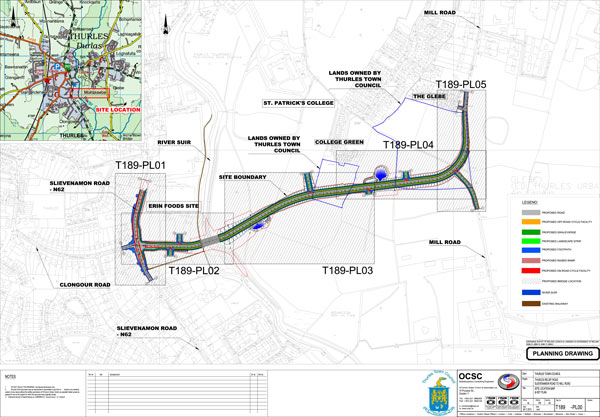
Please see Thurles inner relief road map hereunder, drawn up by Tipperary Co. Council, which appears to indicate that the “Double Ditch”, linking College Lane with the Mill Road is about to be partially at least eradicated.
We had hoped to get reassurance regarding the preservation of the “Double Ditch” and a commitment to its upgrade as a tourist attraction, when we wrote to all elected public representatives and senior Council officials, some 5 weeks ago. However, the silence emanating from all local elected politicians, including Fianna Fáil TD Mr Jackie Cahill; Independent TD Mr Michael Lowry and all County Councillors, within the Templemore / Thurles Municipal District, leave us now fearing the worst possible scenario.
We now cannot be sure what exactly Tipperary County Council is planning. We are aware Mr Joe MacGrath CE instructed his Secretary, Ms Evelyn Harty, to request that Mr Marcus O’Connor contact us over 5 weeks ago. Alas, Mr O’Connor has failed to do so.
A subsequent 4 week reminder, sent by us, to Mr MacGrath’s office received the following reply from Mr Joe MacGrath’s Secretary, “I acknowledge receipt of your email below on behalf of Joe MacGrath, Chief Executive and confirm that the matter is receiving attention”.
Prior to the formation of the present coalition government, we corresponded with Ms Josepha Madigan TD last May, who was then acting Minister for Culture, Heritage and the Gaeltacht.
In correspondence received from her, Ms Madigan stated, and I quote, “So far as we understand, there is no direct impact on the “Double Ditch” from any current development. The Department is a statutory consultee in the planning and development process, but our role in this regard is to respond to particular development proposals as referred to us by the planning authority. If there is a particular proposed development which you believe to be of concern, and you can send us details, we can review further.”
A further query was sent to Ms Madigan via Ms Helen Francis(Private Secretary to Minister Ms Madigan), which went totally unanswered.
Since then, Irish Green Party politician Mr Malcolm Noonan TD, has taken on the role of Minister of State for Heritage and Electoral Reform. While our correspondence to him was eventually acknowledged, to date no further information has been forthcoming from his office. Mr Noonan’s Private Secretary, Ms Danielle McDonnell stated: “On behalf of Mr. Malcolm Noonan TD, Minister of State for Heritage and Electoral Reform, I wish to acknowledge receipt of your recent emails in relation to Thurles / Famine Double Ditch. A further reply will issue as soon as possible”.
There comes a time when silence is betrayal.
The spread of misinformation is not achieved by words only; but also on numerous occasions by people remaining completely silent. We have contacted all elected personnel representing Thurles; requesting the answers to 3 simple questions within the last 3 months; result has been silence. This cannot be allowed to continue.
I might point out to Mr Joe MacGrath CE, Mr Marcus O’Connor and all County Councillors the Code of Conduct for Councillors, prescribed under the Local Government Act of 2001.
Need I quote directly from this document: “The public is entitled to expect conduct of the highest standards from all those involved in the local government service, be they councillors, county/city managers, other local authority staff or non-councillor members (“external members”) of local authority committees. The Local Government Act 2001 (“the Act”) sets out a new ethical framework and imposes a statutory duty on all in the local government service to maintain proper standards of integrity, conduct and concern for the public interest.“
The 3 questions which now need to be answered by Tipperary Co. Council officials; Templemore / Thurles Municipal District Councillors; Michael Lowry TD and Jackie Cahill TD, are as follows and require simple answers:-
(1). Will the planned Thurles inner relief road impinge, in a negative way, on the 1846 Thurles “Double Ditch”, which has been a right of way and a Mass Path for almost 175 years and which is the property of the people of Thurles?
(2). What are the future plans for the 1798 memorial statue [The Stone Man], first erected in Liberty Square, Thurles in 1900, and still standing there, awaiting removal prior to the new upgrade?
(3). Which Municipal District Councillor is responsible for delaying the Thurles Recycling Civic Amenity, which this town so badly needs?
Please answer these 3 questions in writing please, as failure to do so has already placed you in breach of Tipp. County Council Policy,i.e.“Tipperary County Council is committed to providing an efficient and courteous service to all our customers”.
Note Please: All answers to the 3 questions above, by August 27th, must be sent in written format by email, which you already have. All answers will be published.
We find Tipperary County Councils staff and their officials actions; in their failure to answer questions, similar to the errors made recently by Mr Michael Cawley (Fáilte Ireland – holidaying abroad); Mr Dara Calleary and Mr Jerry Buttimer’s behaviour of last Wednesday night; latter who believed there was one law for them and another law for the great unwashed – their electorate. Those who participate in decision making, same likely to impact local people, must maintain a duty to follow the regulations laid down by government.
I took a walk along the “Double Ditch” this afternoon, no effort by Tipperary County Council to resolve fly-tipping has been undertaken whatsoever, despite our request of October 2019. Dumping however, has increased and trees have been cut down, removed possible for firewood.
Tipperary County Councillors, particularly those responsible for the Templemore/Thurles Municipal District don’t get out much anymore; what with recovering from the mental anguish they suffered during their May 2019 local election campaign; then their fear of catching the Covid-19 virus just 11 months later and now having to cancel foreign holidays; forced to instead, spend time on ‘Staycation; during their pending 2020 summer holidays here in boring old Éire.
Possibly because of the coronavirus, no councillors have been answering their emails, since election time. Possibly because, as you our readers will be well aware, computers carry the corona virus and numerous other viruses and malicious malware.
Of course, nowadays, local councillors and even politicians require a hell of a lot more education than what was needed in the past. In a Tipperary media report, Tipperary Councillor and little known botanist, Mr Kieran Bourke, informed the monthly meeting of the Council, that Japanese Knotweed continues to be a “vast problem” down Carrick-on-Suir way, South of the county.
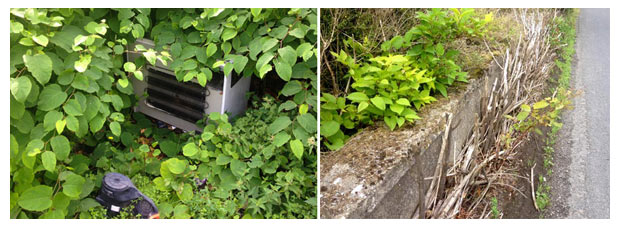
Pictured L-R. Japanese Knotweed used to camouflage fly-tipping – One failed attempt to assassinate Japanese Knotweed. Pictures G. Willoughby
We learn that a contractor working on behalf of the Tipperary Local Authority, over the last four years, has eradicated this plant on sites listed for treatment. [Well not all exactly eradicated all, as just one picture shown above will attest.]
We learn that Transport Infrastructure Ireland (TII) has allocated funding of €11,000 to the Tipperary Co. Council in April 2020, all part of the 2020 Invasive Alien Plant Species plan. We are aware that some 17 sites on national routes around Co. Tipperary were not fully eradicated, despite receiving treatment, between the years 2016 and December 2019, with some now demonstrating signs of re-growth. [Here is one of the few occupations where personnel can get paid consistently for failure. One other occupatin being elected as a Municipal District councillor.]
While we are not aware of what botanical scientific studies, if any, has ever been undertaken by Cllr. Bourke, we would like to highlight recent qualified research, same undertaken by Principal Ecologist Dr. Mark Fennell, latter employed at the engineering firm AECOM.
As part of many years of research, Dr. Fennell’s team looked closely for evidence of the threat by Japanese Knotweed. His team surveyed information supplied by invasive species control contractors and property surveyors and had access to residential properties where Japanese knotweed was known to have been located.
His findings and that of his research team had “found nothing to suggest that Japanese knotweed causes significant damage to buildings – even when it is growing in close proximity and certainly no more damage than caused by other species”.
Dr. Fennell further confirmed that fears regarding Knotweed growing through concrete were not borne out by any real evidence. “It would break the laws of physics if it could grow through concrete, and it absolutely cannot do that. What it can do is grow through cracks in concrete, but it can’t cause those same cracks.
Tipperary County Councillors stressed out, worrying about the growth of Japanese Knotweed, can now relax on holiday. Here in Thurles local residences use this plant very successfully to hide redundant vacuum cleaners and fridge freezers, dumping same in early spring to avoid detection. [See picture above.]
While Tipperary Co. Council, through their Department of the Environment, foolishly continue to waste money using employees to call, checking on homes in the hope that they may find people who have no recycling bins; those people with these bins tell Thurles.Info that worn-out 3 seater leather couches; armchairs of various descriptions; burnt out lawn mower engines and fridge freezers don’t actually fit into any of their green waste bin. The result is inevitably, with the lack of a Recycling /Waste Civic Amenity Site, local fly-tipping will takes place, latter encouraged by Tipperary Co. Council’s inability to solve a simple basic problem.
WEEE collection days in Tipperary postponed due to COVID-19 virus.
We noted Free WEEE Collection Days scheduled for May 2020 were postponed due to the COVID-19 virus until further notice. Free disposal was offered at Civic Amenity Sites on Friday’s from 8:30am – 4:30pm and for a half day on Saturdays. Note these Civic Amenity Sites were named as Nenagh Civic Amenity; Roscrea Civic Amenity; Tipperary: Donohill Civic Amenity; Cashel: Waller’s Lot Civic Amenity; Clonmel: Carrigeen Civic Amenity.
Wait a minute: Question: “Where is the Thurles: Civic Amenity?” Answer: “There is no Civic Amenity in Thurles”. Haven’t we told you that time and time again.
Tomorrow morning, as usual TippFM radio will grant locally elected reps; community activists; politicians, etc. speaking time on matters which they believe will give the impression that they are working for the good of their community. Time now to ask the Question, “Who is holding up efforts to provide a Waste Civic Amenity here in Thurles”. Time now to ‘name and shame‘ those involved.
Meanwhile Tipperary County Council plan to spend €48,000 or €12,000 in each one of the four Tipperary Municipal District this year to attempt to eradicate this non-native plant.
Could we not use the control methods used in Victorian times? Could the council not purchase Nanny goats, latter who love and trive eating Japanese Knotweed? The ‘Resveratrol’, found afterwards in the goat’s milk could possibly assist in aiding cholesterol, blood pressure, cancer, heart disease, age-related cognitive decline and many other health conditions which this plant can help.
This website uses cookies to improve your experience. We'll assume you're ok with this, but you can opt-out if you wish.AcceptRead More
Privacy & Cookies Policy
Privacy Overview
This website uses cookies to improve your experience while you navigate through the website. Out of these, the cookies that are categorized as necessary are stored on your browser as they are essential for the working of basic functionalities of the website. We also use third-party cookies that help us analyze and understand how you use this website. These cookies will be stored in your browser only with your consent. You also have the option to opt-out of these cookies. But opting out of some of these cookies may affect your browsing experience.
Necessary cookies are absolutely essential for the website to function properly. This category only includes cookies that ensures basic functionalities and security features of the website. These cookies do not store any personal information.
Any cookies that may not be particularly necessary for the website to function and is used specifically to collect user personal data via analytics, ads, other embedded contents are termed as non-necessary cookies. It is mandatory to procure user consent prior to running these cookies on your website.





Recent Comments