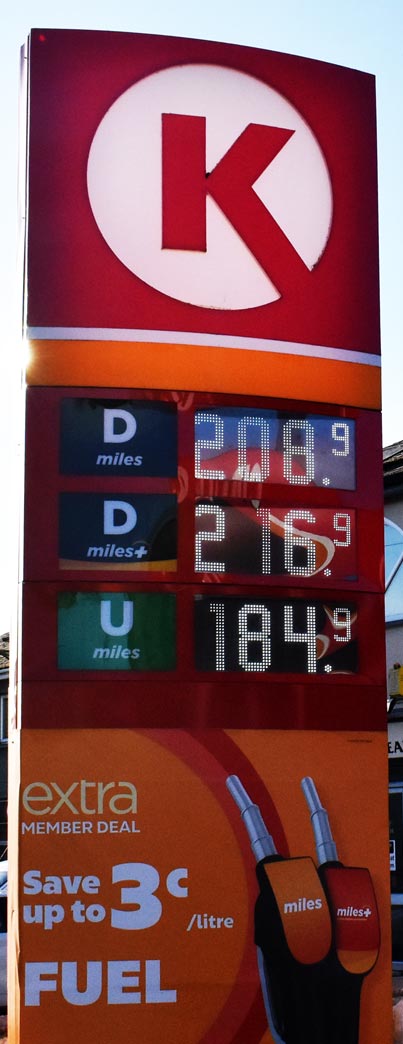
Government leaders are considering whether to recall the Dáil ahead of schedule as renewed instability in the Middle East raises concerns about fuel prices.
Temporary excise reductions introduced in April are due to be withdrawn gradually from September. The relief amounts to 32 cent per litre of diesel and 27 cent per litre of petrol and formed part of a €750 million package of business supports and cost-of-living measures.
Enterprise Minister Mr Peter Burke indicated that the timetable is being actively reassessed. The international outlook has worsened since the withdrawal schedule was agreed, with developments around the Strait of Hormuz contributing to uncertainty in global energy markets.
The Dáil is currently scheduled to return on September 16th next,. however, an earlier sitting may be required if the Government decides that legislation is needed to postpone the planned excise increases. Rising costs are already placing additional pressure on agriculture and the wider economy. The net price of marked gas oil, commonly known as green diesel, has increased from about 94 cent to €1.24 per litre, a rise of approximately 30%. Any extension of the fuel-tax relief would also have budgetary implications. The Government is preparing an overall Budget 2027 package worth more than €8 billion, including €1.5 billion for income-tax measures and an anticipated spending increase of around 6%.
Ministers are also examining ways to lower grocery prices by reducing transport, production and distribution costs. Because fuel expenses affect farming, manufacturing and the movement of goods, further increases could feed through to prices paid by consumers.
No final decision has been made on either the excise timetable or an early Dáil recall. Both options remain under consideration as the Government monitors international developments and prices at Irish fuel pumps.
We learn from press reports that Ireland’s tourism agencies have spent more than €1 million paying influencers to promote holiday destinations, since the beginning of 2025.
That is a substantial amount of public money and it deserves more than impressive claims about followers, views and “audience reach.” It deserves transparent evidence that these campaigns generated additional visitors, bookings and revenue. Tourism has certainly improved. Ireland welcomed more than 3.2 million overseas visitors during the first half of 2026; 15% more than in the same period of 2025. Their spending increased by 18% to €2.6 billion.
Those are encouraging figures, but they do not prove that influencer marketing produced the recovery. Tourism is affected by airline capacity, ferry connections, weather, exchange rates, prices, consumer confidence and many other forms of advertising. An influencer reaching millions of social-media accounts is not the same as delivering millions of tourists. A view is not a booking, a “like” is not a hotel stay, and a follower is not necessarily a prospective visitor.
This distinction is particularly important for Tipperary. The county’s tourism performance during 2025 was positive but mixed. Sixty per cent of tourism businesses reported growth and 14% remained stable, while 26% experienced a decline. Attractions and activity providers performed well, with 82% growing or maintaining attendance.
However, accommodation businesses had a more difficult experience: 34% reported a decline, while shorter stays and later bookings remained significant problems. Much of Tipperary’s strength also came from domestic residents and day-trippers. An impressive 94% of attractions maintained or increased their Ireland-based visitors.
That is good news, but it does not demonstrate that paid influencer visits generated significant additional tourism. In fact, favourable weather, local engagement, repeat visitors and domestic day trips were identified as important reasons for Tipperary’s performance.
Tipperary does has a tourism product that should be capable of selling itself internationally: the Rock of Cashel, Cahir Castle, Lough Derg, the Glen of Aherlow, the Galtee Mountains, Holycross Abbey and a rich combination of history, food, outdoor recreation and authentic rural communities. The county’s challenge is not simply attracting social-media attention. It is converting interest and day trips into overnight stays, encouraging visitors to explore beyond the best-known locations and ensuring that tourism spending reaches local accommodation providers, restaurants, shops and communities.
There is a legitimate place for digital creators in modern tourism promotion. Social media influences approximately 23 – 24% of potential visitors looking for holiday inspiration. However, recommendations and online searches are even more influential.
The biggest reason people choose Ireland is not celebrity endorsement. It is the country itself. Tourism Ireland’s research shows that scenery is the leading reason for choosing Ireland, cited by 33% of potential visitors. It is followed by Culture, Sightseeing and History. Historic Sites, Food and Drink, Walking, Hiking and Nature have exceptionally broad appeal. The public should therefore be asking whether enough money is being invested directly in the things visitors actually come to experience: heritage conservation, trails, public transport, visitor facilities, signage, accessibility, accommodation capacity and effective booking systems.
The strongest criticism is not that every influencer campaign is wasteful. We do not have the evidence to make that claim. The problem is that the agencies have not publicly demonstrated the opposite.
After spending more than €1 million, reporting enormous audience reach is inadequate. The agencies should now publish, for every major campaign: The total fee and associated travel costs. The audience and markets targeted. Engagement from relevant prospective visitors. Confirmed bookings or attributable visitor spending. Cost per booking and return on public investment. Honest regional results, including overnight stays generated in counties such as Tipperary. (Remembering no establishment likes to report decline.)
If those measurements show that influencer marketing works, the agencies will have a strong case for continuing it. If they cannot produce them, taxpayers are entitled to question whether public money is supporting tourism, or merely subsidising attractive trips and highly polished social-media content.
Ireland’s tourism recovery is welcome. Tipperary’s attractions are showing real resilience. But neither development gives tourism agencies a blank cheque.
Publicity is not performance. Reach is not revenue. Public money must produce measurable public value.
The removal of parking spaces is now harming town-centre businesses in both Cashel and Thurles.
Cllr Roger Kennedy recently raised the alarm at a meeting of the Tipperary – Cahir – Cashel Municipal District. He said road-realignment works in Cashel had removed 12 parking spaces, leaving fewer places for passing customers and discouraging people from stopping in to shop locally.
Thurles traders know this story only too well. Successive traffic and public-realm changes have reduced town-centre parking, while the approved second phase of the Liberty Square scheme will remove further spaces. Traders strongly opposed that plan, warning that it could damage businesses and put further jobs at risk. Nevertheless, it was proposed by Cllr Ms Peggy Ryan, seconded by Cllr Mr Seán Ryan and approved by the municipal-district members. Against this background, Tipperary County Council is pressing ahead with countywide “harmonised” parking charges.
So who came up with that idea? The review began following calls from Clonmel councillors. Former Director of Services, Mr Marcus O’Connor, promised the review, after which the council’s Infrastructure Strategic Policy Committee and officials developed the tiered charging system. The final Parking Bye-Laws 2026 were approved by the full County Council on 13th July 2026.
Background to the parking review. Thurles already had paid parking, it dates back at least to the former Thurles Town Council’s 2005 bye-laws. In April 2025, the elected members of Thurles Municipal District adopted replacement bye-laws retaining paid parking in Thurles. The 2026 countywide scheme now places Thurles in Tier 2 and is intended to standardise parking charges across the county.
The council says parking charges encourage turnover and help make spaces available to shoppers. But that argument becomes increasingly difficult to accept when the council is simultaneously approving schemes that remove the very spaces shoppers need.
You cannot improve parking turnover in spaces that no longer exist.
You cannot encourage people to shop locally while making it progressively more difficult—and more expensive—for them to stop.
You cannot speak about revitalising town centres while ignoring traders who depend on passing customers and convenient short-stay parking.
The issue is not simply parking charges, nor is it simply the removal of spaces. It is the combined effect:
Fewer town-centre parking spaces.
Charges on much of what remains.
Increased competition from out-of-town retailers offering free parking.
Less convenience for older people and those with limited mobility.
Reduced passing trade for independent businesses.
Decisions proceeding despite strong concerns from local traders.
There was significant resistance even among councillors themselves. An amendment allowing municipal districts to provide a one-hour-free-parking option passed by only 19 votes to 17. That close vote shows how divided elected representatives were over the council executive’s original 20-minutes-free proposal.
Cashel and Thurles need a joined-up parking policy based on the actual number of spaces available, business needs, accessibility and independently measured town-centre footfall, not a one-size-fits-all charging exercise.
Before further spaces are removed or new charges take effect, Tipperary County Council should publish:
The total number of spaces removed in each town during the past five years.
The number due to be removed under approved schemes.
The expected effect on footfall and local businesses.
Current occupancy and turnover figures.
A clear plan for replacement parking.
The names and recorded votes of councillors who approved the relevant schemes and bye-laws.
Local businesses are being asked to survive with fewer customers, fewer convenient spaces and additional parking costs. That is not town-centre regeneration, but rather an obstacle to it.
Where else in Ireland would a crossroads, latter situated on a blind hill, be allowed to have traffic approaching and exiting at 100 km/h?
Well this remains the case at Turtulla Cross, Thurles, Co. Tipperary. The proposed replacement of Turtulla Cross with a roundabout has been welcomed by local councillors as a major step forward. Nobody disputes that this junction has a serious safety problem. It has been associated with one pedestrian fatality, numerous collisions and long-standing concern among residents, motorists and public representatives.
Turtulla Cross, Thurles, Co. Tipperary, showing blind hill, which, despite previous TII intervention, remains flooded for 10 months of the year. Pic: G. Willoughby.
The present 100 km/h limit is a maximum permitted speed, not an instruction to drive at that speed. Nevertheless, allowing traffic to approach a known hazardous junction under a 100 km/h limit sends entirely the wrong message. Drivers travelling at or near that speed have less time to recognise danger, react to another vehicle and stop safely.
However, welcoming action should not mean giving Transport Infrastructure Ireland and Tipperary County Council a blank cheque. Before large sums of public money are committed to constructing a roundabout, the authorities must explain why a significantly cheaper and quicker safety measure has not been properly trialled; namely reducing the speed limit on the approach and exit to Turtulla Cross from 100 km/h to 50 or 60 km/h.
A roundabout would inevitably force approaching vehicles to slow considerably. That raises an obvious question: why not introduce lower approach speeds now and assess the results before committing to an expensive construction project?
The Government’s own Speed Limit Review recommended lower limits, including a proposed reduction of the default limit on national secondary roads from 100 km/h to 80 km/h. Official guidance also recognises 60 km/h transition zones on national and other significant roads entering areas where traffic conditions become more complex.
A properly designed trial could include a 60 km/h transition zone, a further 50 km/h limit immediately approaching the junction, prominent warning signs, refreshed road markings, flashing speed indicators, improved lighting and targeted Garda enforcement. The trial should be supported by speed surveys and collision-risk assessments, with the results published openly. A few hundred metres closer to Thurles town such signs exist, so just grab a screwdriver or pliers and move them.
According to Tipperary County Council’s May 2026 management report, preliminary design has commenced for a safety scheme involving a roundabout. The project is expected to enter the Part 8 planning process in 2026, with construction anticipated in 2027, or 2028 or maybe 2030.
That timetable provides an opportunity to test lower-cost interventions before construction begins. Public money must be treated with respect. A roundabout may ultimately prove necessary, particularly if the junction’s layout, visibility or traffic movements cannot be made acceptably safe through speed management alone. But that conclusion should be demonstrated through real evidence, not just simply assumed by councillors wishing to take advantage of a video opportunity.
TII and Tipperary County Council should publish the up-to-date collision history, traffic speeds, projected construction cost, alternatives considered and the reasons those alternatives were rejected.
Spending millions without first testing an enforceable speed reduction would be a failure of common sense and responsible public administration. Safety must come first, but value for money, transparency and evidence must come with it.
County Tipperary Chamber is calling on every business in Thurles and the surrounding area to complete the Thurles Bypass Business Impact Survey before Friday, 7 August 2026.
For decades, the people and businesses of Thurles have heard proposals, commitments and political assurances regarding essential road infrastructure. However, the town is still waiting for the completed Inner Relief Road and the long-promised Outer Ring Road or Thurles Bypass.
As recently highlighted by Thurles.info, announcements and expressions of political support are not the same as approved funding, a binding construction programme or a completed road.
Thurles businesses need delivery, certainty and measurable progress. Traffic congestion is not merely an inconvenience. It imposes real and continuing costs on local employers. It delays deliveries, wastes staff time, disrupts logistics, restricts customer access and makes it more difficult for businesses to plan, invest and expand. Every delayed journey affects productivity. Every customer discouraged by congestion represents a potential loss to the local economy. Every infrastructure project that remains uncertain can influence future investment and employment decisions.
This aforementioned survey provides businesses with an opportunity to transform those daily experiences into clear, credible and representative evidence. County Tipperary Chamber recently welcomed Thurles native Mr John O’Shaughnessy CDir MBA LL.B (Hons) Dip IOD, Managing Director of Clancy, as its new President. Mr O’Shaughnessy has taken on the presidency at a critical time for business confidence and regional competitiveness. His focus on delivery, effective advocacy and ensuring that the voice of Tipperary business is heard consistently at local and national level is particularly relevant to the infrastructure challenges facing Thurles.
Under his leadership, the Chamber is determined to ensure that the concerns of local businesses are supported by strong evidence and presented directly to Government and other decision-makers.
That effort now requires the support of the Thurles business community. Whether you operate a retail shop, hospitality venue, professional practice, manufacturing company, transport business or family enterprise, your experience matters.
The survey is open to Chamber members and non-members and to businesses of every size and sector.
Government departments require more than general expressions of concern. They require evidence showing how congestion affects operating costs, staffing, deliveries, customer access, competitiveness, investment and future growth.
The greater the response, the stronger the Chamber’s case will be.
This is not about creating another report that sits on a shelf. It is about establishing a compelling business case for action and demonstrating that Thurles cannot continue to compete effectively without modern, dependable transport infrastructure.
A sincere thanks to every business that has already participated. Your time and first-hand knowledge are all helping to build the evidence needed to secure meaningful progress. To those who have not yet responded, please do not assume that another business will speak for you. Every completed survey adds weight, credibility and urgency to this campaign.
Thurles deserves roads, investment and delivery, not more uncertainty or political promises.
This website uses cookies to improve your experience. We'll assume you're ok with this, but you can opt-out if you wish.AcceptRead More
Privacy & Cookies Policy
Privacy Overview
This website uses cookies to improve your experience while you navigate through the website. Out of these, the cookies that are categorized as necessary are stored on your browser as they are essential for the working of basic functionalities of the website. We also use third-party cookies that help us analyze and understand how you use this website. These cookies will be stored in your browser only with your consent. You also have the option to opt-out of these cookies. But opting out of some of these cookies may affect your browsing experience.
Necessary cookies are absolutely essential for the website to function properly. This category only includes cookies that ensures basic functionalities and security features of the website. These cookies do not store any personal information.
Any cookies that may not be particularly necessary for the website to function and is used specifically to collect user personal data via analytics, ads, other embedded contents are termed as non-necessary cookies. It is mandatory to procure user consent prior to running these cookies on your website.







Recent Comments