Vehicle drivers are being asked to take care, if travelling the R659 roadway, between the junction of Galbertstown Lower and Holycross village this morning.
The area was the scene, last evening, of a single vehicle collision, which saw an English registered Land Rover strike a ditch. Thankfully the driver was uninjured and the vehicle was subsequently removed.
However, early this morning a telephone pole, close to the area collapsed, blocking the roadway. Members of the Thurles Fire Brigade attended at the scene at approximately 7:20am and were joined later by telephone technicians, both of whom currently remain at the scene. Note: Stop and Go signs are currently being manually operated on a very narrow road section close to a dangerous blind bend.
Gardaí and emergency services have confirmed that a man in his 60s has died following a fatal collision with a lorry on a rural road in County Tipperary yesterday afternoon.
The incident occurred at approximately 2:35pm on Thursday, 19th February, along the L8109 road at Ardloman, Breansha, near the Glen of Aherlow, in the west of the county. Emergency services, including local Gardaí and ambulance crews, responded swiftly after the alarm was raised informing them that a pedestrian had been struck by a heavy goods vehicle.
Despite the rapid response by first responders, the pedestrian, latter a male aged in his 60s, was pronounced dead at the scene. Gardaí have confirmed that no other injuries were reported in connection with the incident.
A technical examination of the collision site has been conducted by Garda forensic personnel to establish the circumstances surrounding the crash. Standard procedures have been followed, with both the Health and Safety Authority (HSA) and the Coroner notified as part of the ongoing process. Representatives from the HSA have acknowledged the fatality and indicated that a formal investigation has been launched.
Gardaí say that investigations remain ongoing, and they have not released further details regarding the victim’s identity or specific causes at this time. Gardaí are encouraging anyone who may have witnessed the collision, or who may have relevant dash-cam footage from the L8109 area around the time of the incident, to come forward to assist with inquiries.
No additional information has yet been provided about the circumstances leading up to the collision, and it is not yet clear if road or weather conditions were a contributing factor.
Thurles’ Daily Soaking Service Continues As Blocked Drain Turns Footpath into Splash Zone.
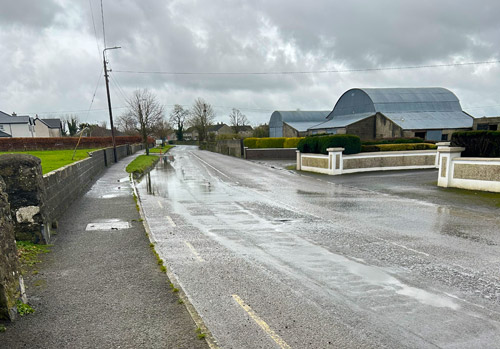
Residents and pedestrians using the Cabragh Road (Thurles town side of the old Sugar Factory site), report that roadside flooding over the past number of days is not a once-off weather emergency linked to Storm Chandra, but an everyday, repeat-performance hazard, caused by a blocked drain.
While Storm Chandra is a real named storm in the current naming cycle, with Met Éireann issuing commentary on its impacts nationally, locals say the Cabragh Road situation is far more reliable: it doesn’t need a storm, a warning, or even a stiff breeze to deliver ankle-deep water and a full-body rinse to anyone on the footpath.
Photo shows standing water across Cabragh Road with surface flooding consistent with inadequate drainage.
According to residents, the scene is depressingly familiar; cars, vans and artic trucks pass, water sheets across the road on both sides and pedestrians get soaked “to say the least”, simply for attempting to walk on a public footpath.
“First we’ve heard of it”, again. Members of the public say they have contacted the local authority repeatedly, only to receive the now-classic response: “Thank you for calling, this is the first we’ve heard of this, and we will get back to you… hopefully a crew will get out there.” Residents report that nobody gets back to anybody, no crew arrives, and the residential community continues to get “drowned”, with no public comment, they say, from local councillors.
A maintenance service, in theory. Tipperary County Council’s own public information states that local authorities maintain drains and gullies on public roads by clearing debris to prevent flooding. Locals say Cabragh Road is an example of what happens when that basic function becomes optional. Other Irish local authorities describe blocked gullies as a straightforward maintenance issue, with clear responsibility for cleaning and response pathways, the kind of normal, boring competence residents say they’d happily settle for on Cabragh Road.
Local reaction A local spokesperson said: “We’d like to thank Thurles Municipal Council for developing this immersive, all-weather pedestrian experience, where the footpath comes with complimentary road-spray, and the customer service line assures you it’s the first they’ve heard of it, every single time.”
Another added: “Storm Chandra may come and go, but Cabragh Road flooding is part of the local heritage at this stage.”
What residents are asking. Residents are calling on Thurles Municipal District / Tipperary County Council to:
Clear the blocked drain immediately and confirm completion publicly.
Inspect and jet/clean the line, not just “have a look”, to prevent repeat blockages.
Introduce a routine gully-clearing schedule for known trouble spots.
Publish a basic response standard for reported drainage hazards on public roads.
Because, as residents point out, a public footpath shouldn’t come with a soaking, and “first we’ve heard of it” shouldn’t be the default setting for an issue that locals say happens continuously; storm or no storm.
So tell me again “Why are we paying rates and property tax?”
Ford has issued an urgent safety warning to 2,865 Irish owners of its Kuga plug-in hybrid (PHEV), advising that a high-voltage battery defect could, in certain circumstances, lead to battery thermal venting and potentially a vehicle fire, with a risk of injury.
Kuga Plug-In Hybrid
The renewed warning follows an earlier safety notice issued in March 2025 affecting the same vehicles, when owners were instructed not to charge the battery due to the risk of a short circuit while driving. Ford later stated that a software update, rolled out in July 2025, would detect anomalies and prevent any fire risk.
However, owners who previously received, and in many cases installed, that update have now been sent a fresh warning letter instructing them to follow the latest guidance regardless of whether the earlier action was completed.
What owners are being told to do now Until a permanent remedy is available, Ford is advising affected customers to:
Limit charging to a maximum of 80% and do not exceed this limit.
Use only the default “Auto EV” mode, and avoid Deep Mud and Snow modes until further notice.
Ford has said it does not yet have a fix, but anticipates a remedy by mid-year, and that customers will be contacted and instructed to arrange a dealer visit once the remedy is ready.
Vehicles affected. Ford said the vehicles impacted were manufactured before 28th November 2023, and that unsold affected vehicles have been placed on hold.
Background and customer impact. The Kuga crossover has been one of Ford’s strongest sellers in Ireland, with 3,124 registrations over the past three years, and more than 95% of those sales being plug-in hybrids. Last year, some owners affected by the initial defect began legal actions against the car maker, with one Circuit Court claim alleging the vehicle was effectively worthless while repayments continued under a personal contract plan. Asked why battery packs are not being replaced and whether compensation would be considered for owners facing difficulties selling affected vehicles, Ford said it would “define the right remedy for this issue”, adding: “We apologise for any inconvenience this may cause to our customers… We remain committed to providing our customers with safe and high-quality vehicles, addressing potential issues and responding quickly.”
Customer guidance: Affected owners are advised to follow the instructions in Ford’s letter and contact Ford’s customer contact centre or their dealer for further assistance.
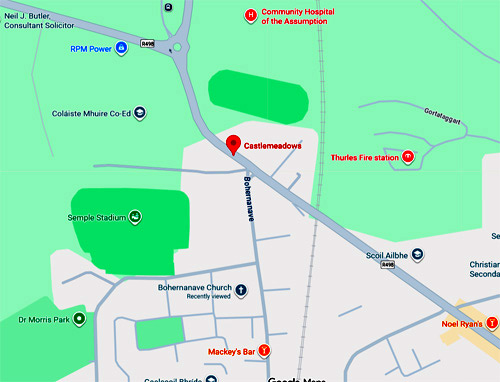
Tipperary County Council: Road Alert – Temporary Traffic Management on the R-498 at Castlemeadows, Thurles, Co. Tipperary.
From January 19th 2026 next until June 7th 2026, Temporary Traffic Management will take place on the R-498 at Castlemeadows, Thurles, Co. Tipperary and the junctions with Racecourse Road (L-4039) and Bohernanave (L-4027), Thurles, Co. Tipperary.
Same is to facilitate construction of the R-498 Castlemeadows Active Travel Scheme. The project will include the installation of cycle and pedestrian infrastructure to improve active travel connectivity along the R498.
The Active Travel Scheme is a government-supported initiative, primarily in Ireland, focused on developing infrastructure (like segregated cycle lanes, wider footpaths, new crossings) to encourage walking, cycling, and “wheeling” (scooters, skateboards) for purposeful journeys, aiming to boost health, cut congestion, and meet climate goals by making sustainable transport safer and more accessible. Key programs include the National Transport Authority (NTA), funding local authorities to deliver projects, and specific initiatives like the “Safe Routes to School Programme”.
Two way traffic will be maintained on the R498, with an intermittent Stop/ Go system being put in place. Commuters are warned to please expect delays.
This website uses cookies to improve your experience. We'll assume you're ok with this, but you can opt-out if you wish.AcceptRead More
Privacy & Cookies Policy
Privacy Overview
This website uses cookies to improve your experience while you navigate through the website. Out of these, the cookies that are categorized as necessary are stored on your browser as they are essential for the working of basic functionalities of the website. We also use third-party cookies that help us analyze and understand how you use this website. These cookies will be stored in your browser only with your consent. You also have the option to opt-out of these cookies. But opting out of some of these cookies may affect your browsing experience.
Necessary cookies are absolutely essential for the website to function properly. This category only includes cookies that ensures basic functionalities and security features of the website. These cookies do not store any personal information.
Any cookies that may not be particularly necessary for the website to function and is used specifically to collect user personal data via analytics, ads, other embedded contents are termed as non-necessary cookies. It is mandatory to procure user consent prior to running these cookies on your website.








Recent Comments