Ireland must accelerate investment in reliable public transport and EV infrastructure to reduce emissions and exposure to fossil fuel shocks, says Climate Change Advisory Council.
Transport remains Ireland’s largest source of energy demand, accounting for 42.3% of total final energy demand in 2024 and 21.8% of national emissions.
Transport emissions fell by only 1.3% in 2024, while the sector is estimated to have exceeded its first sectoral emissions ceiling (2021-2025) and is projected to exceed its second sectoral emissions ceiling (2026-2030) if urgent action is not taken.
The Climate Change Advisory Council has warned that Ireland’s dependence on fossil fuels in transport is leaving people, businesses, public services and the wider economy exposed to repeated fuel price shocks, as geopolitical instability continues to disrupt global energy markets.
Launching the Transport chapter of its Annual Review 2026 today, the Council said Ireland must reduce this exposure by accelerating investment in public transport, active travel, electric vehicle charging infrastructure and the grid capacity needed to support cleaner transport.
The Council says recent temporary emergency responses to fuel price increases have not been sufficiently targeted. It recommends that Government addresses the regressive components of emergency measures and introduce targeted supports within the transport sector for those most exposed and least able to avoid fuel costs, while maintaining planned carbon tax increases and continuing to ring-fence revenues for climate action and a just transition.
The Council is calling for targeted measures to increase EV uptake among lower-income households, particularly in areas with limited access to public transport and high car dependency. The Government’s recent pilot ICE2EV grant to incentivise the purchase of new electric vehicles by owners of 13 year or older fossil fuel cars is welcome.
In the review, the Council also warns that Ireland needs to accelerate the expansion of EV charging infrastructure, including the real time mapping of EV charging points to give people and businesses confidence in the alternatives to fossil fuel use.
However, continued grid constraints and charging infrastructure gaps are hampering Ireland’s ability to fully embrace electric vehicles. Publicly accessible charging infrastructure remains well below the EU average, while further investment is needed to support the electrification of cars, buses, school transport and commercial fleets.
Public transport passenger journeys increased by 6% in 2025, with TFI Local Link services recording a 19% increase. However, largely unchanged passenger journey data across some bus, rail and Luas services may indicate that parts of the public transport system are operating close to capacity.
The Council is calling for increased funding for public transport and for existing Public Service Obligation services in Budget 2027. Accelerated delivery of priority projects such as DART+ South West, Luas Finglas and the National Transport Authority’s Park and Ride Investment Programme are necessary to increase capacity and to cater for the projected population growth in these areas. Ireland must deliver a modern, reliable and cost effective public transport system to encourage commuters out of their cars and onto lower emission alternatives.
The Council also warns that Ireland’s transport network must be made more resilient to extreme weather. Storm Chandra and prolonged rainfall in early 2026 exposed the vulnerability of road and rail infrastructure, underlining the need for climate risk to be built into transport planning, investment and design standards.
The Council is also calling for the updated National Ports Policy to be finalised and published, for greater investment in climate-resilient regional and local roads, and for vulnerable sections of the rail network to be assessed and climate-proofed.
Mr Alex White, (Chairperson of the Climate Change Advisory Council), said: “Fossil fuel shocks are not one-off events. As long as Ireland remains heavily dependent on petrol and diesel for transport, people, businesses and public services will remain exposed to global price volatility and geopolitical crises. The way to reduce that exposure is to give people real alternatives. That means sustained investment in public transport, a charging network people can rely on, and the grid capacity needed to support the switch to electric across cars, buses and commercial fleets. This transition also has to be fair. Supports should be targeted at those most exposed to transport fuel costs, particularly people on lower incomes and those who are car-dependent because they do not have access to practical alternatives. The Government has set the right ambition to end Ireland’s reliance on fossil fuels, the test now is delivery.”
Kickham Street Crossing Danger; Residents Say Road Safety Works Must Be Finished Before Someone Is Seriously Injured
Residents of Kickham Street, Thurles, are calling for urgent action from Thurles Municipal District Council over what they believe has become a serious and growing danger to pedestrians, particularly older people, people with disabilities, and those who are visually impaired or blind.
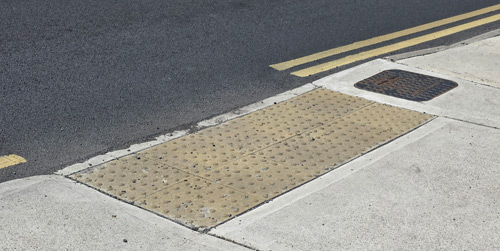
Several tactile slabbed and paved areas were installed on Kickham Street last year, apparently to assist visually impaired and blind pedestrians when crossing the road. However, residents say that these areas, on their own, are not enough. They do little or nothing to slow down traffic, and in the absence of clear road markings, painted lines, or properly designated crossing areas, many drivers appear to be treating the improved street surface as an invitation to increase speed.
Section of Tactile Slabbed Paved Area with Associated Proflo Access Cover.
This is especially noticeable during the late evening and night-time, when traffic speeds are reported to be significantly higher and visibility is reduced. For local residents trying to cross the road, especially elderly people, what should be a simple daily task has become a frightening and dangerous ordeal.
The tactile paving may help identify a crossing point underfoot, but it does not by itself control traffic, slow vehicles, or clearly warn drivers that pedestrians are likely to cross at these points. Without completed road markings and visible crossing designations, pedestrians are left exposed, and motorists are given no clear visual instruction to reduce speed or behave with caution.
Residents are now asking a very simple question: why were these works started but not properly finished? The situation is made even more concerning by the presence of Proflo access covers, measuring approximately 450 × 450 mm, located near the tactile slabbed areas. These covers were presumably installed to provide access to underground utilities while maintaining the continuity and visual safety of the tactile paving. Yet they now appear dormant, adding to residents’ concerns that this scheme has been left incomplete or neglected.
This is not a cosmetic issue. It is a road-safety issue. It is a pedestrian-safety issue. It is a disability-access issue. Most importantly, it is a potential danger-to-life issue.
Residents in the area have therefore come together to sign a petition requesting that Thurles Municipal District Council immediately complete the necessary painting of lines and road markings between the tactile slabbed areas already installed last year. These markings are needed to clearly designate safe crossing areas, alert drivers to pedestrian movement, and help regulate driver behaviour before a serious accident occurs.
Tipperary County Council’s own road-safety approach recognises the need to prevent fatalities and serious injuries, and local authorities have powers to provide traffic-calming measures such as road markings, signs, modified surfaces and other interventions to reduce speed and improve safety.
Kickham Street residents are not asking for anything unreasonable. They are asking for the job to be finished. They are asking for safe, visible, properly marked pedestrian crossing areas. They are asking that elderly residents, visually impaired pedestrians, children, and all local people be able to cross the road without fear.
The longer this issue is left unresolved, the greater the risk. Action is needed now, not after someone is injured.
Tipperary County Council has confirmed a temporary road closure in Thurles to facilitate pedestrian access for the upcoming Liberty Music Festival 2026.
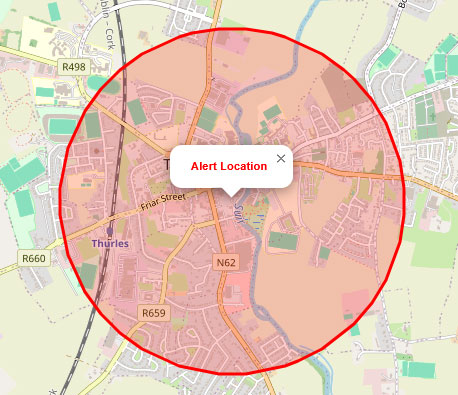
Roads Closed: L-4201 Emmett Street and Thomond Road, Thurles, Co. Tipperary
Closure Period: From 00:00hrs on Saturday, 4th July 2026 to 00:00hrs on Monday, 6th July 2026
Alternative Routes: Traffic travelling north on the N62 will be diverted to Liberty Square to join the N75 east and continue their journey.
Traffic travelling west on the N75 will be diverted into Liberty Square, turning left onto the N62 to continue their journey.
The closure is being put in place to safely facilitate pedestrian access to the Liberty Music Festival.
Motorists are advised to plan ahead, allow extra travel time, and follow all diversion signage in place.
The Environmental Protection Agency (EPA) has today published its greenhouse gas emission projections for the period 2025-2055.
Ireland’s greenhouse gas emissions could achieve a reduction of up to 25% by 2030, compared to a national target of 51%, with full implementation of a wide range of policies and plans across all sectors.
Ireland will be close to meeting the first carbon budget, but nearly all sectors are on track to exceed their sectoral emissions ceilings for the second carbon budget by 2030.
Ireland is projected to exceed its EU Effort Sharing Regulation target of 42% reduction by 2030. EPA projects a maximum reduction of 23%.
With less than four years left to 2030, there must be a strong focus on implementation of policies and measures to meet climate targets which will deliver wide-ranging benefits from environmental protection, supporting public health and wellbeing and reducing Ireland’s dependence on fossil fuels.
EPA analysis shows that Ireland’s planned climate policies and measures could deliver reductions of up to 25% of emissions by 2030, compared to 2018 levels. Assessment of the latest information provided by Governmental bodies and sector representatives indicates that the gap to target is widening in some sectors of the economy, while narrowing in others.
Ireland’s greenhouse gas emissions are projected to be close to meeting the first Carbon Budget (2021-2025) of 295 Mt CO2eq. The second budget is projected to be exceeded by a significant margin of 53 to 82 Mt CO2eq.
Transport, Industry and the Buildings (Commercial and Public) sectors are projected to be the furthest from achieving their sectoral emission ceilings in 2030. Agriculture emissions are projected to reduce by up to 19%.
Dr Eimear Cotter, EPA Director General, said: “The EPA’s projections show that the current rate of delivery of the Climate Action Plan and associated policies could reduce greenhouse gas emissions by 25% by 2030 – only half of the reductions needed. While greenhouse gas emissions are declining, European and national emission reduction targets are projected to be missed. There must be a renewed focus on delivering the actions to meet Ireland’s climate targets which will be a significant challenge given the short timeframe to 2030.”
Dr Cotter added: “Meeting these targets will deliver multiple benefits. These include reducing Ireland’s reliance on fossil fuels in electricity, transport and heating and strengthening national energy security and resilience. Achieving these emission reductions will also improve public health, provide green employment and protect our environment. Overall, these trends demonstrate that progress is achievable but accelerating delivery is critical. Renewable energy is now expected to provide nearly 60% of Ireland’s electricity by 2030. It is imperative given the increasing demand for electricity across several sectors, that renewables are delivered at the pace and scale required to meet this demand.”
Agriculture. Depending on the level of implementation of measures outlined in Government policies and plans, total emissions from the Agriculture sector will decrease between 4% and 19% over the period of 2018 to 2030. Changes in nitrogen fertiliser usage, switching to different fertilisers and lower anticipated livestock numbers contribute to projected emissions savings. A direct comparison of the Agriculture sector against its absolute Sectoral Emission Ceiling is no longer possible given recent scientific updates to baseline historical agriculture emissions.
Transport. Emissions from Transport are projected to reduce by up to 28% over the period 2018 to 2030, if the measures set out in plans and policies are implemented. These include at least 751,000 electric vehicles on the road by 2030, increased biofuel blend rates and measures to support more sustainable transport.
Residential Emissions. Emissions from fuel combustion for home and hot water heating are projected to decrease by up to 18% by 2030. Lower uptake of home energy improvement measures, including planned heat pump installation in existing dwellings, has lowered predictions for emissions savings by 2030.
Industry. Fuel combustion in manufacturing is the primary source of emissions in this sector; emissions from mineral, chemical and metal industries contribute the next largest portion. Emissions from this sector are projected to reduce by 12% over the period 2018 to 2030.
Energy. Continued rollout of renewable electricity generation to provide 52% – 59% of Ireland’s electricity by 2030 as well as increased importation of electricity from interconnectors, are contributing to reductions in Ireland’s emissions. However, delayed delivery of planned renewable energy projects such as offshore wind have lowered potential emissions savings by 2030.
Land use. Emissions from this sector are projected to increase between 4% to 72% over the period of 2018 to 2030 as Irish forestry reaches harvesting age, and shifts from being a carbon sink to a source of emissions. Planned policies and measures for the sector, such as increased afforestation, water table management on agricultural organic soils and peatland rehabilitation are projected to reduce the extent of the emissions increase.
Commenting, Dr Conor Quinlan, Programme Manager said: “The shortfall to our 2030 targets is narrowing in some sectors, for example emissions in the Transport sector are now projected to reduce by up to 28%. Encouragingly, projections for electric vehicle uptake has improved, reflecting growing confidence in the transition to cleaner transport. In contrast, the gap is widening in others such as the Residential sector which is projected now to reduce by up to 18%. It is imperative that ambition and action is maintained across all sectors if we are to meet our targets and realise the benefits of decarbonisation for our society.”
The whole thing kicked off in the Arch Bar in Thurles, Co. Tipperary last Friday night, when Mikey Ryan burst through the door looking like a man who’d just witnessed either a miracle or a tractor on fire.
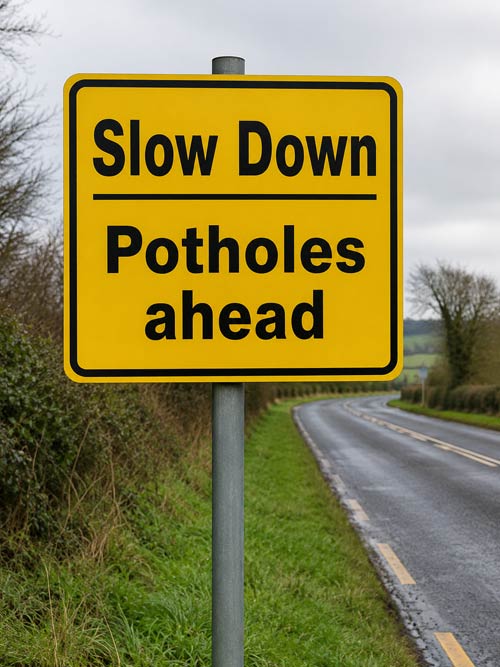
“Lads,” he says, gasping for breath, “Tipperary County Council have given up.” Now that got attention. Even Pat Hayes behind the bar stopped drying glasses. “What d’ye mean given up?” says Pat. “Gone altogether,” says Mikey. “No more speed limits.” The pub fell silent. Jimmy Bourke slowly lowered his pint. “No…” says he in his usual languid manner of speaking turning his single syllables into multiple sounds. “Oh yes,” says Mikey. “They’re replacing every speed sign in the county with signs saying: ‘SLOW DOWN – POTHOLES AHEAD.”
A woman at the corner table crossed herself. Pat blinked twice. “Sure isn’t that just every road in Tipperary?”
“EXACTLY,” says Mikey, lowdly slapping the counter so hard that a bowl of peanuts nearly declared independence.
Apparently the Council realised there was no point changing from 80 km/h to 60 km/h when the average human spine couldn’t physically survive 40 km/h anyway. Mikey claimed he saw three council workers outside Littleton removing a brand-new speed sign only four hours after initially installing it.
“One lad looked exhausted,” says Mikey. “Poor devil, a native of Co. Cork says; ‘What’s the point, bai? The road itself is enforcing the speed limit.”
And according to Mikey, the council has gone fully committed now. Outside Thurles there’s allegedly; a pothole deep enough to baptise a child; another has been classified by NASA as a “seasonal crater,” and one near Templetuohy village that is supposed to have swallowed a Nissan Micra and returned it as a Ford Focus.
“Jaysus,” says Jimmy. “That’s nothing,” says Mikey. “A fella hit one outside Roscrea last week and it activated his airbags, windscreen wipers and Eircode and all at the same time.”
The Council, according to recent rumour, have now stopped measuring potholes in inches. They’re measuring them in sizes; “small dog,” – “washing machine,” and “possible entrance to the underworld.” Meanwhile crews are driving around replacing all official speed signs. 80 km/h sign?Gone. 60 km/h sign? Gone. Now every road in Tipperary just has giant yellow signs reading: “SLOW DOWN – POTHOLES AHEAD”
Mikey says one poor tourist from Ukraine thought it was the county slogan, while another from Gaza asked if “Potholes Ahead” was a village near Cashel. But the best story came from near The Ragg. Council workers arrived with cones, flashing lights, diggers, rollers and enough machinery to invade a small European nation. Locals thought: “Grand. They’re finally fixing the road.” No, they installed six massive warning signs around a pothole before announcing that it was now “part of local Tipperary heritage.” Another engineer apparently referred to it as, “Traffic calming infrastructure.”
At this point the pub was in ribbons laughing. Even the old lad asleep beside the fire woke up laughing and he hadn’t previously been conscious since the 2022 All-Ireland Final.
Mikey took a deep dramatic gulp of Guinness. “But wait till ye hear the newest plan.” “Oh sweet suffering Jaysus,” muttered Pat. “They’re thinking of renaming roads altogether,” announced Mikey “What?” said Pat. “Yeah. Instead of the N62 or the R498…”; He leaned in over the counter. “…they’ll just call them according to the size of the potholes.” Examples include: ‘The Shaky Mile’; ‘Axlebreaker Avenue’; ‘Suspension Lane’ and one outside Nenagh simply called, ‘Abandon Hope All Ye Who Enter Here.” “And what about the speed vans?” an unknown someone asked. “Cancelled,” says Mikey. “Why so?” “No car in Tipperary can physically reach speeding pace anymore,” said Mikey.
At this stage the entire pub was gone completely feral with laughter. Mikey drained the last of the pint, straightened himself proudly and delivered the final line, like a prophet descending from Slievenamon mountain itself; “Mark my words lads… within five years every road sign in Tipperary will simply say: ‘Best of Luck.”
This website uses cookies to improve your experience. We'll assume you're ok with this, but you can opt-out if you wish.AcceptRead More
Privacy & Cookies Policy
Privacy Overview
This website uses cookies to improve your experience while you navigate through the website. Out of these, the cookies that are categorized as necessary are stored on your browser as they are essential for the working of basic functionalities of the website. We also use third-party cookies that help us analyze and understand how you use this website. These cookies will be stored in your browser only with your consent. You also have the option to opt-out of these cookies. But opting out of some of these cookies may affect your browsing experience.
Necessary cookies are absolutely essential for the website to function properly. This category only includes cookies that ensures basic functionalities and security features of the website. These cookies do not store any personal information.
Any cookies that may not be particularly necessary for the website to function and is used specifically to collect user personal data via analytics, ads, other embedded contents are termed as non-necessary cookies. It is mandatory to procure user consent prior to running these cookies on your website.





Recent Comments