|
|
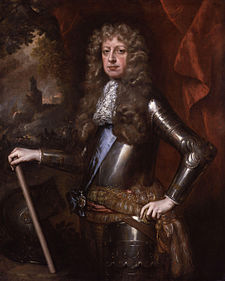 James Butler,Vicount Thurles, a 1680 portrait by Dutch artist Willem Wissing Women, in particular, just love a good romance tale and in keeping with my promise to inform you more about what Her Majesty Queen Elizabeth II missed by not visiting Thurles, her native home, during her recent visit to Tipperary, how better to start than with a factual love story.
James Butler, (1610-1688) the first Duke of Ormonde, was born son of Thomas and Elizabeth Butler (Elizabeth Poyntz – Lady Thurles) at Clerkenwell, London on October 19th, 1610, in the house of his grandfather, Sir John Poyntz. Following the shipwreck, off the coast of Skerries in Dublin resulting in the death of his father in 1619, the boy inherited the title Viscount Thurles.
The year following this family disaster and when he was just nine years of age, because of the influence of his grandfather, his mother brought James back to England, and placed him at school with a Catholic gentleman at Finchley. However it was not long before King James I, anxious that the heir of the Butlers should be brought up Protestant, placed him at Lambeth, under the care of the then Archbishop of Canterbury George Abbot, to be brought up in London under the immediate influence of the court. The boy known as Viscount Thurles, was extremely popular, handsome, and in his early teens quickly became recognised as “the man about town.”
The story regarding his future marriage however is most certainly a romantic one. The young 19 year old Viscount Thurles first cast his eyes on his 14 year old orphaned cousin Elizabeth Preston in church. Elizabeth, only daughter and heiress of the Earl of Desmond, was very wealthy as well as being very beautiful. The Title, ‘Earl of Desmond,’ had been first created for Maurice FitzGerald, 4th Baron Desmond in approximately 1329.
The affection between the couple was immediately noted as being reciprocal. Her father, like his, had also been drowned near Skerries on a passage to England. However, the now orphaned Elizabeth was the King’s ward, she was under the care of Henry, Earl of Holland and George Villiers, then the Duke of Buckingham, had intended her as an excellent ‘catch,’ for his young nephew. However, from all that history has left us, this was a case of love at first sight and Viscount Thurles had resolved he was going to wed her.
Elizabeth Preston, being reserved for someone else, was now guarded under the watchful and jealous eye of Lord Holland, and deliberately kept segregated from Viscount Thurles. Realizing from previous meetings, that his attentions would not be regarded as displeasing by the lovely Elizabeth Preston, Viscount Thurles decided that he would continue to pursue her, regardless of the consequences, so he set upon a devious and clever plan.
He disguised himself as a peddler, and carried his wares to the back-door of Lord Holland’s Kensington residence. During this period and often happily for the course of true love, young ladies were delighted to open their doors to travelling peddlers, and Lord Holland’s own daughters performed this service unknowingly for this love struck disguised Viscount. They made a few purchases from his wares, and then hastened to call Elizabeth, telling her that a handsome English peddler was at the back-door, and begged her to come and view his stock.
The girl recognized Viscount Thurles, and when he urged her to purchase a pair of gloves, she requested him to wait while she went to get some money. Her companions offered to lend her the necessary purchase price, but Elizabeth declined, guessing that one of the gloves could possibly contain a love-note.
Now in the safety of her own room, she read Viscount Thurles’ impassioned letter, and having penned him a favourable reply, came down to the door again and angrily returned the gloves, declaring that they smelt abominably, and could not be worn by any lady of her standing. The disguised peddler accepted the cancellation of this sale and hurridly left, the message in the gloves now settling his doubts and fears, regarding Elizabeth’s true feelings for him.
Women were expensive commodities to maintain even then, and Lord Holland’s consent to the future marriage by James Butler to Elizabeth Preston had to be purchased at a cost of £15,000, which when paid allowed for the smoothing away of the many difficulties opposing this suit. In September 1629, King Charles issued letters patent consenting to this match, on the grounds that it would put a “final end to all controversies between Walter, Earl of Ormond, and Elizabeth, daughter of Richard, Earl of Desmond.”
The groom, James, then but nineteen years and his bride Elizabeth but fourteen years, would now wed in London, during Christmas 1629. The following year, they passed together at her home in Acton, where he devoted his time to study, making up somewhat for past deficiencies in his education, and at the end of 1630 they came over to Ireland, first to rented accommodation in Carrick-on-Suir and later to Thurles and Kilkenny.
The coming of James, Earl of Ormonde to the country and county of his ancestors, was hailed as a welcome sign by most of the then leading Irish families. He was a Protestant, the result of his education in England, but the question of religion was ignored by the Irish, and the handsome and chivalrous Earl was called upon to take his stand in the forefront of the then Irish army.
It seems, Love will always find a way.
The latest volcanic eruption in Iceland forced a reluctant US President Barack Obama to leave Ireland on board Air Force One last night, for his state visit to England. However, this was not before the President had embraced his Irish roots in Moneygall, and the Irish nation had thoroughly embraced him and his very beautiful wife Michelle.
Yesterday despite concerns about the Irish weather, the Obama’s flew by Marine One helicopter to the village of Moneygall, on the Tipperary / Offaly border. As the world and I watched events unfold a few lines from the Irish writer Oliver Goldsmith‘s ‘The Deserted Village ‘ sprang to mind:-
“And, as a hare, whom hounds and horns pursue, Pants to the place from whence at first she flew,
I still had hopes, my long vexations passed, Here to return-and die at home at last.“
This giant of a man who spoke with such eloquence, displaying both Irish empathy and Irish humour, had now finally arrived to embrace his Irish roots and this visit wasn’t for just for votes, this was personal.
 Sláinte ("Health") President Obama with First Lady Michelle and Mayor J.Kennedy in Moneygall. - Picture: AP Source: AP Later while downing a pint of Guinness in Moneygall, latter a small central Irish village, where his great-great-great-grandfather once lived and worked as a shoemaker, we knew he had arrived not just to reaffirm the bonds of affection between the United States and Ireland, but genuinely to visit his past. “My name is Barack Obama, of the Moneygall Obamas and I’ve come home to find the apostrophe we lost somewhere along the way,” he humorously informed over 40,000, mainly young people, who waited for hours to welcome a man whom they truly respected and a man for whom they felt was slowly changing, for the better, the way this world does business.
Local Church of Ireland minister, Canon Stephen Neill confirms: “They were very much at ease here and he was very excited about the official records. The President grabbed his cameraman and said, You got to take a picture of this.”
In paying tribute to the extremely efficient manner that members of An Garda Siochana and the Security Forces oversaw this Presidential event, along with Queen Elizabeth’s visit and Dr. Garret Fitzgerald’s funeral, North Tipperary’s Deputy Noel Coonan stated: “The time that President Obama and first lady Michelle Obama made available to the public was on a scale that was unprecedented and totally unexpected. It was great to observe the huge congregation of brilliant smiles on the faces of the thousands who were present in Moneygall.”
Thurles born North Tipperary Mayor, John Kennedy, one of the US Presidents welcoming committee in Moneygall, later stated “The economy needs a lift, the people need a lift, and this brings a huge lift to the borders of Tipperary. There are millions of Americans who trace their ancestry back to this beautiful island not just through politics, but also through the arts, culture, ancestry and of course commerce. This visit is that lift.”
Ireland has just lowered the Union Jacks that greeted Queen Elizabeth during her landmark visit to Ireland last week. Obama now cited that this was the vital evidence of the willingness and search for progress that Ireland and Britain were making, putting the violence known as “The Troubles,” clearly behind us both, moving forward.
The optimistic phrase “Is féidir linn,” the Irish language version of “yes we can,” was as much about America’s future challenges in re-energising America, as it was telling, we, the Irish that we could overcome our own present economic problems if we undertook the necessary sacrifices needed over the next few years.
The Moneygall visit was without doubt the emotional highlight of the Presidents 12-hour visit to Ireland and as he kicks off a six-day tour of Europe that will also take him to Britain, France, and Poland, immersing him in the thorny issues of military campaigns in Libya and other upheaval daily emerging elsewhere in the Arab world, the Ireland nation wish him every success.
Note the simple emotional words of Irish born actor Brendan Gleeson: “I don’t know about you, I’m fed up looking at the ground. Its time to stand up, breath the air, look around, – What a people.” We must now hope that all the words of wisdom expressed and all the proud feelings we experienced, have somehow been embroidered unto the hearts of each present day Irish inhabitant, for I confidently prophesy, our very future will now depend on each person, each worker’s union and each politician’s personal expression of “real patriotism.” over the next few years.
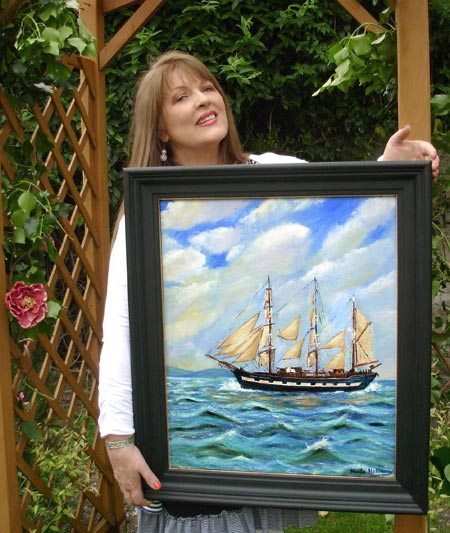 Artist Nuala Holloway with her painting of the 'Jeanie Johnston.' US President Barack Obama and his wife Michelle will to be showered with specially commissioned gifts, when they both arrive at the President’s ancestral home in Moneygall, on the Tipperary/Offaly border, by Marine One helicopter tomorrow.
The US President and America’s first lady, who will first arrive on the tarmac of Dublin Airport tomorrow morning on Air Force One, will travel by helicopter to Offaly, for a short 30 minute visit, before returning to Dublin, for a major public address at College Green later in the evening.
One of the gifts specially commissioned for the US President’s visit, made by calligrapher and historian Tim O’Neill, is an ancient styled calligraphic monastic vellum scroll, scribed in both Irish and English, and including the County Offaly Coat of Arms.
For First Lady Michelle Obama, there will be a gift of a flower pendant depicting an Offaly flower, the Andromeda, more commonly known as Bog Rosemary, latter designed by Rachel McKenna and made by jeweller Cathal Barber. The Obamas will also receive a traditional music CD, together with a book on the history of the thatched house in rural Ireland.
One of the more unique gifts to the US President in Dublin, however will be a painting of the famine ship ‘Jeanie Johnston,’ (Oil on Canvas) by noted Irish artist, former Miss Ireland, actress, and academic, Nuala Holloway. (Click on image above to view larger picture.) Nuala, whose third public exhibition of paintings entitled “Moments,” is due to take place in the Sol Art Gallery, Dawson St. Dublin, from December 2nd to 9th, 2011, presently resides in Dublin, while retaining strong connections with Thurles in Co Tipperary and Moate in Co. Westmeath. It is hoped that the painting will be an everyday reminder to the President, of the difficulties experienced by his early relatives who left Ireland around the time of the ‘Great Famine,’ 1845-1849 on board similar ships, the ‘Caroline Read,’ and ‘Marmion,’ eventually arriving in New York City on the 25th of April 1849 and March 20th 1850, respectively.
Interesting also to note that Falmouth Kearney (c.1830-1878) married Charlotte Holloway (c.1834-1877) – any connection between modern Irish artist and ancestor, I wonder?
The original, three masted ‘Jeanie Johnston ‘ built in Quebec, Canada in 1847, was bought by Tralee, Co. Kerry-based merchants John Donovan & Sons. It was a cargo vessel trading successfully between Tralee and North America for a number of years. The trading pattern then was to bring emigrants from Ireland to North America, and then to bring back timber into Europe. The most passengers she ever carried was 254, from Tralee to Quebec on April 17, 1852, the journey taking 49 days.
With Irish weather forecasters promising high winds and stormy conditions over Tipperary and Offaly, locals in the Moneygall village will be saying prayers to Saint Medard, Patron Saint of bad weather. Legend states that the saint was once sheltered from the rain himself, by a hovering eagle. The Bald Eagle, as we all know was chosen in June 20, 1782 as the emblem of the United States of American, because of its long life, great strength and majestic looks, and also because it was then believed to exist only on the continent of America.
In the words of an old Irish blessing Mr President “Go n-éirí an bóthar leat agus go gcoinní Dia i mbos A láimhe thú.” (Translated:- May the road rise to meet you and may God hold you in the hollow of His hand.)
Her Majesty, Queen Elizabeth II and Prince Philip the Duke of Edinburgh arrived at the Rock of Cashel this morning by royal helicopter, hovering over the site which was the former ecclesiastical capital of Ireland.
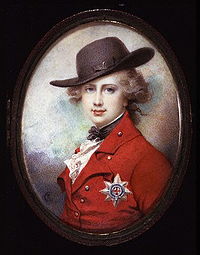 George IV as Prince Regent Her visit to the Rock, the traditional seat of the kings of Munster for several hundred years prior to the Norman invasion in 1169, marked yet another milestone in the history of Irish /English relations. As Queen of England, she became the first reigning British monarch to visit this imposing site, since her forebear King Henry II visited in 1171, although King George IV is believed to have visited the site, while a guest of the Mathew family in Thurles, while then Prince Regent, and prior to ascending the British Throne in 1820.
On landing she was driven from the helicopter by the state Bently to the summit of the rocks outcrop. To loud applause from a group of invited guests and local dignitaries, the Queen went on to visit the 15th century building known as the Hall of the Vicars Choral. She examined a 13th century bronze enamelled Crozier, said to have belonged to Bishop King, Cormac McCarthy, together with the ancient Cashel bell, dating from early 9th century.
Many residents in Cashel felt that security was too tight and regretted not getting a closer view and a chance to properly show their appreciation to the Queen, on her acceptance of their invitation to visit.
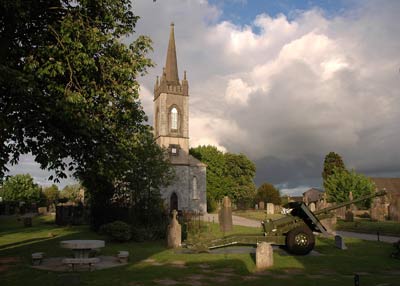 St. Mary's Famine Museum, Thurles. Tipperary. Thurles Famine Museum, housed in St Mary’s Church, Thurles, Co. Tipperary, has re-opened.
The one year closure followed, when over €70,000 worth of malicious damage was inflicted on valuable stained glass windows by local vandals in November 2009. This led to some of Ireland’s most historic artifacts, relating to Ireland’s “Great Famine 1845-1849,” which were on show to the public and stored in the building, having to be removed in the interest of their preservation.
The closure of the museum is calculated to have cost Thurles businesses, particularly the food and accommodation sectors, an estimated .5 million euros in lost revenues, last year.
The Museum, which has never received one cent of financial support from government since opening some 10 years ago, is now about to receive a major face lift, having installed 24 hour state of the art concealed video surveillance equipment to protect the graveyard, the museum and it’s contents.
St Mary’s Church, Thurles, which houses the Museum, and the graveyard attached has huge historical importance not just for Thurles Town, but for the island of Ireland. The graveyard was used extensively for burials during the Great Famine 1845-1849 and was closed as a place of burial in 1942 at the request of Dr J.D. Hourihane, then Local Government Inspector, (With some licenced exceptions,) because of gross over crowding.
Although burials were taking place here in the early 13th century, the first recorded grave in the cemetery is 1520, the Norman ‘Archer Tomb,’ possibly better known for it’s supposed healing properties. A Church has existed on this site since early Norman times in 1179.
Other notable persons buried here include:-
Lady Elizabeth Butler, Viscountess of Thurles and mother of James Butler, Duke of Ormond, ancestress direct of Queen Elizabeth II, Charles, Prince of Wales and the late Diana Spencer, who was interred in the little Chapel of St Mary, Thurles, in 1673.
William Bradshaw, a doctor in charge of the Fever Hospital in Thurles, and who also ran a paupers clinic in The Quarry, Thurles, during the famine years. “The grave of Dr William Bradshaw (Victoria Cross) late Assistant Surgeon 32nd Light Infantry who departed his life 9th March 1861.”
Maurice Leyne, one of the founders of the Young Irelander Movement and joint proprietor / editor of the “Nation” and “Tipperary Leader” newspapers during the famine years. He took part in the Ballingarry uprising of 1848 (Battle of the widow McCormack’s cabbage patch,) and was a grand nephew of Daniel O’Connell (Catholic Emancipation). Leyne died of typhus in 1854. “In this grave are deposited the remains of Maurice Richard Leyne Esq. who died 29th June 1854.”
Continue reading Thurles Famine Museum In Tipperary Re-Opens
|
Support Us Help keep Thurles.info online by donating below. Thank you.
Total Donated 2026: €290.00
Thank You!
Daily Thurles Mass Livestream
|





Recent Comments