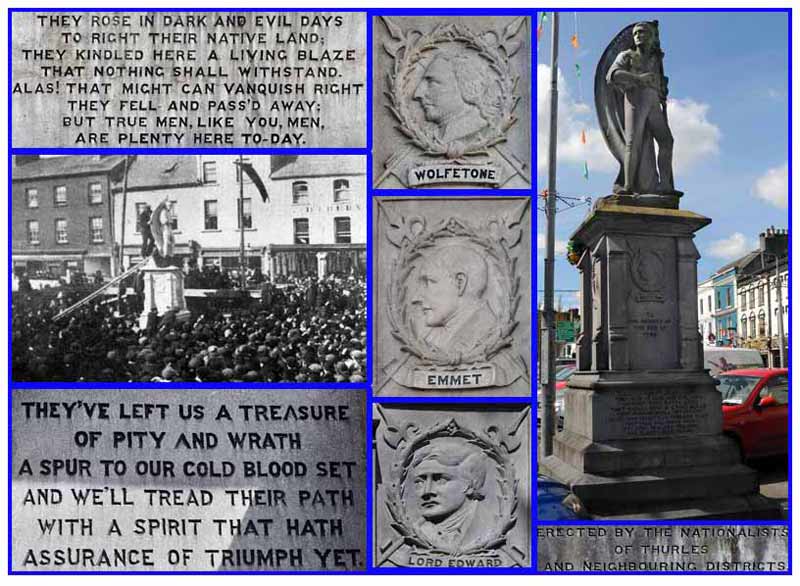
The 1798 monument today positioned in Liberty Square, Thurles, Co Tipperary, is affectionately referred too, most often, as simply ‘The Stone Man’.
In the hustle and bustle of everyday 21st century living here in Thurles and mindful of hefty parking charges and indeed a not insignificant fine for those found remiss in failing to visit a parking meter; very few local people today take the time to ‘stand and stare’, while contemplating the truth of its existence.
The ‘Stone Man’ was first unveiled in 1901 (See old photograph of the official unveiling above) to commemorate the first centenary of the ill fated attempt at a rebellion in 1798. Funding to pay for this very fine monument and indeed its eventual erection, was collected voluntarily from the nationalists of Thurles and surrounding districts. However full funding came some three years too late to actually commemorate this first centenary event.
Indeed many would have believed that the wording on this monument could hardly have been acceptable to local authorities, (See nationalist rhyming principles being propagated in above picture), then subject to strong British rule.
However it would appear that those then in power felt more fear from banning this structure, than in allowing its erection. On the other hand this monument was erected to the memory of three Protestant 1798 wealthy nationalist leaders, in a town (Thurles), described in the British Parliamentary Gazetteer of 1846 as being “decidedly the most Roman Catholic town in Ireland, second only to the city of Galway.”
The Protestant Leaders Commemorated by the ‘Stone Man’ in Liberty Square, Thurles, Co. Tipperary.
(1)Theobald Wolfe Tone, (20 June 1763 – 19 November 1798), today referred to by his sir-name Wolfe Tone, then a leading Irish revolutionary figure and one of the five founding members of the Society of United Irishmen, aimed at a political union between Catholics and Protestants, and is regarded today as the father of Irish Republicanism and the true leader of the 1798 Irish Rebellion.
Wolfe Tone was born in Dublin, the son of a Protestant coach-maker, who also owned a farm near Sallins, in Co. Kildare. His mother who came from a Catholic merchant family, chose to convert to Protestantism, following Theobald’s birth. Educated at Trinity College, Dublin, he qualified as a barrister in King’s Inns at the age of 26 and attended the Inns of Court in London.
(2)Robert Emmet(4 March 1778 – 20 September 1803) was a Protestant; an Irish nationalist; Republican; an orator and rebel leader, who led an abortive rebellion against British rule in 1803.
Emmet was born at No. 109, St. Stephen’s Green, Dublin and was the youngest son of Dr Robert Emmet a wealthy court physician and his wife, Elizabeth Mason. Again educated at Trinity College, Dublin, before being expelled in 1798, and forced to flee to France.
Emmet was captured following his failed Dublin rebellion; was tried for treason and sentenced to be ‘hanged, drawn and quartered’, as was customary for any conviction of treason. He was hanged and once pronounced dead, was beheaded in Thomas Street near St. Catherine’s church in Dublin. Family members and friends failed to come forward to claim his final remains, out of fear of arrest, so alas today we cannot identify, in truth, his last resting place.
(3)Lord Edward FitzGerald(15 October 1763 – 4 June 1798), also a member of the Society of United Irishmen and was part of the Protestant Ascendancy; being the fifth son of Lieutenant-General James FitzGerald, 1st Duke of Leinster; an Irish aristocrat; revolutionary, who died of wounds received while resisting arrest on a charge of treason.
FitzGerald spent most of his early years at Frescati House, Blackrock, Co. Dublin and was privately educated here by a private tutor named William Ogilvie.
Details of these three Irish republican leaders and their involvement in the intervening years, up to their eventual deaths in 1798 and 1803, can be easily accessed online or from your local library.
So why then was a memorial to the 1798 rebellion erected in Thurles; a town and indeed a county who took real, little or no part in this same rebellion?
Watch out for our explanation, in a forthcoming blog, over the coming days.
“On a clear day rise and look around you and you’ll see who you are.
On a clear day how it will astound you that the glow of your being, outshines every star.”
(Words by lyricist Alan Jay Lerner, from the musical “On a Clear Day You Can See Forever”.)
This weekend, weather permitting or not, one could do worse than take a leisurely drive into the area of the Knockmealdown mountains known as The Vee, situated on the remote, wild picturesque borders of Co. Tipperary and Co Waterford.
The Vee, situated on the R668 between Lismore, Co. Waterford and Clogheen in Co. Tipperary gets its name from a V-shaped bend on the road leading to a gap in the Knockmealdown mountains. The roadway itself is situated on the slopes of Sugar Loaf, passing from Tipperary to Waterford; running between Knockaunabulloga and Bay Lough (a low lying picturesque lake) on the right and the Sugar Loaf itself, on the left.
The heavy rain showers during the last few days will possibly have removed a great deal of that sea of pink rhododendron blossoms, stretching for as far as the eyes can see; freely growing in groves in the area, at mother nature’s discretion. However their absence will take little from the rugged, untended, wild beauty of this outstanding landscape, nor indeed the breathtaking panoramic views afforded to travellers and sight-seers.
From this viewpoint almost 2,000 ft above sea level, same lends itself to views across the valley to the towns of Clonmel, Cahir, and the lesser hamlets of Ardfinnan, Clogheen and Ballyporeen, latter village ancestral home to former late United States President Ronald Reagan. You can also view the Galtee Mountains the Comeragh Mountains together with Slievenamon, quite clearly from this vantage point.
Few people today refer to the 1975 British-American period drama film ‘Barry Lyndon’, directed by Stanley Kubrick, which chose this mountainous area ‘The Vee,’ as their period location. Based on the 1844 novel ‘The Luck of Barry Lyndon’, by William Makepeace Thackeray, this film won four Oscars in production categories and is today regarded as one of Kubrick’s finest films ever made.
This film starred Ryan O’Neal, Marisa Berenson, Patrick Magee, Hardy Krüger and, as shown in the clip above, Leonard Rossiter, the dancing Captain, (Remember “Rigsby” in Rising Damp & in the Title Role of “The Fall and Rise of Reginald Perrin”). The film recounts the exploits of a fictional 18th-century Irish adventurer.
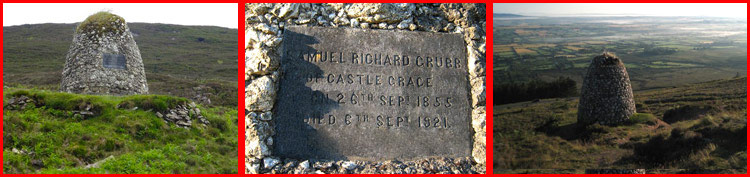
Samuel Richard Grubb, High Sheriff of Tipperary 1916.
It is here also at this scenic area that a rather curious pile of limestone rocks emerge, dome-shaped, from the hillside. This stone erection is the last resting place of Mr Samuel R. Grubb, appointed High Sheriff of Tipperary in 1916 and who requested that he be buried here to overlook a ‘picturesque and romantic view’ of his county.
Local tales that he believed he would be reincarnated into a bee in an after life situation (memorial shaped like a beehive) and that he insisted that he be buried with his horse standing upright are hardly believable, but facts we do know are recorded hereunder.
Picturesque Obsequies – Burial on Mountain.
Funeral of the late Mr S. R. Grubb. (As reported by the Clonmel Chronicle, 10th September 1921.)
“In accordance with his request, the remains of the late Mr Samuel R. Grubb were interred today on the Sugar Loaf Mountain, on his property. The place selected is a most picturesque and romantic one and commands an excellent view of the county for a considerable area.
The remains arrived in Castlegrace on Friday by motor hearse from Dublin, and the funeral started at 10.30 this morning. The coffin containing the remains was conveyed on a farm cart to the foot of the mountain and then carried on the shoulders of his tenants and employees to the place of internment on the mountainside.
On arrival at the grave the remains were received by Rev.J.Talbot, Clogheen, who conducted the Burial Service.
The scene on the wild mountain side was picturesque and impressive and will long remain implanted on the minds and hearts of those who had the privilege of witnessing it.
The chief mourners were – Major Raymond Grubb M.C. (Son), Mrs de Sales le Terriere (daughter), Mrs Grubb (daughter-in-law), Mr de Sales le Terriere (son-in-law), Mr Cecil Barrington, Mrs Taylor, and Mr James Binny.
There were a large number of beautiful floral tributes from, amongst others, Mrs Grubb (Widow), Major Grubb, Mrs Grubb (Suir Island), Mr and Mrs de Sales le Terriere, Mrs Denny, Mrs Gutherie, Lady Beatrice Pole-Carew and Mr D. Mahoney.
Those present in addition to the chief mourners included – Major Murdock, Major Hutchinson, Captain Seymour, Mr Gerard Denny, Mr Blakeney (Junr.), Dr W. Walsh, Mr Palmer, Mr Kennedy (Derrygrath), Mr Kennedy (Ballindoney), Mr E.Boyle, Mr J. Mulcahy (Corabella), Mr W.Byrne (Ballinamona), Mr Sutcliffe, Mr Geoffrey Prendegast, etc.
Acting in accordance with the directions of deceased, all the tenantry and employees who attended the funeral were subsequently sumptuously entertained at Castlegrace.”
Voluntas Ultima (Last Will) [The late Mr Samuel R. Grubb, of Castlegrace, requested that his remains should be interred in a beautiful and romantic spot on the side of the Sugar Loaf hills.]
————————————————— O place me in a silent grave upon the mountain crest, ‘Mid endless fields of golden gorse, the heather on my breast ‘Mid endless fields of golden gorse, O shape my narrow bed, Nor plant the cypress at my feet, the willow at my head.
O place me in a silent grave on storied Knockmealdown, The drowsy churchyard’s not for me, in country or in town; And when the final trumpet sounds and bids the world “Arise” ‘Twill find me nearer unto Thee, wherein salvation lies.
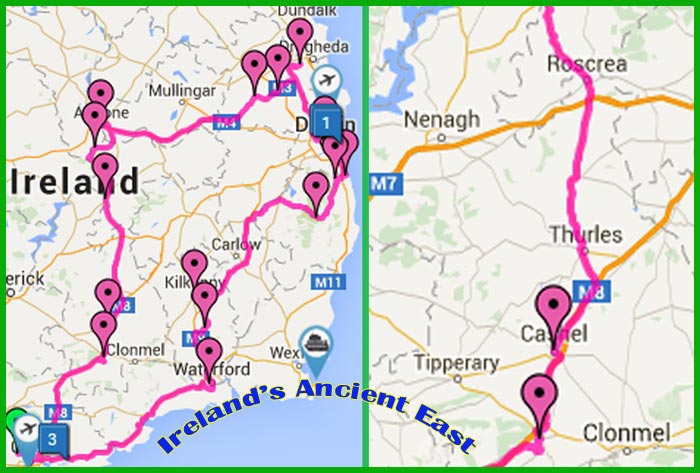
The Map below shows the Route expected to be taken by some extra 600,000 overseas visitors, by the year 2020, thus increasing revenue in this Eastern Tourism Region by almost 25%, or an estimated €950m. Well that’s according to the spin from outgoing Tourism Minister Mr Paschal Donohoe, TD, but do read on as your rural future may very soon depend on it.
“View Ireland’s Ancient East Map Route.
Fáilte Ireland
Firstly we should understand that Fáilte Ireland is Ireland’s National Tourism Development Authority. Their role is to support Ireland’s tourism industry and work to support and maintain all of our beautiful green island equally as a high-quality, attractive, tourism destination. Their work is to support / provide a range of practical business supports to help tourism services to better manage, market and grow already existing services, while working closely with other state agencies and representative bodies to encouraging further value added products.
They are required to promote the island of Ireland fully as a holiday destination, through domestic and overseas marketing (See DiscoverIreland.ie), while managing / financing, a network of nationwide tourist information centres, offering advice to those on holiday.
Ireland’s Ancient East
Ireland’s Ancient East is best described as a “Touring Region,” as opposed to a “Route,” like the “Wild Atlantic Way”. This new cultural and heritage trail stretches in circular motion from the Boyne Valley in the north-east, down through the midland of Meath & Tipperary, and east & south through Wicklow, Kilkenny, Carlow, Wexford & Waterford; eventually ending up in Cork city.
To-date only projects funded by the Office of Public Works (OPW) are seen as worthy of inclusion on this touring route in Fáilte Ireland’s marketing efforts. Private and non nationally funded, but nevertheless, attractive tourism enterprises are deemed not worthy of real note in attracting the visitor.
Efforts to attract Australian tourists for the year ahead here to Co. Tipperary, would appear bleak, following a serious unwarranted travel warning currently being issued to Australian tourists, who maybe planning to visit Ireland this Summer
A website claiming to represent the Australian Department of Foreign Affairs and Trade [Read by clicking here for yourselves.] has issued a warning to Australian tourists intent on visiting Ireland; stating tensions are high between Unionists and Republicans because of the Centenary Celebrations being held and relating to the 1916 Easter Rising.
The Australian website states; “Tensions between Dissident Republicans and Unionists have increased in the lead up to the centenary of the Easter Rising (24-29 April – Proclamation of Irish independence). You should avoid all protests and demonstrations, including those associated with Northern Ireland, as they may turn violent. Instances of civil disorder can rapidly escalate into violence and you should avoid them wherever possible, including through careful monitoring of the media and following the advice of local authorities”.
The website warns that; “Be aware that Ireland is not a party to the Schengen Agreement and therefore does not accept Schengen visas. Visa and other entry and exit requirements can change at short notice, you (visitors) should contact the Irish Naturalisation and Immigration Service, or the nearest Irish Embassy or Consulate for the latest visa information and advice”.
Thankfully there is one very noticeable omission from the supplied, defamatory and libellous data however. Same is that Ireland, despite a general election having been held on February 26th to elect 157 Teachtaí Dála (TDs) across 40 constituencies to our Irish Parliament, Dáil Éireann; to date no government has been agreed, despite some €1.6 million in wages having been earned by those then deemed democratically elected.
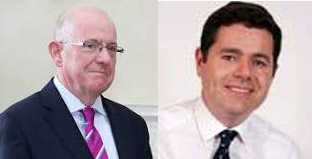
Perhaps the current ‘Squatting’ Fine Gael government Minister’s for Transport, Tourism and Sport, Mr Paschal Donohoe T.D. and the Minister for Foreign Affairs and Trade, Mr Charles Flanagan, TD, could both come into the office some day this week to drop a note to the Australian Department of Foreign Affairs, pointing out the inaccuracies of the information in their supplied data.
Meanwhile; “Attention all you Australian Tourists planning a visit to Ireland”. Please come to Co. Tipperary; enjoy the undemanding wooded trails and pilgrimage walks; appreciate and soak in our sylvan beauty; rid yourself of the stresses and strains of modern life; feel free, in complete safety, to view our historical artefacts and castles and more importantly stay in our Hotel and Guest-houses, all of which cost half the price of similar accommodation to be found in our major cities.
Understand the true meaning of “Céad Míle Fáilte Romhat” [English Translation – One hundred thousand welcomes to you.] Do so with the secure feeling that you will meet the friendliest and most lovable of local people and with the knowledge that even Her Majesty Queen Elizabeth II moved amongst us freely back in 2011.
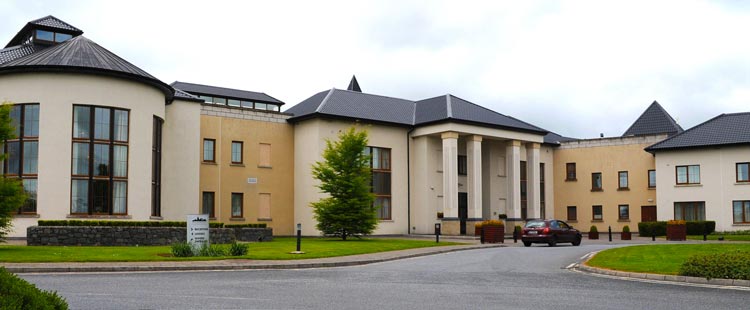
Yet another highly rated provincial Tipperary hotel and golf course is to be offered for immediate sale, with a guide price of €2 million.
The property in question, the four-star Ballykisteen Hotel and Golf Resort, sited opposite the Limerick Junction Racecourse, is situated on the busy Limerick to Waterford road; 6km from Tipperary town; 41km via the R661 from Thurles, (latter home of the GAA); just 2km from Limerick Junction Railway Station; 30 minute’s drive from Limerick city and one hour’s road journey from Cork city.
Set in the shadow of the Galtee Mountains and located on 114 acres surrounded by a rich farming hinterland, the Ballykisteen Hotel and Golf Resort attracts business from a broad area and is particularly well known as an attractive wedding venue. The family friendly hotel was recently voted as being amongst the top 10 of ‘Family Break Resorts’ in Ireland, offering through its ‘Ballyk Kidz Club’, a brilliant programme of fun activities for children aged 3 – 11, available free to all accommodated guests.
The four star Ballykisteen Hotel caters to 40 spacious bedrooms and suites, many of them with balconies which overlook the Des Smyth golf course. The ground floor reception area includes the ‘Junction One Bar’ and separate restaurant / dining area and the ‘Barna Room’, a boardroom style meeting room.
Complimentary Wi-Fi is available in every guest room and in all public areas of the resort.
A total of 14 hotel properties were sold in Ireland in the first three months of 2016, with a total value of some €47 million.
This website uses cookies to improve your experience. We'll assume you're ok with this, but you can opt-out if you wish.AcceptRead More
Privacy & Cookies Policy
Privacy Overview
This website uses cookies to improve your experience while you navigate through the website. Out of these, the cookies that are categorized as necessary are stored on your browser as they are essential for the working of basic functionalities of the website. We also use third-party cookies that help us analyze and understand how you use this website. These cookies will be stored in your browser only with your consent. You also have the option to opt-out of these cookies. But opting out of some of these cookies may affect your browsing experience.
Necessary cookies are absolutely essential for the website to function properly. This category only includes cookies that ensures basic functionalities and security features of the website. These cookies do not store any personal information.
Any cookies that may not be particularly necessary for the website to function and is used specifically to collect user personal data via analytics, ads, other embedded contents are termed as non-necessary cookies. It is mandatory to procure user consent prior to running these cookies on your website.



Recent Comments