|
|
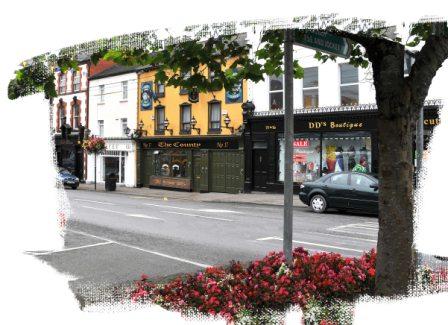 Thurles Town improves its standing in the IBAL (Irish Business Against Litter) league. Thurles Town improves its standing in the IBAL (Irish Business Against Litter) league.
Just one of the three County Tipperary towns taking part in the Irish Business Against Litter League has achieved “litter free” status.
Thurles is ranked 30th of the 60 towns and cities in the IBAL League and has improved from its “moderately littered” ranking at the end of 2008.
The first round report from IBAL for this year rates Clonmel as “moderately littered” while Nenagh has fallen to “littered” status. Latter towns both lost their ‘litter free’ status from last year, finishing in 43rd and 49th respectively.
Litter levels throughout the country have improved once again with over 68% of Irish towns and cities now classed as “litter free” according to the latest litter survey by Irish Business Against Litter (IBAL). However, the group is warning that many areas are likely to suffer this summer with the large-scale reduction of weekend cleaning due to budget cuts. A further concern is that cities’ are not doing as well as the towns as the peak tourist season begins.
The survey of 60 towns and cities, conducted by An Taisce on behalf of IBAL, revealed Wexford to be Ireland’s cleanest town, ahead of Ennis. The number of “Litter Free” areas nationwide hit a record high of 41. Athlone and Mallow were the country’s sole litter black spots, with Arklow ‘seriously littered’.
Wexford is Ireland’s cleanest town with Athlone and Mallow the only ‘Litter Blackspots’ in the league.
Irish Business Against Litter (IBAL) was set up in 1996 as an alliance of companies who believe that litter has a significant impact on our economic well-being. The main sources of our prosperity – tourism, Foreign Direct Investment and our food industries – all depend on an image of Ireland as a clean and green island. We are now a high-cost destination for visitors, who deserve first-class standards of cleanliness.
IBAL believes that it is the job of Local Government to solve our litter problem. It is through enforcement of litter laws – not public information campaigns – that we will rid our country of this scourge.
Latest results show 36 out of 55 towns are Clean to European Norms compared to only 2 when the survey began in 2002.
The St. Patrick’s Day Parade in Thurles is organised by a sub committee of the Thurles Town Council.
The committee is made up of members of the Thurles Town Council and other interested persons who have been co-opted onto the committee. The committee is known as the Thurles Town Council St. Patricks Day Celebration Committee. The Thurles parade takes place on the nearest Sunday to St. Patricks Day and is seen as both a local and a national celebration of our heritage and culture. The Parade is sponsored by the Thurles Town Council, local business people, clubs, organisations and individuals.
Over the past number of years the parade in Thurles has developed into one of the largest such parades in the country. Over 1,000 people participated in the 2008 parade. This included 10 marching bands, local school groups, floats, industrial entries, costumed groups and individuals and numerous walking groups. An estimated 6,000 enjoyed the parade and it was widely agreed that it was one of our best parades to date. Numerous prizes were awarded over a broad range of categories and over 700 medals were handed out to the young people who took part in the parade.The 2009 parade will take place on Sunday 15th March and leaves from Abbey Road at 3pm sharp. The parade route, of one mile, continues down Friar Street entering Liberty Square where the entries pass in front of the reviewing stand. The parade exits down Slievenamon Road and finishes at approximately 4.30pm. Entertainment will be provided in Liberty Square from 2.30pm with a wide variety of music, dancing and fun for the entire family.
Please Note: If you or your band are passing close to Thurles, (possibly you are destined to take part in celebrations elsewhere on March 17th) this town would love to meet you and we extend an open invitation to you all, to come join us in our celebrations on March 15th next.
Contact : Tom Gleeson.
Email: dancingforpleasure@eircom.net
 This year, 2009, will see the Gaelic Athletic Association (GAA) celebrate its 125th anniversary. The man most credited with the original impetus behind this formation was a west of Ireland man, Michael Cusack, a native of County Clare. Cusack’s original dream was to resurrect the ancient Tailteann Games and establish an independent organisation to promote young athletes, however hurling and Gaelic football would over the following years eventually predominate. This year, 2009, will see the Gaelic Athletic Association (GAA) celebrate its 125th anniversary. The man most credited with the original impetus behind this formation was a west of Ireland man, Michael Cusack, a native of County Clare. Cusack’s original dream was to resurrect the ancient Tailteann Games and establish an independent organisation to promote young athletes, however hurling and Gaelic football would over the following years eventually predominate.
Michael Cusack, a native Gaelic speaker, was born in Carron, County Clare in 1847. Regarded by many as having a rather complex personality, he had developed a passion for Gaelic games which was matched only by his love of his native local environment the wild and beautiful limestone landscape of the Burren, where he had been born and raised. Cusack pursued an academic career, eventually becoming a teacher at Blackrock College, in Dublin. In 1877 he set up his own school, known as the Civil Service Academy. The aim of the latter was to prepare students for examinations, necessary to gain them admission into the British Civil Service. This school which was better known as “Cusack’s Academy,” was extremely successful. The many pupils then attending this establishment, were encouraged to get involved in all and any forms of physical exercise. Cusack greatly disappointed by the apparent decline in Irish native games established a hurling clubs at his Academy and thus began his dream to re-establish hurling as the national pastime.
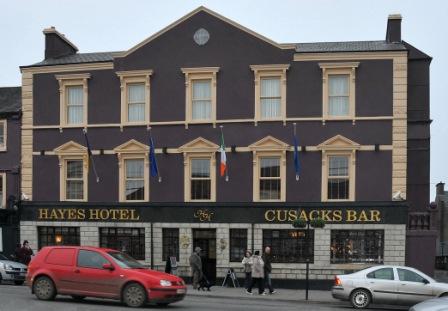
Meanwhile, a farmer from Carrick-on-Suir, Maurice Davin, an outstanding athlete who won international fame in the 1870’s had been actively campaigning for a body to control Irish athletics, so at 3.00pm on Saturday,1st November 1884 at the Haye’s Hotel, Thurles, Co.Tipperary, a meeting of like-minded individuals took place.
This day was chosen for its mythological significance, for according to Irish legends, November 1st was the day when the power of the Fianna died and Cusack’s choice of day was meant to symbolise the rebirth of these mythological Irish heroes, whose aims were; Glaine ár gcroí (Pureness of heart); Neart ár ngéag (Strength of limb); and Beart de réir ár mbriathar (Deeds to match words).
Following this meeting, a committee called The Gaelic Athletic Association for the Cultivation and Preservation of National Pastimes was established. Those elected to form this committee were John Wyse Power, John McKay, J. K. Bracken, Joseph O’Ryan, Maurice Davin, Michael Cusack and Thomas St. George McCarthy. This name was eventually shortened to “The Gaelic Athletic Association“. Others believed to be in attendance at this inaugural meeting included Frank Moloney, Nenagh, William Foley,Carraig-on-Suir, William Delehunty, Thurles, John Butler, Thurles, and William Cantwell, Thurles. Maurice Davin who had presided at this meeting was elected the GAA’s first president and historically the only president ever to serve two terms in office.
The aims now set by this committee were as follows:
• To foster and promote native Irish pastimes
• To open athletics to all social classes
• To establish hurling and football clubs which would organise matches between counties
Within a few weeks of the organisation’s foundation, the then Archbishop of Cashel, Thomas Croke gave this organisation his approval and became its first patron. Its other patrons included both Michael Davitt and Charles Stewart Parnell.
Archbishop Croke would later introduce a new rule to the organisation which forbade members of the GAA from playing foreign games, such as tennis, cricket, polo and croquet. Given later controversies which concerned the playing of ‘foreign games’ and the banning of members of the British armed forces and police from joining, it is notable that one founder member, Thomas St. George McCarthy a native of Bansha, Co.Tipperary was a capped international rugby player, having played for Ireland against Wales in 1883 and was also a District Inspector of the Royal Irish Constabulary (RIC). Also, founder J.K. Bracken, latter the father of Brendan Bracken,who was to become Winston Churchill’s closest friend and Minister for Information in Churchill’s wartime government and then later became a member of the British Cabinet during World War II.
 This day the 21st January, 100 years ago, in 1919 Sinn Féin candidates who had been elected in the Westminster elections of 1918 refused to recognise the Parliament of the United Kingdom and instead assembled as a revolutionary parliament called “Dáil Éireann”. This first meeting of Dáil Éireann on 21st January 1919 was held in the Round Room of the Mansion House. Unlike the normal picture which depicts the first Dáil this photo shows the true first assembly. Éamon de Valera and Arthur Griffith were both in jail on January 21st and Michael Collins, much sought by British Forces together with Harry Boland were busy preparing plans for the successful escape of Éamon de Valera from Lincoln Gaol. This day the 21st January, 100 years ago, in 1919 Sinn Féin candidates who had been elected in the Westminster elections of 1918 refused to recognise the Parliament of the United Kingdom and instead assembled as a revolutionary parliament called “Dáil Éireann”. This first meeting of Dáil Éireann on 21st January 1919 was held in the Round Room of the Mansion House. Unlike the normal picture which depicts the first Dáil this photo shows the true first assembly. Éamon de Valera and Arthur Griffith were both in jail on January 21st and Michael Collins, much sought by British Forces together with Harry Boland were busy preparing plans for the successful escape of Éamon de Valera from Lincoln Gaol.
Prior to 1919, Sinn Féin’s popularity had increased dramatically, following the execution by Englands Major General Sir John Maxwell, of most of some 90 leaders of the 1916 rebellion. Sinn Féin had won 73 out of the 105 Irish seats in the Westminster parliament and the party’s founder, Arthur Griffith, believed that Irish nationalists should emulate the means by which Hungarian nationalists, led by Ferenc Deák, had achieved partial independence from Austria.
However, on precisely the same day as the Dáil’s first meeting took place, two members of the Royal Irish Constabulary were ambushed and killed at Soloheadbeg, in Co. Tipperary, by members of the Irish Volunteers, later to be known as the 3rd. Tipperary Brigade of the IRA. This incident had not been ordered by the Dáil but the course of events soon drove the Dáil to recognise the Volunteers as the army of the Irish Republic and the ambush to be seen as an act of war against Great Britain.
The Tipperary Connection.
In relating this historical blog we will again unveil yet another secret of the true hidden Ireland that is Tipperary.
Soloheadbeg is a small townsland near Limerick Junction railway station. The place is steeped in Irish history, for it was here that King Mahon of Thomond together with his brother Brian Ború defeated the vikings at the Battle of Solohead in 968. It was here also that Dónal Cam O’Sullivan Bere stopped on his epic march from Dunboy Castle in west Cork to O’Rourke’s Castle in Leitrim in 1603.
 On 21st January 1919, two Irish born catholic RIC constables, James Alec McDonnell and Patrick O’Connell, were escorting a horse drawn cart containing a load of gelignite taken from the Tipperary town Military Barracks. This gelignite, was destined for use for blasting purposes, at the local Soloheadbeg Quarry. The driver of the cart was James Godfrey, accompanied by Patrick Flynn, the latter a County Council employee. On 21st January 1919, two Irish born catholic RIC constables, James Alec McDonnell and Patrick O’Connell, were escorting a horse drawn cart containing a load of gelignite taken from the Tipperary town Military Barracks. This gelignite, was destined for use for blasting purposes, at the local Soloheadbeg Quarry. The driver of the cart was James Godfrey, accompanied by Patrick Flynn, the latter a County Council employee.
Constable McDonnell, was a native of Belmullet, Co. Mayo and a widower with seven children. His comrade Constable O’Connell, was a native of Coachford, County Cork, and unmarried. Both men, according to local reports, were reasonably popular as policemen in the area.
Possibly up to eight armed and masked men, members of the then Irish Volunteers from the South Tipperary Brigade, which included their leader Séamus Robbinson, OC; Sean 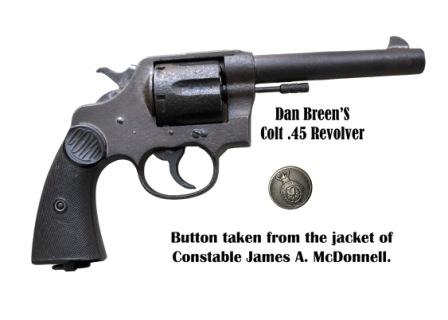 Tracy, Vice OC; Dan Breen, QM; Sean Hogan, Tadgh Crowe, Patrick Dwyer, Michael Ryan, and Patrick McCormack fired on the Constables, killing both men. Volunteer GHQ had not sanctioned this ambush. The driver and County Council worker were left unharmed. In the pocket of Constable McDonnell’s uniform were 30 electric detonators which remained undiscovered by their assailants. Hogan with Treacy and Breen drove the cart, together with the explosives, away from the scene, while the others involved scattered in the opposite direction. Eye witnesses later saw the cart been driven at high speed in the direction of Dundrum village, in Co. Tipperary, and indeed the horse and cart, minus its contents, were later found abandoned at Allen Creamery, near Dundrum, by District Inspector Poer O’Shee of Clonmel. Tracy, Vice OC; Dan Breen, QM; Sean Hogan, Tadgh Crowe, Patrick Dwyer, Michael Ryan, and Patrick McCormack fired on the Constables, killing both men. Volunteer GHQ had not sanctioned this ambush. The driver and County Council worker were left unharmed. In the pocket of Constable McDonnell’s uniform were 30 electric detonators which remained undiscovered by their assailants. Hogan with Treacy and Breen drove the cart, together with the explosives, away from the scene, while the others involved scattered in the opposite direction. Eye witnesses later saw the cart been driven at high speed in the direction of Dundrum village, in Co. Tipperary, and indeed the horse and cart, minus its contents, were later found abandoned at Allen Creamery, near Dundrum, by District Inspector Poer O’Shee of Clonmel.
Condemnation for the killings was swift and from every quarter, even from some well known local republicans and local priests. Dan Breen claimed the constables attacked first, but a body of opinion says that this was unlikely given the odds against them. Dan Breen claims in his book “My fight for Irish Freedom” that the constables raised their rifles in preparation for a fight and that they were forced to kill the two constables.
However Breen also later recalled:”…we took the action deliberately, having thought over the matter and talked it over between us. Treacy had stated to me that the only way of starting a war was to kill someone, and we wanted to start a war, so we intended to kill some of the police whom we looked upon as the foremost and most important branch of the enemy forces … The only regret that we had following the ambush was that there were only two policemen in it, instead of the six we had expected.
The real facts of this incident are possibly forever lost in history.
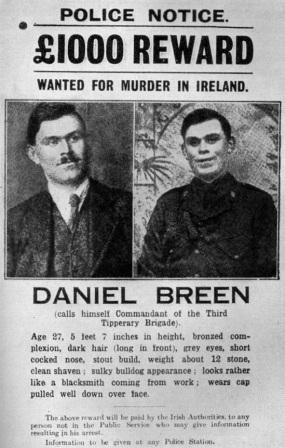
The following day Martial Law was imposed in Co.Tipperary. A reward of £1,000 was offered for information, shown on wanted posters displaying photographs of Dan Breen, which were immediately posted outside every police barracks in the country.
The Soloheadbeg incident is still regarded as the first opening act of the Irish War of Independence, though the Dáil did not formally declare war on Britain until 1921.
Sean Treacy was later killed by British forces and was buried at Kilfeacle in October, 1920. Breen went on to serve as a politician and member of Dáil Éireann (anti-Treaty) from 1923-1927 and 1932-1965. He died in Dublin in 1969 and was buried in Donohill.
One of the more successful, popular and historic golf clubs in Ireland, Thurles Golf Club, will celebrate it’s Centenary this year, 2009.
To mark this occasion the Club’s Committee are preparing a short historical type journal, which, it is hoped will to be completed and printed by the end of May 2009.
This Journal will reflect both the general events in Thurles town and country Tipperary, while recollecting at the same time a “meanwhile, back at the club house” sort of consciousness. To this end, the club’s committee are eagerly seeking information about Thurles Golf Club’s past and are in search of old anecdotes, photographs, trophies, indeed, anything that you, the public, can contribute would be greatly appreciated. The committee are anxious to point out that items loaned for copying, etc. will be returned quickly and in same condition.
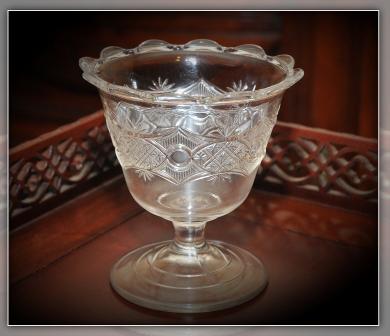
The artifact appearing in the picture in this post, for example, reveals yet another Thurles secret, and is locally referred to as Daniel O’Connell’s Sugar Bowl. This bowl was used by “The Liberator” (Born Aug 6th.1775 Co.Kerry – Died May 15th 1847 Genoa, Italy) at a banquet given in his honour by Nicholas V. Maher M.P. in 1829 at his home (Now home to Thurles Golf Club). It was presented, as a souvenir of this historic event, to the Maher’s housekeeper. The housekeeper, Thurles woman, Mrs Anto Tobin (nee Butler), was, herself, a devoted supporter of O’Connell. This bowl presently holds ‘pride of place’ in St.Mary’s Famine Museum, Thurles, having been presented to the museum by a relative, Miss Alice Smith, Stradavher, Thurles, Co Tipperary, with the wish that it be enjoyed by lovers of local Thurles history.
Thurles Golf Club itself was formed, following an Inaugural Meeting held, in the Grand Jury Room at Thurles Court House on 21st January 1909.
The Members present at that inaugural meeting were:
L.J. Ryan, J.P.Carrigan, J.F. Haskins, P.J. Devlin, J.L. Johnston, J. Laide, P. Moloney, G.F. Knox, P.C. Barry, H. Harold-Barry, J.F. Crowley and S.R. Thorp.
At the moment members are trying to build a profile of background information on each of these ‘Founder Members’ and are seeking photographs or details of any memorabilia that may be available.
Any help, you the public can contribute to this project will be very much appreciated, not only by the many Thurles Golf Club members but also by the people of Thurles in general.
Members to Contact: Frank Conroy and/or Michael Daly Tel: 0504- 21983 or contact us on this site.
|
Support Us Help keep Thurles.info online by donating below. Thank you.
Total Donated 2026: €300.00
Thank You!
Daily Thurles Mass Livestream
|



Recent Comments