|
|
Twelve people were rescued from the River Shannon on the Tipperary Clare border, near Killaloe Bridge late night. Two of these were plucked from the freezing waters having jumped from an overladen vessel on which they were partying and which had begun to take on water.
It is understood that 12 adults, all men in their 20’s, who had been attending a house party near the shoreline, decided to go boating in a 22 foot long speedboat.
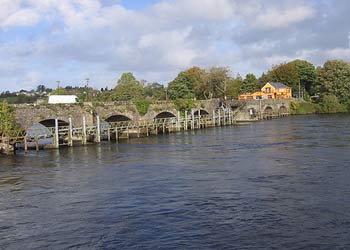 Killaloe Bridge A tragedy was only narrowly averted by the quick response of the emergency services, who managed to reach the scene within minutes of the alarm being raised.
The vessel was almost 3 kms south of the bridge and about 500 metres from the shore, in the darkness, when it began to take on water. Two of the occupants are understood to have jumped into the freezing water to attempt to swim ashore.
Rescuers found an amount of alcohol cans and bottles, in the area around the boat and most of those on board are understood to have been wearing inadequately fitting life jackets, for the intended voyage.
Killaloe Coast Guard spokesman Mr. Michael Quigley said: “So much could have gone wrong on Friday night and there is no doubt twelve lives could so easily have been lost.”
He also warned that when people gets into trouble, they should only ring 999 or 112 and not a member of the public or individual Coast Guard members. This only wastes time and can put lives further at risk.
Killaloe and Ballina is an area much sought out by tourists visiting the Clare and Tipperary region.
Weather conditions for the annual St.Patrick’s Day Parade 2010 in Thurles were excellent this year and this led to a great atmosphere here in Liberty Square.
This was the biggest and best parade, in living memory, to be held in Thurles, with a record 60 entries, each filled with great imagination, colour and a wide variety of topic. Over €3,000 in cash, prizes and medals were handed out on the day.
The parade was viewed from the reviewing stand by local representatives from the Army, Police, all Religious and Political sectors and the Mayor of Thurles Mrs Evelyn Nevin.
The Parade was officially started by His Grace Dr. Dermot Clifford, Archbishop of Cashel and the commentary for this event was provided by Thomas Gleeson, Committee Chairman.
Over 100 business people, clubs, schools, organisations and individuals were involved in the overall celebrations and the organising committee extended a big thank you to all who assisted in any way.
Entertainment commenced in Liberty Square at 2.30pm with excellent music supplied by “The Moynihan Brothers“. Colourful street stilt-walkers from Cork Circus, who appeared representing the four elements, “Air, Fire, Earth and Water”, entertaining both young and old assembled. Other entertainers included Jack Flash (Juggler), Aussie the Emu, Hoppy and Presto, and Face Painters and a Balloon Modellers were also very much evidence, adding greatly to the parade’s overall huge success and enjoyment for the huge crowd assembled.
Here is a small piece of live video footage to give our readers just a small taste of the day’s enjoyment.
The Rosegreen Players won the prize for the best float with their entry “Balls at the Dail” with Trevor Sergeant and Willie O’Dea as the ugly sisters while Mary Harney played the part of Cinderella, and all having a ball. (Who said Mary was in New Zealand?)
The parade included a total of 9 bands, a record for a St. Paddy’s Parade in Thurles.
St Patrick’s Day 2010 Parade Winners in Thurles
Overall Winner: Darmody’s Bar Littleton (Potholes in Ireland)
Best School Entry: Upperchurch National School
Best Traditional Irish Entry: Clonoulty and Rossmore Vintage Club
Best Float: Rosegreen Players (Balls in the Dail)
Best Float Runner Up: Tipperary Institute (Pacman & The Mario Bros)
Best Old Time and Vintage: Thurles & District Vintage Club
Best Local Club: Stakelums Hardware Social Club (Snow White)
Best Marching Band: Blarney Brass and Reed Band
Best Float Display Cabra Wetlands
Best Walking Group: The Special Olympics
Best Dressed windows 1st: Sammons Chemist Shop, 2nd: Virgo Liberty Square, 3rd: The Pike Take-away
Other Prize Winners were:-
Paddy Oz Style: Catch your own Leprechaun: World Taekwondo: Two to Avoid Potholes:The Order of Malta:Holycross Beavers: Thurles Gaels: Durlas Og: Thurles Brownies: Save the Animals:1932 Road Roller.
The youngest prize winner was Jordon Cullen, aged eight, with his creative theme “Save and Protect Wild Life.”
The committee would like to thank the following businesses for their sponsorship:-
Bookworm, Dew Valley Foods, Thurles Sarsfields, Dunnes Stores, Top Oil, Cleary’s Toys and Nursery, Pat Hayes (The Arch Bar and HQ Nightclub), and Thurles and Tipperary Institute.
Video Credits: B.Corbett, G.Willoughby
 Minister M.Hanifin With US President B.O'Bama Thurles born Fianna Fail Minister Mary Hanafin has been given a new role in government, following Tuesday’s Government Cabinet reshuffle.
Mary Hanafin takes over the post of Tourism, Culture, and Sport which was previously known as Arts, Sport and Tourism from Minister Martin Cullen, who resigned from government due to health problems.
Mary has represented the middle class constituency of Dun Laoghaire for some 13 years and has been a successful minister in the high-spending departments of education and, until this reshuffle, headed up the Department of Social and Family Affairs , latter which will be now known as the Department of Social Protection and will also now take over responsibility for the recently disgraced department known as FÁS.
Minister Hanafin is the daughter of former Senator Des Hanafin and his wife Mona, sister of Senator John Hanafin, and first cousin of North Tipperary County Councillor Seamus Hanafin.
Mary Hanafin, a 51-year-old former teacher and experienced politician, has rejected media and Fianna Fail backbenchers claims that suggest this new post is a demotion in her political career, but sees this move as an opportunity to develop and market Ireland properly, both at home and abroad.
In accepting the post she stressed the economic potential of culture, stating, “The day you lose sight of creativity, arts and culture, what this country is famous for, will be a very sad one, I intend to get out there and promote it.” she said.
Here in Thurles her acceptance of the Tourism post is greatly welcomed, in anticipation that funding in relation to Tourism will now not be more fairly distributed within the Shannon Region. It is the opinion of the vast majority of interested tourism supporters in North Tipperary, that funding given to the Shannon Region ends up advertising the West of Ireland e.g. Clare, Limerick and the Shannon basin, at the expense of its poorer neighbouring towns like Thurles, Templemore and Roscrea.
Generally, Mary is regarded as a decent media performer and most certainly gives the impression of being considerably more competent at her job than some of her cabinet colleagues. This is borne out by the fact that when given the task of being the minister who oversaw cuts in Social Welfare payments, she arrived at the other end relatively unscathed.
Tomas Gleeson reports on forthcoming St. Patrick’s Day activities in Thurles.
This years St. Patrick’s Day Parade in Thurles will be held on Sunday the 21st of March
The Parade leaves from Abbey Road at 2.45pm and all participants in this years Parade should be in Abbey Road by 2.15pm. John Kenehan and Martin Taylor, with the help of some stewards, will be in charge of starting the Parade.
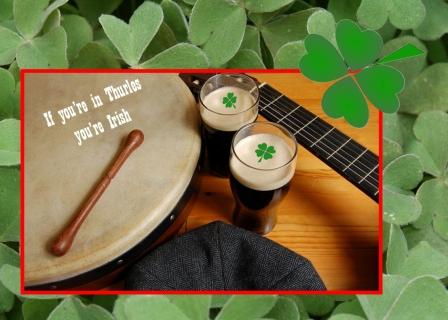 St Patrick's Day Parade - 21st March in Thurles The Parade, with ten bands which promises to be one of our biggest parades ever, will head down Friar Street and on to Liberty Square where the reviewing-stand will be in position.
At the same time as the Parade is starting in Abbey Road, a blessing of the Parade and its participants will take place in Liberty Square and this will be followed by the band playing our National Anthem.
A full afternoon’s entertainment has been organised for that day and it promises to be an enjoyable afternoon for all the family. There is music and dance in Liberty Square from 2.15pm to the music of ‘The Moynihan Brothers’. There are also face painters, a balloon modeller, stilt walkers, magic, comedy etc. to entertain both adults and children. This entertainment will continue after the Parade, until approximately 5.00pm.
Prize Fund
A prize fund of up to €3,000 will see over 20 prizes and 700 medals been given out on the day. The prizes will be presented at a ceremony in Hayes Hotel at 4.45pm approximately. Prizes will also be awarded for the best dressed window and for the best Irish window. All shops are asked to decorate their premises appropriate for the occasion.
Well done to the business community in Thurles, who have contributed so generously to the funding of this Parade. Sponsorship continues to be accepted and all such sponsorship will be acknowledged. Stewards are required for the period from 2.15pm to 5.00pm to help out on the day of the Parade. Please report to Jimmy Purcell (Chief Steward) at the reviewing stand at 2.15pm if you are willing to help out. Show your support and bring along your Irish flags or hats and add a bit of colour to the day. Many of the prizes will be on display in McMahon’s window in Liberty Square until Saturday 20th March. All spectators are asked to donate 50c towards the running of the Parade and a bucket collection for this purpose will be taken up during the Parade. For further information, entries or sponsorship please contact Tom Gleeson (Telephone 087-9732837) or visit the web site www.stpatricksdayparadethurles.com
Parking and Traffic Restrictions
From 11am to 4.45pm:-
No parking in Liberty Square from Executive Menswear to Fones4U.
No parking from Brennan’s Pub to Hayes Hotel entrance.
No parking in the centre of the Square between those areas.
No traffic through this section of the Square from 2.15pm to 4.45pm. Diversions will be in operation.
The viewing stand will be placed outside The First Active and the band stand will be placed in the centre of the Square opposite Brennan’s Pub. Both of these spaces should be clear by 10am on Sunday morning.
No parking on the left hand side of Abbey Road from the Kennedy Park round-about to the Railway Bridge
for the period from 2pm to 4pm.
See you all in Liberty Square, on Sunday the 21st of March.
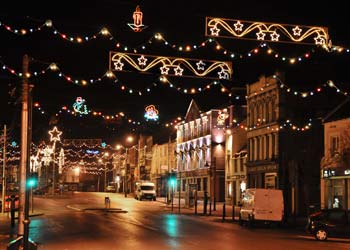 Christmas Lights – Thurles Town Centre For the next two Saturdays,there will be no parking charges applied to vehicles found parked in the six car parks, situated around Thurles Town centre.
Thurles Town Mayor Mrs Evelyn Nevin raised the issue at the recent monthly meeting of the Town Council, following representation from Thurles Chamber on behalf of local businesses.
However it should be noted that normal parking restrictions and charges will still apply to those who continue to park on the streets of Thurles.
Free Car parking for over 300 vehicles will therefore be available at Parnell Street, Friar Street, Cathedral Street, Slievenamon Road, Liberty Square and the Source Arts Centre, thus ensuring easy stress free access to shoppers and tourists, who choose to visit the centre of the town for their annual Christmas shopping.
|
Support Us Help keep Thurles.info online by donating below. Thank you.
Total Donated 2026: €300.00
Thank You!
Daily Thurles Mass Livestream
|



Recent Comments