Australia’s current social media experience offers Ireland an important warning.
More than 80% of Australian children aged 10–15 were still using social media three months after its under-16 restrictions took effect. Some retained existing accounts, supplied false ages or shifted towards messaging and gaming services. Parental awareness of children’s online activity also declined.
Ireland is considering age restrictions while developing a digital age-verification mechanism. However, copying Australia’s blanket ban could reproduce the same problems: circumvention, displacement to less-regulated services, intrusive identity checks and reduced communication between teenagers and parents. Ireland should instead build upon its existing regulatory system, which combines the EU Digital Services Act, the Online Safety and Media Regulation Act 2022 and Coimisiún na Meán’s Online Safety Code.
Ireland should undertake several connected measures:
Expand digital and media literacy throughout primary and secondary education, including lessons on algorithms, misinformation, cyberbullying, privacy and reporting harmful material.
Require social-media companies to make minors’ accounts private by default and prevent unknown adults from contacting them.
Prohibit targeted advertising, location sharing and commercial profiling involving children.
Restrict addictive design features such as endless scrolling, autoplay, streaks and overnight notifications.
Give minors a chronological-feed option instead of automatically placing them under engagement-maximising recommendation systems.
Require independent audits of platforms’ algorithms, age-assurance measures and child-safety outcomes.
Introduce privacy-preserving age checks that confirm an age bracket without revealing a child’s full identity or retaining identification documents.
Provide accessible guidance for parents while involving young people directly in policy design.
Ireland already requires certain platforms serving under-16s to offer parental controls, including tools for screen time, privacy, content and contact management. The next step is to ensure that these protections are switched on automatically and independently tested, rather than leaving families to locate and configure them.
Young people should also be treated as participants in the solution. Ireland’s 2026 Youth Forum on Online Safety brought together approximately 100 people aged 10–17, offering a useful model for continuing consultation. Government of Ireland Policies developed with children are more likely to reflect how they actually use technology and how they might evade ineffective controls.
Australia currently shows that an age barrier alone cannot eliminate young people’s social-media use. Ireland’s more appropriate course is therefore regulated, progressively independent access; strong default safeguards for younger users, increasing autonomy with age, sustained education and enforceable duties placed on the companies that design and profit from these platforms.
The Stench of Neglect: River Suir in Thurles Suffocates in Waste.
A Waterway Left to Fester: Apparent Pollution, Institutional Neglect and an Inexcusable Failure to Act.
The early images in the video immediately below are visually consistent with sewage-contaminated water, inadequately treated wastewater, detergent-bearing grey-water, or another organic effluent. The foam could indicate surfactants, while the grey colour and sludge may indicate suspended solids and decomposing organic matter. It does not resemble clean surface-water run-off.
However, a photograph alone cannot conclusively identify the slowly flowing substance in a river now almost static. Proper investigation should include samples from the suspected discharge point and locations upstream and downstream. Relevant analyses include dissolved oxygen, BOD, COD, ammonia, orthophosphate, suspended solids, E. coli, conductivity and surfactants. EPA material confirms that BOD, dissolved oxygen, ammonia, nitrate and phosphorus are central indicators of organic contamination, and that pollution-incident sampling should cover downstream, discharge-point and upstream locations.EPA sampling procedure
This slide-show above, however, presents a disgusting and deeply alarming picture; grey, foaming liquid and foul-looking sludge accumulating in what should be a living watercourse. Its exact composition must now be determined by laboratory testing, but its visible condition is wholly incompatible with the clean, healthy river environment the public is entitled to expect.
This river is neither a sewer nor a dumping ground. If analysis confirms an unlawful discharge, its source must be stopped, the damage remediated and every available enforcement power used.
Continued neglect after documented notification would be indefensible, a betrayal of the waterway, its wildlife and the community these authorities and representatives are supposed to serve.
Reminder
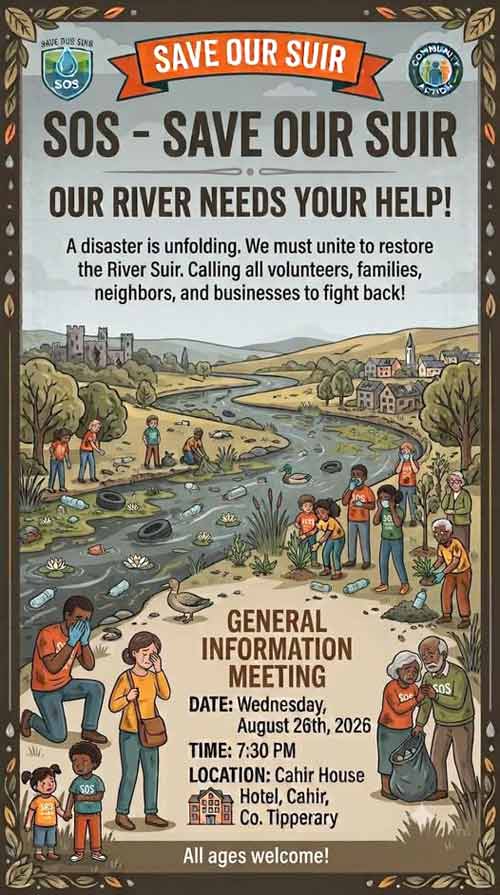
We can confirm that the above public meeting will take place, as stated above.
Thirteen years of warnings As stated in a recent post on Thurles.Info, the deterioration of the River Suir cannot credibly be described as “sudden” or “unforeseeable”. For more than a decade, residents, anglers and environmental campaigners have raised concerns about pollution, excessive vegetation, restricted flow, sediment, litter and neglect. These concerns were documented in “River Suir Crisis—Thirteen Years of Warnings, But Still No Coordinated Action”.
Now, 13 yearslater; the Minister of State Mr Kevin “Boxer” Moran recently visited sections of the Suir in Thurles and Holycross following representations from Independent TD Michael Lowry. It was stated that the Office of Public Works would support an application by Tipperary County Council under the enhanced Minor Flood Mitigation Works Scheme. However, I can confirm from recent discussions with varying responsible bodies, that they are not aware of any recent communication. Support for an application is welcome, but it is not a restoration programme. The public has not been shown the precise work proposed, the scientific evidence supporting it, the environmental assessments required, the anticipated cost and timetable or the body responsible for delivery and monitoring.
Political videos, visits and announcements by politicians and councillors cannot substitute for accountable work. Councillor Micheál Lowry, Deputy Michael Lowry and every other representative addressing the issue must be judged by measurable results. The same standard must apply to Tipperary County Council officials. [ Which begs the question; “Where were all the other local elected councillors when a recent promotional video, capturedby Mr Lowry TD, was uploaded unto social media.” ]
The missing ingredient for the River Suir is not more talk, it is delivery.We need clear answers:
► What works will be carried out? ► When will they begin? ► Who is responsible for delivery? ► Has the funding application now been submitted? ► What section of the river will be prioritised first? ► How will pollution and damaging discharges be reduced? ► How will progress be measured and reported publicly?
We learn from press reports that Ireland’s tourism agencies have spent more than €1 million paying influencers to promote holiday destinations, since the beginning of 2025.
That is a substantial amount of public money and it deserves more than impressive claims about followers, views and “audience reach.” It deserves transparent evidence that these campaigns generated additional visitors, bookings and revenue. Tourism has certainly improved. Ireland welcomed more than 3.2 million overseas visitors during the first half of 2026; 15% more than in the same period of 2025. Their spending increased by 18% to €2.6 billion.
Those are encouraging figures, but they do not prove that influencer marketing produced the recovery. Tourism is affected by airline capacity, ferry connections, weather, exchange rates, prices, consumer confidence and many other forms of advertising. An influencer reaching millions of social-media accounts is not the same as delivering millions of tourists. A view is not a booking, a “like” is not a hotel stay, and a follower is not necessarily a prospective visitor.
This distinction is particularly important for Tipperary. The county’s tourism performance during 2025 was positive but mixed. Sixty per cent of tourism businesses reported growth and 14% remained stable, while 26% experienced a decline. Attractions and activity providers performed well, with 82% growing or maintaining attendance.
However, accommodation businesses had a more difficult experience: 34% reported a decline, while shorter stays and later bookings remained significant problems. Much of Tipperary’s strength also came from domestic residents and day-trippers. An impressive 94% of attractions maintained or increased their Ireland-based visitors.
That is good news, but it does not demonstrate that paid influencer visits generated significant additional tourism. In fact, favourable weather, local engagement, repeat visitors and domestic day trips were identified as important reasons for Tipperary’s performance.
Tipperary does has a tourism product that should be capable of selling itself internationally: the Rock of Cashel, Cahir Castle, Lough Derg, the Glen of Aherlow, the Galtee Mountains, Holycross Abbey and a rich combination of history, food, outdoor recreation and authentic rural communities. The county’s challenge is not simply attracting social-media attention. It is converting interest and day trips into overnight stays, encouraging visitors to explore beyond the best-known locations and ensuring that tourism spending reaches local accommodation providers, restaurants, shops and communities.
There is a legitimate place for digital creators in modern tourism promotion. Social media influences approximately 23 – 24% of potential visitors looking for holiday inspiration. However, recommendations and online searches are even more influential.
The biggest reason people choose Ireland is not celebrity endorsement. It is the country itself. Tourism Ireland’s research shows that scenery is the leading reason for choosing Ireland, cited by 33% of potential visitors. It is followed by Culture, Sightseeing and History. Historic Sites, Food and Drink, Walking, Hiking and Nature have exceptionally broad appeal. The public should therefore be asking whether enough money is being invested directly in the things visitors actually come to experience: heritage conservation, trails, public transport, visitor facilities, signage, accessibility, accommodation capacity and effective booking systems.
The strongest criticism is not that every influencer campaign is wasteful. We do not have the evidence to make that claim. The problem is that the agencies have not publicly demonstrated the opposite.
After spending more than €1 million, reporting enormous audience reach is inadequate. The agencies should now publish, for every major campaign: The total fee and associated travel costs. The audience and markets targeted. Engagement from relevant prospective visitors. Confirmed bookings or attributable visitor spending. Cost per booking and return on public investment. Honest regional results, including overnight stays generated in counties such as Tipperary. (Remembering no establishment likes to report decline.)
If those measurements show that influencer marketing works, the agencies will have a strong case for continuing it. If they cannot produce them, taxpayers are entitled to question whether public money is supporting tourism, or merely subsidising attractive trips and highly polished social-media content.
Ireland’s tourism recovery is welcome. Tipperary’s attractions are showing real resilience. But neither development gives tourism agencies a blank cheque.
Publicity is not performance. Reach is not revenue. Public money must produce measurable public value.
On August 2nd, 2026, Thurles.Info highlighted the growing litter problem caused by drinks containers being discarded on streets, roadsides and in public spaces around Thurles and other Irish towns.
Among the containers increasingly being found are round aluminium BuzzBallz cocktail cans and miniature plastic bottles used for spirits and cocktail mixes. Many of these containers cannot be returned through Ireland’s Deposit Return Scheme.
The scheme generally covers PET plastic drinks bottles and aluminium or steel drinks cans with a capacity of between 150ml and three litres. However, containers must also display the Re-turn logo and carry a barcode registered with the Irish scheme. To be accepted, they must be empty, undamaged and retain their original shape. Consequently, an imported or unregistered container may be rejected by a Reverse Vending Machine, even when it is made from aluminium or PET plastic and falls within the specified volume range. Miniature glass bottles and containers made from plastics other than PET remain outside the scheme.
Government Minister’s office contacted Following publication of that report, we contacted Minister of State Mr Alan Dillon, who has responsibility for the Circular Economy at the Department of Climate, Energy and the Environment.
We received the following standard automated acknowledgement: “Thank you for your email to Minister of State Alan Dillon’s Office. Your correspondence will be brought to the attention of the Minister and relevant officials in the Department of Climate, Energy and the Environment. Please be advised that if the issue raised in your correspondence is more appropriate to another Government Department or Agency, your correspondence will be forwarded to that organisation for direct response, in accordance with the provisions of the Department’s Data Protection Policy.”
This acknowledgement merely confirms receipt of our correspondence. It provides no substantive response to the litter problem raised and offers no indication as to what action, if any, may be taken.
“100% recyclable” is not the same as being eligible for a deposit refund. Result littering.
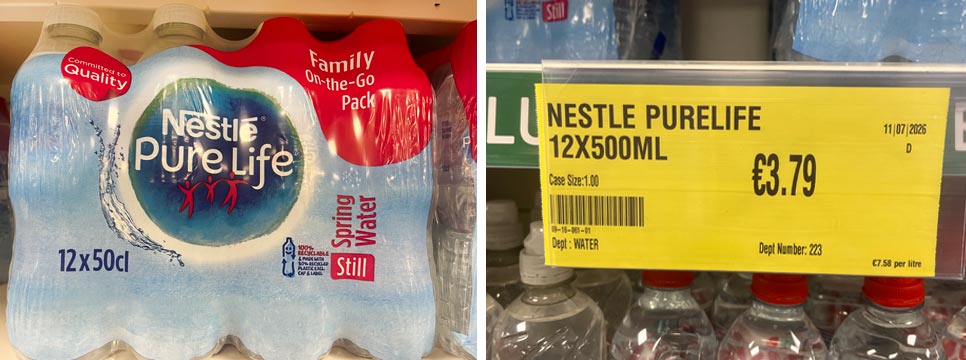
Bottled water without the Re-turn logo We have again contacted Minister Dillon’s office after observing Irish retailers selling multipacks of bottled water whose packaging states that the bottles are “100% recyclable”, but which do not appear to display the official Re-turn logo.
“100% recyclable” is not the same as being eligible for a deposit refund Under the published scheme rules, in-scope containers must display the Re-turn logo and carry a barcode registered with the scheme. Re-turn states that all in-scope drinks containers placed on the Irish market must meet these labelling requirements.
The water shown in our accompanying photograph above is sold in 500ml plastic bottles; a size that would normally fall within the scope of the Deposit Return Scheme if the bottles are made from PET plastic and properly registered. Their apparent lack of a Re-turn logo therefore raises questions as to why such products are being offered for sale and whether Irish consumers can return them for a deposit refund.
Without a financial incentive to return these bottles, more of them are ending up discarded along roadsides, on streets and in other public places, adding to an already serious litter nuisance.
Consumers who see a recycling symbol may understandably believe that a bottle can be placed in a Reverse Vending Machine. If the machine then rejects it because its barcode is not registered or because it lacks the required Re-turn marking, the system becomes confusing and public confidence is weakened.
We now respectfully ask Minister Dillon and his Department to clarify:
Why drinks containers that appear to fall within the scheme’s material and volume requirements are still being offered for sale without the Re-turn logo? Whether retailers are permitted to sell such products in Ireland? Which authority is responsible for inspecting retailers and enforcing compliance/ What measures will be taken to include, or otherwise address, aluminium cocktail containers, miniature bottles and other drinks packaging currently falling outside the scheme? Whether the Deposit Return Scheme will be reviewed to prevent avoidable gaps that contribute to litter?
Ireland’s Deposit Return Scheme can reduce litter only when the containers most likely to be discarded are included and when consumers can easily identify what is returnable.
A recyclable container that cannot be returned is still a container that can become litter.
Ireland’s latest greenhouse gas figures bring a welcome headline: emissions fell again in 2025. But behind that progress lies a much harder truth. The country is still nowhere near the pace of change required to meet its legally binding climate targets, and the next few years are likely to be far more difficult than the last few.
The Environmental Protection Agency’s provisional figures show that Ireland’s greenhouse gas emissions decreased by 2.2% in 2025, equivalent to 1.2 million tonnes of carbon dioxide equivalent. It was the fourth year in a row that emissions fell. Reductions were recorded across all main sectors, with the biggest falls in energy industries, buildings, industry and transport.
That is encouraging. It shows that emissions can fall while Ireland’s economy and population continue to grow. It also suggests that policy, investment and cleaner technology are beginning to have an effect.
But the scale of the challenge remains stark. Ireland’s national climate law requires a 51% reduction in greenhouse gas emissions by 2030 compared with 2018 levels. By 2025, emissions had fallen by only 14.5% when land use, land-use change and forestry are included. The EPA has warned that emissions must now fall by more than 10% every year to 2030 if Ireland is to meet its national climate target.
That is the central difficulty. A 2.2% annual fall is progress, but it is not enough. Ireland is moving in the right direction, yet not nearly fast enough. The easier gains may also be running out. The energy sector has delivered major reductions, helped by renewable electricity, less fossil-fuel generation and changes in the power system. Emissions from power generation and large industrial companies fell by 5.5% in 2025, according to the EPA. But future reductions will increasingly depend on harder-to-change parts of daily life: how people travel, how homes are heated, how farms produce food, how industry uses energy, and how quickly infrastructure can be built.
Transport is one of the biggest warning signs. Emissions fell in 2025, helped by more biofuel use and rising electricity consumption in road transport. But transport still exceeded its sectoral ceiling. This points to a deeper problem: Ireland is making improvements, but car dependency, slow public transport delivery, rising travel demand and freight emissions continue to make transport one of the most difficult sectors to decarbonise.
Industry faces similar pressure. Industrial emissions fell in 2025, but the sector still overshot its ceiling. Some reductions can come from fuel switching or lower fossil-fuel use, but long-term progress will require deeper changes in manufacturing, cement production, industrial heat and investment in cleaner processes. That will not be simple, cheap or quick.
Agriculture remains perhaps the most politically sensitive challenge. The 2025 fall in agricultural emissions was very small. Lower cattle numbers helped, but this was offset by increased fertiliser use and higher milk production. Agriculture is central to rural Ireland and the national economy, but it is also a major source of methane and nitrous oxide. Reducing these emissions at the speed required will involve difficult choices about land use, herd size, fertiliser, food production and farm incomes.
Buildings offer another mixed picture. Emissions fell in 2025, helped by a warmer winter and reduced fossil-fuel use. Residential emissions are now much lower than in previous decades. But warmer weather is not a climate policy. Lasting reductions will require faster retrofitting, more heat pumps, improved energy efficiency, skilled workers and financial supports that make upgrades realistic for households and businesses.
Ireland also faces a serious EU compliance challenge. Under the EU Effort Sharing Regulation, Ireland must reduce emissions in sectors such as agriculture, transport, buildings, waste and smaller industry by 42% by 2030compared with 2005. The EPA says Ireland is projected to miss that target, with a maximum projected reduction of 23% by 2030 even under a scenario with additional measures.
The cost of missing targets could be significant. Reuters reported that Ireland’s fiscal and climate watchdogs warned the State could face EU compliance costs ranging from €8 billion to €26 billion by 2030, if emissions-reduction plans are not delivered. That means failure would not simply be environmental. It could become a major financial burden on the public purse. There is a risk that one positive year creates a false sense of security. Falling emissions are welcome, but climate targets are not judged by headlines. They are judged by cumulative reductions, carbon budgets and legally binding limits. Ireland may be provisionally under its first carbon budget, but future budgets will be tighter and harder to meet.
The real test now is delivery. Targets have been set. Carbon budgets have been agreed. Sectoral ceilings have been created. The legal framework is in place. What Ireland needs next is faster implementation; more renewable power, stronger grids, cleaner transport, warmer homes, lower-emission farming, industrial investment and public policies that make low-carbon choices affordable and practical.
Ireland’s emissions are falling. That matters. But the road to 2030 is getting steeper, not easier.The 2025 figures should be welcomed, but they should not be mistaken for success. They are a reminder that progress has begun, and that the hardest work is still ahead.
This website uses cookies to improve your experience. We'll assume you're ok with this, but you can opt-out if you wish.AcceptRead More
Privacy & Cookies Policy
Privacy Overview
This website uses cookies to improve your experience while you navigate through the website. Out of these, the cookies that are categorized as necessary are stored on your browser as they are essential for the working of basic functionalities of the website. We also use third-party cookies that help us analyze and understand how you use this website. These cookies will be stored in your browser only with your consent. You also have the option to opt-out of these cookies. But opting out of some of these cookies may affect your browsing experience.
Necessary cookies are absolutely essential for the website to function properly. This category only includes cookies that ensures basic functionalities and security features of the website. These cookies do not store any personal information.
Any cookies that may not be particularly necessary for the website to function and is used specifically to collect user personal data via analytics, ads, other embedded contents are termed as non-necessary cookies. It is mandatory to procure user consent prior to running these cookies on your website.






Recent Comments