Club Chairperson Mr Enda Bourke (Secretary) Reports:-
Thurles Special Olympics Basketball Club 2025/26 season concluded with final competitions at the Presentation Sports Hall on Wednesday June 10th. Medals were presented to the athletes; concluding another successful campaign and the Chairman thanked the athletes for their dedication to training during the year and all the families and carers who support the athletes every week, along with a great group of volunteers.
On Tuesday 16th, Thurles Golf Club hosted our Club, with the Golf Club Professional, Mr Raymond Ryan giving the athletes a clinic on ball striking and putting. Afterwards, the athletes and their families were treated to refreshments in the Clubhouse, courtesy of Thurles Golf Club.
A big thank you to all who supported Thurles Special Olympics Basketball Club during the past year and we look forward to next season, which will commence at the end of September 2026.
Finally, we remember with sadness the family of Ms Mary Long, a long-time member of our Club, who passed away recently. May Mary rest in peace.
Step back in time and enjoy a wonderful day of tradition, music, dancing, games and community spirit at Killea Sportsfield on Sunday, June 21st, 2026.
Journalist Tom Ryan Reports:-
The village of Killea, nestled in the shadow of the famous Devil’s Bit, will once again celebrate the much-loved Killea Fun Day and Margaret O’Sullivan Féile in true old-fashioned style. The day will be officially opened by the Thomas MacDonagh Pipe Band from Templemore, setting the tone for a colourful afternoon of entertainment for all ages.
A major highlight will be the National Sheaf Pitching Competition for the Rory O’Dwyer Memorial Cup, held in memory of the late Rory O’Dwyer of Currabaha, Borrisoleigh, Thurles; latter a legendary sheaf pitcher and great friend of the organising committee. Competitors from all over Ireland are expected to take part, making this a very special occasion.
There will be music, song and dance throughout the afternoon, including Irish dancing, set dancing, figure dancing and the ever-popular Sean-nós dancing, a traditional style known for its intricate footwork and body movement. Members of Killea Comhaltas and talented musicians, singers and dancers from across Mid Tipperary will help create a lively and welcoming atmosphere.
The fun begins with a tractor run at 12 noon, returning to Killea Sportsfield, followed by a packed programme of more than 30 events from 1:30pm to 5:00pm.
Attractions on the day will include: Sheaf pitching, sheep racing, dog show, pony rides, stock judging, skittles, darts, horseshoe throwing, pillow fights, penalty taking, face painting, bouncy castles, music, dancing, children’s entertainment and much more. Children will be admitted free of charge, and face painting, bouncy castles and music will also be free, making it a fantastic family day out.
A local celebrity will judge the Elegant Lady Competition, while visitors can also enjoy a shop, canteen and barbecue on site. Homemade treats will include locally baked confectionery, pancakes and traditional Irish Colcannon, prepared by the local ladies committee.
Proceeds from the day will support local community groups, including Killea National School, Killea GAA, Killea Tidy Villages and Killea Community Centre.
Committee officers for the 2026 event are: Chairman:Michael Duff; Secretary: Jim Hamill and Treasurer: John Fogarty.
Come along to Killea on Sunday, June 21st, for a day full of nostalgia, tradition, music, laughter and community pride.
Killea Fun Day & Margaret O’Sullivan Féile 2026 – a day not to be missed!
The Molony family, long-time owners of Thurles Racecourse, have agreed to extend a temporary arrangement with Horse Racing Ireland (HRI). This follows a similar agreement that kept the track operational for the previous season after the family signalled their intention to step back from running the venue due to ongoing operational challenges.
Thurles Racecourse.
The continuation of racing under this framework allows valuable time for discussions around the long-term future of the racecourse, which has been a cornerstone of Ireland’s winter racing calendar for generations.
Operational Continuity Under Ms Jessica Cahalan. Ms Jessica Cahalan will remain in charge of day-to-day operations at Thurles for the upcoming season. Her continued leadership is seen as key to maintaining stability at the track while the Molony family considers future plans for the venue, located on the Nenagh Road just outside Thurles.
Industry Support Recognised. Suzanne Eade, CEO of HRI, welcomed the development, highlighting the collaborative effort involved in securing the agreement. She acknowledged the role of the Irish Horseracing Regulatory Board (IHRB), as well as the broader racing industry, in supporting the continuation of racing at Thurles.
The IHRB oversees approximately 500 fixtures annually across Ireland, covering Flat, National Hunt, and Point-to-Point racing, with around 39,000 runners each year, underlining the scale and importance of the sector.
Strategic Importance to Racing Calendar. Thurles Racecourse has long been regarded as a vital component of the Irish National Hunt season, particularly during the winter months when its track conditions are highly valued by trainers and jockeys.
The decision to extend operations is also influenced by broader infrastructure factors within the sport. Notably, nearby Tipperary Racecourse is currently closed for a major redevelopment project and is not expected to reopen until October 2027, when it will feature both a new all-weather surface and an upgraded turf track.
Looking Ahead. While the agreement secures the immediate future of racing at Thurles, it remains a transitional solution. The additional time afforded by this extension is expected to be used by stakeholders to explore sustainable long-term options for the venue.
For now, however, the message is clear: Thurles Racecourse will continue to play a central role in Irish racing for another season, much to the delight of fans and the wider industry.
Thurles Special Olympics Basketball Club – Annual General Meeting.
Club ChairpersonMr Enda Bourke(Secretary)Reports:-
The 2025 Annual General Meeting of Thurles Special Olympics Basketball Club took place on Tuesday 24th March last at the Order of Malta premises, Bohervaroon, Thurles, Co. Tipperary. A good attendance representing athletes, volunteers and family members were present to get an update on Club affairs over the past year.
With a full agenda, reports were given by Club ChairpersonMr Enda Bourke(Secretary), Ms Mary Ryan Maher(Treasurer), Ms Carmel Sammon(Club Safeguarding Officer), Ms Marian O’Reagan and Mr Dennis Jordan(Medical Officer).
The reports confirmed a satisfactory year for the Club and the Chairperson complimented the athletes for their commitment and dedication to weekly basketball and training sessions at the Presentation Convent Sports Hall.
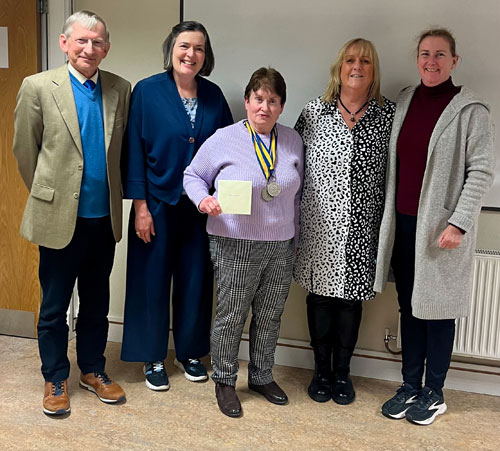
Pictured following a presentation made to silver medals winner Ms Maureen O’Shea, are L-R: Mr Enda Bourke, Ms Catherine Dwan, Ms Maureen O’Shea, Ms Mary Ryan Maher and Ms Carmel Sammon.
The Club acknowledged the support of family members and carers, Presentation Sports Hall Manager, Mr Martin Hehir, Meitheal 21 staff, Tipperary Co Council, Mr Jim Ryan MC, Mr Paul Scully (Thurles Photo Station), Mr Darren Hassett (Tipp Star) and Mr George Willoughby (Thurles Information).
Officers for the various roles were selected for 2026 and the Chairperson wished the athletes and members success for the year ahead.
At the conclusion of the AGM a special presentation was made by the Chairperson to athlete, Ms Maureen O’Shea, (See image above), to acknowledge the 30th anniversary of her fantastic performance at the 1995 Special Olympics World Games in the U.S. when she won 2 silver medals representing Ireland. Ms O’Shea is a member of the Thurles Club since its inception in 2004 and is the athlete representative at all Club meetings. There was huge applause for what Ms O’Shea achieved in 1995, and she proudly showed off the medals to all in attendance.
The meeting concluded with refreshments at the impressive Order of Malta premises and our thanks to them for facilitating our visit.
Thurles Co. Tipperary came alive today as the rural heart of mid-County Tipperary marked St Patrick’s Day with a parade that reflected the warmth, pride and community spirit for which the town is so well known. Despite the cold and cloudy conditions, large crowds gathered along the streets in great numbers, creating a lively and welcoming atmosphere from start to finish. Thurles is a thriving town in County Tipperary, and St Patrick’s Day, celebrated each year on 17th March, remains one of the most important occasions in Ireland’s civic and cultural calendar.
Families, friends, neighbours and visitors of all ages turned out in good spirits, wrapped up against the chill but full of enthusiasm and festive cheer. The parade offered a proud display of local identity, bringing together a broad and mixed population in a shared celebration of Irish heritage, community and belonging. The sight of the crowd lining the route, applauding participants and waving flags, captured the very best of Thurles; resilient, friendly and united.
Video: Courtesy G. Willoughby.
Today’s event was a reminder that even under grey skies, the spirit of St Patrick’s Day shines brightly in towns such as Thurles. The success of the parade is a credit to the organisers, volunteers, participants and all those who attended and supported the celebration. Their contribution ensured a memorable occasion that honoured tradition while strengthening the bonds of community that continue to define Thurles.
This website uses cookies to improve your experience. We'll assume you're ok with this, but you can opt-out if you wish.AcceptRead More
Privacy & Cookies Policy
Privacy Overview
This website uses cookies to improve your experience while you navigate through the website. Out of these, the cookies that are categorized as necessary are stored on your browser as they are essential for the working of basic functionalities of the website. We also use third-party cookies that help us analyze and understand how you use this website. These cookies will be stored in your browser only with your consent. You also have the option to opt-out of these cookies. But opting out of some of these cookies may affect your browsing experience.
Necessary cookies are absolutely essential for the website to function properly. This category only includes cookies that ensures basic functionalities and security features of the website. These cookies do not store any personal information.
Any cookies that may not be particularly necessary for the website to function and is used specifically to collect user personal data via analytics, ads, other embedded contents are termed as non-necessary cookies. It is mandatory to procure user consent prior to running these cookies on your website.






Recent Comments