Limerick is the second location to trial Body Worn Cameras following their introduction in Dublin in early June, which saw an overall positive reaction from the public, as to their necessary use.
Garda Body Worn Cameras.
Garda Commissioner Drew Harris, today launched the Body Worn Cameras proof of concept at Henry Street Garda station in Limerick city. Limerick is the just the second of three pilot locations to test the use of Garda Body Worn Cameras (BWCs) before a national rollout.
The Garda Síochána (Recording Devices) Act 2023 was signed into law just last December. The Act provides for Body Worn Cameras, Garda CCTV, automatic number plate recognition, and Community CCTV.
An Garda Síochána is undertaking three phased introductions as part of its proof of concepts stage. Three vendors have been chosen with different BWCs to be deployed in each trial location. The cameras in use in the DMR and Limerick are from different manufacturers.
The pilot roll-out of BWCs will continue later this year in Waterford. When complete, the three-phased pilot will inform their introduction in Garda Stations nationwide.
Each BWC can record footage to its own internal encrypted storage, which will be uploaded when the Garda docks the camera in a Garda station. The camera footage is uploaded at the end of a shift so it can be used as evidence at court or is deleted after an agreed time, if it is not required as evidence. All of the digital imagery collected by BWCs will be managed by a Digital Evidence Management System (DEMS).
Commissioner Harris also warned Garda members that they will face dismissal from the force, and potential criminal prosecution, if they are found to have shared or leaked footage of incidents captured on Garda BWCs.
A planning application by Tipperary County Council to install a footpath on the outskirts of Thurles, at Mill Road (formerly Manor Mill Road) was published last week.
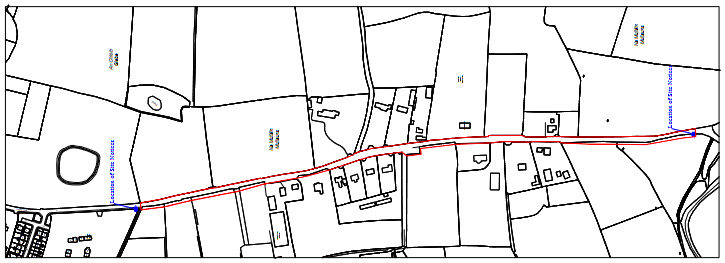
Map of Proposed Footpath For Mill Road, Thurles, Co. Tipperary.
The footpath, according to these overdue published plans, will stretch over a distance of some 950 meters in length (3117.0 ft or 0.6 of a mile) with a width throughout of 1.8 meters (almost 6ft), linking from the end of the existing broken path, almost to the stone bridge crossing the Drish River close to Lady’s Well.
The planning application notes that the Mill Road is a narrow, winding, local road connecting both the N75 (If travelling northwards) and the N62 (If travelling southwards) and has more recently come into huge use particularly by heavy goods vehicle (HGV’s), in their attempt to speed-up their access to other national routes, thus avoiding the bottleneck that has totally destroyed the business centre of Thurles Town .
The planning application now published, for this narrow stretch of the Mill Road, (affectionately known to locals as ‘Fat Arse Boulevard’), is necessary so as to provide a safe walking area for pedestrians and those intent on partaking of physical exercise.
The plans for this footpath project are indeed to be welcomed and are now on display until August 23rd next at the Council offices at Mathew Avenue, Thurles, and indeed also available online HERE.
Nota Bene: When you do go online HERE, to examine these plans, scroll down to “Report of Particulars of Proposed Development.pdf” and click on download.
NextSee Site Description:“The Mill road connects the N75 to the north and the N62 via Archerstown to the south. While this is a local road it also serves as a ‘rat run’ for vehicles avoiding Thurles town, seeking to access the national routes and also access the N62 north of Thurles …….”.
Using their words above; here, in this above statement, is full acknowledged admission by Council officials; (namely Mr Thomas Duffy [Checker] and Ms Sharon Scully [Approver]), that Thurles town centre has been destroyed, from the point of view of the operation of local businesses, with major traffic now avoiding the Liberty Square area.
Then, before you, our readers, let out a high pitched maniacal cry; comes sadly, an even greater admission. Quote, “There are a number of housing estates located on the N75 side of the L-4001 Mill Road, which are served by a roadside pedestrian footpath (500m) and also a paved, pedestrian, walking route along ahistorical walking path (‘double ditch’), located some 500m off the N75. Extension of the existing footpath from the‘Double Ditch’access, extending to the Drish Bridge for approx. 950m.“
As our readers will be aware, this historical walking path (‘double ditch’), now menctioned twice in this application, according to local councillors and their officials, did not formerly exist previously and was conveniently never included in the Archaeological Impact Statement by F. Coyne BA MIAI, which was commissioned and paid for by Tipperary Co. Council, courtesy of Tipperary rate payer funding.
No, it is not a paved pedestrian walking route, it is now a route which was completely levelled and received only a temporary coating of tarmacadam. Sadly, today an area critical in the attraction of Tourism to Thurles, no longer exists, courtesy mainly of former FF councillor Mr Seamus Hanafin and his other council colleagues, following the decision to build a useless ‘Inner Relief Road‘ through this historic area, when, if ever, eventual funding can be found. Of course there is no reference to this ‘Inner Relief Road’, mentioned in this planning application.
It should also be noted: The council, in principal only, recently agree a price for the purchase of land west of this Mill Road, with which to deliver the aforementioned ‘Inner Relief Road’, and the late delivery of plans for this new footpath, is understood to have been now an agreed component of this same land deal where space for the footpath had been earlier refused, and which contrary to commitments given by TD Mr Jackie Cahill in a press release, (dated back in October 4th 2021), the project has not yet received government funding.
Meanwhile: Submissions to the proposed development can be made free of charge until 4:30pm on Friday August 6th.
To quote the words contained in Sir Walter Scott’s epic poem, Marmion: A Tale of Flodden Field :- “Oh what a tangled web we weave, when first we practice to deceive.”
Expansion Of Accelerated Processing of International Protection Applications Announced.
From today, Monday July 29th 2024, the International Protection Office will prioritise cases from the top 2 countries of origin with the highest number of applications in the previous three months.
From today (Monday) the International Protection Office (IPO) will prioritise cases from the top 2 countries of origin with the highest number of applicants in the previous three months.
There were 881 international protection applications from Jordan in Q2 of 2024, making it the country with the second highest volume of applications. Thus in accordance with the expansion of the highest volume category, applicants from this country will now be processed on an accelerated basis.
Top 5 IP application nationalities up to the end of June 2024.
Country
Number
Nigeria
2,999
Jordan
1,037
Pakistan
769
Somalia
664
Bangladesh
649
Other
4,482
Total:
10,600
An Garda Síochána have arrested 115 people in the first half of 2024, for arriving without appropriate documentation and a significant number have been convicted. The number of deportation orders signed up to 25th July 2024 (1174), has increased by 90% for the same period in 2023 (617 up to 28 July 2023).
This builds on accelerated processing introduced in April 2024 which saw citizens of the country with the highest number of applicants in the previous quarter (Nigeria) being prioritised and accelerated.
Expanding this category to the country with the second highest number of applications will further speed up international protection application processing and enable the IPO to transition to meet the faster processing requirements of the EU Pact on Migration and Asylum.
Accelerated processing was introduced in November 2022 and now applies to the following cohorts:
15 safe countries of origin – Albania, Algeria, Bosnia and Herzegovina, Botswana, Brazil, Egypt, Georgia, India, Kosovo, Malawi, North Macedonia, Montenegro, Morocco, Serbia and South Africa.
Applicants who have received protection elsewhere in Europe.
Citizens of the countries which provides the greatest number of applicants in the previous quarter.
For safe countries, there has been a drop of up to 70% in applications from the already designated safe countries, following the introduction of accelerated procedures.
The list of Safe Countries is kept under review, having regard to the profile of applications being received.
Vocals: American folk singer and social activist Pete Seeger. Lyrics: American folk singer-songwriter Tom Paxton. [The song is about the American school system, that stands accused of misinforming children giving them an optimistic outlook on history and just one of many protest songs written by Tom Paxton].
What Did You Learn In School Today?
What did you learn in school today, Dear little boy of mine? What did you learn in school today, Dear little boy of mine?
I learned that Washington never told a lie, I learned that soldiers seldom die, I learned that everybody’s free, And that’s what the teacher said to me, And that’s what I learned in school today, That’s what I learned in school.
What did you learn in school today, Dear little boy of mine? What did you learn in school today, Dear little boy of mine?
I learned that policemen are my friends, I learned that justice never ends, I learned that murderers die for their crimes, Even if we make a mistake sometime, And that’s what I learned in school today, That’s what I learned in school
What did you learn in school today, Dear little boy of mine? What did you learn in school today, Dear little boy of mine?
I learned our government must be strong; It’s always right and never wrong! Our leaders are the finest men, And we elect them again and again, And that’s what I learned in school today, That’s what I learned in school.
What did you learn in school today, Dear little boy of mine? What did you learn in school today, Dear little boy of mine?
I learned that war is not so bad, I learned about the great once we have had. We fought in Germany and in France And some day I might get my chance. And that’s what I learned in school today, That’s what I learned in school.
Robust, fair and proportionate legislation will meet the challenges of an increasingly complex media landscape.
Abolition of juries in High Court defamation actions will reduce disproportionate and unpredictable awards.
Protections against SLAPP proceedings, which are recognised internationally as a threat to press freedom and democracy.
Range of provisions to support agreed resolution of defamation cases and reduce high legal costs.
The Irish Government have granted approval to publish the Defamation (Amendment) Bill 2024. The full text of the Bill will be published on the website of the Houses of the Oireachtas next week.
The Bill provides for a range of reforms to address concerns raised by stakeholders during the public consultation on review of the Defamation Act 2009. Its publication marks significant progress on the Programme for Government commitment to review and reform Irish defamation laws.
The main purposes of the Bill are to:
Tackle disproportionate awards, and support more consistent, proportionate and predictable redress in defamation cases, including the abolition of juries in High Court defamation cases.
Support easier access to justice for individuals whose reputations are unfairly attacked.
Provide that, if a person is defamed, the correction must be the same or similar prominence to the defamatory publication.
Provide enhanced and clearer protection for responsible public interest journalism.
Reduce legal costs and delays for all parties, by supporting the use of alternative dispute resolution (ADR) and by measures to encourage prompt correction and apology, where mistakes are made.
Deter abusive use of unfounded defamation proceedings, particularly SLAPPs*.
*SLAPPs are unfounded and abusive legal actions that aim to silence those working in the public interest on matters such as fundamental rights, the environment, and public access to information.
Several further key reforms are being finalised, during the Bill’s passage through the Oireachtas. These include the clearer and simpler defence of fair and reasonable publication in the public interest, which is particularly important to protect responsible public interest journalism. They also include a statutory power for the Circuit Court to issue a ‘Norwich Pharmacal’* order, directing a digital services provider to identify an anonymous poster of defamatory online material, thus significantly reducing the legal costs for a person subjected to such comments. Work on a power for the courts to award damages for harm suffered by a person targeted by SLAPP proceedings is already in the pipeline.
* A Norwich Pharmacal order is an order made by the court which compels the respondent to disclose certain information or documents to the applicant. This form of order is primarily sought as a means of identifying the appropriate defendant to an action. It is commonly sought against an innocent intermediary who, although not directly involved in the offending activity, holds information or documentation required for the issuing of proceedings.
The Bill will introduce a new statutory defence in ‘retail defamation’ cases, which is in response to stakeholder concerns about a large recent increase in claims of verbal defamation made against retail businesses, particularly against SMEs.
The Circuit Court has repeatedly held that it is not defamatory, for example, simply to ask a person who walks past the checkout to leave the shop with goods, to produce a receipt for them; or to explain that a banknote cannot be accepted in payment, if it does not seem to be legal tender. Nevertheless, defamation claims in such cases are now generating significant extra legal and insurance costs for these businesses.
The Bill addresses the problem by providing a new statutory defence for the retailer, which builds on the defence of qualified privilege. The new defence does not apply if the retailer is acting with malice, or if the retailer’s comments are publicised excessively, when discretion could have been used.
The Bill gives effect to the General Scheme for a Defamation Amendment Bill which was approved and published by Government on 28th March 2023. It responds to the Report of the Review of the Defamation Act, published in March 2022, which was informed by an extensive public consultation.
The Bill also takes account of the pre legislative scrutiny report on the General Scheme, published by the Oireachtas Joint Committee on Justice on 27 th September 2023.
This website uses cookies to improve your experience. We'll assume you're ok with this, but you can opt-out if you wish.AcceptRead More
Privacy & Cookies Policy
Privacy Overview
This website uses cookies to improve your experience while you navigate through the website. Out of these, the cookies that are categorized as necessary are stored on your browser as they are essential for the working of basic functionalities of the website. We also use third-party cookies that help us analyze and understand how you use this website. These cookies will be stored in your browser only with your consent. You also have the option to opt-out of these cookies. But opting out of some of these cookies may affect your browsing experience.
Necessary cookies are absolutely essential for the website to function properly. This category only includes cookies that ensures basic functionalities and security features of the website. These cookies do not store any personal information.
Any cookies that may not be particularly necessary for the website to function and is used specifically to collect user personal data via analytics, ads, other embedded contents are termed as non-necessary cookies. It is mandatory to procure user consent prior to running these cookies on your website.





Recent Comments