Some 20 submissions in total were forwarded to Tipperary Co. Council in reference to current plans submitted on the Phase 2 Liberty Square Public Realm Scheme. All submissions can be read in full by our readers, simply by accessing and scrolling down the page located at the LINK SHOWN HERE.
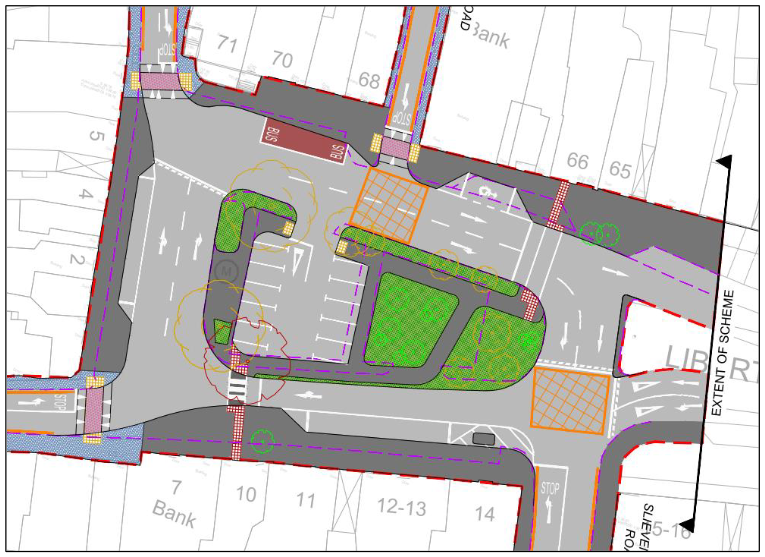
Proposed Liberty Square West Layout (Phase 2).
The closing time and date for all submissions closed at 4:30pm today, Friday August 30th, 2024.
No local resident consumers/shoppers made submissions or raised serious concerns about the planned designs for either Liberty Square or the several adjacent streets i.e. Rossa Street, Parnell Street, Nicholas Street (Cúchulainn Road) and Friar Street. Same have learned, from passed interactions with regards to such submissions sent to Tipperary Co. Council, that their opinions went unacknowledged and were rejected outright without discussion.
Parnell Street (formerly New Street)at the junction (right) withCúchulainn Road (formerly Nicholas Street).
In the main; Tipperary Co. Council now stand accused of failing to conduct detailed trials in respect of such planned changes to the town centre traffic flow and also of failing to fully consider the real impact of such proposed changes, on future ability of local businesses to continue to trade profitably.
Thurles.Info will be highlighting further failings, with regards Thurles planning issues, in the coming days.
Resident, local Fianna Fáil, TD Mr Jackie Cahill, has stated publicly, confirming his support for the cleaning of the River Suir in Thurles, however he has also admitted, on Tipp Mid-West Radio, that he is unable “to excessively influence policy in this area”. He also claims that people interested in fishing in the river, struggle to even find access to its banks. But of course there is no difficulty in gaining access to the banks once you have trampled down the three foot high stinging nettles and briars, using a supermarket trolley in an effort to locate water.
We now trust that Mr Cahill will have a chat with his sister, councillor Mrs Kay Cahill-Skehan, to brief her, before the next Thurles Municipal District Council Meeting.
River Suir pictured six years apart. Pics: G. Willoughby
We welcome also the input from re-elected Independent Councillor Mr Jim Ryan, who is committed to, at the next council meeting, quote “calling on all the relevant bodies to come together to formulate a future plan, for the River Suir in Thurles. Currently it is completely overgrown with vegetation. There is no flow or depth and there is always the continuous problem of the green algae forming on the surface. It has become an eyesore and an embarrassment to the town”. SEE HERE:Thurles. Info first raised this issue on November 7th 2013 so this “calling” now comes 11 years to late.
Perhaps all public representatives can confirm: (A)Where has our Grundfus submersible water pump gone, latter which fed our three river fountains? (B) Why has the two weirs, which controlled water levels close to Barry’s Bridge been allowed to deteriorate ? (C)Why do we constantly continue to highlight new projects, while failing to maintain or support that which already exists?
Meanwhile, elected councillors, while you a talking to those who receive large salaries and who must take direct responsible for this total neglect, please see the short video hereunder.
I feel I should point out that Thurles is trying to attract tourists; albeit with little or no success. Perhaps our two resident TD’s; our recently re-elected councillors, together with Thurles Municipal District officials, should take a short walk from the River Walk entrance on the N62, (close to Lidl supermarket), and continue their journey, to the Thurles Town park, situated close to “The Source” building.
Note: the messages of hate scrawled on the Rainbow Seat, placed to celebrate Pride and the LGBTQ+ community and also painted on the flood barriers. See the filth both in and on the surface of the river water. See also the nettles and briars converging unto the walkway, in the name of biodiversity, which now confines young children to their pushchairs and perambulator devices, when choosing to use this river side walkway. God knows we have all the biodiversity we need growing out of our drains, currently within the town’s streetscapes.
Ask why hate messages have not been removed by salaried individuals. Same messages do not represent the feelings of the vast majority of Thurles residents and proper administration must now be immediately implemented.
Time now to take back our town and yes this will put a few noses out of joint, but what the hell! Elected representatives have my full permission to reveal red faces and to feel shame and embarrassed. So what are we getting for our Property Tax, Rates, Parking Charges etc?
Proposals are invited for community and youth service organisations to establish new Youth Diversion Projects (YDPs) in North Tipperary. Once fully operational, the new project will ensure full YDP coverage across the State, fulfilling commitments in both the Programme for Government and Youth Justice Strategy.
Youth Diversion Projects (YDPs) work with young people at risk of crime and anti-social behaviour, to divert them away from criminal behaviour and towards better life outcomes.
Same are seen as a key support to An Garda Síochána, in the operation of the statutory Garda Youth Diversion Programme, under the Children Act 2001.
There are currently 99 YDPs in operation and the intention under the Youth Justice Strategy 2021-2027 is to have the service available throughout the State.
The establishment of these new projects is understood to mark a significant milestone in the achievement of this objective.
Expressions of interest must be from registered charities and demonstrate a strong track record of delivering programmes of support for challenging young people and sound corporate governance and financial management capabilities.
Expressions of interest are welcome from individual organisations or from a consortium of eligible organisations, (with one specified lead for governance and financial management purposes).
These must include proposed supports or dedicated Youth Justice Workers, targeting family support interventions for typically hard-to-reach young people and early interventions for 8-11 year-olds, who may be at increased risk of becoming engaged in criminal activity.
Details of the operational requirements for YDPs are available HERE
Expressions of interest from community-based organisations in establishing new YDPs in any of these areas, should be submitted to yjs@justice.ie, by Monday30th September 2024. Shortlisting may apply.
Additional information for approved applicants on the youth crime profile in the specific areas and operational boundaries for the new projects will then be made available at the start of October 2024. Completed final proposals should then be sent to yjs@justice.ie, by Thursday, 31st October 2024.
Thurles Golf Club commenced work on Friday August 9th, to fell their commercial forestry at the Mill Road entrance to “Our Ladies Well” walk-way. Walkers will be aware that the “Our Ladies Well” walk-way remained closed from both entrances (both from the Mill Road and N62 Turtulla entrances), on Wednesday 14th, Thursday 15th and Friday 16th last (August 2024), but has since opened again to the public.
“Our Ladies Well Walk-Way”, Thurles. Pic. G. Willoughby.
Perhaps the seat on the walk-way, kindly sponsored by Dew Valley Meats, in Thurles, could now be moved slightly westward, into shelter. In the coming months for those who may choose to“Dwell Awhile”, at where it resides presently, no shelter remains available and that line taken from an Irish blessing, “Go raibh an ghaoth go brách ag do chúl” (English translation- May the wind be always at your back.), I have no doubt was written for those walking and not for those seated.
Meanwhile; back on Barry’s Bridge, in the Thurles town centre, a mystery has unfolded.
Where Are The Missing Chrome Bollards Gone? Pic. G. Willoughby.
Where are the 4 Chrome impact protection bollards/posts, each costing possibly €137.00 [ inc VAT. (Total €548.00)plus labour costs ] and once situated on the left-hand-side, as you crawl westward, slowly behind numerous HGV’s? Were they stolen? Were they struck by a heavy goods vehicle, (HGV)?
The bolts end, which once retained these missing chrome bollards to the pavement, suggest that an angle grinder had at least a small part to play in their sudden disappearance.
The waste of ratepayers money, by Tipperary Co. Council, continues.
We will of course be forwarding an email to Ms Scully again later tonight, seeking further assistance with regards to the next 100 metres of this town’s valued river Suir.
Pic (1) Despite two days with no rain, evidence of ground water continuously flowing from under the Leisure Centre. Note the plastic papers ready to exit, come the next downpour to push open the heavy drain lid. Pic (2, 3, 4) Supermarket Trolley’s which have remained in the River Suir for months.
What we would like is that Ms Scully would contact three of the local Supermarkets, latter backing unto the river Suir, asking that they remove their shopping trolleys from the water.
I know that Ms Scully will be anxious to observe this area herself, (after all seeing is believing), and so there are two other issues she might help us with, which are as follows:-
(1). Take a walk on now retired Mr S. Hanifin’s tarmac path from the ‘Swinging Gates’, on Emmet Street and examine the crater close to the now deceased Chestnut tree stump, same waiting for some pedestrian to fall into. (Yet another day out in Dirty Dublin, emerging for Tipperary Co. Council to visit the High Court, may still await.)
Pic (left) – Giant crater on riverside walk near Emmet Street ‘Swinging Gates’. Pic (right) – Some unknown liquid flowing into the river Suir from behind the future useless and yet unfunded ‘Thurles Inner Relief Road’.
(2). What is flowing into the river Suir from a drain at the area where the inner relief road will be built. (Look, it’s possible that it was someone just brushing their teeth). Sure you know the area that I am talking about, didn’t TD Mr Jackie Cahill get the money from government to buy and update this area way back in 2021, or was he joking. [See video HERE quickly, before someone teaches him how to remove it.]
This website uses cookies to improve your experience. We'll assume you're ok with this, but you can opt-out if you wish.AcceptRead More
Privacy & Cookies Policy
Privacy Overview
This website uses cookies to improve your experience while you navigate through the website. Out of these, the cookies that are categorized as necessary are stored on your browser as they are essential for the working of basic functionalities of the website. We also use third-party cookies that help us analyze and understand how you use this website. These cookies will be stored in your browser only with your consent. You also have the option to opt-out of these cookies. But opting out of some of these cookies may affect your browsing experience.
Necessary cookies are absolutely essential for the website to function properly. This category only includes cookies that ensures basic functionalities and security features of the website. These cookies do not store any personal information.
Any cookies that may not be particularly necessary for the website to function and is used specifically to collect user personal data via analytics, ads, other embedded contents are termed as non-necessary cookies. It is mandatory to procure user consent prior to running these cookies on your website.





Recent Comments