The Government has appointed Dr. Jane Mulcahy to the Policing Authority following an open State Boards selection competition, conducted by the Public Appointments Service.
Dr. Mulcahy has worked as a researcher in the area of criminal justice, penal policy and social justice since 2005 and is currently employed as a Research Fellow with the Research Evidence into the Policy, Programmes and Practice (REPPP) team at the University of Limerick.
Dr. Mulcahy is the project manager of a pilot project seeking to reduce children’s involvement in criminal networks and provide them with positive social opportunities.
Minister for Justice Mrs Helen McEntee said: “I welcome the appointment of Dr. Mulcahy to the Policing Authority and wish her every success in her new role. She brings with her a wealth of knowledge and experience in criminal justice, penal policy and social justice and will bring a valuable perspective to the important work of the Authority.”
The appointment of Dr. Mulcahy fills the vacancy on the Authority which arose following the resignation of Ms Shalom Binchy in May of this year (2023).
Dr. Mulcahy has been appointed for the period until March 8th, 2024 (expiry term date of the recently resigned member, Ms Shalom Binchy) or upon the dissolution of the Authority following the enactment of the Policing, Security and Community Safety Bill, whichever is the sooner.
The Bill, which completed Report and Final Stage in the Dáil and will go to the Seanad in the Autumn, will provide for a new governance and oversight framework for policing, as recommended by the Commission on the Future of Policing.
This will result in the dissolution of the Policing Authority and will provide for the establishment of a new independent oversight body replacing the Policing Authority and the Garda Síochána Inspectorate. The new body will encompass the functions of both the Authority and the Garda Síochána Inspectorate as well as a range of community safety-related functions.
The Board of Rásaíocht Con Éireann (RCÉ) / Greyhound Racing Ireland (GRI) has announced the appointment of Mr Tim Lucey as the organisation’s new CEO.
Mr. Lucey has been Chief Executive of Cork County Council since 2014. During his expansive career in Local Government, he also has served as Manager of Cork City Council (2010-2014).
Tim Lucey is an experienced Chief Executive, having served the last 9 years as Chief Executive of Cork County Council, after progressing from a 4-year period in the same role at Cork City Council. He previously held the position of assistant County Manager (for North Cork) and Head Of Corporate Affairs for Cork County Council.
The native of Bandon in County Cork, who will assume his new CEO role in November 2023, has led transformational change in the Local Government sector with a focus on investment in corporate development, commercial thinking and supporting the importance of rural, community, and cultural aspects of Ireland’s fabric, while at the same time securing significant investment in infrastructure, urban and business growth.
He is a member of the Institute of Directors and a member of the Board of the Institute of Public Administration (IPA), the Local Government Management Agency and Promoting Cork Ltd, and has extensive qualifications in accountancy, company direction and business.
“I am honoured to accept the position of CEO and I am very much looking forward to working with the Board of Directors and staff of RCÉ and the vibrant greyhound community across Ireland,” commented Mr. Lucey.
Mr. Lucey continued, “I am committed to using my extensive experience in corporate leadership and management, crisis management, communications and stakeholder engagement in complex multi-sectoral environments to further develop a commercial greyhound racing industry built on a high-quality entertainment, consumer-focused product, which meets the highest international regulatory and welfare standards.”
Frank Nyhan, Chairperson of the Board of RCÉ, said, “On behalf of the staff and Board, I am pleased to announce that Tim Lucey has, following an extensive recruitment process, accepted the position as our new CEO. Tim is a tremendously experienced leader, and we are delighted to announce that he will be joining our organisation.Mr John Tuohey will remain as interim CEO until Tim takes up his new position and RCÉ would like to acknowledge and thank John for his contribution during this transition,” added Mr. Nyhan.
According to Mr John Tuohey, (Interim CEO of RCÉ), “RCÉ will greatly benefit from Tim’s wealth of experience in corporate and financial governance and his management of Ireland’s largest local authority by area. On behalf of staff, I want to congratulate Tim and I look forward to him taking up his new position this November.”
RCÉ is a commercial semi-state body responsible for the control and development of the greyhound industry in the Republic of Ireland. GRI has licensed a total of 14 tracks in the Republic, of which nine are owned and controlled by the organisation. The remainder are owned and operated by private enterprise. There are also a further two privately owned stadia in Northern Ireland.
Government extends temporary suspension of the operation of the European Agreement on the Abolition of Visas for Refugees (Council of Europe).
Visa-free travel arrangements for Ukrainian nationals fleeing the war unaffected.
The Government has decided to extend the temporary suspension on the operation of the Council of Europe Agreement on the Abolition of Visas for Refugees, to be reviewed in 12 months. The suspension, which in effect means that people with refugee status require a visa to travel to Ireland rather than travelling visa-free with their Convention Travel Document, was originally introduced in July 2022.
The decision to introduce visa requirements for those with refugee status was taken in light of evidence of people applying for asylum in Ireland, who had already received refugee status in another European country. The Government agreed last year to review the suspension in 12 months.
The visa-waiver arrangements for people fleeing the war in Ukraine remains unaffected.
Tánaiste, Minister for Foreign Affairs and Minister for Defence, Mr Micheál Martin TD, said “This decision has been taken by Government in the context of unprecedented pressures on our international protection system. It is not a decision taken lightly but it is the right one for Ireland at this time to ensure the integrity of our immigration system, to avoid any undue pressure on systems that are already under strain and to make sure that those who need protection in Ireland can get it and get it quickly.”
Minister for Justice Mrs Helen McEntee said: “This is a carefully considered decision that we believe is necessary to protect the integrity of Ireland’s immigration system in the context of continued pressures on our international protection and accommodation systems. The visa waiver I introduced for people fleeing to Ireland from Ukraine remains unaffected. Ireland’s commitment to protecting and assisting those in need remains steadfast. We are committed to upholding our international and EU obligations towards international protection applicants and refugees.”
Ireland continues to see high levels of applications for international protection when compared to pre-pandemic levels. Before the suspension of visa free travel arrangements was introduced in July 2022, there was a 191% increase in applications by the end of June 2022 compared to the same period in 2019.
Notwithstanding the increase in applications, the International Protection Office has made significant progress in increasing the numbers of decisions made and significantly reducing processing times.
Minister McEntee also recently updated Cabinet on the modernisation programme and also on the accelerated procedure for applicants from safe countries of origin.
Last November, new accelerated procedures for those who arrive in Ireland from safe countries seeking International Protection were introduced. The changes have ensured that a first instance decision is made within three months in such cases, a significant reduction from a norm of 17 to 24 months last year. The numbers arriving from these countries has significantly decreased.
Since last November, the numbers arriving from these countries have decreased from 210 applications in November to 64 in May this year – a drop of almost 70%. It should be emphasised that the continued imposition of a visa requirement will not prevent travel to Ireland by 1951 Convention document holders. Genuine travel plans will be facilitated through standard visa arrangements.
Since the introduction of the suspension, there have been 803 Convention Travel Document visa applications, of which 697 were granted and 105 refused.
‘Honest belief’ that a victim had given consent will no longer be a defence in rape cases.
Character references must be given on oath or via affidavit in sexual offence trials.
Bill delivers on key reforms in ‘Supporting a Victim’s Journey’ to improve the criminal justice system for victims.
Establishment of new coordination framework to help victims of human trafficking.
The Minister for Justice, Mrs Helen McEntee TD, has secured Government approval to publish a wide-ranging new Bill that strengthens the law around sexual offences and improves protections for victims of sexual offences and of human trafficking.
Among the main provisions of the Criminal Law (Sexual Offences and Human Trafficking) Bill 2023 is a strengthening of the law in relation to consent. At present, a person can be found not guilty of rape if they honestly, but mistakenly, believed that they had the consent of the victim.
The law is subjective. In effect, the alleged perpetrator can claim they are not guilty of rape, because they honestly but mistakenly believed they had consent. This new Bill from Minister McEntee, is a key element of her Zero Tolerance Plan to tackle Domestic, Sexual and Gender Based Violence will change this. The question now will be whether the belief is one that a reasonable person would have held in the circumstances, rather than whether such belief was honestly held. This belief must be objectively reasonable rather than subjective.
Where the question of reasonable belief arises in a trial, the jury must have regard to the steps, if any, taken by the accused to ascertain whether the victim consented to the intercourse.
Minister McEntee said: “One of my key priorities as Minister for Justice is tackling domestic, sexual and gender-based violence and better supporting and protecting victims of crime. The Criminal Law (Sexual Offences and Human Trafficking) Bill 2023 is a key piece of legislation to deliver on these priorities. It will strengthen the law around consent in rape cases, requiring that an alleged perpetrator must have ‘reasonably believed’ that they had consent and removing the current defence of ‘honest belief’. A subjective belief that a person had consent should not be sufficient to be used a defence. This is in line with recommendations of the Law Reform Commission.”
Another change in this Bill is strengthening protections for victims as regards character references in sexual offence trials, another commitment from Minister McEntee’s Zero Tolerance plan. This Bill will provide that if a person wants to give a character reference for someone who has been convicted of a sexual offence at their sentencing hearing, the reference must be given on oath or via affidavit. Currently if a witness is called to court to provide character evidence, this evidence is given under oath. However, written testimonials are not sworn. Minister McEntee’s Bill provides that when a person has been convicted of a sexual offence, character references presented at sentencing must be made via oath or affidavit. This will ensure that the person providing the reference swears to the veracity of their statement and can be called before the court for cross examination. In effect, it will mean character reference letters will no longer be able to be read out in court unchallenged, if warranted. The purpose of including this provision in the Bill is to protect the victims of sexual crimes from further traumatisation during the sentencing hearing.
The Minister has now received Cabinet approval for these changes, and she has also worked with Senators Regina Doherty, Lisa Chambers and Pauline O’Reilly on the issue.
Minister McEntee further stated: “The use of character references can often cause further trauma for victims and it is clear to me that we need stronger rules around how they can be used in court. This legislation will introduce a requirement for character references in sexual offences cases to be made under oath or affidavit, rather than by an unsworn letter to the Court. This means that the person who provides the character reference can be cross examined if necessary.”
The Criminal Law (Sexual Offences and Human Trafficking) Bill 2023 will also deliver on key reforms in ‘Supporting a Victim’s Journey’ to improve the criminal justice system for victims.
These include:
Separate legal representation for victims of sexual assault if there is an application to question them on their previous sexual experience;
If this application is granted, the barrister representing the victim will continue to represent the victim during the questioning;Ensuring anonymity for victims in all trials for sexual offences;
Providing anonymity for the accused for certain sexual offences;
Updating the definitions for publish and broadcast;
Repeal of statutes that provide that the verdict or decision in trials be announced in public.
Minister McEntee said: “We are delivering a number of the recommendations from the O’Malley report relating to legal representation for victims if there is an application to cross-examine a victim about their previous sexual history in sexual offence trials and including ensuring victim anonymity in all trials for sexual offences. These are all issues that we know can further victimise, re-traumatise and deny justice to survivors of sexual assault, and I determined to see these important protections legislated for introduced as soon as possible.”
The new legislation will also implement recommendations by the Defence Forces Independent Review Group (IRG). The IRG recommended amendments to the Defence Act 1954 to ensure that persons subject to military law who commit sexual offences in this jurisdiction will be dealt with by An Garda Síochána and the civilian courts rather than by courts-martial. This Bill gives effect to those amendments.
The Bill will also put a revised National Referral Mechanism (NRM) in place for identification and support of victims of human trafficking.
The National Referral Mechanism is the framework through which the State identifies and supports victims of human trafficking. At the moment, An Garda Síochána is solely responsible for identifying victims of human trafficking.
Under the new NRM, multiple other relevant Departments and agencies will be designated as competent authorities to identify victims and will also allow civil society organisations supporting victims of trafficking to be designated as Trusted Partners.
Minister McEntee continued: “This new approach will make it easier for victims of trafficking to come forward, be identified and access advice, accommodation and support. The reality is that some victims of trafficking, because of interactions they may have had with law enforcement officials in other jurisdictions, have a perception that police cannot be trusted. This may prevent them from identifying themselves to An Garda Síochána as victims, ultimately limiting their access to supports and justice. The new approach acknowledges other State bodies – outside of An Garda Síochána – and NGOs have a role in identifying victims of human trafficking and referring them to the NRM, through which identified victims can get the necessary supports.”
The published Bill will now be presented to the Houses of the Oireachtas, where it will be debated.
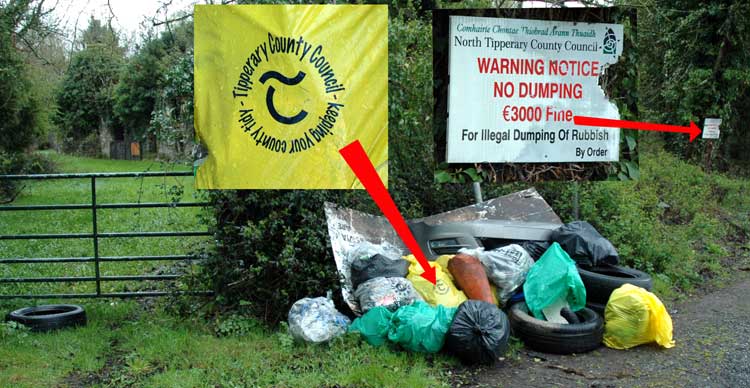
An anti-dumping initiative for Tipperary residents has been organised by Tipperary County Council, once again ignoring the needs of Thurles residents.
Litter and dumped household waste collected by Thurles volunteers
The Mattress Amnesty, for those with private transport and a car trailer, will reside at a number of other locations across the Premier with effect from July 25th next until July 27th, inclusive from 9:00am until 4:00pm on these dates.
Residents of Co. Tipperary are being encouraged to use this opportunity to rid themselves of up to a total of three mattresses, per household, completely free of charge.
TheFiveMattress Amnesty Locations:
Donohill: Recycling Centre, Garryshane, Donohill, Co. Tipperary, [E34 A090].
This website uses cookies to improve your experience. We'll assume you're ok with this, but you can opt-out if you wish.AcceptRead More
Privacy & Cookies Policy
Privacy Overview
This website uses cookies to improve your experience while you navigate through the website. Out of these, the cookies that are categorized as necessary are stored on your browser as they are essential for the working of basic functionalities of the website. We also use third-party cookies that help us analyze and understand how you use this website. These cookies will be stored in your browser only with your consent. You also have the option to opt-out of these cookies. But opting out of some of these cookies may affect your browsing experience.
Necessary cookies are absolutely essential for the website to function properly. This category only includes cookies that ensures basic functionalities and security features of the website. These cookies do not store any personal information.
Any cookies that may not be particularly necessary for the website to function and is used specifically to collect user personal data via analytics, ads, other embedded contents are termed as non-necessary cookies. It is mandatory to procure user consent prior to running these cookies on your website.








Recent Comments