National Cyber Security Centre Launches 2025 National Cyber Risk Assessment revealing Escalating Threat Landscape.
Rapidly evolving cyber risks put country’s critical infrastructure at risk.
Today (December 2nd) the National Cyber Security Centre (NCSC) launched its 2025 National Cyber Risk Assessment. This is a comprehensive review of the cyber threats, systemic risks, and sectoral vulnerabilities facing the State.
Launched at the NCSC’s annual conference, the assessment provides the most detailed national overview to date of Ireland’s cyber risk environment and builds on the foundation laid by the 2022 assessment.
The assessment identifies key developments in the national and global cyber threat landscape, including increasingly sophisticated nation-state activity, the accelerating pace of cybercrime, and the growing likelihood of cascading impacts across interconnected sectors such as energy, transport, healthcare, and financial services.
Key findings of the 2025 National Cyber Risk Assessment include:
As technology has advanced and reliance on digitalisation has intensified, the cyber threat landscape has become more complex with an increased risk of incidents, leading to significant cross sectoral impacts.
Taking an all-hazards approach, the 2025 National Cyber Risk Assessment has identified three key systemic risks:
The dynamic geopolitical environment,
Evolving technology and its implications on security.
Supply chain security.
If any or all these risks were to be realised, it could undermine Ireland’s delivery of essential services, disrupt its critical sectors, and erode trust in government, institutions, and organisations.
To mitigate Ireland’s identified risks, five recommendations have been identified:
Strengthen visibility and detection – investing systems and structures to enhance national visibility will reduce systemic blind spots and allow the State to be better positioned to anticipate and respond to risks before they escalate.
Implement proactive cyber defence capabilities – reactive responses alone are not sufficient to protect society and the economy from the potential cascading effects of attacks on critical systems. Ireland must enhance its proactive cyber defence posture, disrupting the cyber-attack lifecycle earlier to prevent incidents at scale.
Enhance national resilience –by implementing EU frameworks in full and extending resilience beyond infrastructure to society itself, Ireland will ensure that both services and democratic institutions remain robust in the face of systemic cyber risks.
Secure critical supply chains – the State must strengthen our supply chain through strengthening procurement rules in government, embed security-by-design and risk management practices, and increase visibility of vendor ownership.
Invest in national cyber resilience – investment in people, innovation and our indigenous industrial base will ensure that Ireland has the capacity not just to respond to today’s threats but to anticipate and shape the next generation of resilience measures.
These recommendations provide a framework for the next National Cyber Security Strategy, ensuring that systemic vulnerabilities are reduced and national resilience strengthened.
The 2025 National Cyber Risk Assessment is now available HERE.
Today and Tomorrow 5,200 people will be granted Irish citizenship at the INEC Killarney.
Applicants from over 132 countries and across all 32 counties on the island will make a declaration of fidelity and loyalty to the State and become Irish citizens; 94 of whom will reside in Co. Tipperary.
There will be six ceremonies held over the two days in Killarney, with a government Minister of State with responsibility for Migration, in attendance, joined by 3 Ministers of State.
The Presiding Officer at the ceremonies over the next two days is Judge Mr Paddy McMahon, who will confer the attendees with Irish Citizenship. He will administer the Declaration of Fidelity to the Irish Nation and Loyalty to the State. The new Irish citizens will undertake to faithfully observe the laws of the State and to respect its democratic values.
In just over two years the Citizenship Division of the Department has gone from processing around 12,000 applications a year to processing over 20,000 applications in 2023, and nearly 31,000 in 2024.
Significant changes have been introduced in the Citizenship Division of the Department of Justice, Home Affairs and Migration to speed up the application process for applicants, including the introduction of an online digital application, online payments, and eVetting.
As a result, processing times are now decreasing year on year. The length of time it takes to process an application has dropped from 15 months in 2023 to 8 months in 2024.
Citizenship ceremonies were first introduced in 2011 in order to mark the occasion of the granting of citizenship in a dignified and solemn manner.
Since citizenship ceremonies were first introduced, there has been a total of 216 ceremonies (excluding the upcoming dates) with people from over 180 countries receiving their certificates of naturalisation.
To date, including minors, approximately 222,000 people have received Irish citizenship since 2011. Following the Killarney ceremonies in December, the confirmed attendees of over 5,200 will be added to this figure.
The proposal to strip Herzog Park of its name is more than a routine motion before Dublin City Council. It is a gesture that cuts directly across Ireland’s own history, its values, and its long, if now fading, relationship with our Jewish community.
An Taoiseach Mr Micheál Martin was right to call this proposal “divisive and wrong”. It is exactly that. To remove the Herzog name is to erase a story woven deeply into the fabric of the Irish State: a story of solidarity, shared struggle, and the willingness of a small minority community to stand with Ireland, before Irish independence was secure.
LateRabbi Yitzhak Halevi Herzog. (1888–1959)
Chaim Herzog’s father, Rabbi Yitzhak Halevi Herzog, took his place beside the first Dáil at a moment when such an act carried real personal risk. He did not choose silence or obscurity. Instead, he offered his leadership, his scholarship, and his friendship to a fledgling nation then struggling to define itself.
In the decades that followed, Rabbi Herzog built an unlikely, but enduring, relationship with Éamon de Valera. He learned Irish, advised during the drafting of the 1937 Irish Constitution, and ensured that the Jewish community, then facing existential threat elsewhere in Europe, was explicitly protected in our founding document. De Valera himself regarded this protection as essential.
Removing the Herzog name now shows little regard for that legacy. It risks signalling that Irish memory is selective, and that contributions made by minorities count only until the political winds shift.
The forest of 10,000 trees planted in Israel in 1965 in de Valera’s honour was intended as a lasting symbol of mutual respect. Today, that symbol stands in stark contrast to a relationship that has deteriorated to the point where the Israeli Embassy has closed its doors in Dublin. Ireland’s foreign policy in recent years has been shaped by new pressures, shifting alliances, and at times, an eagerness to move with global trends rather than stand firmly in the centre.
The debate over Herzog Park is symptomatic of something deeper: a narrowing of historical perspective. In the heat of present-day geopolitical tensions, there is a temptation to reduce Ireland’s stance to simple binaries, solidarity with one cause, with condemnation of another. But this neglects the complexities of our own past, including the violence we once justified in the name of liberation. The Good Friday Agreement may have delivered peace, but it also allowed a form of civic amnesia to settle in. We remember heroics; we forget those who suffered outside the story we prefer to tell.
It is easy to brandish the language of liberation and resistance. It is harder to honour the quieter, older stories, like that of the Herzogs, who stood with Ireland not for applause or advantage, but because it was right.
Contemporary Political Climate. Renaming Herzog Park would say far more about today’s Ireland than about its past. It would suggest a willingness to discard historical nuance, to minimise minority contributions, and to allow contemporary tensions to override long-established bonds.
The proposal should be immediately withdrawn. Not as a favour to one community, but as an affirmation of Ireland’s own basic integrity, its commitment to remembering fairly, honouring generously, and resisting the pull of easy revisionism by those foolishly elected individuals, each with little knowledge or understanding of our rich Irish history. Ireland’s political landscape has been increasingly influenced by global tensions, including heightened pro-Palestinian activism by in particular Fine Gael. Critics warn that the Irish State has risked aligning itself with more extreme elements, even as it seeks to preserve long standing international relationships, including its strategic ties with the United States.
However, there are statutory safeguards and restrictions already in place. Name changes require formal procedures, not ad-hoc renaming. While there isn’t a blanket ban on changing Irish place names, there are laws which regulate and restrict how name changes can happen.
Dear Esteemed Voices of Opposition in Government. (Yes, you lot).
We, the People of Tipperary (yes, that rag-tag, unwashed mob, who struggle to pay the rent, mind the children, endure freezing radiators and fruitless housing-hunts), write to you today with admiration.
Oh yes, you have mastered something truly impressive: the art of being perpetually angry and outraged, heroically indignant and spectacularly unhelpful. (Bravo, Three Cheers, Hip, Hip, Hooray).
You stand there in the Dáil, gesturing grandly, as though you are the last defenders of Irish morality and justice, and the nation watches on, in overwhelming fear and general anxiety, before wondering what the hell exactly were you offering yet again?
Our Civic Palace of Stone & Voice.
Awe-inspiring words (volume high, content light). Your speeches soar with righteous anger. You denounce, you condemn, you rail against government failures. You paint bleak pictures of homelessness, cost-of-living, neglect, inequality. You raise the volume, you draw the cameras, you craft the headlines and welcome criminals into our Ardeaglais na nDlíthe (Cathedral / High Church of Laws), our Civic Palace of Stone and Voice, our People’s Drawing-Room, better known as Leinster House.
Yet, when the press lights dim and the papers close, the problems remain. Those health waiting lists grow – the rents continue to climb – the vacant units and houses stay vacant and deteriorate – and the young people we highly educate for free simply emigrate to the benefit of other states.
Is this your grand plan? A master-class in rhetorical fury, without a blueprint, without a map, without wheels that actually roll.
No plan, no policy, just performance You accuse the Government of failure, and indeed with some justice. But then: what is your remedy? You hand us soundbites, slogans, finger-pointing. You hand us anger and outrage. You do not hand us homes. You do not hand many people peace of mind. If politics is a fire, you seem to delight in fanning flames of indignation, but offer no water, no ladder, no shovel to dig foundations to rebuild what has burned.
Procedure over purpose. You treat parliamentary procedure like a stage for drama. Adjournments, speaking-rights rows, stand-off’s, delicious theatre. Critics dare to call it “chaos.” Some might even call it an embarrassment. But to you, it’s perfect. Because nothing says “principled opposition” like disruption for disruption’s sake. You trumpet this as integrity. We hear the loud banging and the unconstructive silence that follows those bangs.
Then amongst the so called Independents; those great parliamentary wallflowers who would sooner walk barefoot across hot coals than appear in a live television debate. They know full well that the moment they open their mouths without a script, the entire country would witness the intellectual equivalent of a slow-motion car crash. So instead, they clutch their pre-written sheets, like a toddler clings to a comfort blanket, lift them up with trembling hands; while attempting to read aloud words they clearly had only encountered for the first time, just moments earlier.
What follows is a linguistic bloodbath: mispronounced names, mangled terminology, long pauses where they glare at the page as if the letters are rearranging themselves out of spite. They stutter, they stumble, they sweat, like someone trying to defuse a bomb using only phonics. It becomes obvious that the speech wasn’t written for them, so much as in spite of them. By the time they reach the end, the chamber is left wondering not what point they were trying to make, but how such a person was ever trusted with a microphone, a mandate, or indeed the ability to read aloud in public. These today are, allegedly, our lawmakers. God help us.
And then, of course, we have the Opposition’s “Elder States People”Sinn Féin, those political veterans who behave as though their entire past was spent rescuing kittens from trees and mentoring youth choirs, rather than, whatever it was they were actually doing. Their official biographies glide gracefully from birth to present day, skipping over entire decades the way a dodgy landlord skips over mentioning mould in a rental advert.
These are the same people who now lecture the public about peace, ethics and moral leadership, while hoping no one ever dusts off the old photo albums from their glory days, which saw them remembered for blowing things up with great enthusiasm and who involved themselves in robbing banks and home grown genocide.
Listening to them now; polished, pious, freshly laundered, you’d swear they spent the 1980s running charity bake sales rather than attending strategy meetings in windowless rooms, lit by a single flickering candle. Their reinventions are so dramatic they make witness protection programmes look lazy.
And yet, with straight faces and quivering angry indignation, they condemn everyone else for moral failings. It would be funny if it weren’t so magnificently ridiculous, a whole troupe of reformed revolutionaries pretending their pasts were nothing more than a misunderstanding, involving fireworks and enthusiastic landscaping.
The people, now weary, watch from the sidelines. We are tired; not of the problems, no we cannot afford that luxury. We are tired of the show. We are tired of the endless promises of change, if only the Government is shamed enough. Shame. Shame again, and then, nothing.
We, the salary payers, used to believe that opposition was a safeguard: a watchdog, a conscience, a balance. Now, increasingly, we suspect it’s become a puppet-show, put on for the people, yes, your employers, who are now a jaded audience.
What we the people would like you to remember:
If you believe there is a crisis, propose a fix, not just an angry rant.
If you object to the way things are run, say how you would run them, not just why they are wrong.
If you seek to hold power accountable, do so without turning every debate into a circus. Clarity beats chaos.
And finally; remember those of us who don’t work a 3 day week outside of Leinster House. The ones who count the days until payday, who worry where the next rent cheque will come from, who wonder if home will ever mean more than a roof and attempt to give us hope.
Without hope, loud speeches become hollow noise, and parliament becomes a theatre of shadows.
Yours sincerely, We, the People of Tipperary, (tired of the Drama, longing for Delivery).
“The sign of a healthy economy should be a drinkable river.”
[Quote by Ms Li An Phoa, (founder of the organization ‘Drinkable Rivers’)].
In relation to the pollution of the River Suir in Thurles which we, after 13 years of watching the sheer neglect of same, by Tipperary Co. Council, drew to the attention of the Environmental Protection Agency (EPA) at the end of August last, has finally received a reply.
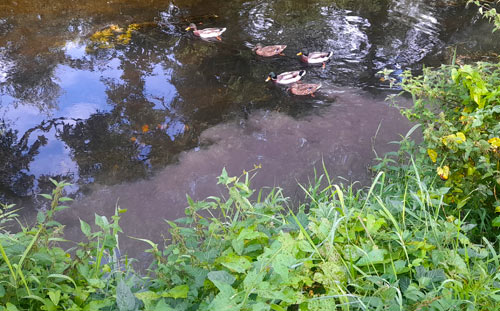
Effluent continues to flow into the River Suir in Thurles Town centre. Pic: G. Willoughby (Dated October 9th, 2025)
It is with great personal sadness and utter frustration that I report, first on the reply received from the EPA on Tuesday 25th November, 2025 which reads as follows:
(Ref: COM021813) Dear Mr Willoughby, Further to previous correspondence and responding to your concerns, the EPA wrote to Tipperary County Council seeking a written response from them on actions taken or planned on this matter. Tipperary County Council replied to the EPA on 23/10/2025. I enclose for your information a copy of a report received from Tipperary County Council in response to the issues raised in your complaint. The EPA is satisfied that Tipperary County Council is dealing with the issue raised in your complaint and in view of this, the EPA will not be pursuing it further at this time. The EPA recommends that you report any further issues directly to Tipperary County Council (preferably in writing) as the responsible authority. Please use the reference number above in any further correspondence with the EPA regarding this matter. Kind regards, Nessa Dearle.
While the EPA publicly admit that wastewater discharged from 59% of Ireland’s existing treatment plants fail to consistently meet standards set in EPA licences to prevent pollution and further admit that wastewater discharges continue to harm water quality in rivers, estuaries, lakes and coastal waters, they are not anxious to take on Tipperary Co. Council.
We will be publishing the inadequate awareness of the facts in the reply sent to the EPA by Ms Colette Moloney (Senior Executive Scientist with Tipperary County Council) shortly, as soon as time permits.
This website uses cookies to improve your experience. We'll assume you're ok with this, but you can opt-out if you wish.AcceptRead More
Privacy & Cookies Policy
Privacy Overview
This website uses cookies to improve your experience while you navigate through the website. Out of these, the cookies that are categorized as necessary are stored on your browser as they are essential for the working of basic functionalities of the website. We also use third-party cookies that help us analyze and understand how you use this website. These cookies will be stored in your browser only with your consent. You also have the option to opt-out of these cookies. But opting out of some of these cookies may affect your browsing experience.
Necessary cookies are absolutely essential for the website to function properly. This category only includes cookies that ensures basic functionalities and security features of the website. These cookies do not store any personal information.
Any cookies that may not be particularly necessary for the website to function and is used specifically to collect user personal data via analytics, ads, other embedded contents are termed as non-necessary cookies. It is mandatory to procure user consent prior to running these cookies on your website.





Recent Comments