Mr Ryan O’Meara’s criticism of his far more experienced Fianna Fáil leader, Mr Micheál Martin, has emerged during the fallout from the recent 2026 fuel protests, when he and other younger Fianna Fáil TDs publicly challenged the government’s response as too slow and disconnected from public anger. In a notably pointed intervention, they warned that “it should not require protests and deep community frustration to get a Government to listen and to act,”, latter a remark widely interpreted as a direct rebuke of Martin’s leadership style and decision-making approach. While framed as a call for the party to“do better” rather than a personal attack, the intervention exposed a growing generational divide within Fianna Fáil, where newer TDs like O’Meara are signalling frustration that seasoned leadership figures may be increasingly out of touch with the pressures facing ordinary voters.
Mr Ryan O’Meara TD.
When Ryan O’Meara was elected to the Dáil in late 2024, he represented something Fianna Fáil had been searching for: youth, energy, and a fresh connection to voters. At just around 30 years old, his rise from mild local activist, to national politician was observed as rapid, almost unusually so, in Irish political terms. But nearly a year and a half into his tenure as a TD for Tipperary North, a more important question has emerged: “What has that rise actually meant for the people of North Tipperary he represents?”
That Meteoric Rise. O’Meara’s political journey has been anything but slow. He moved from being a local area representative and councillor in 2024, to securing a Dáil seat within months. Before entering elected politics, he worked as a parliamentary assistant to a Fianna Fáil TD, giving him limited insider exposure to how the system works.
Limited local profile through community involvement:
Director of Nenagh Credit Union.
Mental health awareness initiatives.
Local heritage and community groups.
This combination, grassroots involvement and political apprenticeship, helped shape his image as a somewhat grounded, yet approachable candidate.
A New Voice in Leinster House. Since entering the Dáil, O’Meara has taken on the typical responsibilities of a first-term TD:
Serving on committees such as Budgetary Oversight, Defence, and Education.
Raising parliamentary questions on regional development, social welfare, and planning issues.
Acting as a Fianna Fáil spokesperson on education and youth.
He has also positioned himself as part of a younger bloc within Fianna Fáil, willing to challenge leadership tone and direction. This month, April 2026, he joined other young TDs in expressing “real and deep concern” about how the government handled fuel protests, criticising what they saw as a lack of responsiveness to public frustration.
This moment suggested something important: O’Meara is not just a party loyalist, he is attempting to carve out an independent voice.
Delivering Locally: The Missing Piece. Despite this activity, the key test of any TD, especially in rural Ireland, is delivery. And here, the picture is more mixed.
O’Meara has:
Opened a constituency office in Thurles, fulfilling a campaign promise and improving local accessibility.
Raised issues around healthcare, education, and regional development.
Maintained a visible presence in local and national discussions.
But there is little clear evidence of major, tangible wins for North Tipperary so far:
No major infrastructure projects directly attributed to him.
No standout funding announcements linked to his efforts.
No defining policy achievement.
The above means his impact is still more potential than proven.
Politics Under Pressure. O’Meara’s time in office has not been without controversy or challenge. In late 2025, his constituency office was vandalised with graffiti labelling Fianna Fáil as “traitors,” which he described as an attempt to intimidate democratic work. While possibly unrelated to his policy positions, the incident highlighted the increasingly tense atmosphere surrounding present Irish politics, particularly around cost-of-living issues.
More recently, his criticism of government handling of protests reflects a broader reality; younger politicians are feeling pressure from voters who believe the system is not responding quickly enough.
The Bigger Question: What Kind of TD Will He Be? Ryan O’Meara sits at an interesting crossroads.
Yes he has:
Youth and relatability.
Strong party backing.
Early signs of independence.
But he lacks:
Seniority.
Proven delivery.
A defining political achievement.
In a constituency with experienced operators and high expectations, that gap matters.
Final Thoughts. Ryan O’Meara’s story so far is not one of failure, but neither is it one of clear success. It is the story of a politician in formation, representing a generational shift within Fianna Fáil, but for many here in North Tipperary, the real test is still ahead; Can he move from raising personal issues to delivering results? Until then, his legacy remains unwritten, full of promise, but still waiting for proof.
Mr Tim Maher (PRO),Bournea Reaching Out Historical Societyreports:-
The Bournea Reaching Out Historical Society has announced an upcoming public lecture examining the foundation and early years of Ireland’s national police service, An Garda Síochána. The event will take place in Lismackin Community Hall, on Monday, April 28th at 8:00 pm sharp, and all members of the public are warmly invited to attend.
The lecture will be delivered by renowned historian Dr John Reynolds, a former member of the Gardaí who trained at Templemore Garda College. Drawing on both academic research and personal insight, Dr Reynolds will explore the dramatic and often challenging beginnings of the force during a pivotal moment in Irish history.
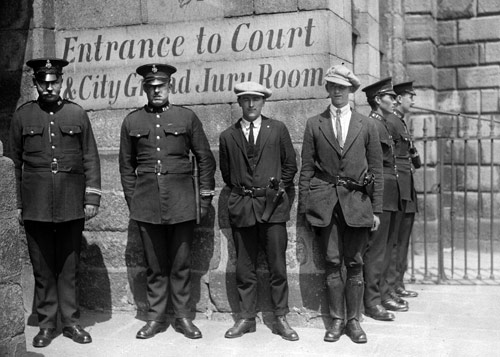
Early Civic Guards. Note:In 1922 many recruits didn’t yet have standard uniforms.
An Garda Síochána traces its origins to February 1922, when the newly formed Provisional Government established the Civic Guard to replace the disbanded Royal Irish Constabulary (RIC) and take responsibility for policing the emerging Irish Free State . The initiative, closely associated with Michael Collins, aimed to create a national police service rooted in the community rather than the militarised traditions of the past.
The lecture will highlight key milestones in the formation of the force, including the early organisational meeting held in Dublin’s Gresham Hotel in February 1922 , the appointment of Michael Staines as the first Commissioner, and the transfer of authority symbolised by the Gardaí taking over Dublin Castle in August of that year.
Dr Reynolds will also examine the significant challenges faced during the early months, such as the Kildare Mutiny, which exposed tensions within the new force and ultimately shaped its development as an unarmed police service relying on public trust and moral authority . The transformation of the Civic Guard into An Garda Síochána under legislation in 1923, and its later unification with the Dublin Metropolitan Police in 1925, will also be discussed.
This promises to be an engaging and informative evening for anyone interested in Irish history, policing, or the foundations of modern Ireland.
Government Announces Extended Fuel Relief Measures as Pressure Mounts to End Disruptive Protests.
The Government has confirmed a further extension of fuel cost relief measures, as Taoiseach Mr Micheál Martin announced new steps aimed at easing the financial burden on households and businesses amid ongoing nationwide protests.
Under the revised plan, temporary reductions in excise duty on petrol, diesel, and marked gas oil will now remain in place until the end of July, rather than expiring at the end of May.
Taoiseach Mr Micheál Martin.
The updated measures include:
A 10 cent per litre reduction on both petrol and diesel.
A 2.4 cent per litre reduction on marked gas oil (“green diesel”).
A deferral of the planned carbon tax increase, originally due in May, now postponed until the Budget in October.
These steps are intended to provide immediate cost relief in response to sustained increases in fuel prices linked to global supply pressures.
Despite these concessions, significant disruption continues across the country as protest actions, largely organised via informal networks of transport operators, farmers, and drivers, have blocked key transport routes and fuel depots.
The Government has reiterated that it recognises the financial strain facing those in fuel-dependent sectors. However, it has strongly criticised the ongoing blockades, warning that such actions are having serious and disproportionate consequences for the general public.
With schools reopening and workers returning after the weekend, the continuation of these protests risks widespread impact on daily life. Commuters face delays, families are affected in getting children to school, and essential services, including healthcare and emergency response, remain under pressure due to fuel supply concerns and traffic disruption.
The obstruction of critical infrastructure, including fuel depots and major roadways, has also raised concerns about the availability of medicines, agricultural supplies, and other time-sensitive deliveries. Authorities, including An Garda Síochána, have now moved into an enforcement phase, and the Defence Forces remain on standby to assist in removing vehicles where necessary.
Public Interest and Proportionality. While the Government’s latest measures demonstrate a willingness to respond to rising costs, the continuation of large-scale disruption raises serious questions about proportionality.
The burden of these protests is not being carried by policymakers alone, it is being felt most acutely by ordinary members of the public. Workers attempting to commute, parents preparing for the school week, and vulnerable individuals relying on timely access to services are all directly affected.
In this context, the persistence of blockades appears increasingly difficult to justify, particularly as concrete measures have now been introduced to address core concerns around fuel pricing.
The Government has urged all participants to disengage from disruptive actions and instead pursue dialogue through established representative bodies, emphasising that meaningful progress can only be achieved without jeopardising public safety and national infrastructure.
Further developments are expected in the coming days as pressure intensifies to restore normality across the country.
Tipperary County Council: World Leaders in Revenue Collection, but still Struggling With… Roads.
Tipperary County Council has proudly confirmed that it extracted a tidy €308,112 in parking fines in 2025, proving once again that when it comes to collecting money, efficiency is not an issue.
Fixing roads, however, remains a bold and experimental concept. See in particular Emmett Street, Westgate junction, Barry’s Bridge etc. etc. here in Thurles,
Across nine towns, thousands of motorists were “caught red-handed”, — “embarrassed even”, according to local press reports, having been photographed by traffic wardens, committing the heinous crime of allowing two wheels to exist slightly outside a faded white line or failing to have their hair permed within the 15 minute permitted free time frame.
Thurles, notably, now continues to excel in two key areas: (1)Generating revenue. (2)Avoiding pothole repairs.
Of course, as one would expect, Clonmel led the charge with 2,469 fines, followed by Nenagh with 1,346fines, Thurles(God help us in a town where most car parks were closed in 2025)1,258fines, while Carrick-on-Suir tried and failed to catch-up with a mere 1,052fines.
A further breakdown reveals a more refined vehicle operator: Tipperary Town:914 fines. Cashel:548 fines. Templemore:267 fines. Roscrea:256 fines. Cahir: took the wooden spoon, with a miserable 142 fines only. Still all admirable figures, if the goal is to run a highly efficient penalty collection service, rather than maintain public infrastructure.
Motorists are charged €40 – €80 for parking offences, rising by 50% after 28 days, because nothing says “public service” like interest rates that would impress a credit card company.
Other highlights include: ♣ €60 for failing to display a tax disc. ♣ In keeping with Health & Safety, No Charge for failing to display a NCT disk. ♣ €150 for parking in a disabled space.
Meanwhile, in Thurles, the surface of Barry’s Bridge is once again disintegrating, bravely demonstrating the council’s innovative “Natural Erosion Management Strategy.”
Residents are reportedly delighted to see their contributions; over €300,000 worth, being reinvested into… somewhere; possibly sending salaried staff on St Patrick’s weekend junkets; but certainly not road surfaces.
A spokesperson, (latter who does not wish to be named), standing carefully to avoid loose flying gravel, stated: “We take great pride in maintaining strict parking enforcement, while also maintaining a flexible, evolving interpretation of the word ‘roadworthy.”
Local drivers have expressed confusion, noting that while their tyres are expected to meet exact legal standards, the road beneath them appears to be auditioning for a gravel pit. Experts confirm that if potholes themselves could be fined, Tipperary County Council would likely be running a budget surplus.
Until then, motorists are advised to: ♦ Display their tickets correctly facing upwards. ♦ Pay promptly. ♦ Have a suspension system worthy of Dakar Rally conditions▲ when crossing Barry’s Bridge. {▲The Dakar Rally is considered the world’s most challenging endurance motorsport event, held annually over two weeks in extreme desert conditions.}
Wonder would Tipperary Sinn Féin TDs meet and move a motion of no confidence in Tipperary Co. Council. Ops, sorry, forgot that the Tipperary electorate failed to elect Sinn Féin TD’s, last election. I wonder why?
Yes, here in Tipperary, the fines are fixed – but the roads are anything but.
Minister For Justice, Home Affairs & Migration Mr Jim O’Callaghan TD has stated in a press release issued at 6:28pm this evening that, quote: “Over the past four days An Garda Síochána has engaged extensively with protestors seeking to allow access to critical sites and ensure certain trucks containing fuel, medicine and animal feed were allowed pass through blockades.
Despite the increasingly difficult situation facing people across the country and requests from Government to end the blocking of critical infrastructure, the blockades continued. This is unacceptable.
While we all acknowledge the impact of higher fuel prices, and seek to minimise that impact, no groups are entitled in our Republic to hold our people to ransom in such a manner.
An Garda Síochána has commenced operations to allow critical infrastructure to operate, so that people have access to fuel.
I will continue to engage with the Garda Commissioner and my colleagues in Government as these operations continue.
I want to thank the Gardaí and their colleagues from the Defence Forces, for carrying out these difficult duties in such a professional manner.”
We now understand that An Taoiseach Mr Micheál Martin has convened a Cabinet meeting for tomorrow where an update on ongoing fuel crisis talks, undertaken between ministers and sectoral representatives will be given. However, the Government has stated that nothing will be announced until protesters end their blockades.
This website uses cookies to improve your experience. We'll assume you're ok with this, but you can opt-out if you wish.AcceptRead More
Privacy & Cookies Policy
Privacy Overview
This website uses cookies to improve your experience while you navigate through the website. Out of these, the cookies that are categorized as necessary are stored on your browser as they are essential for the working of basic functionalities of the website. We also use third-party cookies that help us analyze and understand how you use this website. These cookies will be stored in your browser only with your consent. You also have the option to opt-out of these cookies. But opting out of some of these cookies may affect your browsing experience.
Necessary cookies are absolutely essential for the website to function properly. This category only includes cookies that ensures basic functionalities and security features of the website. These cookies do not store any personal information.
Any cookies that may not be particularly necessary for the website to function and is used specifically to collect user personal data via analytics, ads, other embedded contents are termed as non-necessary cookies. It is mandatory to procure user consent prior to running these cookies on your website.






Recent Comments