The whole thing kicked off in the Arch Bar in Thurles, Co. Tipperary last Friday night, when Mikey Ryan burst through the door looking like a man who’d just witnessed either a miracle or a tractor on fire.
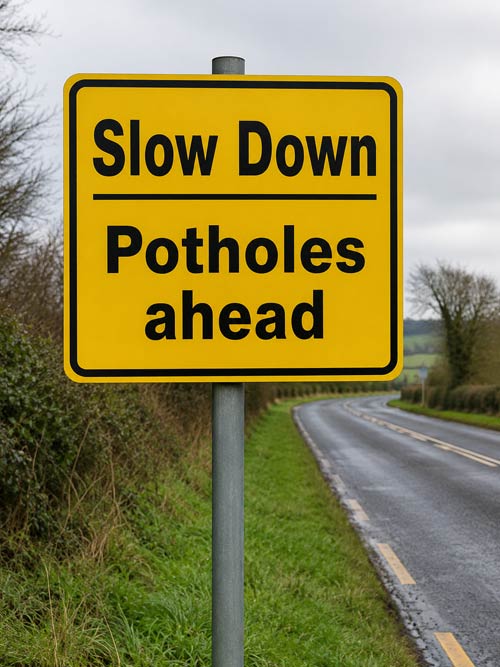
“Lads,” he says, gasping for breath, “Tipperary County Council have given up.” Now that got attention. Even Pat Hayes behind the bar stopped drying glasses. “What d’ye mean given up?” says Pat. “Gone altogether,” says Mikey. “No more speed limits.” The pub fell silent. Jimmy Bourke slowly lowered his pint. “No…” says he in his usual languid manner of speaking turning his single syllables into multiple sounds. “Oh yes,” says Mikey. “They’re replacing every speed sign in the county with signs saying: ‘SLOW DOWN – POTHOLES AHEAD.”
A woman at the corner table crossed herself. Pat blinked twice. “Sure isn’t that just every road in Tipperary?”
“EXACTLY,” says Mikey, lowdly slapping the counter so hard that a bowl of peanuts nearly declared independence.
Apparently the Council realised there was no point changing from 80 km/h to 60 km/h when the average human spine couldn’t physically survive 40 km/h anyway. Mikey claimed he saw three council workers outside Littleton removing a brand-new speed sign only four hours after initially installing it.
“One lad looked exhausted,” says Mikey. “Poor devil, a native of Co. Cork says; ‘What’s the point, bai? The road itself is enforcing the speed limit.”
And according to Mikey, the council has gone fully committed now. Outside Thurles there’s allegedly; a pothole deep enough to baptise a child; another has been classified by NASA as a “seasonal crater,” and one near Templetuohy village that is supposed to have swallowed a Nissan Micra and returned it as a Ford Focus.
“Jaysus,” says Jimmy. “That’s nothing,” says Mikey. “A fella hit one outside Roscrea last week and it activated his airbags, windscreen wipers and Eircode and all at the same time.”
The Council, according to recent rumour, have now stopped measuring potholes in inches. They’re measuring them in sizes; “small dog,” – “washing machine,” and “possible entrance to the underworld.” Meanwhile crews are driving around replacing all official speed signs. 80 km/h sign?Gone. 60 km/h sign? Gone. Now every road in Tipperary just has giant yellow signs reading: “SLOW DOWN – POTHOLES AHEAD”
Mikey says one poor tourist from Ukraine thought it was the county slogan, while another from Gaza asked if “Potholes Ahead” was a village near Cashel. But the best story came from near The Ragg. Council workers arrived with cones, flashing lights, diggers, rollers and enough machinery to invade a small European nation. Locals thought: “Grand. They’re finally fixing the road.” No, they installed six massive warning signs around a pothole before announcing that it was now “part of local Tipperary heritage.” Another engineer apparently referred to it as, “Traffic calming infrastructure.”
At this point the pub was in ribbons laughing. Even the old lad asleep beside the fire woke up laughing and he hadn’t previously been conscious since the 2022 All-Ireland Final.
Mikey took a deep dramatic gulp of Guinness. “But wait till ye hear the newest plan.” “Oh sweet suffering Jaysus,” muttered Pat. “They’re thinking of renaming roads altogether,” announced Mikey “What?” said Pat. “Yeah. Instead of the N62 or the R498…”; He leaned in over the counter. “…they’ll just call them according to the size of the potholes.” Examples include: ‘The Shaky Mile’; ‘Axlebreaker Avenue’; ‘Suspension Lane’ and one outside Nenagh simply called, ‘Abandon Hope All Ye Who Enter Here.” “And what about the speed vans?” an unknown someone asked. “Cancelled,” says Mikey. “Why so?” “No car in Tipperary can physically reach speeding pace anymore,” said Mikey.
At this stage the entire pub was gone completely feral with laughter. Mikey drained the last of the pint, straightened himself proudly and delivered the final line, like a prophet descending from Slievenamon mountain itself; “Mark my words lads… within five years every road sign in Tipperary will simply say: ‘Best of Luck.”
EPA finds almost six out of ten septic tanks fail inspection, putting drinking water wells and rivers at risk.
► Local authorities completed 1,466 septic tank inspections in 2025 targeting areas of greatest risk from an environmental and health perspective. ► Of these, 59% (863) failed inspection with many posing a risk to nearby rivers and drinking water wells. ► Since 2013, some 7,212 septic tanks failed inspections, with 84% fixed by the end of 2025. ► Improved resolution of faulty septic tanks by homeowners has been aided by increased Government grant support.
The Environmental Protection Agency (EPA) today released the report on Domestic Waste Water Treatment System Inspections 2025, which details the findings of septic tank inspections completed by local authorities in 2025. In 2025, 1,466 septic tanks were inspected, with 59% (863) failing because they were not built or maintained properly. Faulty systems pose a risk to human health from harmful bacteria and viruses through the contamination of drinking water wells, and can pollute rivers and streams through releases of nutrients such as nitrogen and phosphorus.
Sewage Flowing Into The River Suir, Thurles Town CentreIgnored.
When septic tanks fail inspection, local authorities issue advisory notices to householders setting out what is required to fix the problem. Of the 7,212 septic tanks that failed since inspections began in 2013, 84 percent had been fixed by the end of 2025. The number of failed systems with advisory notices unresolved for longer than two years reduced from 523 in 2024 to 442 in 2025.
Tipperarylocal authority area Inspection findings. Sadly Tipperary Water Service Authority shows only a moderate rate of Domestic Waste Water Treatment Systems (DWWTS commonly known as septic tanks) failures fixed.
Water Service Authority.
Inspections Required 2025▲.
Inspections Completed 2025.
Failure Rate 2025.
Systems failing 2013 – 2025.
% Fixed at end 2025.
Tipperary.
40
44
52%
205
78%
▲ Includes minimum number of inspections allocated in the National Inspection Plan (NIP) 2022-2026 and inspection shortfalls carried forward from 2024.
Commenting on the report, Mr Pat Byrne, Director of the EPA’s Office of Radiation Protection and Environmental Monitoring said: “The gradual increase in the number of faulty septic tanks being fixed by homeowners since 2013 in response to failed inspections is welcomed, as these are in the areas of greatest risk to rivers and drinking water wells. This has been aided by increased Government grant aid and greater enforcement activities by proactive local authorities. However, more consistent and sustained enforcement is needed across all local authorities to ensure that faulty septic tanks are fixed as soon as possible and that public health and the environment is protected.”
River Suir Thurles town centre.
The grant schemes for remediation of septic tanks were amended in 2024 and increased from €5,000 to €12,000. There were 460 grants awarded in 2025, totalling nearly €4.77 million, up from 265 grants awarded in 2024. Mr Noel Byrne, EPA Programme Manager said: “In 2025, some 59% of inspected septic tanks failed. This is a worrying statistic, as many homeowners may be exposing their families to health risks from contaminated private wells, or polluting local rivers, often without realising it. Regular checks and routine maintenance of septic tanks by homeowners can prevent minor issues becoming major problems, helping to protect their family’s health and the environment. Where eligible, homeowners should also make use of grant support of up to €12,000 to remediate faulty systems.”
There was a shortfall in inspections by three local authorities (Donegal, Fingal and Wexford) in 2025 and this shortfall must be made up in 2026, in addition to the planned inspections. The EPA will continue to monitor local authorities that are required to make up these shortfalls in 2026. Nine local authorities had less than 80 per cent of their issued advisory notices resolved by the end of 2025, which means that too many faulty septic tank systems continued to be a risk.
Local authorities are required to ensure septic tanks that fail inspection are fixed by homeowners in an appropriate timeframe. The report, Domestic Waste Water Treatment System Inspections 2025, is available HERE to download on the EPA website.
Something is deeply wrong, when Ireland tolerates terrorist symbols but ignores the murder of Private Seán Rooney.
Private Seán Rooney was not a politician, activist or a celebrity; he belonged to a far higher order of human achievement and character. He was a 24-year-old Irish soldier from Donegal serving his country on a United Nations peacekeeping mission in Lebanon. By all accounts he was courageous, decent and deeply committed to protecting his fellow soldiers.
Private Seán Rooney, Irish Soldier Murdered by Hezbollah in Lebanon.
On December 14th 2022, just 11 days before Christmas, while travelling in a clearly marked UN vehicle near the Hezbollah stronghold of Al-Aqbiya, Private Seán Rooney and his colleagues came under sustained gunfire from Hezbollah-linked attackers. Seán, sadly, was killed trying to protect his comrades, while another Irish soldier was seriously injured.
The aftermath of this event has been a grotesque insult to his family and indeed to the Island of Ireland itself. The main suspect, Hezbollah member Mohammad Ayyad, was eventually convicted and sentenced in his absence after repeatedly avoiding court appearances. He still remains at large today, after previously being released on “medical grounds.” Meanwhile, others involved received sentences so absurdly lenient that even the Irish Government publicly condemned them as unacceptable. Private Seán Rooney’s mother correctly described the process as a “sham trial” and said justice had neither been done nor even seen to be done.
While Seán Rooney’s family continue to fight for accountability, Ireland has witnessed crowds marching openly through Dublin and Cork waving Hezbollah and Hamas flags, latter organisations synonymous with sectarian violence, terrorism, hostage-taking and the murder of civilians.
Perhaps nothing captures the moral confusion of our modern-day Ireland more than the sight of Irish Tricolours being waved beside Hezbollah and Hamas flags on the streets of Dublin and Cork, as though the values represented by our national flag are somehow compatible with organisations linked to terrorism, sectarian hatred and the murder of an Irish peacekeeper, Private Seán Rooney.
For Seán Rooney’s family, and for many decent Irish people, that image is not “solidarity” or “activism.” It is a profound national disgrace and an insult to the memory of a young Irish soldier who died serving under the UN flag at the hands of Hezbollah-linked gunmen.
What is truly repellent is not only that these flags appear, but that so many so-called and self-appointed champions of “human rights” refuse to condemn them. Many politicians, activists and celebrity figures appear far more interested in performative anti-Israel activism than in showing even basic solidarity with the family of an Irish peacekeeper, murdered by extremists, linked to Hezbollah. That silence is not moral courage; it is moral bankruptcy.
Jerome Lawrence rightly warned in his 1955 play, “Inherit the Wind”, that: “Fanaticism and ignorance is forever busy, and needs feeding.”
That is exactly what we are witnessing today. Fanaticism survives when hatred becomes fashionable, when ideological tribalism replaces moral consistency, and when people excuse or romanticise violent extremism because it aligns with their political worldview. Bigotry is not confined to race or religion; it also includes the irrational hatred and dehumanisation of anyone considered politically inconvenient, including Israelis, Jews, or even Irish soldiers whose deaths disrupt a preferred narrative.
Supporting innocent Palestinians does not require anyone to glorify Hamas or Hezbollah. But too many people in Ireland have crossed that line. They excuse terrorist symbolism, ignore antisemitism when it comes disguised as activism, and remain conspicuously silent about the murder of Private Seán Rooney because acknowledging it would force them to confront uncomfortable truths about the movements they openly, through ignorance, tolerate.
The Rooney family deserved national outrage, unity and relentless demands for justice. Instead, they got evasions, hypocrisy and silence from people who claim to stand against violence and extremism; latter a disgrace on modern Ireland.
A new policy approved in Tipperary will ban roadside memorials in areas where speed limits are 60 kilometres per hour and above. The decision follows updated national road safety guidelines aimed at reducing dangers for motorists, pedestrians, and road maintenance crews.
Under the new rules, future memorials will not be allowed along higher-speed roads due to concerns about driver distraction, roadside parking and pedestrian safety. Existing memorials will remain in place, but any damaged memorials requiring replacement must comply with the updated regulations.
While many understand the importance of improving road safety, the decision has sparked debate among communities who see roadside memorials as important tributes to loved ones lost in tragic accidents. The issue is especially sensitive for grieving families and local residents who feel these memorials serve as lasting reminders for drivers to slow down and take greater care on dangerous roads.
At the same time, many people are questioning whether enough attention is being given to other road safety problems across the county. In Thurles, concerns continue to grow about road signage in several busy areas. A number of directional signs have reportedly become loose, damaged, are pointing in the wrong direction, or in some cases have disappeared altogether.
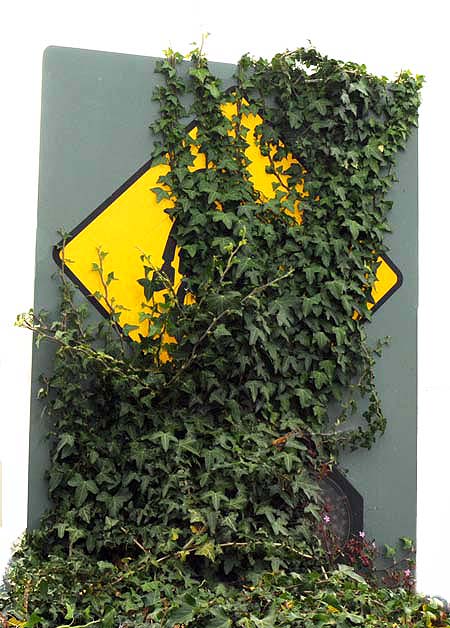
Areas such as Mill Road, Cathedral Street and Liberty Square in Thurles have been highlighted by residents as locations where signage problems are creating confusion for motorists and visitors alike. Many signs are hidden by hedge growth and some locals believe these practical road safety issues should also be prioritised alongside the introduction of any new policies and restrictions.
Road safety campaigners continue to stress that clearer signage, proper maintenance, safer junctions, and responsible driving all play a major role in preventing accidents and protecting lives on local roads.
As discussions continue, many will be watching closely to see how the new memorial policy is implemented and whether wider road safety concerns throughout Tipperary receive the same level of urgency and attention.
Eviction Ban Ruled Out as Housing Minister Signals Easing of Rural Planning Rules.
Ireland’s rural planning rules are set to be relaxed under new housing guidelines due to be published within weeks, according to Housing Minister Mr James Browne TD. The Minister said the updated guidelines aim to make it easier for people to build homes in rural communities, while also creating greater consistency in planning decisions nationwide.
Speaking during a visit to social housing projects in Donegal, Mr Browne said the Government is committed to reducing restrictions on rural housing development across the country. He added that the new framework would provide a more balanced and predictable approach for rural applicants.
The Minister also rejected renewed opposition calls for an eviction ban, following a sharp rise in eviction notices during the opening months of 2026. Recent figures from the Residential Tenancies Board showed more than 7,000 notices of termination were issued in the first quarter of the year; a rise of roughly 50% compared with the same period in 2025.
Mr Browne argued that previous eviction bans damaged rental supply and insisted the Government’s focus must remain on increasing housing availability. He pointed to signs that termination notices began to decline in March, with expectations of a further drop in April.
The minister said reforms introduced earlier this year are intended to strengthen protections for renters while encouraging more long-term participation in the rental market. Updated RTB figures also showed a modest increase in the number of landlords and registered tenancies nationwide.
This website uses cookies to improve your experience. We'll assume you're ok with this, but you can opt-out if you wish.AcceptRead More
Privacy & Cookies Policy
Privacy Overview
This website uses cookies to improve your experience while you navigate through the website. Out of these, the cookies that are categorized as necessary are stored on your browser as they are essential for the working of basic functionalities of the website. We also use third-party cookies that help us analyze and understand how you use this website. These cookies will be stored in your browser only with your consent. You also have the option to opt-out of these cookies. But opting out of some of these cookies may affect your browsing experience.
Necessary cookies are absolutely essential for the website to function properly. This category only includes cookies that ensures basic functionalities and security features of the website. These cookies do not store any personal information.
Any cookies that may not be particularly necessary for the website to function and is used specifically to collect user personal data via analytics, ads, other embedded contents are termed as non-necessary cookies. It is mandatory to procure user consent prior to running these cookies on your website.






Recent Comments