The union has confirmed that a central part of the deal is a Government commitment to negotiate comparable pension entitlements for all staff.
Fórsa trade union has called off its strike action by school Secretaries and Caretakers, having reaching an agreement with the present Government through the Workplace Relations Commission (WRC).
Fórsa’s Head of Education, Mr Andy Pike, welcomed the breakthrough, describing it as “a major step forward” for their members. He said the commitment to negotiate pensions represented a “significant advance” and that progress on leave and payroll would provide a fair basis for staff to return to work.
The agreement also provides for discussions on a range of workplace issues, including a new pay framework for caretakers; access to bereavement and sick leave; acute illness protocols and the full implementation of payroll arrangements.
The government has welcomed Fórsa’s decision to suspend strike action and enter discussions. They have praised the resilience of school communities during this dispute, while urging both sides to approach talks in good faith.
Formal discussions under the council of the WRC, will commence on Wednesday, September 10th next.
The Irish Government announces a €1.75 million fund to support children, young people, and families in International Protection Accommodation (IPAS).
Fund will be delivered locally through Children and Young People’s Services Committees (CYPSC).
CYPSC bring together the main statutory, community and voluntary providers of services to children and young people with projects designed to improve the health and wellbeing of children and young people in IPAS.
This 2025 Funding Framework was designed in collaboration with the CYPSC National Office at Tusla – Child and Family Agency.
Tipperary CYPSCto run a project promoting community integration by linking children staying in IPAS accommodation with local sports clubs.
CYPSC are a key structure identified by Government to plan and co-ordinate services for children and young people in every county in Ireland. Policy and strategic direction for the CYPSC initiative is provided by the Department of Children, Disability and Equality. There are 27 CYPSC nationwide and operational leadership is provided by TUSLA – Child and Family Agency through CYPSC National Office.
CYPSC bring together the main statutory, community and voluntary providers of services to children and young people in each county. CYPSC work to enhance interagency co-operation at both a local and national level with the goal of improving outcomes for children and young people (including those aged 0-24 years).
The CYPSC international protection fund was first established in 2023. The fund has successfully delivered a broad range of initiatives supporting children and young people seeking international protection in Ireland.
The framework for the 2025 fund was designed in collaboration with CYPSC National Office within Tusla – Child and Family Agency. The framework sets out the objectives, scope, and operational details of the fund. Local CYPSC were invited to propose a range of initiatives and projects falling under a range of objectives.
The objectives, which are aligned with the National Policy Framework for Children and Young People, include:
Community Integration.
Health and wellbeing.
Supports for Parents.
Emergency Accommodation.
Pathways to Independence.
Some examples of the projects selected to receive funding this year and that will be delivered by CYPSC, in collaboration with local partners, include:
Tipperary CYPSC: Same will run a project promoting community integration by linking children staying in IPAS accommodation with local sports clubs. Kildare CYPSC: Same will provide an educational project for 18-24 year olds looking at career options, horticultural training and experience, language supports, CV and interview preparation supports, job readiness skills, and personal development. Cork CYPSC: Same will run a project that aims to enable parents in emergency IPAS accommodation to teach their children culturally aligned cooking skills and good eating habits. Donegal CYPSC: Same will provide a surf camp that will serve as a platform for intercultural exchange by encouraging teamwork, mutual understanding, and friendships for children and young people from diverse backgrounds. Dún Laoghaire Rathdown CYPSC: Same will provide access to a Sensory Attachment Intervention programme useful for children and adults who have suffered trauma.
In an email received by Thurles.Info this morning from the Environmental Protection Agency (EPA) it has now been confirmed that Tipperary Co. Council are directly responsible for failure to protect the River Suir from pollution.
The email reply in its entirety reads:“The Environmental Protection Agency (EPA) acknowledges receipt on 30/08/2025 of your correspondence with regard to the alleged pollution of the river Suir and perceived lack of action by Tipperary County Council and other authorities as listed by you. Our Ref. COM021813.
The remit of the EPA allows us to support complainants by ensuring local authorities give due consideration to every complaint received from all members of the public and uphold their obligations under environmental protection legislation. We do not have the same enforcement remit with regard to the other authorities listed by you, but do report complaints and concerns to all with the aim of highlighting issues of environmental impact and working together to resolve issues, where possible.
Tipperary County Council has responsibility for dealing with the issues described in your correspondence.
The EPA would like to forward a copy of your correspondence to Tipperary County Council for their attention, action, and direct response to you.
In order to allow them to respond to you, we will need to share your contact information with them. Please confirm in a reply to this email if you consent (for data protection GDPR compliance purposes) to the EPA sharing your contact information with the Council.
Please note, a referral from the EPA obliges the local authority to log the complaint, open a case file, investigate the matter and report back to the complainant (you in this instance) as to any assessment and/or action planned or taken.
I trust you will find this of assistance“ Signed: Programme Officer – Complaints Unit, Office of Environmental Enforcement, Wexford.
Pic: G. Willoughby.
My reply To the EPA sent today is as follows: “Thank you for your quick reply to my communication received today. I confirm that I have no objection to the EPA sharing my contact information with Tipperary Co. Council. However, I fear by doing so you will receive little response.
I have contacted Tipperary Co. Council on numerous occasions over the past 5 years and all I ever receive is automated responses from secretaries.
My last contact with Tipperary Co. Council was just one week ago. A standard reply came back stating that my complaint would be forwarded to the relevant environmental department. I have heard nothing since.
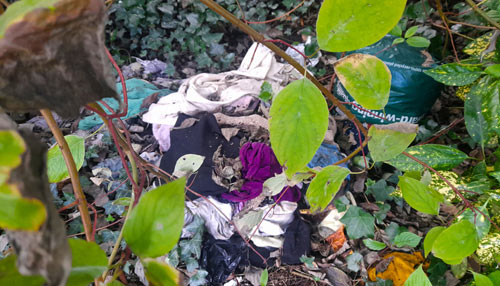
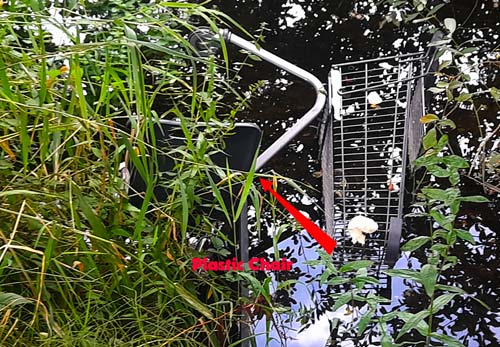
This morning a survey of the area undertaken by me has revealed little or nothing has changed in the past 7 days. Ladies’ clothing previously dumped on the river bank, has received further contributions. (See picture shown above). To their shame, no effort has been made by local Thurles Municipal District Council officials or by elected councillors either. The smell of sewage is about the same. Two more Supermarket Trolleys and one plastic chair have been added to the now stagnant waterway. (See picture shown hereunder).
Pic: G. Willoughby.
Please send me a copy of all/any communications forwarded to Tipperary Co. Council, regarding the present state of the River Suir in Thurles, including that using my contact information.
Please find (shown here above) pictures attached; which further highlight this pressing issue.
I remain Yours sincerely, etc.
So where do we go from here? It would appear that we, as residence of Thurles, have lost total control of our area and a commitment by our local authority to involve themselves in a public consultation process, no longer exists. While elected councillors are aware of Tipperary Co. Council’s official’s plans, same are not being shared with their electorate. Some 300 metres away from this current stench ridden River Suir; a building is being upgraded and due to come on line in December 2025; same reconstructed at a cost of €3.4 million euro of taxpayers money, courtesy of the Rural Regeneration & Development Fund (RRDF). Through this taxpayer-funded venture, Tipperary County Council will collect about €21,000 in yearly rental income. Instead of focusing on its duty to represent the local community, Tipperary Co. Council has positioned itself as a competitor to already existing, tax and ratepaying businesses; yet enjoys an unfair advantage by sidestepping the significant setup expenses that other ordinary businesses are obliged to pay. We await Tipperary County Councils reply.
Notice has been given in accordance with Section 183 of the Local Government Act 2001, pursuant to powers contained in Section 211of the planning & Development Act 2000, with regards to the disposal of property known as Thurles Market Place, Cathedral Street, Thurles, which is now set for consideration at a meeting of the Council on Monday next, September 8th, 2025.
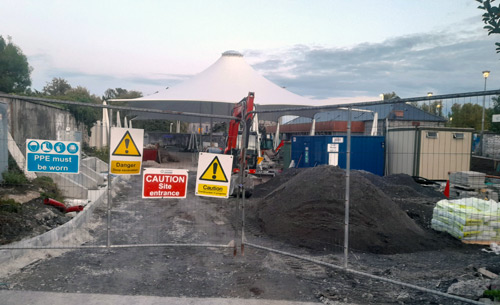
Up-to-datestate of Thurles Market Place, currently under construction. Pic: G. Willoughby.
We understand that Tipperary Co. Council sought submissions from interested parties to operate a Cafe within the soon to be fully developed/completed ‘Thurles Market Quarter‘ area. Same was part of a regeneration initiative, funded through the Rural Regeneration & Development Fund (RRDF begun in 2019), and was designed to enhance the vibrancy, in this case Thurles town, which over the past 4 years has lost over 60% of its footfall, through poor forced planning. Following an assessment of submissions by the Council it is now recommended that ‘One19 Coffee’ be awarded the contract under a 5 year lease period.
One19 Coffee. On any given weekday, as you drive through Templemore Town, you will be greeted by the sight of people queuing outside of ‘One19Coffee‘. What began as a small coffee shop, has successfully expanded to offer cakes, snacks, sandwiches, açaí bowls (latter a thick, smoothie-like nutrient-rich fruit treat made from pureed and frozen açaí berries), together with a wide range of other ‘light bites’. It now enjoys a devoted and ever-growing customer base, with young and old traveling from Thurles and indeed all over Tipperary, to enjoy great coffee and quality food.
Today we just learned that a coffee and light bite from ‘One19 Coffee’ may no longer require a trip to Templemore. In a move that many will welcome, ‘One19 Coffee’ may soon open its doors in Thurles, in the old re-constructed stone 1849 shed building on Cathedral Street in the town.
The quality reputation of ‘One19’ will surely boost footfall to the Thurles Town Park, if confirmed. If ‘One19’ are successful they will rent this stone building at a cost of €1,750:00 per month and will commit to signing a 5 year lease.
Who wouldn’t agree that this seems great in theory? In terms of local development, ‘One19’ coupled with an attractive albeit costly canopy roofed marketplace yet to be completed and paid for by taxpayer funding; same is arguably positive steps in the right direction.
Nevertheless, as they say in real estate circles, a property’s worth boils down to three things – location, location, location! ‘One19 Coffee’ in Templemore has greatly benefited from its prime location near one of Tipperary’s most beautiful parks. Latter is meticulously landscaped and looked after; boasting a recently upgraded playground, Templemore Park is indeed a tourist attraction in and of itself.
The Playground in Thurles Town Park is also enjoyed daily and is adjacent to an excellent Library, Theatre and Leisure Centre. Although all these man-made structures are attractive (the permanently closed skating park being the exception), in contrast to Templemore the natural surroundings in Thurles Town Park are seen as sorely neglected; even abandoned; polluted and smells to high heaven, caused by a lack of action on the part of Council Officials.
Time now to call on Tipperary County Council to see this project to a successful end and once and for all invest funding to clean up the river and develop the riverside walk.
At a minimum can the rent from ‘One19 Coffee’ and funds raised from other market and festival events being paid for by taxpayers, be reinvested in Thurles and not simply disappear back into the coffers of Tipperary County Council.
Wouldn’t we all relish the sight of happy families and customers queuing for food and enjoying the beauty of a revitalised River Suir and Riverside walk? Here’s hoping it will be part of our near future.
“You Will Die in Prison”, is a Tipperary man’s true story, which will be featured on RTÉ One Tonight, September 3rd, at 10:35pm.
A Tipperary man, wrongly imprisoned in Iran, states that he continues to suffer following his treatment in an Iranian prison. Mr Bernard Phelan, a Tipperary man who spent some seven months in an Iranian prison, has said the trauma of his ordeal continues to affect both him and his family.
Mr Bernard Phelan
Mr Phelan, originally from Clonmel, Co Tipperary, revealed that he recently suffered a stroke, which doctors have conclusively linked to post-traumatic stress disorder.
The 65-year-old, who holds both Irish and French citizenship, had been travelling to Iran since 2017, first as a tourist and later to develop trekking holidays. In October 2023, he was arrested, accused of providing information to an enemy state, before being held in prison until May of 2023. He was forced to go on hunger strike, before finally being pardoned and released on humanitarian grounds.
Speaking about his time in captivity, Mr Phelan said he was haunted by fears that his father would die before his release. Their reunion following his eventual return was he stated, “deeply moving”. He later got a chance to meet President Michael D Higgins, latter who failed to criticise Iran for its constant call for the total destruction of the state of Israel and for its funding and the arming of terrorist organisations, namely Hamas and Hezbollah, not to mention its violations of human rights against its very own citizens. In mid-2024, Irish President Mr Higgins had written to Iran’s new president Mr Masoud Pezeshkian to congratulate him on his new appointment. The letter was not officially published by the President’s office, but was circulated online and received some criticism, including from members within Fine Gael, who rightly accused President Higgins of being “tone deaf” to civil rights issues within Iran. Former Minister for Foreign Affairs Mr Charlie Flanagan had rightly informed the Press that he felt Mr Higgins’ views on Iran were “somewhat misplaced”. The Irish President then falsely accused the Israeli embassy in Ireland of circulating the letter, when in fact it was proven to have been circulated by the Iranian embassy as a “Look Ireland Supports Iran” PR stunt.
Mr Phelan now called for stronger EU action in securing the release of European citizens wrongly imprisoned abroad. Mr Phelan believes, and with justification, that European citizens are not being helped by EU authorities.
His story will be told in a new RTÉ documentary entitled, “You Will Die in Prison”, being airing tonight on RTÉ One at 10.35pm.
This website uses cookies to improve your experience. We'll assume you're ok with this, but you can opt-out if you wish.AcceptRead More
Privacy & Cookies Policy
Privacy Overview
This website uses cookies to improve your experience while you navigate through the website. Out of these, the cookies that are categorized as necessary are stored on your browser as they are essential for the working of basic functionalities of the website. We also use third-party cookies that help us analyze and understand how you use this website. These cookies will be stored in your browser only with your consent. You also have the option to opt-out of these cookies. But opting out of some of these cookies may affect your browsing experience.
Necessary cookies are absolutely essential for the website to function properly. This category only includes cookies that ensures basic functionalities and security features of the website. These cookies do not store any personal information.
Any cookies that may not be particularly necessary for the website to function and is used specifically to collect user personal data via analytics, ads, other embedded contents are termed as non-necessary cookies. It is mandatory to procure user consent prior to running these cookies on your website.







Recent Comments