When Does Somebody Else’s Pollution Become Our Responsibility?
Since yesterday September 1st 2026, Ireland’s fixed, on-the-spot fine for littering has increased from €150 to €250. This includes rubbish thrown from cars; whether it is a cigarette butt, bottle, food container or takeaway wrapper.
But fines raise a bigger question: At what point does somebody else’s pollution become our responsibility, especially when it enters a local river or waterway?Responsibility begins with the person who discarded the waste. Irish law prohibits causing or permitting polluting matter to enter waterways. Local authorities can investigate pollution, require remedial action and prosecute offenders.
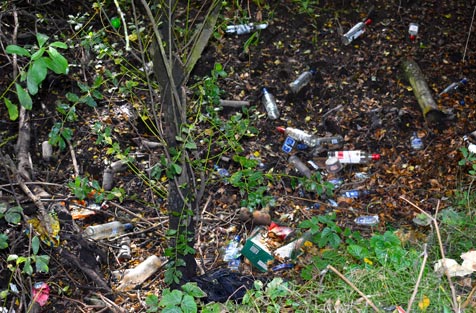
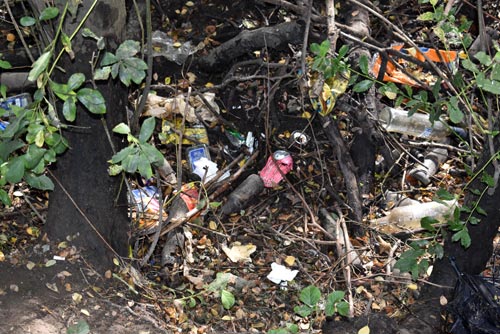
Suir Riverbed Thurles town centre, mainly caused by failure to provide a nearby litter bin.
However, responsibility cannot end with the individual. Many communities like Thurles town, point to too few conveniently located litter bins, or bins that are full or poorly maintained, in town centres, recreational areas and beside popular walking routes. Public-bin provision and maintenance are local-authority services, so councils also have a role in supplying suitable infrastructure where litter is regularly generated.
However, a lack of bins is never an excuse to throw rubbish from a car or throw it in or beside a river. If no bin is available, we must take our waste home. Nevertheless, enforcement works best when it is accompanied by adequate bins, regular collections, public education and convenient recycling facilities. Fining people without addressing obvious gaps in infrastructure tackles only part of the problem.
Once discarded, litter rarely remains where it falls. Rain washes roadside waste into drains, streams and rivers often promoted by Co. Councils. Currents carry it through neighbouring communities and towards lakes and the sea, where it can harm wildlife, obstruct waterways and leave the public paying for its removal. Ordinary residents are not legally responsible for another person’s offence. But once we see pollution threatening a shared waterway, we acquire a civic responsibility; report it, refuse to ignore it and support safe efforts to protect the area.
In the Republic of Ireland, litter, illegal dumping, overflowing public bins and local water pollution can be reported to the relevant city or county council. The EPA also recommends its “See It? Say It!” app, which sends photographs and location details to the appropriate authority.
The person who pollutes should pay. Councils must provide sensible disposal facilities and enforce the law. Communities should not be expected to continually clean up after repeat offenders, but silence allows the damage to travel downstream.
The litter may belong to somebody else, but the river belongs to all of us. Personal responsibility, proper infrastructure and effective enforcement must work together.
Adults found with a small quantity of controlled drugs for personal use may now be referred to the Health Service Executive instead of being prosecuted under Ireland’s new Health Referral Scheme.
The nationwide pilot scheme took effect on 1 September 2026. It gives An Garda Síochána an alternative response when dealing with an eligible person’s first drug-possession offence.
To qualify, a person must:
Be at least 18 years old.
Have no previous drug-possession conviction or adult caution.
Admit that the drugs were intended for personal use.
Agree to participate in the voluntary referral process.
The person must then contact the HSE and arrange an appointment with a trained SAOR practitioner. The appointment includes screening, discussion of the person’s substance use and support needs, and practical information and advice. Further treatment or specialist support may be recommended where appropriate.
This is therefore not necessarily a compulsory rehabilitation programme. It begins with a screening and brief intervention, followed by additional support when needed.
The Health Research Board explains the intervention. Anyone who declines the referral may instead be prosecuted under existing drugs legislation. Possession of a controlled drug remains a criminal offence under Section 3 of the Misuse of Drugs Act; the scheme does not legalise or decriminalise drug possession.
Garda Commissioner Mr Justin Kelly welcomed the initiative, saying it would allow Garda members to support harm reduction by directing eligible first-time offenders towards health services instead of the criminal justice system. The Government says the scheme is designed to encourage early engagement with support services, reduce drug-related harm and limit the potentially lasting consequences of a first possession offence. It is also intended to allow Garda resources to remain focused on drug dealing, organised crime and exploitation. The Department of Health describes it as a new health-led pathway.
Potential benefits:
It may help people address risky or problematic drug use at an early stage.
It can prevent a first offence from resulting in a conviction that affects employment, education or travel.
It treats some personal drug use as a health matter while retaining penalties for supply and trafficking.
It may reduce unnecessary pressure on Gardaí, prosecutors and the courts.
It can connect people with specialist services they might not otherwise approach.
Potential drawbacks:
Eligibility is limited to first-time offenders, leaving little scope for people whose repeated offending may be connected to addiction.
The decision depends partly on Garda discretion, which may raise concerns about consistency.
There is no single fixed quantity defining personal use; Gardaí assess factors such as the amount and how the drugs are packaged.
The scheme could place additional demand on already stretched health and addiction services.
Because possession remains illegal, critics may regard the initiative as too limited and argue that broader legal reform is needed.
Referral information remains relevant to how any later offence is handled, even though the first incident is diverted from prosecution.
The scheme represents a significant change in Ireland’s response to first-time personal drug possession, but its impact will ultimately depend on consistent implementation, adequate HSE resources and whether participants meaningfully engage with the support offered.
However, questions remain. Could participants be pressured to reveal the source of the drugs, and is the scheme genuinely focused on public health, or partly intended to ease pressure on Ireland’s overcrowded prisons?
Official information describes the scheme as voluntary and focused on screening, advice and support; it does not state that participants must identify a supplier. There is also no published evidence that reducing prison overcrowding is one of its stated objectives.
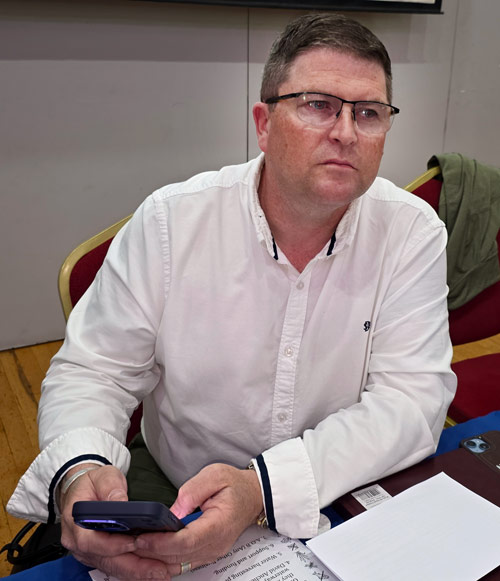
The recent meeting concerning the River Suir, held at Cahir House Hotel in Cahir, County Tipperary, on Wed 26th last, attracted a packed room of anglers, Tidy Towns personnel and environmentalists all united by their concern for the future of the river Suir. The meeting was chaired by Mr Derek Cagney, (National Secretary of the Trout Anglers Federation of Ireland and Chairman of the Cashel, Golden and Tipperary Anglers Association). Despite the strong public attendance and the importance of the issues under discussion, no politicians, elected councillors or other local Thurles representatives were seen to be present.
Meanwhile, independently a formal complaint has now been made once again by myself, directed at the Environmental Protection Agency (EPA) concerning the continuing condition of the River Suir in Thurles town centre and the failure to respond by the known responsible body, namely Tipperary County Council.
The complaint, (EPA reference COM021813), concerns the stretch running from Eircode E41 NX94(Barry’s Bridge) along the full stretch of river running to and including the area Eircode E41 C6K7, (Slievenamon Road River Walk entrance).
Concerns have been raised about this watercourse repeatedly since approximately November 2013. Recent photographs, vidoes and observations indicate that serious problems remain, including:
abnormal, opaque or grey-looking water;
foam or surface scum;
dark material or sludge in the channel;
water suspected of containing domestic wastewater or run-off;
extensive rush and vegetation growth, sucking the oxygen from the shallow water;
bottles, drinks containers and other litter throughout the riverbed and floating on now stagnant, polluted water.
Loss of the River Suir Fountains at Barry’s Bridge It is deeply regrettable that Tipperary County Council removed the two fountains from the River Suir These fountains were more than decorative features. They enhanced this prominent riverside area, while helping to circulate and aerate the water. Although fountains cannot themselves remedy pollution or replace proper river management, their operation can improve local water movement and dissolved-oxygen levels. At a time when residents are reporting stagnant-looking water, excessive vegetation, algae, sludge and litter, their removal represents the loss of both a valued public amenity and a potentially beneficial source of aeration.
Tipperary County Council should now explain why the fountains were removed, what assessment preceded the decision and whether they will be again restored. Their return should form part of a wider, properly funded programme to investigate pollution, clean the channel and restore this neglected stretch of River,
Photographs alone cannot fully establish the composition or exact source of the water or material contained. That requires a professional inspection, laboratory testing and proper source-tracing. However, the visible conditions are sufficiently abnormal to justify an urgent investigation.
In September 2025, the EPA referred the matter to Tipperary County Council as I requested. The Council subsequently outlined immediate and planned actions, including a proposed catchment-management plan and pilot study, details of which I am not privy. In November 2025, the EPA informed me that it was satisfied, based on the Council’s response, that the Council was taking appropriate steps to fulfil its environmental responsibilities.
Alas however, the continuing conditions during 2026 now raises serious questions about whether those promised measures were ever implemented and whether they produced any measurable environmental improvement.
On 23rd August 2026, the EPA acknowledged my further correspondence. It has again referred the matter to Tipperary County Council and has stated that it will assess what further EPA action may be appropriate after reviewing the Council’s next response. An update has been promised within the next four weeks.
It has been made clear that another referral and exchange of correspondence will not, by themselves, clean this river, identify the source of any discharge or prevent the problem from recurring. The Council’s handling of the matter is itself a central part of this complaint. Independent oversight now requires verification of what is happening on the ground.
Dried-up riverbed in Thurles town centre.
It has been formally requested that a suitably qualified EPA officer conduct an unannounced inspection while the conditions are visible. I am available to meet an officer at the site and identify the affected locations.
The EPA have also been asked to:
inspect and photograph the affected watercourse;
arrange properly documented upstream and downstream sampling;
analyse the water for appropriate chemical, biological and microbiological indicators;
trace relevant drains, pipes, culverts and outfalls;
establish whether any discharge exists and whether it is authorised;
examine Tipperary County Council’s complaint, inspection and enforcement records;
obtain evidence that Tipperary County Council’s promised actions were completed;
specify deadlines for investigation, cleaning and remediation;
consider its statutory supervisory powers if the evidence shows that Tipperary County Council has not performed its environmental duties adequately.
The EPA’s own guidance states that people may complain about a council’s environmental performance where a problem has not been addressed within a reasonable period or properly investigated. It also states that the EPA may issue legal notices or direct a council to take action where its duties have not been performed adequately. Under section 63 of the Environmental Protection Agency Act 1992, as amended, the EPA oversees local authorities’ performance of their environmental-protection functions.
The EPA are being asked to prejudge whether an offence has occurred. A rigorous, evidence-based and independent investigation is being sought. If the EPA decides that an inspection is unnecessary, a reasoned written decision has been asked for, explaining what verified evidence supports that conclusion.
After approximately thirteen years of complaints, plans, promises and political assurances are no longer enough. The public is entitled to a clean watercourse, accountable environmental governance and clear answers about what has entered this section of the River Suir.
From today, August 30th, I will make the substantive correspondence and official responses publicly available, subject to the appropriate protection of personal information. Further photographs and updates will follow.
Ireland’s First-Home Divide: A Six-Figure Salary Is Now Required in Three Irish Counties.
A single first-time buyer now needs to earn more than €100,000 a year to buy a typical home in Dublin, Wicklow or Kildare, according to new research from Chill Insurance. Last year, Dublin was the only county where a six-figure salary was needed.
The estimated salary required is €108,000 in Dublin, €101,250 in Wicklow and €100,238 in Kildare. Yet the current national median salary is only €44,816. Even in Longford, the country’s most affordable county, a single buyer would need to earn €48,375.
The figures assume that buyers have a 10% deposit and can borrow four times their annual income; the usual Central Bank limit. They are estimates and do not include personal debts, household bills or other circumstances.
There is no easy answer to this problem. State schemes can help some people with their deposit or the gap between their mortgage and the purchase price. However, Ireland also needs many more affordable homes, including smaller homes and apartments for people buying alone.
Simply allowing people to borrow more could push prices even higher. Research from the OECD’s Economic Survey suggested in 2025, that the lasting solution is to build more homes by speeding up planning, making serviced land available, lowering construction costs and building more suitable housing near/close to places of employment and public transport.
The real warning is clear: an average single worker can no longer today afford a typical first home in any Irish county. Home ownership is increasingly limited to couples, high earners or people who can get financial help from their families or the Irish State.
According to local radio, Mr Michael Lowry TD has rejected suggestions that the Garda Training College in Templemore is now under threat.
Mr Lowry says he secured a commitment during negotiations on the Programme for Government that Templemore would remain the primary national Garda training centre. He also says a recent review endorsed maximising Templemore’s capacity and prioritising investment there and also at an outreach facility in Tallaght. The Government previously denied making a deal with Mr Michael Lowry, however Mr Lowry nevertheless now says he secured a commitment on Templemore, during government-formation negotiations.
Templemore clearly remains Ireland’s principalGarda college and is receiving further investment. However, the wording “primary” does not mean “exclusive”.
The published Programme for Government commits to considering a second Garda training college and allowing trainees to complete parts of their training elsewhere. It does not guarantee that every existing course will remain in Templemore, Co. Tipperary. Mr Lowry’s stronger assurance appears to arise from government-formation negotiations, however no published agreement, letter or memorandum setting out its precise terms can be located.
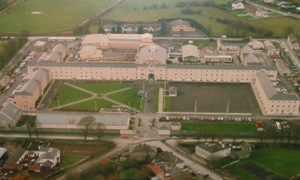
Garda Training College, Templemore, Co. Tipperary.
The Training Review A Garda Training Review Group examined how to increase training capacity, including: ► maximising Templemore’s throughput; ► establishing a second college; ► using other institutions or locations; ► providing outreach training.
Mr Lowry says the review protects Templemore’s status but concluded that developing Dromard would require unjustifiable investment. However, the complete final report, Dromard assessment and comparative costings do not appear to have been published. Until they are released, those conclusions remain Mr Lowry’s account of the review rather than independently verifiable findings.
Dromard Farm Dromard Farm at Clonmore is approximately six kilometres from Templemore and comprises about 256 acres: 160 acres of grazing land and 96 acres of woodland, together with a uninhabited period house and sheds. The OPW purchased it in 2006, at the Department of Justice’s request, for a proposed Garda Centre of Excellence. Planned uses included public-order, firearms, detective, surveillance, dog, mounted and water-unit training, together with off-road motorcycle, four-wheel-drive and other driver training. It is therefore reasonable to say that Dromard was bought partly for advanced Garda driver training. It was not purchased solely as a high-speed pursuit track. A tactical training building was constructed in 2008, while part of the woodland was used for off-road vehicle and motorcycle exercises. The notion of introducing a larger Centre of Excellence was abandoned following Ireland’s financial crisis.
What Did It Cost? The strongest contemporaneous records give Dromard’s purchase price as €4.3 million. Some recent political statements, by Mr Alan Kelly TD, use a figure of €5.5 million, but no public breakdown supporting that amount can we locate. It possibly could include fees, taxes or subsequent expenditure, but the OPW should now clarify this. Until then, €4.3 million is the best-supported purchase price. At approximately €16,800 per acre, Dromard’s €4.3 million purchase price was below reported national and regional farmland averages during the 2006 property boom. It cannot therefore be described as a clear market overpayment on the available figures. However, the property contained substantial woodland and an uninhabitable house, and the State may have purchased a much larger and more expensive estate than Garda requirements justified. The later failure to develop or fully use it turned a potentially market-priced acquisition into questionable value for the taxpayer.
Then came the Rent Controversy Between 2009 and 2013, Garda College administration rented Dromard land to local farmers, even though the OPW was its legal owner. The OPW could find no documented agreement authorising the Garda College to take over the letting. An internal audit initially identified €124,903 in rent. Instead of being paid to the OPW, the money had been lodged into the Garda College Restaurant Account. The final verified amount was €131,260.80. An Garda Síochána then repaid that money to the OPW on July 6th 2017. This same €131,260.80 was repaid to the OPW from the “Garda Vote”, latter An Garda Síochána’s taxpayer-funded annual budget. This meant that public money intended for Garda services was used to replace rent that had previously been placed in the Garda College Restaurant Account.” The Public Accounts Committee report found a serious failure to monitor and control State property and finances, but no public outrage was observed.
Was It A Cover-Up? There is strong evidence that the wider Templemore financial problems were kept from effective scrutiny for years. The Public Accounts Committee found that: ► financial problems had been identified as early as 2006; ► recommendations from earlier reports were not implemented; ► senior management had numerous opportunities to address the problems; ► internal auditors did not receive adequate support or cooperation; ► disclosure to oversight bodies was unacceptably delayed; ► a significant number of senior personnel knew about the irregularities.
Mr John Barrett, then Garda Executive Director of Human Resources, alleged that senior figures tried to prevent the issues from “breaking cover”. Evidence also emerged of communications suggesting auditors should be kept “at bay”. It is therefore reasonable in ordinary language to describe the wider affair as prolonged institutional concealment or obstruction of oversight. However, no court finding located establishes that named individuals entered into a criminal conspiracy specifically to conceal or steal the Dromard rent. Therefore it is reasonable to conclude that there is strong evidence of prolonged institutional concealment and avoidance of proper oversight concerning the wider Templemore finances. Whether this constituted a criminal cover-up of the Dromard rent specifically has not been established in a court of law. GSOC completed a six-year criminal investigation into the wider financial irregularities and sent a file to the Director of Public Prosecutions in 2023. No reliable public confirmation of a prosecution concerning the Dromard rent can be located.
Questions Still Requiring Answers Before Dromard is sold, the Government and OPW should now publish:
The final Garda Training Review report.
The complete Dromard technical and cost assessment.
Its present valuation, use and rental income.
An explanation of the €4.3 million and €5.5 million figures.
Any formal decision authorising its disposal.
The comparison between investing in Dromard, Templemore, Tallaght or a second college.
Templemore is not facing closure, but political assurances are not a substitute for published evidence. Given Dromard’s history, the public deserves complete transparency before a valuable State training asset is disposed of.
This website uses cookies to improve your experience. We'll assume you're ok with this, but you can opt-out if you wish.AcceptRead More
Privacy & Cookies Policy
Privacy Overview
This website uses cookies to improve your experience while you navigate through the website. Out of these, the cookies that are categorized as necessary are stored on your browser as they are essential for the working of basic functionalities of the website. We also use third-party cookies that help us analyze and understand how you use this website. These cookies will be stored in your browser only with your consent. You also have the option to opt-out of these cookies. But opting out of some of these cookies may affect your browsing experience.
Necessary cookies are absolutely essential for the website to function properly. This category only includes cookies that ensures basic functionalities and security features of the website. These cookies do not store any personal information.
Any cookies that may not be particularly necessary for the website to function and is used specifically to collect user personal data via analytics, ads, other embedded contents are termed as non-necessary cookies. It is mandatory to procure user consent prior to running these cookies on your website.






Recent Comments