The whole thing kicked off in the Arch Bar in Thurles, Co. Tipperary last Friday night, when Mikey Ryan burst through the door looking like a man who’d just witnessed either a miracle or a tractor on fire.
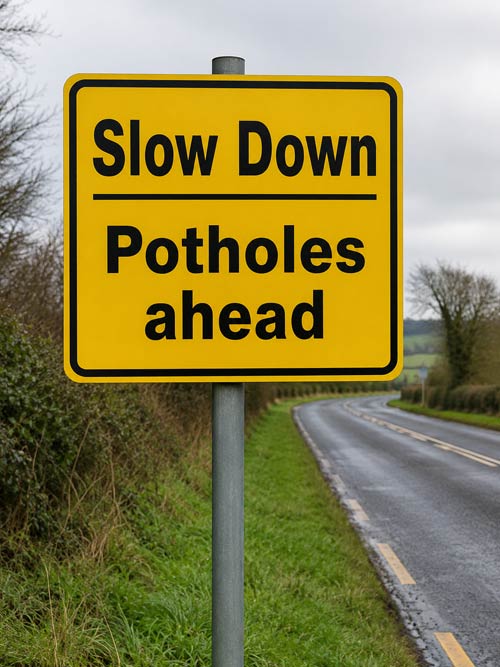
“Lads,” he says, gasping for breath, “Tipperary County Council have given up.” Now that got attention. Even Pat Hayes behind the bar stopped drying glasses. “What d’ye mean given up?” says Pat. “Gone altogether,” says Mikey. “No more speed limits.” The pub fell silent. Jimmy Bourke slowly lowered his pint. “No…” says he in his usual languid manner of speaking turning his single syllables into multiple sounds. “Oh yes,” says Mikey. “They’re replacing every speed sign in the county with signs saying: ‘SLOW DOWN – POTHOLES AHEAD.”
A woman at the corner table crossed herself. Pat blinked twice. “Sure isn’t that just every road in Tipperary?”
“EXACTLY,” says Mikey, lowdly slapping the counter so hard that a bowl of peanuts nearly declared independence.
Apparently the Council realised there was no point changing from 80 km/h to 60 km/h when the average human spine couldn’t physically survive 40 km/h anyway. Mikey claimed he saw three council workers outside Littleton removing a brand-new speed sign only four hours after initially installing it.
“One lad looked exhausted,” says Mikey. “Poor devil, a native of Co. Cork says; ‘What’s the point, bai? The road itself is enforcing the speed limit.”
And according to Mikey, the council has gone fully committed now. Outside Thurles there’s allegedly; a pothole deep enough to baptise a child; another has been classified by NASA as a “seasonal crater,” and one near Templetuohy village that is supposed to have swallowed a Nissan Micra and returned it as a Ford Focus.
“Jaysus,” says Jimmy. “That’s nothing,” says Mikey. “A fella hit one outside Roscrea last week and it activated his airbags, windscreen wipers and Eircode and all at the same time.”
The Council, according to recent rumour, have now stopped measuring potholes in inches. They’re measuring them in sizes; “small dog,” – “washing machine,” and “possible entrance to the underworld.” Meanwhile crews are driving around replacing all official speed signs. 80 km/h sign?Gone. 60 km/h sign? Gone. Now every road in Tipperary just has giant yellow signs reading: “SLOW DOWN – POTHOLES AHEAD”
Mikey says one poor tourist from Ukraine thought it was the county slogan, while another from Gaza asked if “Potholes Ahead” was a village near Cashel. But the best story came from near The Ragg. Council workers arrived with cones, flashing lights, diggers, rollers and enough machinery to invade a small European nation. Locals thought: “Grand. They’re finally fixing the road.” No, they installed six massive warning signs around a pothole before announcing that it was now “part of local Tipperary heritage.” Another engineer apparently referred to it as, “Traffic calming infrastructure.”
At this point the pub was in ribbons laughing. Even the old lad asleep beside the fire woke up laughing and he hadn’t previously been conscious since the 2022 All-Ireland Final.
Mikey took a deep dramatic gulp of Guinness. “But wait till ye hear the newest plan.” “Oh sweet suffering Jaysus,” muttered Pat. “They’re thinking of renaming roads altogether,” announced Mikey “What?” said Pat. “Yeah. Instead of the N62 or the R498…”; He leaned in over the counter. “…they’ll just call them according to the size of the potholes.” Examples include: ‘The Shaky Mile’; ‘Axlebreaker Avenue’; ‘Suspension Lane’ and one outside Nenagh simply called, ‘Abandon Hope All Ye Who Enter Here.” “And what about the speed vans?” an unknown someone asked. “Cancelled,” says Mikey. “Why so?” “No car in Tipperary can physically reach speeding pace anymore,” said Mikey.
At this stage the entire pub was gone completely feral with laughter. Mikey drained the last of the pint, straightened himself proudly and delivered the final line, like a prophet descending from Slievenamon mountain itself; “Mark my words lads… within five years every road sign in Tipperary will simply say: ‘Best of Luck.”
A new policy approved in Tipperary will ban roadside memorials in areas where speed limits are 60 kilometres per hour and above. The decision follows updated national road safety guidelines aimed at reducing dangers for motorists, pedestrians, and road maintenance crews.
Under the new rules, future memorials will not be allowed along higher-speed roads due to concerns about driver distraction, roadside parking and pedestrian safety. Existing memorials will remain in place, but any damaged memorials requiring replacement must comply with the updated regulations.
While many understand the importance of improving road safety, the decision has sparked debate among communities who see roadside memorials as important tributes to loved ones lost in tragic accidents. The issue is especially sensitive for grieving families and local residents who feel these memorials serve as lasting reminders for drivers to slow down and take greater care on dangerous roads.
At the same time, many people are questioning whether enough attention is being given to other road safety problems across the county. In Thurles, concerns continue to grow about road signage in several busy areas. A number of directional signs have reportedly become loose, damaged, are pointing in the wrong direction, or in some cases have disappeared altogether.
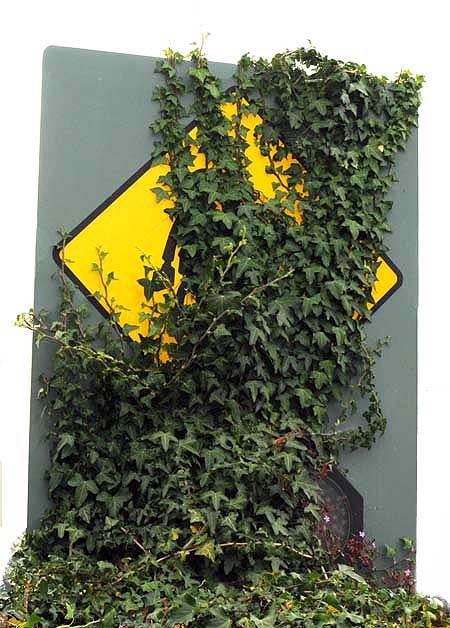
Areas such as Mill Road, Cathedral Street and Liberty Square in Thurles have been highlighted by residents as locations where signage problems are creating confusion for motorists and visitors alike. Many signs are hidden by hedge growth and some locals believe these practical road safety issues should also be prioritised alongside the introduction of any new policies and restrictions.
Road safety campaigners continue to stress that clearer signage, proper maintenance, safer junctions, and responsible driving all play a major role in preventing accidents and protecting lives on local roads.
As discussions continue, many will be watching closely to see how the new memorial policy is implemented and whether wider road safety concerns throughout Tipperary receive the same level of urgency and attention.
Eviction Ban Ruled Out as Housing Minister Signals Easing of Rural Planning Rules.
Ireland’s rural planning rules are set to be relaxed under new housing guidelines due to be published within weeks, according to Housing Minister Mr James Browne TD. The Minister said the updated guidelines aim to make it easier for people to build homes in rural communities, while also creating greater consistency in planning decisions nationwide.
Speaking during a visit to social housing projects in Donegal, Mr Browne said the Government is committed to reducing restrictions on rural housing development across the country. He added that the new framework would provide a more balanced and predictable approach for rural applicants.
The Minister also rejected renewed opposition calls for an eviction ban, following a sharp rise in eviction notices during the opening months of 2026. Recent figures from the Residential Tenancies Board showed more than 7,000 notices of termination were issued in the first quarter of the year; a rise of roughly 50% compared with the same period in 2025.
Mr Browne argued that previous eviction bans damaged rental supply and insisted the Government’s focus must remain on increasing housing availability. He pointed to signs that termination notices began to decline in March, with expectations of a further drop in April.
The minister said reforms introduced earlier this year are intended to strengthen protections for renters while encouraging more long-term participation in the rental market. Updated RTB figures also showed a modest increase in the number of landlords and registered tenancies nationwide.
Tipperary County Council’s decision to approve the demolition of the 52 unfinished houses at Ballypadeen near Cashel has reignited debate about planning, dereliction, and the wider housing crisis. While many people understandably see the structures as potential homes, the reality behind the site is far more complicated.
The partially completed houses have stood idle for almost two decades overlooking the Rock of Cashel after construction stopped in 2007. Originally approved during the Celtic Tiger era, the development was never intended to function as a standard residential estate. Planning permission was granted for tourism accommodation linked to a large hotel and leisure complex that was never built.
According to Tipperary County Council, the site sits on unzoned and unserviced land outside the Cashel settlement boundary, placing it in conflict with current planning policy. Independent engineering and technical assessments commissioned as part of the process concluded that the structures contained significant defects and that restoring them for long-term residential use would not be financially viable.
The council has also confirmed that the demolition forms part of a legally binding mediated settlement between the local authority and the landowner following years of legal disputes connected to the development.
Public frustration is understandable given Ireland’s ongoing housing shortage. Critics, including local representatives and members of the public, have argued that demolishing 52 partially completed houses during a housing crisis appears counterproductive. However, the issue is not simply about unfinished houses being left unused. The core problem is that the development was approved under a tourism model tied to infrastructure and zoning conditions that never materialised.
What is also important to note is that despite the national attention the site has received, the houses are not visible when entering or leaving Cashel itself. The development sits outside the town and is largely hidden from the main approach roads, contrary to some impressions created online and in wider media coverage.
The council says the demolition will help address long-term dereliction and protect the visual setting surrounding the Rock of Cashel, one of Ireland’s most historically important landmarks.
Ultimately, Ballypadeen has become a symbol of wider failures in Irish planning and development during the boom years. The debate now is not only about whether these buildings should remain standing, but how developments like this were ever allowed to reach such a stage without proper long-term oversight, infrastructure, or viable planning foundations in place.
“Though the mills of God grind slowly, Yet they grind exceeding small, Though with patience He stands waiting, With exactness grinds He all.”
[Extract from Henry Wadsworth Longfellow’s poem “Retribution”; the lines meaning that God’s judgment or moral justice does not happen quickly. Wrongdoers may seem to escape consequences for a long time. But when justice finally comes, it is thorough and precise. ]
Nothing escapes accountability. For over a decade the people of Thurles have been subjected to political spin and conflicting claims regarding the so-called Thurles Inner Relief Road. What was once presented as an urgent infrastructure priority now appears increasingly unlikely to begin construction before 2028, despite repeated assurances from politicians that funding had already been secured years ago.
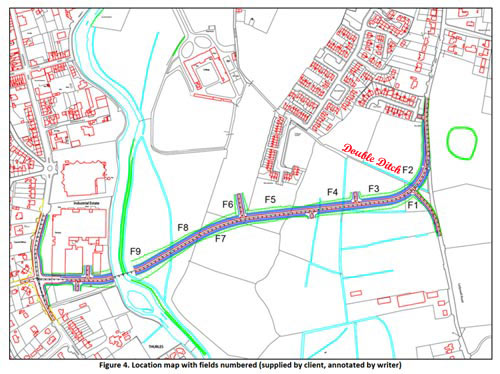
Figure 4, pictured above as stated, was ‘annotated by writer‘, meaning that notes were added to the diagram, giving explanation or comment. Same annotation was not supplied by Tipperary Co. Council.
Even more remarkably, recent political statements from other quarters have continued to portray the project as somehow newly “secured” or “advanced”, despite those earlier promises. The people of Thurles are now being asked to believe that funding was secured in 2021, land acquisition was the breakthrough in 2024, government commitments were obtained again in 2025, and yet construction still cannot realistically begin before 2028. None of this adds up.
The facts tell a very different story. Tipperary County Council’s own 2025 Service Delivery Plan confirms that the project still remained at Department appraisal and detailed design stage, not construction stage. Earlier reports showed that only modest sums such as €75,000 and later €100,000 had been allocated for planning and design-related work. That is not what a shovel-ready infrastructure project looks like.
Meanwhile, the town itself continues to choke under worsening traffic congestion, while politicians repeatedly issue triumphant press releases claiming “progress”.
But the greatest disgrace surrounding this project is not merely the delay. It is the destruction and dismissal of Thurles heritage, [See HERE page 6], in pursuit of a road many residents believe will never adequately solve the town’s traffic crisis in the first place.
The proposed route, shown on the map above, cuts through the historic Great Famine “Double Ditch”, a rare surviving famine-era landscape feature, known locally to date from the 1846. This historic pathway, associated with famine relief works, was effectively treated as expendable. Despite its historical significance to many in Thurles, archaeological assessments failed to properly recognise or protect it. Campaigners repeatedly warned that a unique part of Thurles history was being sacrificed for a project whose actual traffic benefits remain questionable.
What makes the situation even more infuriating is that Thurles still does not have the bypass it has needed for generations. The town’s medieval street layout continues to carry modern heavy traffic because successive governments failed to prioritise a proper outer bypass solution. Instead, taxpayers are expected to fund an “Inner Relief Road” which many believe will simply shift congestion from one bottleneck to another, while permanently damaging part of the town’s heritage.
For years the public has been bombarded with photographs, announcements, consultations, launches, and declarations of “fantastic news”, yet the basic reality never changes. The project drifts endlessly between planning, appraisal, land acquisition, consultation, and redesign, while local politicians compete to claim ownership of it.
At this stage, many residents no longer trust a word of it. If funding was truly secured years ago, where is the road? If construction was imminent, why is detailed design still ongoing? If this project is so transformational, why has the timeline repeatedly slipped further and further into the future?
The people of Thurles deserve honesty instead of political theatre. They deserve real infrastructure instead of endless press releases. Most importantly, they deserve a serious long-term bypass solution rather than another decade of delay, confusion, and public relations exercises masquerading as progress.
This website uses cookies to improve your experience. We'll assume you're ok with this, but you can opt-out if you wish.AcceptRead More
Privacy & Cookies Policy
Privacy Overview
This website uses cookies to improve your experience while you navigate through the website. Out of these, the cookies that are categorized as necessary are stored on your browser as they are essential for the working of basic functionalities of the website. We also use third-party cookies that help us analyze and understand how you use this website. These cookies will be stored in your browser only with your consent. You also have the option to opt-out of these cookies. But opting out of some of these cookies may affect your browsing experience.
Necessary cookies are absolutely essential for the website to function properly. This category only includes cookies that ensures basic functionalities and security features of the website. These cookies do not store any personal information.
Any cookies that may not be particularly necessary for the website to function and is used specifically to collect user personal data via analytics, ads, other embedded contents are termed as non-necessary cookies. It is mandatory to procure user consent prior to running these cookies on your website.





Recent Comments