With Tipperary named by Lonely Planet as one of the world’s top places to visit in 2026, the county’s lesser-known heritage sites deserve renewed attention and care. An example of same should include a small, enclosed burial ground, where a scattering of largely forgotten eighteenth and nineteenth century headstones still survives at the edge of Thurles town.
Carved stones from a lost church, mounted on a pillar. Pic: G. Willoughby.
St Bridgid’s graveyard (Eircode E41 AC91), the remnant of a former medieval parish church site, lies just west of Ardán Bhríde (Bridgid’s Terrace), directly opposite Thurles train station and running parallel to what was once named Garryvicleheen Road, now better known as Abbey Road.
Trailing Ivy now protects Thurles history. Pic: G. Willoughby.
What makes this modest graveyard particularly significant, however, is a limestone pillar beside the entrance to this enclosure, where architectural fragments and carved stones, wisely salvaged from the lost church, have been gathered and mounted for safekeeping.
A pillar of fragments and a warning in stone. On the south face of the pillar, four carved stones are now just about visible. At the top sits a rectangular corner stone bearing a carved seated cat, traditionally said to have once had two tails. Severe weathering has already softened key details, and the carving is now so worn that it may not survive intact for another generation. The cat’s face is described as V-shaped, with what appears to be a mouse held in its jaws. Locally, the workmanship has been associated with the trademark craft of An Gobán Saor (Gobban the Builder),the legendary seventh-century master mason, though the cat itself appears stylistically later, likely of eighteenth or nineteenth-century date.
To the right of the cat is a square stone depicting a lion, set within a circular frame. Same may also have British Royal Family connections. A surviving window fragment, same a rare prominent, ornate window arch, with S-shaped curves (ogee) and decorative carved panels (spandrels) is yet another striking historic piece. Finally, a rectangular limestone block carved with what appears to be a bald individual in a long robe and tunic, the clothing suggesting a cleric, (could it represent St Bridgid/ Bridget). The individual holds a cross in their right hand and a circular string of beads, most likely a paternoster♦, in their left. Beneath the figure, the names Patrick Kennedy and James Bulter have been crudely cut, later interventions that now form part of the stone’s layered story.
♦Paternoster: The paternoster was used to count prayers, typically 150 recitations of the “Our Father”. These beads often formed a loop, sometimes with a cross, reliquary (a container for holy relics), or pomander (latter worn or carried in a case as a protection against infection in times of pestilence or merely as a useful article to mask bad smells), as its end. This style eventually evolved into the modern rosary beads used today. Wearing the paternoster openly served as a devotional act, identifying the wearer as a Christian and displaying their religiosity. Depending on the materials used, serve as a display of wealth.
The west side of the pillar carries a single, highly recognisable carving, now unseen while protected by ivy: a limestone block showing a unicorn and lion rearing on their hind legs, (See immediately hereunder) beneath a crown, framed within a recess with a semi-circular head and straight sides. This scene represents the Royal Coat of Arms of the United Kingdom; Thurles being the ancestral Home of current reigning King Charles III. The window head and the heraldic carving are considered older than the cat, with a provisional seventeenth-century date proposed for the lion and unicorn, (See picture hereunder).
A simple, yet urgent message: Please Protect What Remains!
Behind the ivy, the Royal Coat of Arms of the United Kingdom. Pic: G. Willoughby.
The carvings at St Bridgid’s/Bridget’s gaveyard site are not museum pieces behind glass; they sit in the open air, exposed year-round. Weathering is now actively destroying this history, softening edges, flattening relief work, and erasing the very features that allow the stones to be read, dated and understood.
Once those details are gone, they are gone for good. There is now a clear need for immediate, practical conservation at this site which must include protective covering to reduce direct rainfall and frost damage.
A practical way to safeguard this valuable heritage would be to enlist the services of Mr James Slattery, Slattery Monumental Works, Fianna Road, Thurles, Co. Tipperary (Tel: +353 86 2430213) to oversee the careful, professional removal of the carved stones and their placement in more secure, sheltered conditions.
It is suggested that the four limestone relief blocks, depicting (1) cat, (2)lion, and (3) unicorn and lion, be taken in hand and sympathetically installed within the Thurles Library area of ‘The Source’, in Cathedral Street, Thurles, where they could be properly interpreted and enjoyed by the public and visitors, in a controlled environment.
In addition, the limestone block carved with the (a) cleric figure shown in a long robe and tunic, and the (b) window fragment, could be respectfully mounted on a pedestal within the nearby Church of St Joseph & St Brigid, in Thurles, ensuring, again, both protection and an appropriate setting.
In both instances, these measures would not only secure all the fragments for future generations, but would also create safe, welcoming and attractive points of interest for visitors and history-minded tourists to Thurles.
While St Bridgid’s graveyard maybe a quiet corner of Thurles; these stones, gathered loosely on the top of that pillar, carry centuries of craft, belief, power, memory and identity. If they are left fully exposed, the weather will finish what time has already begun, erasing an important and irreplaceable chapter of Thurles history in plain sight.
This post has been sent to officials at Tipperary Co. Council, marked for the attention of Ms Sinead Carr, (sinead.carr@tipperarycoco.ie).
♦ Note: At no stage should an attempt to remove these historic fragments out of Thurles town, be undertaken, and any efforts to do so should be vehemently and firmly resisted.
With Tipperary skies cloud free tonight, the first full moon of 2026, known as the Wolf Moon, lights up our skies.
Why is it called the Wolf Moon, I hear you ask? The name “Wolf Moon” is traditionally used to name the January full moon. It’s commonly linked to winter folklore, particularly the idea of wolves howling more often in midwinter, and belongs to a wider set of seasonal full-moon names popularised in North America and echoed in other traditions. It’s also been known historically by other names in some traditions, including the “Moon After Yule.”
“Wolf Moon” or “Moon After Yule”.
The term “supermoon” is not a formal astronomical definition, but is widely used in public skywatching guides. Ireland’s first full moon of the year, the Wolf Moon, reached peak illumination this morning (10:02am Irish time/GMT), with skywatchers getting their best viewing opportunities from Friday evening (January 2nd 2026) through the weekend, weather permitting.
This January 26 full moon is also widely being described as a “supermoon”, an informal term used when a full moon occurs relatively close to Earth in its orbit, which can make it appear a little larger and brighter than average. Even if you have already missed the exact peak time earlier this morning, not to worry, the moon will still look full to the naked eye across this weekend, all you need is a clear horizon, and a few minutes outside away from bright street lighting.
Best ways to see it in Ireland. Look for moonrise at dusk: the moon will rise in the east around sunset and climb higher as the evening goes on, with times varying by location. Try an open viewpoint: parks, beaches, higher ground, or anywhere with a clear eastern sky. Use binoculars or a small telescope; while the “full” phase flattens shadows on the lunar surface, it can still be striking, especially near the horizon.
Extract from a publication by L. M. McCraith, [Mrs Laura Mary McCraith-Blakeney (born 1870)], originally published in 1912. (See Part One HERE)
“The first, the gentle Shure (Suir) that making way By sweet Clonmell (Clonmel), adornes (adorns) rich Waterford; …” (Excerpt from poem Edmund Spenser’s ‘Irish rivers’.)
Holy Cross. Beyond Thurles, the Suir, now a broad and shallow stream, flows lazily, through sedge and reeds and fringes of flowering water-weeds, between some of the finest pasture lands in Munster.
About three miles south-west of Thurles, on the right bank, low down by the river-side, stands the lovely ruin of the once far-famed Abbey of Holy Cross. [ Note: This building has since been extensively restored to its former beauty and serenity.]
The once ruin of Holycross Abbey. [Artist James Stark Fleming (1834-1922)]
This Abbey was founded in 1168, for Benedictines, by that indefatigable church-builder, Donal Mór O’Brien, King of Munster. The original charter is still in existence, by which it appears that, about 1182, the Abbey was transferred from the Black Monks to the White, that is, from the Benedictines to the Cistercians.
Early in the twelfth century the Pope, Paschal II, gave to the grandson of Brian Boru, Donough O’Brien, a bit of the True Cross. It was magnificently enshrined and set about with precious stones, and confided to the care of the Cistercians. In 1214 this Abbey was re-built, and about that time the sacred relic, which gave its name to Holy Cross, came to its resting-place on the banks of the Suir.
This relic, being amongst the most revered in Christendom, the Abbey was, for over three and a half centuries, one of the most frequented places of pilgrimage in Ireland. In the reign of Queen Elizabeth the English described the relic as “the idol which the Irish more superstitiously reverence than all the idolatries in Ireland.”
In 1600, the great Hugh O’Neill came in state to Holy Cross to visit the holy relic, for reasons no less political than pious. He marched through the centre of the island at the head of his troops, a kind of royal progress, which he thought fit to call a pilgrimage to Holy Cross. He held princely state there, concerted measures with the southern lords, and distributed a manifesto announcing himself as the accredited Defender of the Faith.
In 1603, Red Hugh O’Donnell came to Holy Cross, on his way to the disastrous battle of Kinsale, and demanded that the fragment of the True Cross should be borne out to him at the west door, to bless him on his way.
The Abbey of Holy Cross was suppressed in 1536, at the break-up of the monastic orders in Ireland. In 1563, Elizabeth conferred the Abbey lands upon Gerald, Earl of Ormonde. The Butlers remained friendly, if not faithful, to the old faith, and the line of Abbots continued at Holy Cross until as late as 1700. The relic also passed eventually into Butler hands. It was exposed for public veneration for the last time in Holy Cross Abbey about the year 1632. In that year, Walter, eleventh Earl of Ormonde, seeing his grandson, the first Duke, had become a Protestant, confided the relic to Catholic keeping until such time as the House of Ormonde should return to the old faith.
Subsequently, it passed through various hands, until in 1809 it was given to the Catholic Bishop of Cork, who deposited the relic in the Ursuline Convent in Cork. It continues in the Ursulines’ keeping, having moved with them to Blackrock.
Perhaps the most interesting thing which remains in ruined Holy Cross Abbey is the lovely little pillared shrine between the two side chapels in the north transept. This arcade is a fine example of thirteenth-century carving. Its pointed arches spring from a double row of beautifully twisted pillars. Its roof is a marvel of graceful groining. Every variety of delightful detail has been lavished upon this little sanctuary. Its sides are elaborately adorned with fine carving.
The design of two doves and two owls, kissing, is repeated upon the panels, and the beautiful Gothic details show a French influence. The elaborate wealth of detail and the loving workmanship point to some special, and important, purpose for this unique feature. It has been suggested that here the dead Cistercians lay before burial. But surely not a dead brother, but rather the Relic, the True Cross itself, occupied such a shrine. Was it within this greatly ornamented little arcade that the Relic was preserved when not exposed upon the Gospel side of the High Altar? This is, however, a matter of controversy.
Another matter of keen controversy is “the Tomb of the Good Woman’s Son.” Who was the “Good Woman”? Why are the Royal Arms of England carved on the shields between the arches of the canopy of the tomb, together with those of Ormonde and Desmond? Was the “Good Woman” an English Queen, her son a Plantagenet Prince? Was he “Pierce the Fair,” son of Isabella of Angoulême, the widow of King John, by her second husband, Le Brun, Count of La Marche, and half-brother of King Henry III? His death is recorded by the Four Masters as having occurred in Ireland in 1233.
Many maintain that this canopied monument is nothing more than a beautifully elaborate three-seated sedilia for the priests. Others suggest that it is the tomb of one who re-built the Abbey of Holy Cross in a far finer style than that of King Donald, at the close of the fourteenth century. The position, at the north side of the High Altar, is that usually assigned to founders.
Legend and tradition tell a more mysterious and interesting tale. The personality of “the Good Woman’s Son” is sufficiently interesting to make it worthwhile to quote the local story, as told by the custodian of the ruins, in her own words:
“The King of England’s son he was, and he was sent over to Ireland to collect the Peter’s Pence for the Pope. Now, there was a family in these parts in those times by name Fogerty, and they knew of all the money the young Prince had with him. So they followed him to a lonely place, and set upon him and killed him there, and stole the money. Then they buried the body in the soft ground in the wood, without waiting to know was the life gone out of it altogether or not.
Now, in the Abbey of Holy Cross at this time there was an old monk, and he was blind. One night he dreamed a dream. He dreamed that the Good Woman, his mother, had placed upon the young prince’s stone here, (set in the corner of the High Altar, of course, it is only set up by the Board of Works to show where the High Altar stood, for the dear knows where the real stones were thrown to by the soldiers when they were quartered in the ruins a hundred years ago), and there is a little round hole right through that stone. That hole was bored through the stone by the dropping of a tear. For seven generations they repented, and as the tear wore the hole through the slab of stone the curse wore away from the Fogertys.“
So some say, anyway, and a priest wrote it all down in a book lately, so I’m told, and sure isn’t it as likely as not it is true, after all?
The chief beauty of Holy Cross Abbey which remains are its windows. Their tracery is perhaps unmatched in perfection in Ireland, and its elaboration points to the fourteenth, rather than the twelfth, century. No doubt they belong to the period of the Abbey’s splendid restoration, whenever exactly that took place. The reticulated (or “honeycomb”) east window is notably fine. It is particularly beautiful when observed from the opposite bank of the Suir, from which the most picturesque view of Holy Cross Abbey may be obtained.
The plan of the Church of the Holy Cross is cruciform, with double side chapels. Quaint bits of carving here and there have escaped the hand of the spoiler and the ignorant. But for many years the Abbey passed from one to another, and fell into a lamentable condition. About thirty years ago the Board of Works took over the ruin, restored it to some decency and order, and ensured its preservation. The cloisters, however, are in private hands, and the cloister garth is used as a croquet ground.
The site of Holy Cross is unimpressive. Thick groves of trees now surround the ruins, which are of great extent, and in remarkably good preservation, all things considered. Little houses cluster round the approaches to the Abbey, as they may have done in the monastic days. It is not easy to picture the stately processions which must have crossed the old bridge and wound their way to the west door.
Holy Cross has still about it a peaceful, graceful, scholastic charm hard to describe or define, not easy to account for. Perhaps the aura of calm, holy, austere lives still lingers, like the perfume in dead rose-leaves. There is a homeliness about Holy Cross, for all that its rule was Cistercian and its Abbots Lords of Parliament and Vicars-General of the Order, as well as “Earls of Holy Cross.”
The Suir at Holy Cross is spanned by an ancient bridge, which was built in 1626 by James Butler, Baron Dunboyne, and his wife Margaret O’Brien, a descendant, doubtless, of King Donald, the Abbey’s founder. Their pious act is recorded in Latin on a carved stone set in the wall facing the ruins. It bears the Butler and O’Brien arms, with the initials of James and Margaret, and a Latin inscription which ends and bids the traveller to say a short prayer that both the builders may escape the Stygian Lake.
It was only natural, in medieval days, that bridge-building should be accounted a blessed and meritorious deed. Women, to whom the difficulties of medieval travelling no doubt came home with special force, were ever foremost in this work in Ireland. The famous and beautiful Margaret O’Carroll, “Áinéigh”(The Bountiful), was long remembered as a builder of bridges, as well as a giver of feasts, in the fifteenth century. In this case, another Margaret evidently followed her example a century later.
END.
Today January 2026 Visiting Tourists Please Note:
Holycross Abbey painstakingly restored in the early 1970s after centuries of ruin.
Still set on the banks of the River Suir, Holycross Abbey today is one of Tipperary’s great places of quiet grandeur; a medieval Cistercian foundation whose clean lines, cloistered calm and finely worked stone immediately draw you in. Painstakingly restored in the early 1970s after centuries of ruin, it has regained the sense of harmony and purpose that shaped it in the first place, still serving today as a living place of worship as well as a welcoming stop for visitors.
One last bit of Christmas magic before the Christmas tree is taken down this Year.
❤️ Turning a simple family photo into a nostalgic, storybook-style keepsake is pure heart.
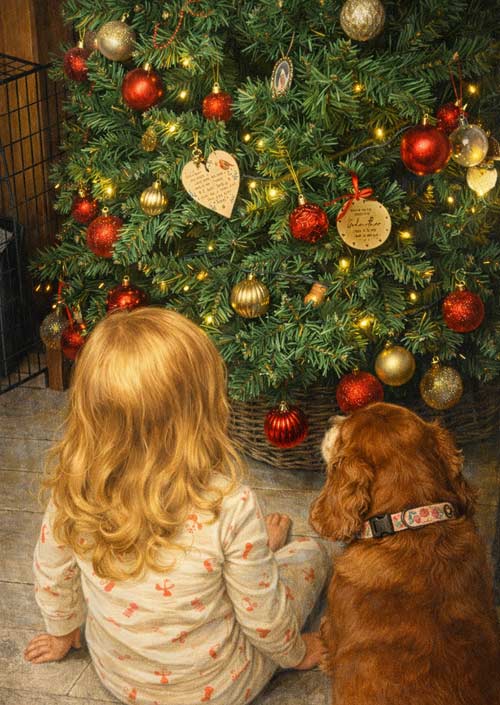
Before you take down the Christmas tree, take one last photo of the kids in front of it, then try the following. Having dropped your image into ‘chatGPT‘, request the advanced AI chatbot, to “Please turn this photo into a Norman Rockwell-style painting“.
Christmas 2025.
Norman Rockwell’s work is famous for warm, detailed scenes of everyday family life, the kind that feel instantly nostalgic. The result can be a beautiful, print-ready keepsake for your wall, and even better, a perfect start on next year’s Christmas cards. [Please view HERE]
🎄✨ For expected result see above picture. Same will be returned with properties of over 3.00 MB in size, suitable for a high quality 10 X 8in print. If you try it, post your copy on our facebook, we would love to see your Christmas memories turned into something timeless.
Wishing all athletes and their families a very Happy Christmas and a healthy 2026.
Basketball training has been moving forward most satisfactorily this season so far. We have huge numbers turning out each week for exercising, ball skills and basketball training.
Well done to each of them and their families and carers for transporting the athletes to every session. We welcomed a group of new volunteers this season and they have blended in very nicely with our existing group.
Thanks to all the volunteers and Mr Martin Hehir, at the Presentation Sports Hall, for their support.
We held our annual Christmas party in Meitheal on Wednesday, December 10th last and a great night was had by all present.
A big thank you to Linda and Meitheal Staff, Mr Paul Scully from Photo Station who looked after the photographs on the night, the volunteers who prepared the gifts and assisted at the party and all the athlete members who danced and sang on the night.
Training resumes on Wednesday January 7th, and in the meantime a very Happy Christmas to everyone associated with Thurles Special Olympics Basketball Club.
This website uses cookies to improve your experience. We'll assume you're ok with this, but you can opt-out if you wish.AcceptRead More
Privacy & Cookies Policy
Privacy Overview
This website uses cookies to improve your experience while you navigate through the website. Out of these, the cookies that are categorized as necessary are stored on your browser as they are essential for the working of basic functionalities of the website. We also use third-party cookies that help us analyze and understand how you use this website. These cookies will be stored in your browser only with your consent. You also have the option to opt-out of these cookies. But opting out of some of these cookies may affect your browsing experience.
Necessary cookies are absolutely essential for the website to function properly. This category only includes cookies that ensures basic functionalities and security features of the website. These cookies do not store any personal information.
Any cookies that may not be particularly necessary for the website to function and is used specifically to collect user personal data via analytics, ads, other embedded contents are termed as non-necessary cookies. It is mandatory to procure user consent prior to running these cookies on your website.










Recent Comments