Gardaí arrest 193 motorists on suspicion of drink and drug-driving over St Brigid’s bank holiday weekend.
Gardaí arrested 193 drivers on suspicion of driving under the influence of alcohol or drugs during an enhanced road safety operation over the St Brigid’s bank holiday weekend.
The operation, which ran from Friday 30th January to Monday 2nd February, also saw more than 660 vehicles detained, with around half detained for having no insurance. Gardaí said there were two fatalities on Irish roads over the weekend and 15 serious injuries. Thirteen people have died on Irish roads so far this year.
During the four-day period, gardaí and GoSafe mobile and fixed speed cameras detected almost 3,500 motorists speeding, with the highest volume recorded on the bank holiday Monday, when more than 800 speeding detections were made.
Separately, nearly 400 drivers were detected for driving while using a mobile phone.
Among the notable speeds detected over the weekend were:
95km/h in a 50km/h zone on the Malahide Road, Dublin 3.
90km/h in a 50km/h zone on the R405, Celbridge, Co Kildare.
86km/h in a 50km/h zone on the R183, Doohamlet, Co Monaghan.
134km/h in a 60km/h zone on the Katherine Tynan Road, Dublin 24.
123km/h in a 60km/h zone on the R154, Trim, Co Meath.
95km/h in a 60km/h zone on the R267, Bundoran, Co Donegal.
154km/h in an 80km/h zone on the N16, Glencar, Co Sligo.
130km/h in an 80km/h zone on the R239, Fahan, Co Donegal.
113km/h in an 80km/h zone on the N59, Westport, Co Mayo.
190km/h in a 100km/h zone on the N4, Aughamore, Co Leitrim.
173km/h in a 100km/h zone on the N18, Ballinacurra (Weston), Limerick.
140km/h in a 100km/h zone on the N4, Multyfarnham, Co Westmeath.
Gardaí renewed their appeal to all road users not to drive distracted, not to drive under the influence of drugs or alcohol, to drive within posted speed limits and to always wear a seatbelt.
An Order have been signed to commence key aspects of the Gambling Regulation Act 2024, to allow the Gambling Regulatory Authority of Ireland (GRAI) to begin issuing remote and in-person betting licences.
The signing of the commencement order, which comes into effect tomorrow Thursday, February 5th 2026, enables the Authority to start accepting and processing applications, and issuing licenses for remote and in-person betting operators. It also commences the necessary enforcement and oversight and complaints mechanisms that underpin the new licensing framework. In addition, the order commences those sections of the Act that amend and repeal existing legislation on the statute book. In particular, it will repeal the Totalisator Act 1929 and the Betting Act 1931.
The Commencement Order confers robust investigative powers to the GRAI and allows for administrative sanctions of fines of up to €20 million or 10% of a licensee’s turnover, whichever is the greater, to be imposed on licensees, where they are found to be in contravention of the Gambling Regulation Act 2024.
A number of criminal enforcement powers will be commenced, as will provisions which will allow the GRAI to apply to the Court for an order directing illegal operators to cease operations.
The order also provides for the commencement of several other key measures including:
Prohibiting the use of credit cards as a means of payment for gambling;
Prohibitions on allowing a child to gamble or to be employed by licensees;
Enabling customers to set monetary limits on how much they can gamble on-line or remotely;
Obligations on licensees to notify the Authority of suspicious gambling activity;
Obligations on remote gambling providers to protect children online;
Regulating the operation of online gambling accounts;
Safeguards for account holders such as the ability of the Authority to limit the amount of money that may be lodged with a licensee; and obligations concerning the closure of accounts and refunds of monies.
Switzerland didn’t “get lucky” with clean rivers. It decided, in law, in funding, and in enforcement, that clean water is basic infrastructure. After decades when wastewater and industrial pollution badly damaged waterways, Switzerland eventually hard-wired wastewater treatment into national policy. By 2005, some 97% of the population was connected to a central sewage treatment plant.
And Switzerland didn’t stop at “good enough”. A revised waters protection law took effect on January 1st 2016, requiring many treatment plants to add extra purification stages to tackle trace pollutants. Today, Switzerland’s own federal assessment says bathing water in lakes and rivers is generally very good, with more than 97% of assessed bathing waters at least “sufficient”.
That’s the core lesson; clean rivers don’t come from speeches. They come from a system that measures, funds, upgrades, and insists on outcomes.
Now let us look at the Suir in Thurles. A river described as “disgraceful” in a town that should be proud of a God given assett. Indeed, the positioning of the River Suir should be one of Thurles’s defining assets. Instead, the public record reads like a running argument, frustration, photos, political rows, and a river that locals and officials say is fast “slipping away”.
Video hereunder shows one area of River Suir in the heart of Thurles town.
At a Tipperary County Council meeting, one councillor described the Suir running through Thurles as “disgraceful, embarrassing and shocking”, alleging rubbish, trolleys and “raw sewerage”. Local radio carried similar comments in 2024, calling the river an “eyesore” and “an embarrassment to the town”. This is not just “bad optics”, it’s a signal to the people on the ground that local government, charged with keeping essential infrastructure working and keeping the environment protected, is now seriously broken.
Tipperary County Council says it has a remit. Residents are asking, “Where are the results?” A national newspaper reported that EPA sampling, at Thurles Bridge in 2023, found the river “poor”, and quoted the council saying it has “a statutory remit to maintain and protect the water quality status of rivers” and works with the Local Authority Waters Programme (LAWPRO). Fine, but “remit” isn’t recovery. LAWPRO’s own reporting at a public meeting in Templemore captured what many locals believe is happening in the Suir catchment around Thurles; declines in water quality, impacts on fish and aquatic life, and “river weed growth” and “general neglect”, much of it linked to excessive nutrients. So the public isn’t imagining that something is wrong. Multiple sources, local reporting, stakeholder meetings, and the council’s own statements about responsibility, all point back to the same uncomfortable truth; the river needs a plan that delivers measurable improvement.
The wastewater system is a known pressure point, and the utility admits it Here’s the part that should end the “who’s to blame” merry-go-round. Uisce Éireann’s own project page for Thurles states plainly that “the current wastewater infrastructure in the town is inadequate” and that upgrades are required to meet environmental compliance and “alleviate flooding issues”. When your own infrastructure provider says the network is inadequate, it’s no longer credible to treat river decline as a mystery. It becomes a delivery question, what is being done, by when, and how will the river show improvement?
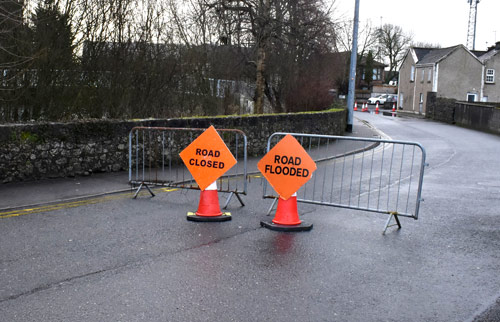
Robert Emmet Street, Thurles, closed today due to flooding for the second time in past 3 months.
Flooding, when the river rises, the same arguments return. This week, Tipperary County Council issued an operational update noting elevated levels on the Suir and overtopping in parts of the catchment area. Local press also reported flood scenes in South Tipperary, with the council saying water levels had risen and overtopping had occurred at several points. Thurles residents are familiar with what follows: the river rises, pinch points show up fast, and the anger sharpens around a simple claim, basic river management and preventative maintenance are not being done consistently enough.
A Thurles.Info article (November 2025) illustrates the Emmet Street riverside walkway and describes it as unserviceable due to flooding, arguing that repeated warnings over a 13-year period have not been matched by the maintenance needed to prevent blockages and overflow. To be clear, the precise causes of any single flooding incident, whether reeds, silt, debris, undersized drainage, or all of the above, require engineering assessment. But the political point is unavoidable, if people can’t see routine, transparent upkeep and enforcement, they assume it isn’t happening.
And here’s the paragraph Ireland can’t ignore: we have the money What turns this from local frustration into national hypocrisy is the scale of spending Ireland is willing to contemplate elsewhere. The Irish Government has backed the Water Supply Project for the Eastern and Midlands region, intended to bring a new long-term water source from the Shannon system towards the greater leaking Dublin area. RTÉ reported the proposal would take about 2% of the average flow and was estimated to cost €4–€6 billion. The Department’s own press release gives a preliminary cost estimate of €4.58bn to €5.96bn (verified through an expert review process).
So yes: Ireland can mobilise billions for water infrastructure for Dublin when it chooses. Which makes the Suir question harder to dodge: how can we plan to move vast volumes of water across Ireland while towns like Thurles are still fighting over basics; river health, monitoring, enforcement, and routine maintenance?
Switzerland vs Thurles: the difference is measurable accountability Switzerland’s lesson isn’t “be rich” or “buy better technology”. It’s this, treat water quality as a deliverable.
If Thurles wants a Suir that supports biodiversity, recreation, tourism, and doesn’t become a recurring source of anger, then the county needs to stop treating the river like a PR problem and start treating it like infrastructure with a public scoreboard:
Quarterly updates on the Thurles stretch (water quality trend points, incident reporting, actions taken).
A clear, named lead for publishing progress locally, one place the public can check.
Transparent milestones for the wastewater upgrades already acknowledged as necessary.
A preventative maintenance programme that is visible, scheduled, and publicly reported, so people aren’t left guessing until the next flood.
Switzerland didn’t fix its rivers by talking. It fixed them by building a system that delivers, and proving it, year after year. Thurles deserves the same axtion and seriousness.
Ireland’s Daily Drug Docket: Punish the Profiteers, Treat the Addicted.
Hard on Supply, Human on Use: Time for Common Sense in Irish Drug Policy.
Spend any time around a District Court and you quickly get the sense of a system carrying a weight it was never designed to hold. Day after day, more people find themselves before the courts on drug-related charges; possession, small-scale supply, probation breaches linked to use, and the petty crimes that trail behind addiction, like a shadow.
The scale is not anecdotal. In 2023, the courts made 21,907 orders in relation to drug offences in the District Court alone, involving 15,858 defendants. The wider crime picture is hardly reassuring either: the CSO recorded 16,119 incidents of controlled drug offences in 2024, and noted that the decline that year included falls in both possession for sale/supply and personal use incidents. Even if the trend line moves up or down in a given year, the reality in communities is constant: drugs are an everyday presence, and the courts are one of the last public services left standing at the point of crisis.
Against that backdrop, it infuriates decent people to see what looks like “soft” sentencing for dealers, especially when the damage is so visible. Families are burying loved ones. The Health Research Board recorded 343 drug poisoning deaths in 2022, a grim number behind which sit real kitchens, real bedrooms, real unanswered phones.
So why, people ask, does someone caught dealing sometimes receive a shorter sentence because they have no previous convictions and plead guilty early?
The first uncomfortable answer is that sentencing in Ireland is not a simple “one crime, one fixed penalty” system. Judges set a sentence based on the seriousness of the offence, then adjust it for aggravating and mitigating factors. Two of the most common mitigating factors are (a) no previous convictions, and (b) an early guilty plea.
The logic of the guilty plea is not mysterious, even if it sticks in the throat. A timely plea saves court time, shortens lists, avoids a contested trial, and often spares witnesses the ordeal of giving evidence. Citizens Information says plainly that you can generally expect a reduced sentence for pleading guilty, because it saves time and can be seen as remorse. The Director of Public Prosecutions’ own guidelines also recognise that a guilty plea is a factor to be taken into account in the mitigation of a sentence.
A clean record is treated as relevant because courts look not only backwards at wrongdoing, but forwards to the likelihood of rehabilitation and reoffending. It doesn’t mean “good character” cancels out harm. It means the system is trying, sometimes clumsily, to calibrate punishment to a person as well as to an act.
None of this means the law is blind to serious trafficking. Ireland’s Misuse of Drugs Act has a specific high-value supply offence, the well-known €13,000 threshold, aimed at commercial dealing and importing. Citizens Information summarises the core idea: for importing drugs at that level, there is a very severe sentencing framework, with limited scope to depart where the court finds exceptional circumstances. In other words, at the top end, the law’s intent is deterrence and long sentences. If the public perception is that dealers “walk free”, the more likely explanation is that many of the cases clogging lower courts are not kingpins, but street-level, low-level, or messy hybrid cases where addiction and dealing overlap, and where the headline seriousness is assessed differently.
But the deeper question is not really about discounts for pleas. It is about who we choose to blame. In the public conversation, users are often spoken about as if they are simply reckless, selfish adults who should carry full moral responsibility for every ripple of harm that follows. Yet, as anyone who has watched addiction up close knows, dependence is not a lifestyle accessory. It is frequently bound up with trauma, mental ill-health, homelessness, coercion, and despair. That reality is precisely why the Citizens’ Assembly on Drugs Use recommended that the State introduce a comprehensive health-led response to possession of drugs for personal use, responding primarily as a public health issue rather than a criminal justice issue, even while possession remains illegal.
This matters because criminalising users can make the problem worse. A conviction narrows employment, housing, and education options. Shame drives people away from services. Fear keeps people silent when they should be calling for help. Meanwhile, organised supply adapts, recruits, and replaces. If we’re honest, the criminal courts are often being asked to do the work of health, housing and social care, at the wrong end of the pipeline.
That doesn’t mean turning a blind eye to crime. It means recognising different roles in the drug economy and responding accordingly. A person in addiction who possesses a small amount is not the same as the person profiting from others’ dependence. The law already distinguishes, but our rhetoric often doesn’t.
There are also practical models that point in a better direction. The Drug Treatment Court in Dublin is explicitly designed as a supervised treatment and rehabilitation programme for offenders with problem drug use, as an alternative to custody in suitable non-violent cases. It is not soft. It is structured. It requires engagement, monitoring, and consequences for non-compliance. But it is at least an admission of reality: that for some offenders, reducing harm and reoffending means treating addiction rather than simply warehousing it.
So where does that leave the public anger, the very real anger, at dealers and the devastation around them? We should direct it with precision. The profiteers, the organisers, the coercers, the groomers of teenagers, the ones who intimidate communities and treat addiction as a business model, they deserve the full force of law and sustained policing pressure. The legislation exists to impose very serious sentences in the higher-end cases, and it should be applied firmly where the evidence supports it.
But if we keep pouring users through the courts as if punishment alone will cure dependency, we will continue to fill lists, fill cells, and fill graveyards, while congratulating ourselves on being “tough”. A country can be hard on the trade and humane to the addicted at the same time. In fact, if we want fewer victims, it is the only approach that makes any sense.
A 31-year-old man has appeared before a District Court sitting in Thurles, charged with the murder of Timothy (“Teddy”) Murnane, aged 81, a retired bus driver from St Michael’s Avenue, Tipperary Town.
Thurles Courthouse.
The accused, Mr Sean Harding, of Marian Terrace, Tipperary Town, had previously faced a charge of assault causing harm to Mr Murnane at the same address on September 12th 2025. On Wednesday, that assault charge was withdrawn on the direction of the Director of Public Prosecutions (DPP), and Mr Harding was charged with murder.
The court heard Mr Murnane was discovered with head injuries at his property at about 9.35pm on September 12th 2025. Paramedics attended before the victim was taken to University Hospital Limerick, where he died on September 14th 2025.
Det Garda Conor Gleeson, of Cashel Garda Station, gave evidence of arrest, charge and caution. The court was told that when the charge was put to Mr Harding after caution, he replied “No.”
Sgt Cathal Godfrey told the court the DPP had directed that Mr Harding be tried on indictment on the murder charge at a sitting of the Central Criminal Court.
The court also heard Mr Harding had previously been charged with three counts of burglary, with the DPP directing that he be sent forward on two of those charges, while clarification was being sought in relation to the third.
Mr Harding, represented by solicitor Mr Colin Morrissey, was remanded in custody to appear at Tipperary Town District Court (sitting in Thurles) on February 4th 2026 for service of the book of evidence and to address outstanding directions relating to the burglary charges.
This website uses cookies to improve your experience. We'll assume you're ok with this, but you can opt-out if you wish.AcceptRead More
Privacy & Cookies Policy
Privacy Overview
This website uses cookies to improve your experience while you navigate through the website. Out of these, the cookies that are categorized as necessary are stored on your browser as they are essential for the working of basic functionalities of the website. We also use third-party cookies that help us analyze and understand how you use this website. These cookies will be stored in your browser only with your consent. You also have the option to opt-out of these cookies. But opting out of some of these cookies may affect your browsing experience.
Necessary cookies are absolutely essential for the website to function properly. This category only includes cookies that ensures basic functionalities and security features of the website. These cookies do not store any personal information.
Any cookies that may not be particularly necessary for the website to function and is used specifically to collect user personal data via analytics, ads, other embedded contents are termed as non-necessary cookies. It is mandatory to procure user consent prior to running these cookies on your website.








Recent Comments