|
|
Irish Government approval secured for the findings of the Review of Ireland’s opt-in Protocol on the area of freedom, security and justice (Protocol 21).
The findings of the Review, a legal mechanism that is part of the Treaties of the European Union and which uniquely provides for Ireland to be able to opt-into measures that relate to the area of freedom, security and justice on a case-by-case basis; has today been published.
Protocol 21, together with Protocol 19 and Protocol 20, provide Ireland with flexibility in its approach to European integration in potentially politically sensitive areas and allows for a pragmatic approach to its engagement with the Area of Freedom, Security and Justice (AFSJ).
The review, which is available HERE, was undertaken by the Department of Justice and informed by detailed statistical analysis of relevant legislation, internal and external consultations, and by a targeted consultation process with a range of key stakeholders, facilitated by the Institute for International and European Affairs (IIEA).
The Review recommends that Ireland continue to be covered by Protocol 21. It also recommends that greater adherence be given to the undertaking in Declaration No. 56, which was made by Ireland at the time of the negotiation of the Protocol, and which commits to Irelands participating, to the maximum extent possible, in all measure covered by the Protocol.
The Review’s headline recommendations, approved by Government, are that:
- Ireland should continue to be covered by the terms of Protocol 21.
- That greater adherence be given to the undertaking in Declaration No. 56 to the Treaties to exercise Ireland’s right under Article 3 of Protocol 21 to take part in JHA measures to the maximum extent possible.
- The review also recommends the following additional actions that the Department of Justice should consider further:
- To participate in Justice and Home Affairs (JHA) measures by default, opting out only where concrete and well-defined national interests are at stake.
- To undertake a comprehensive, retrospective review of all the Protocol 21-related measures in which we do not participate and determine whether we can accede to these measures or not.
- To consider, to the extent practicable, mirroring via domestic legislation those EU measures which it has not opted into due to administrative constraints.
- To explore the possibility of joining the European Public Prosecutor’s Office.
- To explore the creation of a specialised body to facilitate the processing of mutual assistance and mutual recognition requests in a more efficient way.
Go Purple Day – An Garda Síochána’s National Day for domestic abuse awareness – takes place next week, on Friday 30th May.
Go Purple Day aims to increase awareness of domestic abuse and the supports available to those experiencing it. An Garda Síochána encourages you to get involved and support this years Go Purple Day Campaign by baking purple; sewing purple or wearing purple.
Perhaps you might invite friends in for tea or hold a coffee morning in the office. All ideas are welcome!
Above all, An Garda Síóchána asks that you speak to one another about this issue. Without realising, you might just give someone the crucial support they’ve needed to begin to share some of the fear they deal with alone.
If you or someone you know is a victim of domestic abuse, please contact 999 or 112 or your local Garda station.
Research report entitled “Operation of In Camera Rule in Family Law Proceedings” now published.
Today the Review of the Operation of the ‘In Camera’ Rule in Family Law proceedings was published. The review, latter a key action in the Family Justice Strategy, was conducted by a team from University College Cork and Trinity College Dublin.
Some types of court proceedings, including family law proceedings, are not open to members of the public; they are held in private; or what is often termed ‘in camera’, with restrictions placed on what can be reported. The intention behind this is to ensure the privacy of the parties in such proceedings and any children to whom those proceedings may relate.
This is being observed as an important piece of research which details the perspectives of many stakeholders regarding the current understanding and operation of the ‘in camera’ rule in family law proceedings. Importantly, it includes the views of those who have been parties in such proceedings, with the authors of this report being Dr Aisling Parkes, Dr Simone McCaughren and Dr Kenneth Burns.
Currently, the starting point for any consideration of the ‘in camera’ rule, whether in family law proceedings or otherwise, is Article 34.1 of the Constitution which provides that justice shall be administered in public, save such special and limited cases as may be prescribed by law.
The new report contains 21 recommendations in total, including:
- The need to retitle the rule to ensure it is understood by all family court users.
- That it is clearly and consistently defined.
- That its operation does not impede parties accessing support outside Court.
The report also recommends that family law proceedings continue to be held in private, and that the privacy rights of children and parties to proceedings be maintained. It recommends that the Court should retain its discretion to lift the rule in cases where it is deemed to be in the interest of justice to do so.
The report also contains a number of recommendations to promote greater transparency, including that there should be a presumptive right for all journalists and other authorised members of the media who are members of the Irish Press Council and subscribe to its ethics and standards and/or those of Coimisiún na Meán (Media Commission) to attend family law proceedings.
It also recommends that a private family law reporting system be established.
Officials will now consider this report and revert by the end of this year with policy proposals for government consideration that will reform the ‘in camera’ rule.
In the coming weeks a tender is expected to be issued for the establishment of a Private Family Law Reporting Project.
- New GNIB Facilities Planned for Shannon Airport.
Fine Gael Deputy Mr Joe Cooney is calling for increased resourcing to tackle the illegal drug trade across the Mid-West region, after figures released to the Clare Fine Gael TD reveal that there are just 18 Garda members assigned to the Clare/Tipperary Divisional Drugs Unit.
In response to a Parliamentary Question (PQ), the Minister for Justice, Mr Jim O’Callaghan, said that 15 Gardaí and 3 Sergeants are currently attached to the Divisional Drugs Unit, which covers an area stretching from Loop Head Lighthouse, West Clare – to Ballyvaughan, North Clare – to Carrick-on-Suir, South Tipperary.
Deputy Cooney stated, “Tackling drug dealing and targeting the work of organised crime groups, who inflict intimidation, violence, and misery on families and communities across Ireland, must be a top priority for this Government.
I fully support the measures being taken at national level as part of Government plans to tackle illegal drug use, but there is a need for greater resourcing of our Drugs Units.
Measures such as increasing the maximum sentences for those who direct gangland and drug-related crime, and introducing initiatives aimed at breaking the link between gangs and the children they try to recruit, are welcome,” he explained.
“However, the resourcing of our Drugs Units remains our most effective tool for taking drugs off our streets and cracking down on those directly engaged in drug trafficking.”
He continued: “The Clare/Tipperary Divisional Drugs Unit has been doing outstanding work in tackling the scourge of illegal drugs in our communities — but they urgently need more resources to sustain and strengthen that effort. I am calling on the Minister for Justice and Garda management to allocate additional personnel and resources to the Divisional Drugs Unit to support the great work they are doing as highlighted in recent significant seizures. We need to ensure that Gardaí on the front lines of this fight have the tools, support, and numbers required to disrupt drug networks, protect our young people, and safeguard our towns and rural communities.
Drugs are destroying lives and tearing families apart. A strong, well-resourced Divisional Drugs Unit is critical to turning the tide and restoring a sense of safety and security across Clare and Tipperary,” he added.
Meanwhile, Deputy Cooney has received confirmation from the Minister for Justice of plans to develop new facilities for the Garda National Immigration Bureau (GNIB) at Shannon Airport.
In response to the Clare TD’s PQ on the GNIB, Minister O’Callaghan said the Shannon Airport Group is currently developing a design scheme to redevelop the Arrivals Hall, including new, modern facilities for the GNIB and other State functions.
The Minister commented, “The GNIB, and other State bodies, have recently approved the design layout for their new accommodation and the next step is the commencement of the tender process by the Shannon Airport Group. The works, which will be required to be phased to ensure the continuation of services, are currently expected to be complete in 2027, subject to agreement on funding and the appropriate governance approvals being in place.”
As of May 2025, 13 Gardaí are based at Shannon Airport, consisting of both Sergeant and Garda ranks.
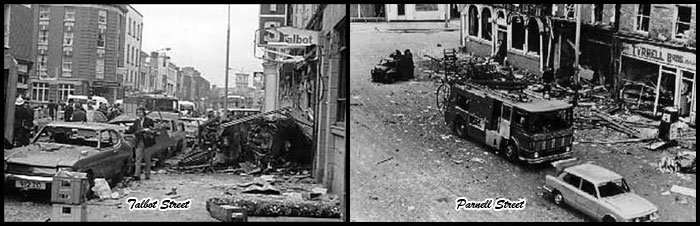
Here in Co. Tipperary today, we again remember the two victims of the Dublin bombings; both murdered in the city, 51 years ago this very day, 17th May 1974.
In Dublin city car bombs were detonated without warning during rush hour, resulting in the murder of Miss Breda Turner, Thurles, Co. Tipperary aged 21 years and Mrs Maureen Shields, aged 46 years, originally from the village of Hollyford, west Co. Tipperary.
Mrs Shields, married with one son and two daughters, was murdered in the Talbot Street explosion, while Miss Turner, who was then engaged to be married on the following Easter, was murdered in the Parnell Street explosion.
It is at this time also that we remember Mr George Bradshaw, aged 30 years, a bus conductor from Fethard, Co. Tipperary, who was a victim of the Dublin bombing of December 1st 1972, at Sackville Place, in the city.
Statement by the Minister for Justice Jim O’Callaghan on the 51st Anniversary of Dublin and Monaghan Bombings.
“Today marks the 51st anniversary of the Dublin and Monaghan bombings, a devastating series of coordinated explosions in Dublin city centre and in Monaghan town.
Today, we remember all those that tragically lost their lives and we remember the survivors of the bombings. We think of their families and friends whose loved ones were injured or killed, and who have carried unbearable loss and traumatic memories for over five decades.
The Government will not forget our duty to the victims and survivors, and we will persevere in our efforts to seek out the truth behind the tragic events of 17 May 1974 and, hopefully, secure some measure of comfort for those effected by these callous attacks.
We have worked consistently to implement the all-party motions which call on the British Government to allow access to all relevant documents relating to the Dublin-Monaghan bombings and I specifically raised this issue with the British Government at the recent meeting of the British-Irish Intergovernmental Conference at Hillsborough Castle.
The investigation into the bombings remains an open case in this jurisdiction. Any new evidence that comes to light will be fully investigated by An Garda Síochána.
The Government is committed to working with victims’ groups and our Northern Ireland and British counterparts to develop fit-for-purpose mechanisms to meet the needs and expectations of all those impacted by those dark days, including the victims of the Dublin and Monaghan bombings. We will play our full part in legacy processes including addressing the legacy of the conflict in this jurisdiction.”
Former Northern Ireland Police Ombudsman, Baroness Nuala O’Loan (Member of House of Lords
of the United Kingdom), previously found that Special Branch officers gave the killers immunity,
thus ensuring that the murderers were never brought to justice.
|
Support Us Help keep Thurles.info online by donating below. Thank you.
Total Donated 2026: €290.00
Thank You!
Daily Thurles Mass Livestream
|








Recent Comments