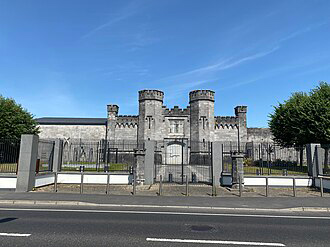
A man in his 50s, and the chief suspect in the suspected murder, has again been rearrested in connection with the death of an 89-year-old woman in Nenagh, Co Tipperary.
Mrs Josephine (Josie) Ray (née O’Meara), also known as Joan, with an address at St Joseph’s Park, Nenagh, Co Tipperary, was found with severe bruising to her face. Blood was also found close to her body and a pillow seized as part of the murder probe, was subjected to a full forensic examination. Emergency services located Mrs Ray’s deceased body just after midday, on Sunday August 4th, 2024 last.
The male arrested today remains detained under the provisions of Section 4 of the Criminal Justice Act. Previously, two people had been arrested, under Section 4 of the Criminal Justice Act 1984, in connection with the investigations into her death, but were both released later, without charge, with files prepared for the Director of Public Prosecution (DPP). We understand that this rearrest today, by gardaí, follows new information recently received in the case.
The couple arrested by gardaí on the same day as the funeral of Mrs Ray; were named as Mr Hasan Ali Gori and Ms Mary Ray (latter her daughter), both aged in their 50s, who both strongly deny any role in the death of Ms Ray’s mother.
Mrs Josephine Ray was well known throughout Nenagh, especially in her community of St Joseph’s Park. Following her murder, her funeral took place at St Mary of the Rosary Church, in Nenagh, where she was remembered as a woman of remarkable presence and a beacon of the town.
It was reported that gardaí had been called to Mrs Josephine Ray’s home on several occasions, during the weeks prior to her death; in an effort to deal with a number of different alleged complaints.
Gardaí will continue to investigate all of the circumstances surrounding this suspected murder.
Drug Searches Drop By 44% In Tipp-Clare Garda Division Says Fine Gael TD, Mr Joe Cooney.
Clare Fine Gael TD, Mr Joe Cooney has expressed deep concern at the significant decline in both the sharp reduction in drug-related searches carried out across the Tipperary/Clare Garda Division and the number of Gardaí serving in County Clare.
Fine Gael TD, Mr Joe Cooney
Deputy Cooney said he would be raising the matter directly with the Minister for Justice, calling for urgent action to boost resources and personnel allocated to the Divisional Drugs Unit and An Garda Síochána more broadly throughout the region.
New figures provided to Deputy Cooney reveal that Garda numbers in County Clare have fallen by over 8% since 2020 — decreasing by 27 from 314 to 287. In Ennis alone, Garda numbers have dropped from 190 to 167, while Kilrush has seen a reduction of eight Gardaí over the same period, with 55 now stationed there.
Meanwhile, the number of searches conducted under the Misuse of Drugs Act 1977/1984 across the Tipperary/Clare Garda Division has plummeted by a collosal 44%; from 2,726 in 2022 to 1,546 so far in 2024. There has also been a drop in overall detections of ‘Possession of Drugs for Sale and Supply’ and ‘Simple Possession’.
Deputy Cooney pointed out that just 18 Gardaí, same comprising 15 Garda members and 3 Sergeants, are currently assigned to the Tipperary/Clare Divisional Drugs Unit, which is tasked with covering a vast geographic area, stretching from Loop Head and Ballyvaughan in Co. Clare to Carrick-on-Suir in South Co. Tipperary.
“The Tipperary/Clare Divisional Drugs Unit has been doing outstanding work in tackling the scourge of illegal drugs in our communities, but they urgently need more resources to sustain and strengthen that effort,” said Deputy Cooney. “I am calling on the Minister for Justice and Garda management to allocate additional personnel and resources to the Divisional Drugs Unit to support the great work they are doing, as evidenced by recent significant drug seizures. We need to ensure that Gardaí on the front lines of this fight have the tools, support, and numbers required to disrupt drug networks, protect our young people, and safeguard our towns and rural communities.”
Deputy Cooney said that while he welcomed Government initiatives such as Operation Tara and the substantial increase in national policing budgets, more targeted resourcing is urgently needed in the Mid-West region.
“Tackling drug dealing and targeting the work of organised crime groups, who inflict intimidation, violence, and misery on families and communities across Ireland, must be a top priority for this Government,” he added. “I fully support the measures being taken at national level as part of Government plans to tackle illegal drug use, but there is a clear and pressing need for greater resourcing of our Drugs Units in areas like Tipperaryand Clare.”
Deputy Cooney confirmed he will be tabling questions to the Minister for Justice, Mr Jim O’Callaghan, and pressing for a clear plan to reverse the decline in local Garda numbers and restore search and enforcement capacity across the region.
During searches of five homes in counties Tipperary and Clare; as part of ongoing investigations into organised crime in the southern region, Gardaí have discovered four 3D printed firearms together with ammunition.
Gardaí also seized drugs with an estimated value of some €22,000 and have arrested one woman, understood to be in her 40s and a male, understood to be in his 30s, both of whom remain in custody for further questioning.
The firearms seized will undergo full ballistic testing and forensic analysis.
Final Implementation Plan For Zero Tolerance Strategy On Domestic, Sexual & Gender-Based Violence Published.
Priority areas include expanding refuge accommodation, advancing legislative reform, and cross-sectoral training initiatives for frontline professionals.
There are 95 actions in total across the strategy’s four pillars of protection, prevention, prosecution and policy co-ordination.
A robust monitoring and reporting framework establishes performance indicators to track progress and understand impact.
A targeted implementation plan for the final phase of Zero Tolerance, the Third National Strategy on Domestic, Sexual and Gender-Based Violence (DSGBV) has been published.
The implementation plan contains 95 actions across the strategy’s four pillars of Protection, Prevention, Prosecution and Policy Co-ordination, with a strong focus on delivery and collective action to 2026.
The DSGBV Agency Cuan worked in collaboration with officials from the Department of Justice and in close consultation with other Government Departments, state agencies and external stakeholders to develop the plan for 2025-2026.
Priority areas include continuing national leadership and cross government alignment, expanding refuge accommodation, delivering a comprehensive national emergency domestic violence accommodation plan, and advancing legislative reform. That legislative reform includes removing the guardianship rights of a person who has been convicted of killing their intimate partner; developing a mechanism to ensure any person in an intimate relationship can be informed if their partner has a history of domestic violence; and advancing provisions to ensure counselling records are only released where the Court decides that they contain material relevant to legal proceedings.
The plan also includes actions to continue to deliver impactful awareness campaigns on sexual consent and pathways to safety, and a comprehensive set of training actions to upskill front-line professionals across the health and social care sector, DSGBV services, the judiciary, courts and other justice agencies.
The development of the plan was collaborative and evidence informed, involving research and a review of implementation to date, followed by in-depth consultations with Government departments and state agencies. It takes an intersectional approach, ensuring that actions and outcomes are responsive to the diverse and overlapping identities of victims and survivors of DSGBV, supported by the development and establishment of survivor-centred structures to ensure that victim/survivor voice is heard. The work to develop foundational structures, build networks and relationships lays the groundwork for beginning the transition to a Fourth National Strategy on DSGBV.
Also published today is the second 2024 Progress Report, covering the period July to December 2024, which highlights continued progress across government and the sector in implementing the Zero Tolerance strategy.
Notable achievements during the reporting period include:
Expanding emergency accommodation capacity including launch of a state-of-the-art refuge facility in Wexford and strengthening the pipeline for refuge and safe home expansion.
Reform of the Social, Personal and Health Education (SPHE) Curriculum to empower students to be healthy and resilient young adults who have the skills and confidence to nurture healthy relationships.
Expansion of services for children and young people experiencing domestic or sexual violence, with €17m in funding distributed to 60 services supporting children and young people.
Enactment of the Family Courts Act 2024 providing for the establishment of family court divisions within the existing court structures including a Family High Court, a Family Circuit Court and a Family District Court.
Supporting the Game Changer campaign, a three-year initiative led by Ruhama, in partnership with the GAA and the Men’s Development Network, using sports-based advocacy to raise awareness of gender-based violence.
Convening of a National Consent Forum.
Engagement with the Central Statistics Office (CSO) to scope the development of a Domestic Violence survey to commence in 2025.
A new chapter for over 7,500 people who will be granted Irish Citizenship at the INEC Arena, Killarney, Co. Kerry.
Today and tomorrow over 7,500 people will be granted Irish citizenship at the INEC Killarney. Applicants from over 143 countries and across all 32 counties on the island will make a declaration of fidelity and loyalty to the State and become Irish citizens.
Over seven ceremonies held over two days, Minister for Justice, Home Affairs and Migration, MrJim O’Callaghan will be joined by Minister of State with responsibility for Migration, Mr Colm Brophy, and Minister of State with responsibility for International Law, Law Reform and Youth Justice, Mr Niall Collins.
Speaking ahead of the ceremonies, Minister O’Callaghan said: “This ceremony marks an important milestone in the lives of those receiving Irish citizenship. For each new citizen it signifies a deep connection to Ireland, its values, and its people. Ireland welcomes our new citizens as full members of society, and their contributions will undoubtedly strengthen the fabric of our nation. I encourage all new citizens to continue to actively engage in their communities so that, together, we can build a thriving society”.
Minister Brophy said: “I congratulate our newest citizens and wish each of them well as they begin this new part of their lives. Migration plays an essential role in Ireland’s development. It strengthens our economy, enriches our cultural diversity, and deepens our sense of solidarity. We are proud to welcome each new citizen as valued members of our communities.”
Minister Collins said: “Those becoming Irish citizens over the next two days are joining a diverse and inclusive Ireland. Citizenship is not only a right but a symbol of shared responsibility and mutual trust. These new citizens now have a place in shaping the future of Ireland. I sincerely congratulate each of our new Irish citizens. This is a proud and memorable day for them, their families, and for the whole country.”
The Presiding Officer at the ceremonies over the next two days is Judge Mr Paddy McMahon, who will confer the attendees with Irish Citizenship. He will administer the Declaration of Fidelity to the Irish Nation and Loyalty to the State. The new Irish citizens will undertake to faithfully observe the laws of the State and to respect its democratic values.
In just over two years the Citizenship Division of the Department has gone from processing around 12,000 applications a year to processing over 20,000 applications in 2023, and nearly 31,000 in 2024.
Significant changes have been introduced in the Citizenship Division of the Department of Justice, Home Affairs and Migration to speed up the application process for applicants, including the introduction of an online digital application, online payments, and eVetting. As a result, processing times are now decreasing year on year. The length of time it takes to process an application has dropped from 15 months in 2023 to 8 months in 2024.
It is expected that going forward, the vast majority of applicants will continue to receive a decision within one year, however, it is important to note that no two naturalisation applications are the same and some take longer than others to process.
This website uses cookies to improve your experience. We'll assume you're ok with this, but you can opt-out if you wish.AcceptRead More
Privacy & Cookies Policy
Privacy Overview
This website uses cookies to improve your experience while you navigate through the website. Out of these, the cookies that are categorized as necessary are stored on your browser as they are essential for the working of basic functionalities of the website. We also use third-party cookies that help us analyze and understand how you use this website. These cookies will be stored in your browser only with your consent. You also have the option to opt-out of these cookies. But opting out of some of these cookies may affect your browsing experience.
Necessary cookies are absolutely essential for the website to function properly. This category only includes cookies that ensures basic functionalities and security features of the website. These cookies do not store any personal information.
Any cookies that may not be particularly necessary for the website to function and is used specifically to collect user personal data via analytics, ads, other embedded contents are termed as non-necessary cookies. It is mandatory to procure user consent prior to running these cookies on your website.
Recent Comments