A man, understood to be aged in his 40s, remains fighting for his life after being doused in petrol and set on fire, during a violent incident in South Co Tipperary
Gardaí have confirmed they are investigating what they described as a serious assault in the Knockane area of Tipperary, shortly after 9:00pm last evening (Saturday October 11th).
We understand that emergency services treated the victim at the scene, before he was transferred by ambulance to Cork University Hospital suffering with critical injuries.
Two men, both in their 20s, were arrested a short time later in connection with the incident and are being detained under Section 4 of the Criminal Justice Act, 1984, at an unnamed Garda station in Tipperary.
In a statement, a Garda spokesperson has stated that investigations are continuing.
“Annual income twenty pounds, annual expenditure nineteen and six, result happiness. Annual income twenty pounds, annual expenditure twenty pounds nought and six, result misery”. Extract from Charles Dickens’s 1850 novel “David Copperfield”.
Government Confirms €473,000 Cost Of Recent Deportation Flight To Pakistan.
The Minister for Justice, Home Affairs and Migration, Mr Jim O’Callaghan, has confirmed that a chartered flight used to deport 24 men from Ireland to Pakistan on September 23rd last cost approximately €473,000 — almost €20,000 per person, the most expensive deportation operation to date this year.
It was the fourth chartered deportation flight in 2025, following earlier flights to Georgia and Nigeria, which together cost over €530,000. In total, 130 people have been deported via chartered flights so far this year, with a further 137 removals carried out on commercial flights by the Garda National Immigration Bureau (GNIB).
Mr O’Callaghan said the cost of the Pakistan flight may rise as invoicing is still being finalised. He noted that deportations are “costly and complex to enforce,” adding that voluntary returns remain the preferred option.
“The returnees on this flight were accompanied by Garda personnel, medical staff, an interpreter, and a human rights observer,” he added.
The Department of Justice has issued 3,035 deportation orders so far this year, up from 2,403 in 2024.
One wonders would it have been cheaper to have allowed them to stay and found them jobs in the catering industry at the new national minimum wage of €14.15 per hour, but then I suppose what with no houses and despite global warming, tents can be still be draughty in Ireland in our winters.
Sadly, the government Learjet 45 owned by Irish taxpayer has only 7 passenger seats and the new one we the taxpayers just bought for world influencers Mr Simon Harris and Mr Micheál Martin at a cost of €53m; (due for delivery Xmas 2025, in time for Ireland’s EU Presidency in the second half of 2026), will only have 10 seats.
Could they not have used an Emirates Economy Return Flight from Dublin to Karachi which would only have costs €842.37 per person, (a saving of €19,000 per person), but then I suppose unions representing Garda personnel, medical staff, an interpreter and a human rights observer, would have objected to travelling Economy Class. Meanwhile, we read last month that Community Foundation Ireland, ranks Ireland 16th out of 27 European Union countries when child poverty is rated.
Ms Karolina Kovacova, with an address at O’Callaghan’s Lane, Carrick-on-Suir, stands accused of the murder of Mr Pavel Javorski.
Gardaí and emergency services had been called to an apartment on O’Callaghan’s Lane on Saturday night, where Mr Javorski was found unresponsive. He was pronounced dead a short time later.
The victim Mr Javorski, aged in his 40s was a native of the Czech Republic, who had been living in Ireland for some 20 years.
A postmortem examination is understood to have confirmed that he died as a result of a violent assault.
Ms Kovacova, who is also from the Czech Republic and is understood to have been living in Ireland for a number of months. Detective Garda Ruairí Ryan informed the court that Ms Kovacova made no reply when the charge was put to her. Defence solicitor Mr Aidan Leahy told the court that prison would be a difficult environment for his client as she has very limited English, and he requested that she receive whatever assistance was currently available. Judge Mr John O’Leary remanded Ms Kovacova in custody and recommended to the prison governor that her vulnerability be taken into account.
She is due to appear before the court again today.
Gardaí are expected to launch a murder investigation following the discovery of a man’s body in a house in Carrick-on-Suir, Co Tipperary, late on Saturday night.
A 999 call was received shortly after 11:30pm, and emergency services arrived at the property on O’Callaghan’s Lane, in the town to find the man, believed to be in his 30s, with what are thought to be stabbing injuries in the living area of the house.
Paramedics attempted to resuscitate him, but were unsuccessful, and he was pronounced dead at the scene.
The State Pathologist’s Office has been notified, and the results of a post-mortem examination at University Hospital Waterford are expected to guide the direction of any future investigation. However, detectives are understood to be satisfied that the man’s injuries were not self-inflicted and are preparing to launch a full murder inquiry.
A 24-year-old woman from the Czech Republic was arrested at the scene on suspicion of assault. She is being detained at Clonmel Garda Station under Section 4 of the Criminal Justice Act, which allows gardaí to hold suspects for up to 24 hours before they must be charged or released.
Gardaí have not yet released the identity of the deceased pending notification of all next of kin, but it is understood he was originally from eastern Europe and had been living in the house for a period of time.
The scene remains sealed off for a forensic examination, and the Garda Technical Bureau is expected to travel from Dublin today to carry out a detailed analysis.
Meanwhile, gardaí have begun door-to-door inquiries in the O’Callaghan’s Lane area to establish whether anyone heard a disturbance or noticed suspicious activity in the cul de sac late on Saturday night.
Officers are also canvassing nearby homes and businesses for CCTV footage that may assist in tracking the man’s final movements.
An incident room has been set up, and investigators are appealing to anyone who may have information to contact Clonmel Garda Station Tel: (052) 617 7640.
Scientific facts published by Local Authority Waters Programme (LAWPRO). See HERE.
Water Quality in River Suir in Thurles only 33% satisfactory down from 61% in 2010-2012 which equals a relative drop of 46% in about 12 years.
Almost no aquatic life.Samples taken down stream of Thurles Bridge in town centre (Barry’s Bridge) on 11/09/24, result in no invertebrates typical of clean water such as Mayflies or Stoneflies – essential food for trout and salmon.
A few water shrimps (Gammarus), some biting Midge larvae (Simuliium) Extensive Cladophora algae.
Current data raises a harsh question: if our drinking water is so delicately balanced, how much “extra load” can rivers accept without tipping into crisis?
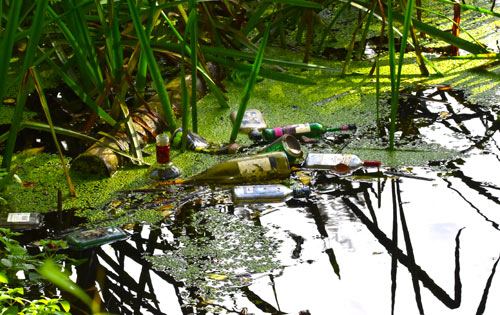
A small sample of floating bottles, River Suir, Thurles town centre. Pic: G. Willoughby. (Image taken Sept. 29th 2025)
Slurry Spreading: Tipperary’s Silent Pollution.
Hypocrisy is very much alive and well in Ireland, with the strict promotion of standards loudly proclaimed, yet quietly ignored when it comes to agriculture.
If an individual is caught illegally dumping a mattress or a bag of household rubbish, the law comes down hard. The penalties are steep: on-the-spot fines, €4,000 if convicted in the District Court, and up to €130,000 on indictment for more serious offences. Add to that the local authority’s investigation and legal costs, plus extra charges for continuing offences, and the message is crystal clear — thesepolluters will pay.
But here is the contradiction: when sewage or agricultural slurry is allowed to seep into our rivers, with the blessing of Tipperary Co. Council itself, the penalty is nothing, zero, zilch, no costs, no fines, no legal prosecution, and no accountability.
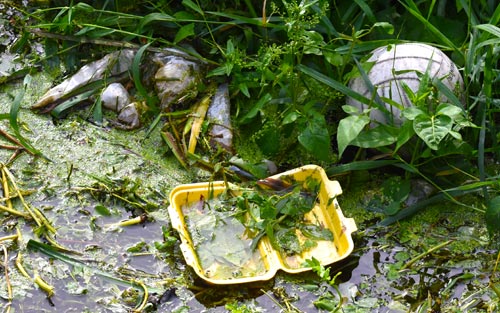
Just a small sample of the discarded litter at Barry’s Bridge, in River Suir, Thurles Town centre. Pic: G. Willoughby. (Image taken Sept. 29th 2025)
This double standard undermines public trust, punishes the ordinary citizen while shielding powerful interests, and leaves communities to live with the consequences — polluted drinking water, fish kills, and waterways turned into toxic drains. The rules are strict when it suits, yet curiously silent when the polluter is a farmer or an industry player with political influence.
Until agricultural slurry is treated as seriously as other forms of dumping, Tipperary and the rest of Ireland will continue to suffer the hidden, silent pollution that seeps into every stream and spring water well.
Tipperary was renowned for its rivers and lakes, the Suir winding through Thurles, the Shannon and its tributaries, and countless smaller streams supporting fish, wildlife, and local communities. Yet these waters are under increasing pressure, largely from the way slurry is managed on farms.
Slurry, a liquid mix of animal waste, provides a quick nitrogen boost to grass, making it popular among farmers. But its environmental costs are severe. Being liquid; slurry runs off easily during rainfall, carrying nutrients into rivers and lakes, triggering algal blooms, oxygen depletion and fish kills. Strong odours signal ammonia emissions, while heavy tankers compact soils, further increasing runoff.
By contrast, traditional dung releases nutrients slowly and enriches the soil with organic matter, improving structure, fertility, and biodiversity. Though slower to handle, it poses far less risk to water quality.
Evidence from EPA and Local Water Authorities The EPA’s 2023 report shows that many Irish rivers are failing to reach “good ecological status,” often due to nutrient pollution. In Tipperary, seven public water supplies, including Borrisokane, Nenagh, and Roscrea, are on the EPA’s Remedial Action List, meaning urgent improvements are needed. Dr. Fran Igoe from LAWPRO reports that water quality satisfaction in Tipperary has dropped from 61% to 33% over a 12 year period, with rivers around Thurles and Templemore particularly badly affected.
Voices from the Field Local anglers and fishing clubs have become strongly outspoken. Mr Joe O’Donoghue of Ormond Anglers says, “It’s doing untold damage to the river – the ecosystem is disappearing. Fly life we used to see in the evenings … it’s gone.” Inland Fisheries Ireland has prosecuted companies in Tipperary for slurry-related pollution. Ms Lynda Connor, regional director, states: “Ensuring clean and healthy water is not just a responsibility, but a necessity for the survival of fish and the ecosystems they thrive in.” Now the leading question “So why has Inland Fisheries Ireland not prosecuted Tipperary County Council for permitting sewage to flow into the River Suir?
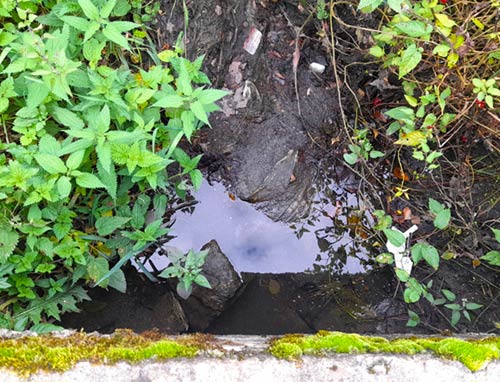
Mixed effluent flowing from a pipe on the river walk close to the rear of Thurles shopping centre. Pic: G. Willoughby (Image taken Sept. 29th 2025)
Time for Action. Tipperary as a county can no longer rely on excuses. The County Council, Uisce Éireann, and the Department of Agriculture must now act together and this will require:
Enforcement of slurry regulations with inspections and severe penalties.
Support for farmers to adopt safer alternatives, including dung use and low-emission spreading technologies.
An investment in water infrastructure, buffer zones, and monitoring.
An engagement with stakeholders such as anglers, environmental groups, and local communities in oversight and planning.
Short-term gains from slurry can no longer be allowed to outweigh the long-term damage to rivers, drinking water, and local ecosystems. Tipperary’s waters deserve decisive action now, before more fish die, more rivers are polluted, and the county’s natural heritage is irreversibly harmed.
Now regarding my last communication, which further updated details of the 12 year old River Suir pollution problem in Thurles; seven emails in total were sent 10 days ago, on Friday September 19th 2025 to:-
(1)Ms Sinead Carr(CE Tipperary Co. Council), [sinead.carr@tipperarycoco.ie]; ) Result: No Reply or acknowledgementreceivedto date.
(2)Ms Sharon Scully, (Thurles Municipal District Admin)[sharon.scully@tipperarycoco.ie]; Result: No Reply or acknowledgementreceived to date.
(3)Mr Darragh O’Brien (darragh.obrien@oireachtas.ie) (Minister for Climate, Energy and the Environment & Minister for Transport). Result: Correspondence acknowledged. (Ref: HPLG-MBO-03271-2025). Reply “Your correspondence is currently receiving attention and a further reply will issue as soon as possible”.
(4)Mr Alan Dillon (alan.dillon@oireachtas.ie) (Minister of State with responsibility for Small Businesses and Retail and Minister of State with responsibility for Circular Economy). Result: No Reply or acknowledgementreceived to date.
(5) Mr Timmy Dooley (timmy.dooley@oireachtas.ie) (Minister of State with responsibility for Fisheries, Minister of State with responsibility for the Marine). Result: Correspondence acknowledged. (Ref: CCAE-MOSD-00280-2025). Reply:“I would like to acknowledge your recent correspondence regarding Pollution of the River Suir. The contents of your email have been noted and I will bring this to the Minister’s attention and we will respond accordingly”.
(6)Environmental Complaints section EPA[E.Complaints@epa.ie], Result: Reply received as shown hereunder.
(7)Mr Robert O’Brien(A/Executive Scientist, Environment & Climate Action, Tipperary County Council, Civic Offices, Clonmel, Co. Tipperary).[robert.obrien@tipperarycoco.ie]. Result: Reply received as shown hereunder.
Hello George, You are correct to highlight the seriousness of the pollution of our rivers and the priority that must be given to public health and safety. Any immediate actions that could have been taken are completed. To address the overall issue and root cause will require a longer-term approach. The consultative process is not intended to be a talking shop, but this pilot study ensures accountability, coordination and long-term protection of the river and community. I appreciate this can be frustrating but reversing water quality decline often takes years to be realised. Any information you request must be formally applied for under the Freedom of Information Act 2014. Regards……….
This website uses cookies to improve your experience. We'll assume you're ok with this, but you can opt-out if you wish.AcceptRead More
Privacy & Cookies Policy
Privacy Overview
This website uses cookies to improve your experience while you navigate through the website. Out of these, the cookies that are categorized as necessary are stored on your browser as they are essential for the working of basic functionalities of the website. We also use third-party cookies that help us analyze and understand how you use this website. These cookies will be stored in your browser only with your consent. You also have the option to opt-out of these cookies. But opting out of some of these cookies may affect your browsing experience.
Necessary cookies are absolutely essential for the website to function properly. This category only includes cookies that ensures basic functionalities and security features of the website. These cookies do not store any personal information.
Any cookies that may not be particularly necessary for the website to function and is used specifically to collect user personal data via analytics, ads, other embedded contents are termed as non-necessary cookies. It is mandatory to procure user consent prior to running these cookies on your website.







Recent Comments