“On a clear day rise and look around you and you’ll see who you are.
On a clear day how it will astound you that the glow of your being, outshines every star.”
(Words by lyricist Alan Jay Lerner, from the musical “On a Clear Day You Can See Forever”.)
This weekend, weather permitting or not, one could do worse than take a leisurely drive into the area of the Knockmealdown mountains known as The Vee, situated on the remote, wild picturesque borders of Co. Tipperary and Co Waterford.
The Vee, situated on the R668 between Lismore, Co. Waterford and Clogheen in Co. Tipperary gets its name from a V-shaped bend on the road leading to a gap in the Knockmealdown mountains. The roadway itself is situated on the slopes of Sugar Loaf, passing from Tipperary to Waterford; running between Knockaunabulloga and Bay Lough (a low lying picturesque lake) on the right and the Sugar Loaf itself, on the left.
The heavy rain showers during the last few days will possibly have removed a great deal of that sea of pink rhododendron blossoms, stretching for as far as the eyes can see; freely growing in groves in the area, at mother nature’s discretion. However their absence will take little from the rugged, untended, wild beauty of this outstanding landscape, nor indeed the breathtaking panoramic views afforded to travellers and sight-seers.
From this viewpoint almost 2,000 ft above sea level, same lends itself to views across the valley to the towns of Clonmel, Cahir, and the lesser hamlets of Ardfinnan, Clogheen and Ballyporeen, latter village ancestral home to former late United States President Ronald Reagan. You can also view the Galtee Mountains the Comeragh Mountains together with Slievenamon, quite clearly from this vantage point.
Few people today refer to the 1975 British-American period drama film ‘Barry Lyndon’, directed by Stanley Kubrick, which chose this mountainous area ‘The Vee,’ as their period location. Based on the 1844 novel ‘The Luck of Barry Lyndon’, by William Makepeace Thackeray, this film won four Oscars in production categories and is today regarded as one of Kubrick’s finest films ever made.
This film starred Ryan O’Neal, Marisa Berenson, Patrick Magee, Hardy Krüger and, as shown in the clip above, Leonard Rossiter, the dancing Captain, (Remember “Rigsby” in Rising Damp & in the Title Role of “The Fall and Rise of Reginald Perrin”). The film recounts the exploits of a fictional 18th-century Irish adventurer.
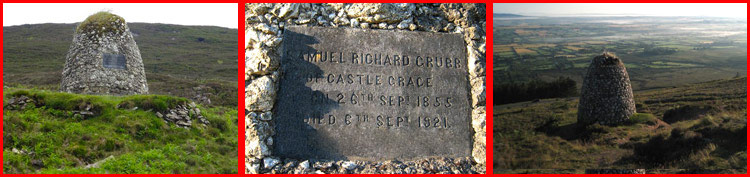
Samuel Richard Grubb, High Sheriff of Tipperary 1916.
It is here also at this scenic area that a rather curious pile of limestone rocks emerge, dome-shaped, from the hillside. This stone erection is the last resting place of Mr Samuel R. Grubb, appointed High Sheriff of Tipperary in 1916 and who requested that he be buried here to overlook a ‘picturesque and romantic view’ of his county.
Local tales that he believed he would be reincarnated into a bee in an after life situation (memorial shaped like a beehive) and that he insisted that he be buried with his horse standing upright are hardly believable, but facts we do know are recorded hereunder.
Picturesque Obsequies – Burial on Mountain.
Funeral of the late Mr S. R. Grubb. (As reported by the Clonmel Chronicle, 10th September 1921.)
“In accordance with his request, the remains of the late Mr Samuel R. Grubb were interred today on the Sugar Loaf Mountain, on his property. The place selected is a most picturesque and romantic one and commands an excellent view of the county for a considerable area.
The remains arrived in Castlegrace on Friday by motor hearse from Dublin, and the funeral started at 10.30 this morning. The coffin containing the remains was conveyed on a farm cart to the foot of the mountain and then carried on the shoulders of his tenants and employees to the place of internment on the mountainside.
On arrival at the grave the remains were received by Rev.J.Talbot, Clogheen, who conducted the Burial Service.
The scene on the wild mountain side was picturesque and impressive and will long remain implanted on the minds and hearts of those who had the privilege of witnessing it.
The chief mourners were – Major Raymond Grubb M.C. (Son), Mrs de Sales le Terriere (daughter), Mrs Grubb (daughter-in-law), Mr de Sales le Terriere (son-in-law), Mr Cecil Barrington, Mrs Taylor, and Mr James Binny.
There were a large number of beautiful floral tributes from, amongst others, Mrs Grubb (Widow), Major Grubb, Mrs Grubb (Suir Island), Mr and Mrs de Sales le Terriere, Mrs Denny, Mrs Gutherie, Lady Beatrice Pole-Carew and Mr D. Mahoney.
Those present in addition to the chief mourners included – Major Murdock, Major Hutchinson, Captain Seymour, Mr Gerard Denny, Mr Blakeney (Junr.), Dr W. Walsh, Mr Palmer, Mr Kennedy (Derrygrath), Mr Kennedy (Ballindoney), Mr E.Boyle, Mr J. Mulcahy (Corabella), Mr W.Byrne (Ballinamona), Mr Sutcliffe, Mr Geoffrey Prendegast, etc.
Acting in accordance with the directions of deceased, all the tenantry and employees who attended the funeral were subsequently sumptuously entertained at Castlegrace.”
Voluntas Ultima (Last Will) [The late Mr Samuel R. Grubb, of Castlegrace, requested that his remains should be interred in a beautiful and romantic spot on the side of the Sugar Loaf hills.]
————————————————— O place me in a silent grave upon the mountain crest, ‘Mid endless fields of golden gorse, the heather on my breast ‘Mid endless fields of golden gorse, O shape my narrow bed, Nor plant the cypress at my feet, the willow at my head.
O place me in a silent grave on storied Knockmealdown, The drowsy churchyard’s not for me, in country or in town; And when the final trumpet sounds and bids the world “Arise” ‘Twill find me nearer unto Thee, wherein salvation lies.
There have been rather strange rumours; (hush hush ‘goings-on’ even); emanating from the picturesque village of Kilcommon, Thurles, Co. Tipperary, over the past six to eight months. United Kingdom (UK) Metropolitan Police’s Royalty and Specialist Protection Command Officers have been observed, visiting the homes of elderly people and local historians.
We can now confirm, thanks to Kilcommon historians Mr Paddy Ryan and Parish Priest Very Rev. Daniel Woods, that these officers were attempting to locate the descendants of Lord Herbert Kitchener’s once Personal Protection Officer. These visiting officers were attempting to locate the descendants of a former native, named as Detective Sergeant Matthew McLoughlin, ahead of the Centenary of his death, latter which occurred during the First World War.
The UK Specialist Protection Squad, we understand, now intend to honour Detective Sergeant Matthew McLoughlin, by naming their new Offices after him, when they move from their current premises at Scotland Yard, later this year.
Sergeant McLoughlin, was born on a hillside in the townsland of Foilnadrough, a mile to the west of Kilcommon village; latter address located in the very scenic Slieve Felim Mountains (See Video above), some 32.2 km from Thurles via the R503. Matthew was born on February 6th 1879, to parents and local farmers Michael and Bridget McLoughlin, the seventh of 14 children.
Sergeant McLoughlin died, along with the British Secretary of State for War, Field Marshal Lord Herbert Kitchener(“Lord Kitchener of Khartoum,” – himself an Irish man, born in Ballylongford near Listowel, County Kerry), and some 734 others on June 5th 1916. The HMS Hampshire was sailing to Russia, carrying Field Marshal Lord Kitchener, when it is believed to have struck a mine laid by a German submarine. The cruiser sank with heavy loss of life, including Kitchener and his staff near Orkney; an archipelago in the Northern Isles of Scotland.
Matthew McLoughlin had joined the Metropolitan Police Service on September 17th 1900, after moving to London in January of that same year. He went on to join the Specialist Protection Unit in 1904; latter whose dedicated job it was to shield Royalty and UK Government Ministers.
McLoughlin married Margaret Amelie McLoughlin; possibly a lady of French origin (née Quernel, Queruel or Quesnel), in Kensington, west London, on January 13th 1912. The couple had one son, Michael Paul McLoughlin, born some three months later on April 19th 1912, in Wootton-St-Lawrence, west of Basingstoke; part of the Shire County of Hampshire.
Specialist Protection Command Officers now believe that Matthew’s son, Michael Paul, may have travelled to Caracas, in Venezuela. It appears that someone, bearing that same full name, applied for an overseas passport in the past.
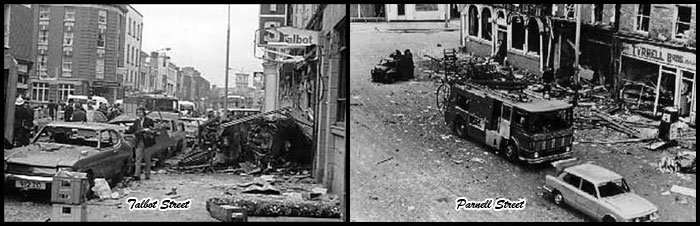
Today, the 17th of May 2016, marks the 42nd anniversary of the Dublin and Monaghan bombings in 1974.
Four devices exploded in both counties, taking the lives of 33 civilians and a full-term unborn child, while injuring almost 300 other innocent civilians; whose only crime was being in the vicinity.
In Dublin city three car bombs were detonated without warning, during rush hour on the 17th of May 1974, and shortly afterwards another bomb was exploded in Monaghan, some ninety minutes later.
Here in Co. Tipperary, today in particular, we remember two victims of this outrage; namely M/s Breda Turner and Maureen Shields.
Miss Breda Turner aged just 21 was working in the Office of the Revenue Commissioners, the primary State Body responsible for the assessment and collection of Taxes and other Duties here in the Republic of Ireland. Originally from Thurles, in Co. Tipperary, she had moved to Dublin and was engaged to be married on the following Easter.
Murdered in the Parnell Street explosion; M/s Turner was then survived by her parents, Bridget (Biddy) and Jimmy, together with other siblings.
Mrs Maureen Shields aged 46 was originally from the village of Hollyford, Co. Tipperary. Maureen had moved to Dublin, where she also worked in the Civil Service until her marriage to Leo in 1953. The couple had one son and two daughters.
Maureen was murdered in the Talbot Street explosion.
At this time of remembrance, let us not forget the Tipperary victim of the Dublin bombing of the 1st of December 1972.
Mr George Bradshaw, aged just 30, was a bus conductor from Fethard, in Co. Tipperary, one of two male victims who died when a car bomb exploded at Sackville Place at approximately 8.15pm on that fateful day. Both victims were bus drivers with CIE and brutally murdered, having just left the nearby CIÉ Workers’ Club.
Mr Bradshaw had only moved to Dublin less than two years previously. Married to wife Kathleen, a nurse from Belfast; both were parents to two young children, Lynn and Rory.
While these Dublin and Monaghan crimes in 1974 were the biggest mass murder in the history of the Irish state, no one person has ever been charged with these bombings. The Ulster Volunteer Force (UVF), a loyalist paramilitary group from Northern Ireland, claimed responsibility for the bombings in 1993.
Former Northern Ireland Police Ombudsman, Baroness Nuala O’Loan, found that Special Branch officers gave the killers immunity and officers ensured that the murderers were never caught.
“A Badly Wanted Man: The Story of Sean Hogan” by Tom Hurley.
Sean Hogan (1921)
There will no doubt be much interest generated in the Premier County and further afield in an upcoming four-part documentary due to be aired on Tipp Mid West Radio, which investigates the life of IRA freedom fighter Sean Hogan, a native of Stokaun, Greenane, situated just outside of Tipperary Town, in Co. Tipperary.
Sean Hogan first gained notoriety as a teenager from his role in the Soloheadbeg and Knocklong engagements of 1919. He went on to become one of the most wanted men in the British Empire for the duration of this Irish revolutionary period. Hogan together with Dan Breen, Sean Treacy and Seamus Robinson made up what was known as “The Big Four”, and participated in numerous other IRA engagements, which will be highlighted in this radio broadcast.
When the civil war ended in 1923 Sean Hogan did his best to re-adjust to some sort of normal life, but at times down through the years found this exceedingly difficult to achieve. Possible reasons for this are examined in detail in these broadcasts, along with a look at his time spent in America; jail; later family life; vices, and the circumstances behind his death in 1968.
The programmes, which chronicle his whole life, also reflect on the reasons behind his move to live to the Leinster area; querying why he never in later years provided a written account of his revolutionary activities, as did so many of his former comrades. These radio broadcasts will conclude with a look at his legacy and how he is regarded in his native county today.
His life story is investigated and revealed through incorporating material taken from newspaper accounts; parish records; census records, together with genealogical documentation and interviews recorded in his native county and further afield.
Contributors to the programmes include his son Sean Hogan (Jnr); his grandson Treacy Hogan; historians John Connors (Borrisoleigh), Tom Toomey (Limerick) and Sean Hogan (Puckane). There are also interviews with Aileen Sweeney (a descendant of one of the RIC men killed at Soloheadbeg); Anne Power (Tipperary Town); Cormac O’Malley (son of Ernie O’Malley) and Micheál Martin (Cork).
Overall there is a lot of new information contained in these programmes and light is shed on the lasting effects that involvement in the independence struggle had on many of the leading participants.
The four-part documentary entitled “A Badly Wanted Man: The Story of Sean Hogan” by Tom Hurley will be aired at 11.05am on May 16th, 17th, 18th & 19th on Tipp Mid West Radio.
A State commemoration ceremony for Francis Sheehy Skeffington and journalists Thomas Dickson and Patrick McIntyre, all who were executed together in Portobello Barracks (today known as Cathal Brugha Barracks), in Rathmines, Dublin, was held recently on the 26th April of this year.
It is however possibly less well known that Hanna Sheehy (1877-1946 & wife of Francis Sheehy Skeffington) lived and received her early education at Loughmore, Thurles, Co. Tipperary, at the end of the 19th century. This historic occurrence, today, closely connects the now presently inactive Loughmore Corn and Wool Tucking Mill, with this same unfortunate April 26th 1916 event.
Pictured L-R: (A) (L-R) Msgr. Dr. Maurice Dooley, with mill proprietors Tom, Geraldine & Tomás Larkin. (B) Existing partial interior of Sheehy’s original Mill, soon to be restored. (C) Hanna Sheehy’s original residence, as seen today.
About 1878 David Sheehy (Hanna Sheehy’s father), his wife Bessie (née McCoy), and their eldest child Hanna, came to live; renting the Mill in Loughmore. David was born in County Limerick and attended the Irish College, studying for the priesthood, in Paris with his older brother, Eugene,[*1] latter known as the ‘Land League Priest‘ and also one of Éamon de Valera’s teachers. However he (David), was sent home from Paris during an outbreak of cholera, there in 1866. On his return home he became implicated in the ill-fated Rising of 1867, after which he fled the country, going to sea. After a few years he returned home and ran a mill at Kilmallock and later at Kanturk, before renting the mill at Loughmore around 1878. It was while in Kanturk that he married Bessie McCoy,[*2] who was from the region of Ballyhahill, in Co. Limerick.
[*1]In 1886 Fr Eugene Sheehy was C.C. of Kilmallock, Co. Limerick and later P.P. of Bruff. He resigned in 1909 because he had gotten into trouble with his bishop, Dr Edward Thomas O’Dwyer. He went to live with the Sheehy’s who were then living in Dublin. He was jailed in Kilmainham with Charles Stewart Parnell. He died in 1917 and is buried in Glasnevin cemetery.
[*2]Bessie’s sister Kate was Mrs Kate Barry of Barry’s Hotel, Dublin.
David and Bessie went on to have seven children, six of whom were born in the village of Loughmore, Thurles, Co Tipperary. Before the end of the century the whole family had moved to No 2. Belvedere Place, Dublin. David became Secretary to the Irish Parliamentary Party and an M.P. for Meath and later for South Galway; a post he held until the Sinn Féin landslide of 1913. James Joyce, a student at the nearby Belvedere College was a regular visitor to No 2. Belvedere Place, in 1896-1897 and he nursed a secret love for Hanna’s sister Mary, who was later married to Irish economist, journalist, barrister, writer, poet, soldier and Home Rule politician Tom Michael Kettle. Bessie died in 1917 and David around 1932/33, at the age of 86.
Before moving to Loughmore, his eldest daughter Hanna Sheehy had been born 3 years earlier in Kanturk, North Co. Cork, on the 24th May 1877.
The text hereunder is reproduced from an old newspaper clipping from the year 1938.
This website uses cookies to improve your experience. We'll assume you're ok with this, but you can opt-out if you wish.AcceptRead More
Privacy & Cookies Policy
Privacy Overview
This website uses cookies to improve your experience while you navigate through the website. Out of these, the cookies that are categorized as necessary are stored on your browser as they are essential for the working of basic functionalities of the website. We also use third-party cookies that help us analyze and understand how you use this website. These cookies will be stored in your browser only with your consent. You also have the option to opt-out of these cookies. But opting out of some of these cookies may affect your browsing experience.
Necessary cookies are absolutely essential for the website to function properly. This category only includes cookies that ensures basic functionalities and security features of the website. These cookies do not store any personal information.
Any cookies that may not be particularly necessary for the website to function and is used specifically to collect user personal data via analytics, ads, other embedded contents are termed as non-necessary cookies. It is mandatory to procure user consent prior to running these cookies on your website.







Recent Comments