|
|
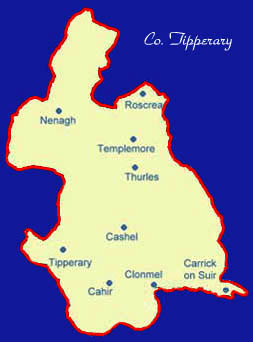 Some 196 Community projects nationwide are set to benefit from grants just announced (2017) by the Heritage Council. Community Projects in Co. Tipperary which have been awarded Grants are listed hereunder, with total bestowed funding amounting to €15,000. Some 196 Community projects nationwide are set to benefit from grants just announced (2017) by the Heritage Council. Community Projects in Co. Tipperary which have been awarded Grants are listed hereunder, with total bestowed funding amounting to €15,000.
Tipperary Libraries – Carrick-on-Suir Library – Urban Wildlife Garden 2017.
Awarded €1,500 to convert the library garden into an Urban Wildlife Garden which will raise awareness while also providing habitat for small mammals, insects, birds and especially pollinators.
BirdWatch Ireland – Making nature accessible – “Wildlife outside your window”.
Awarded €4,000 to showcase less accessible natural heritage to a diverse audience through video productions to engage children and adults of all ages with the wonders of wildlife outside their window.
Commons Old School – The Commons Past and Present.
Awarded €1,500 to provide a structured activity for young people living in the village to record/research/present past life of The Commons village, through different media of visual art, audio recordings and model Construction.
Burncourt Community Council Ltd. – Repair of windows to a John Nash designed hunting lodge (Mountain Lodge).
Awarded 6,000 to restore Mountain Lodge and return to use as a niche accommodation facility, hill-walkers stop and seasonal café.
South Tipperary Beepkeepers’ Association – Pollinator Education in South Tipperary in line with the All Ireland Pollinator Plan.
Awarded €2,000 to increase awareness of the plight of native Irish pollinators. To encourage young adults to take on the responsibility of safeguarding our bee and pollinator population.
Thurles Library’s “All Hands Together” Exhibition
As part of the Bealtaine Festival, Thurles Library (The Source, Cathedral Street, Thurles) are currently and kindly hosting an amazing exhibition in the Source Library & Arts Centre Gallery.
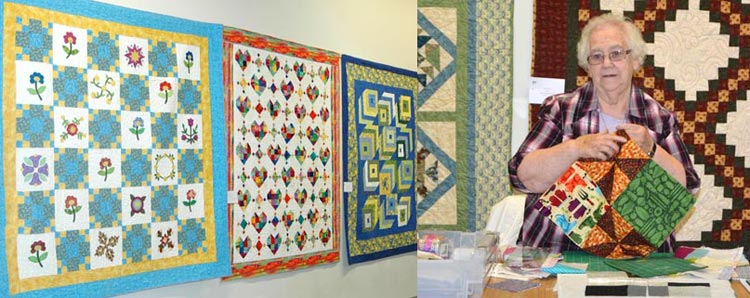 Ms Phyl Dwyer, Turtulla, Thurles, demonstrates the ancient art of ‘Quilting’. This exhibition, featuring the skills of the ‘Spike Quilters of Littleton’ and entitled “All Hands Together”, is open free to the public until Tuesday May 30th next; to be viewed in conjunction with the opening hours of Thurles Library.
The Spike Quilters of Littleton.
‘Spike Quilters’ are a group of compatible and inclined women aged between 15 years & 90 years, who meet together on a monthly basis to undertake and learn the ancient art of patchwork. With their monthly meeting place in The Muintir na Tíre Hall, Littleton, Thurles, Co. Tipperary; here the elderly share the considerable knowledge they have acquired in the art of ‘Quilting’ with their younger counterparts. Meetings are held in the hall from 10.30am to 4.00pm on the appointed day, (Usually second Sunday of every month), with each individual working on their own project, be it a ‘Wall-Hanging’ or a ‘Quilt’. Here colours are discussed, ideas are exchanged, progress encouraged and all over numerous cups of tea and chat. Guest teachers are a regular feature of these workshops, initiating new ideas and up skilling.
The Patchwork Quilt.
A patchwork quilt is a multi-layered textile in which the top layer consists of pieces of fabric sewn together to form a design. Originally, this was to make full use of accumulated left-over or salvaged scraps of fabric.
As stated, the quilt is usually formed of three individual layers; the patchwork quilt top; a layer of insulation wadding (batting), and a layer of backing material. Same may be used as throws, wall hangings, table runners or even tablecloths.
- The art of quilting has a long history, first evidence of which appears back in the 35th century BC, with an ivory carving, found in the Temple of Osiris, at Abydos near the modern Egyptian towns of el-‘Araba el Madfuna and al-Balyana, during 1903 and currently in the collection of the British Museum. This carving features the king of the Egyptian First Dynasty wearing a cloak which appears to be quilted.
- Attributed to the 1st century BC – 2nd century AD, we have a textile in the form of a quilted linen carpet found in a Mongolian cave tomb which today is housed in the collection of the Leningrad Department of the Institute of Archaeology of the Academy of the Sciences of the Union of the Soviet Republic.
- Made circa 1400 AD, we have a Milanese ivory carving of the Holy Family depicting the ‘Flight into Egypt’, showing Joseph wearing a coat quilted in a diamond pattern. Same is housed in the collection at the Victoria & Albert Museum, United Kingdom.
- In 1547, the Inventory of King Henry VIII of England lists “Quyltes” and “Coverpointes” among the bed linen. The inventory describes the quilts as made of “holland cloth” (linen or cotton), “bockeram” (cotton),” or various types of silk including “sarceonett”, “tapheta,” and “lynnen.” Some of these quilts would have been given to lesser members of Court, either as a sign of favour or as a gift. Indeed, the young 16 year old Catherine Howard, fifth queen (for three months only) of Henry VIII, was given a gift of two dozen quilts, sometime before being beheaded, on the grounds of treason, and for supposedly committing adultery, while married to Henry.
Now thankfully, due to the ‘Spike Quilters of Littleton’ and Thurles Library; in 2017, the craft of quilting can be seen to continue, with this exhibition showcasing work to most impressive effect.
When shopping in Thurles over the next 10 days, please do take a coffee break and go visit this exhibition of splendour and truly talented aptitude.
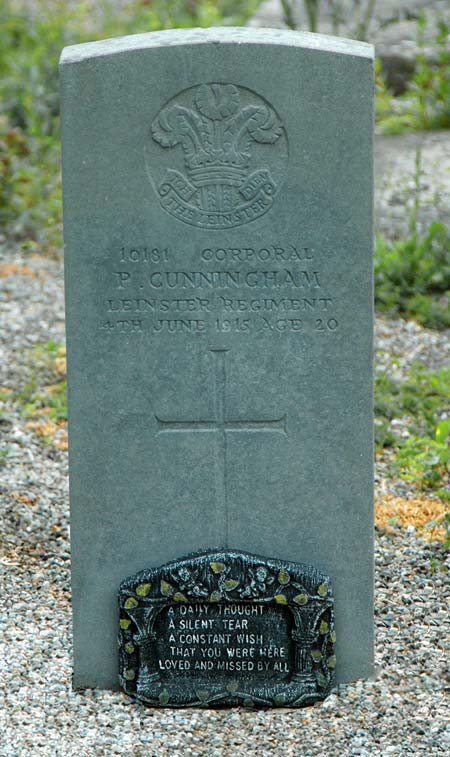 Resting place of Corporal Patrick Cunningham, younger brother of Thurles born Corporal John Cunningham, latter honoured by His Royal Highness, Charles (Prince of Wales) and his wife Camilla (Duchess of Cornwall) in Glasnevin Cemetery, Dublin today. He Ain’t Heavy, He’s My Brother
“The road is long, with many a winding turn
That leads us to who knows where, who knows where,
But I’m strong, strong enough to carry him,
He ain’t heavy, he’s my brother”.
(Lyrics – Bobby Scott and Bob Russell.)
His Royal Highness, Charles (Prince of Wales), unknowingly, just got a little bit closer to his ancestral home of Thurles, today (May 12th, 2017), when he unveiled and paused before a memorial paving stone, dedicated to Corporal John Cunningham, while at Glasnevin Cemetery in Dublin.
Prince Charles and his wife Camilla (Duchess of Cornwall), were taking part in a ceremony to unveil remembrance stones to World War I Irish-born Victoria Cross recipients (1917) – namely Company Sergeant Major Robert Hill Hanna (Kilkeel, Co. Down & Canada); Lieutenant Frederick Maurice Watson Harvey (Wanderers & Ireland Rugby player, Athboy, Co Meath & Canada); Private Michael James O’Rourke (Kildimo, Co. Limerick & Canada) and the aforementioned Corporal John Cunningham (Thurles, Co. Tipperary).
Corporal John Cunningham VC.
Son of Joseph Cunningham and Johanna Smith, natives of Stradavoher, Thurles, Co. Tipperary; Corporal Cunningham was born on October 22nd, 1890 in Thurles and died on April 16th, 1917, at the age of 26 years, while a member of the 2nd Battalion, Prince of Wales’s Leinster Regiment fighting in Barlin, Pas-de-Calais, Nord-Pas-de-Calais, in France.
An Irish recipient of the Victoria Cross, [VC. (without Bar)]; latter the highest and most prestigious award given to British and Commonwealth forces, for gallantry in the face of the enemy; Corporal Cunningham today is buried in Barlin cemetery, Pas de Calais, France, (Plot 1, Row A, Grave 39).
Perhaps the outstanding bravery carried out by Corporal John Cunningham on that fateful day in April 1917, may have been partially influenced by the loss of his brother Corporal Patrick Cunningham, also a member of the Leinster Regiment, who tragically lost his life some twenty two months earlier, on June 4th 1915, at the tender age of just 20 years. Corporal Patrick Cunningham, is buried in St. Mary’s Churchyard, St Mary’s Lane, Thurles, Co. Tipperary. (See picture above, left.)
Corporal John Cunningham’s citation published in,’The London Gazette’, dated June 8th 1917, relates to a deed performed on April 12th 1917 at Bois-en-Hache, near Barlin, and reads as follows:-
“For most conspicuous bravery and devotion to duty when in command of a Lewis Gun section on the most exposed flank of the attack. His section came under heavy enfilade fire and suffered severely. Although wounded he succeeded almost alone in reaching his objective with his gun, which he got into action in spite of much opposition. When counter-attacked by a party of twenty of the enemy he exhausted his ammunition against them, then, standing in full view, he commenced throwing bombs. He was wounded again, and fell, but picked himself up and continued to fight single-handed with the enemy until his bombs were exhausted. He then made his way back to our lines with a fractured arm and other wounds. There is little doubt that the superb courage of this N.C.O. cleared up a most critical situation on the left flank of the attack. Corporal Cunningham died in hospital (later) from the effects of his wounds.”
The medals belonging to Corporal John Cunningham, we understand remain on loan to the Imperial War Museum in London, however his name and that of his brother are recorded on the WW1 Memorial Wall, (Separate from Patrick’s grave site), situated in St. Mary’s Cemetery, Thurles, Co. Tipperary
“At the going down of the sun and in the morning
We will remember them.”
[Extract from poem “For the Fallen”, by Robert Laurence Binyon (1869-1943).]
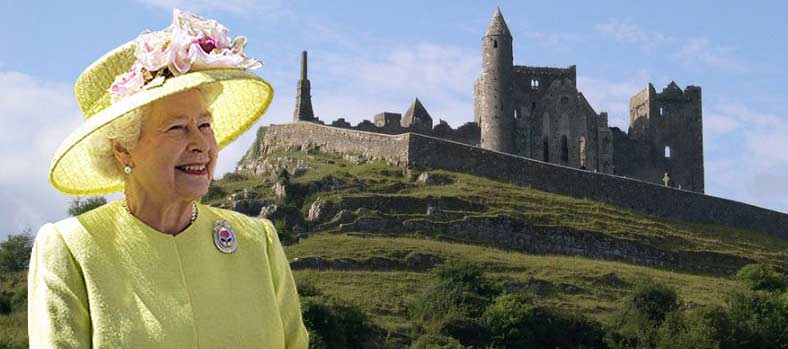
Again this year, access to OPW-managed heritage sites will be free on the first Wednesday of every month, to individuals wishing to visit these sites, and for the duration of their particular opening season.
Families looking for a free day out in Ireland, particularly here in Tipperary and indeed elsewhere here is your chance “To see old Ireland free”. So please, old age pensioners and those enjoying free travel, do take full advantage.
That means that visits to sites in Tipperary such as:- Cahir Castle, the Swiss Cottage, the Rock of Cashel, Roscrea Heritage (Castle) and the Blackmills, and venues further afield nationally like Kilkenny Castle, Clonmacnoise, Ross Castle in Killarney; to name but a few, won’t cost you a red cent.
Of course, tickets will be allocated on a ‘first-come, first-served basis’, so visitors are advised to arrive early to avoid delays, and do keep in mind that some attractions are open all year-round, while others may have opening hours which are seasonal.
You can get more information regarding these venues, simply by clicking HERE.
 At Kilshane House, Co. Tipperary recently, attended by over 200 guests from the Multi-National and Indigenous Sectors, Enterprise Ireland, the IDA, as well as high profile figures drawn from the world of Sport and Entertainment were L – R; Tipperary Co. Council Chairperson Siobhan Ambrose, Minister for Jobs, Enterprise and Innovation Mitchell O’Connor with the very able Tipperary County Council Chief Executive (CE) Joseph MacGrath. Here in Co. Tipperary we respectfully ask the questions:
(1) Is Thurles Co. Tipperary ‘THE PLACE, ‘THE TIME’ for to encourage the government to “join other leading organisations”, to couple with our “rich culture of heritage“?
(2) “Is a purchase, by Government, of the ‘Black Castle’ here in Thurles justified, given our present economic situation nationally?
(3) Should the Minister for Arts, Heritage and the Gaeltacht, M/s Heather Humphreys or Minister for Jobs, Enterprise and Innovation M/s Mitchell O’Connor be asked, by our local politicians, to bring this ‘Black Castle’ purchase matter before Cabinet, recommending its purchase?
 History of the Black Castle History of the Black Castle
For those not familiar with the historic Black Castle in Thurles, do please read on; remembering that same building has now come up for sale as part of a commercial lot, having been previously in private ownership.
The sale of the Black Castle, which is located on the west side of Liberty Square, presents an ideal opportunity for the present government to now, through the Office of Public Works (OPW) who maintain the State’s property portfolio, bring this historic castle into public ownership.
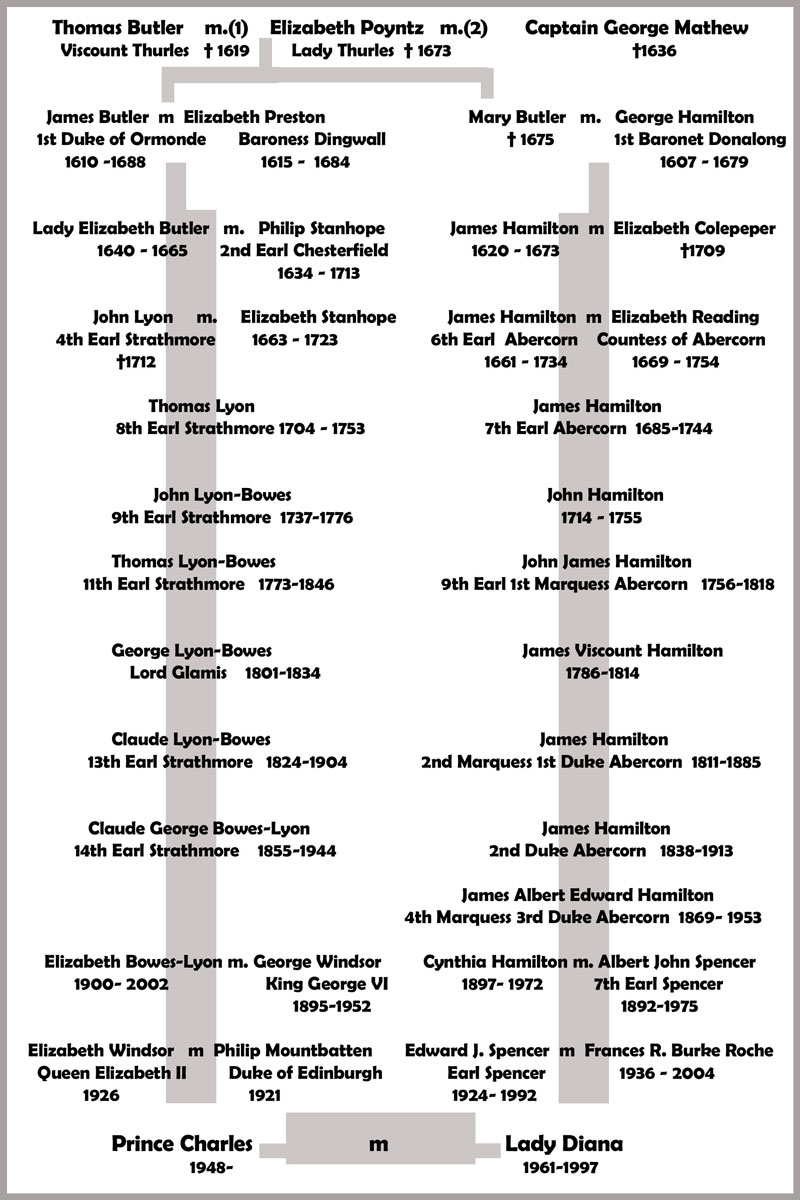
The castle was once the home of Elizabeth Poyntz, formerly of Acton Court, Iron Acton, Gloucestershire, England,[A] known as Lady Viscountess Thurles, following her marriage to Thomas Butler, Viscount Thurles, in 1608. Thomas Butler was son of Walter Butler “Walter of the Rosaries,” latter probably the first of the Butler family to take up residence in Thurles Castle.[B] Viscount Thurles was summoned from Tipperary, to England in 1619 to answer charges of treason, but the ship, conveying him, was wrecked off the coast of Wales, in an area known as The Skerries and he was drowned on 15th December 1619. His wife Elizabeth Butler (Poyntz), the celebrated Lady Thurles was now a widow and the lone parent of three sons and four daughters.
After the death of Viscount Thurles, Lady Thurles, married again, about 1620, Captain George Mathew of Radyr and Llandaff in Glamorganshire, Wales, by whom Lady Thurles had a further two sons and a daughter.
Captain George Mathew died at Tenby in Wales in 1636. A period portrait, oil on canvas, of Lady Viscountess Thurles is in the possession of the Tipperary County Library, situated in the Source building, Cathedral Street, Thurles.
 Memorial Plaque marking the burial place of Elizabeth Butler in St. Mary’s Church Thurles. Note Elizabeth Butler (Poyntz) was also progenitor (ancestor) to Honora “Nano” Nagle (1718-1784) the “Lady with the Lantern”, founder of the “Presentation Sisters” and a pioneer of Catholic education in Ireland. The Presentation Sisters here in Thurles this year celebrate 200 years of being resident in the town (1817-2017). Nano Nagle was declared venerable in the Roman Catholic Church on 31st October 2013 by Pope Francis (Jorge Mario Bergoglio). Elizabeth and Thomas Butler (Lord & Lady Thurles), through their first son James FitzThomas Butler, 1st Duke of Ormond, is a direct progenitor (ancestor) to Charles Prince of Wales, who is the eldest child and heir apparent of the present Queen Elizabeth II.
The late Princess Diana is also connected to the history of the castle and through the daughter of Lord and Lady Thurles, (Mary Butler), and her ancestors the Hamiltons, descendants of whom married into the Spencer family. Indeed the late Princess Diana was the 12th cousin, twice removed, of Prince Charles.
Despite a visit from Oliver Cromwell’s Parliamentarian army during the period 1658 to 1660, Lady Thurles and her children resided in the castle for a great deal of her life. Following her death in 1673 she was buried, at her own earlier request, in Thurles, inside the earlier pre 1820 ‘Little Chapel of St.Mary’, now St. Mary’s C of I Church. A commemorative polished limestone plaque, within the church building, recalls this historic period.
Does Rural Ireland Receive its Fair Share of Government Funding?
Here in the Thurles half of our Templemore / Thurles Municipal District of Tipperary, our appointed fiscal executives at both Municipal District and County Council level, correctly and carefully count the cost of administration, prioritising our spend. Thurles after all is part of a forgotten rural Ireland; which the present Fine Gael government fully agree has been totally neglected for at least the past 15 years.
According to our recent 2016 Census returns, between 2011 and 2016 the Thurles Urban Electoral Division population actually dropped by 115 persons (From 6,929 to 6,814), while Thurles Rural Electoral Division increased only by 14 persons (From 2,300 to 2,314 – a miserable .61% increase). Of course the figures posted in these 2016 Census returns are not in fact actually true; instead these figures reflect the numbers of persons forced to migrate or emigrate elsewhere in order to find work; with all employment prospects in the town completely absent.
On April 27th last, we posted details of Fáilte Ireland’s recently announced €11.5m funding, to be invested in the refurbishment of ten key OPW sites in Dublin, within Ireland’s Ancient East Region. I pointed out that within a 33 miles radios of Dublin’s popular O’Connell street, went the majority of funding; yes over €8m in total. This included €3m towards a new museum and viewing platform in ‘The Record Tower,’ at Dublin Castle; €300,000 towards a Phoenix Park tourism and amenity study. While twenty-five miles’ away the Brú na Bóinne Visitor Centre got €2.58m; and thirty three miles away Newgrange got €1m with Knowth a further €1.4m.
Continue reading Is The Purchase By Government Of The Thurles ‘Black Castle’ Justified?
|
Support Us Help keep Thurles.info online by donating below. Thank you.
Total Donated 2026: €290.00
Thank You!
Daily Thurles Mass Livestream
|





Recent Comments