Mr Martin Mansergh, former Irish Minister of State and key Irish peace process adviser, sadly dies aged 78 years.
Martin George Southcote Mansergh, former Minister of State, historian, and one of the most influential advisers in the Northern Ireland peace process, has died at the age of 78 years, while on a trip to the Sahara with fellow retired parliamentarians.
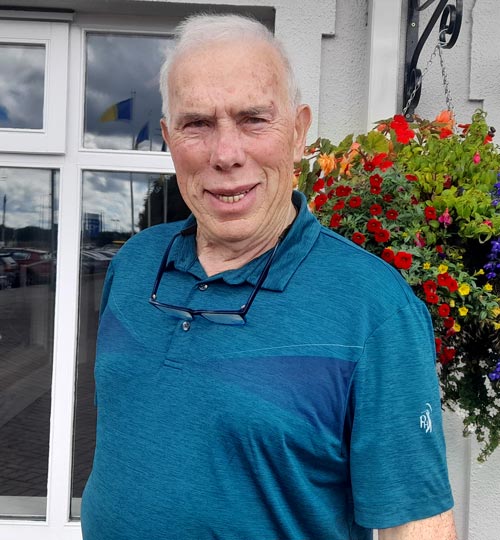
M.Mansergh, R.I.P.
Born in Surrey, England, in December 1946, Mr Mansergh was the son of historian and Oxford academic Nicholas Mansergh, a renowned authority on Anglo-Irish relations, and Diana Mary Mansergh. He was educated at The King’s School, Canterbury, before going on to study at Christ Church, Oxford, where he obtained a doctorate in history. His academic background and deep interest in Irish and European affairs shaped both his intellectual outlook and his later political career.
Although English-born, Mr Mansergh made Ireland his home and dedicated his professional life to Irish public service. His historical awareness, combined with a sharp political mind, made him a trusted adviser to Fianna Fáil Taoisigh Charles Haughey, Albert Reynolds, and Bertie Ahern. He was regarded as a central figure in the complex and often secret efforts to open dialogue with Sinn Féin from the late 1980s, laying the groundwork for the negotiations that led to the Good Friday Agreement in 1998.
Elected to Seanad Éireann in 2002, he served until 2007, when he was elected TD for Tipperary South. In government, he was appointed Minister of State with responsibility for the Office of Public Works. While his parliamentary career was significant, it was his quiet, steadfast role in shaping government policy on Northern Ireland and his contribution to peace that most defined his public legacy.
Tributes following his death have described him as a man of integrity, intellect, and generosity. His early negotiations on behalf of successive Taoisigh, his resilience during years of painstaking dialogue, and his commitment to reconciliation earned him the respect of political leaders across divides. “Few on the Irish side were more crucial to the Peace Process,” one tribute reflected, “whether through his role as an intermediary or in crafting a new political and intellectual framework for peace.”
He is recalled as being a key figure in establishing contacts and building trust in the years leading to the Good Friday Agreement. His contribution, alongside that of Mr John Hume, senior government officials, and Sinn Féin representatives, was pivotal in transforming the political Irish landscape.
Away from politics, Mr Mansergh was known as a historian and writer, contributing to Irish and European scholarship and offering reflections on politics and history that drew on both his academic training and his practical experience.
He is remembered as a warm and thoughtful man, generous with his time, devoted to his family, and proud of his roots in County Tipperary, where he lived for many years.
Mr Mansergh is survived by his wife, Elizabeth and their five children. His passing marks the loss of a figure whose intellect, dedication, and quiet determination were instrumental in securing peace in Ireland and whose life leaves behind a proud legacy of service and reconciliation.
A book, entitled “The Oldest Of Old Kriegies”, has now been published by Moycarkey-Borris, Littleton Men’s Shed History Group, under the guidence of Dr Pat McMahon.
The word “Kriegie”[pronounced kree-gee] is the German military slang for an Allied prisoner of war held in a German internment camp during World War II.
Local history researcher and member of Moycarkey-Borris Littleton History Group, Mr Michael Dempsey, now reports.
The new publication “The Oldest Of Old Kriegies”, is a well sourced publication which has researched, for the very first time and in greatest detail, the life of former Littleton, Thurles, Co. Tipperary resident Mr Lawerence (Larry) Slattery. Before coming to Littleton, Mr Slattery was born on February 28th 1913, some 35km away in Rossacrow, Donohill, Co. Tipperary, of parents Mary Ann (nee Moran) and Michael Slattery, both primary school teachers.
On September 4th 1939, Mr Slattery’s aircraft was shot down over the sea at Wilhemshaven, west of Hamburg, latter a coastal town in Lower Saxony, Germany, while attempting to bomb 4 warships.
Picked up from the sea Mr Slattery would go on to become the longest detained British P.O.W of the entire War; not being finally freed until Allied troops reached his prisoner-of-war camp (stalag) in April of 1945.
Moycarkey-Borris History Group Littleton (MBL) would like to thank the National Archives of Ireland, Military Archives of Ireland, University College Dublin (UCD) Archives, Rockwell College Archives, Lincoln University Digital Archives, British National Archives, Tipperary Studies (at Thurles Library), and family descendants, from whence this extensive research now featured in this publication was gleaned.
This new publication can be purchased from Book Worm Bookshop & Cafe,Thurles, The Horse & Jokey Hotel, from all retail shops in Littleton and directly from members of the Moycarkey-Borris, Littleton Men’s Shed, History Group. Mobile Phone:086-3648664.
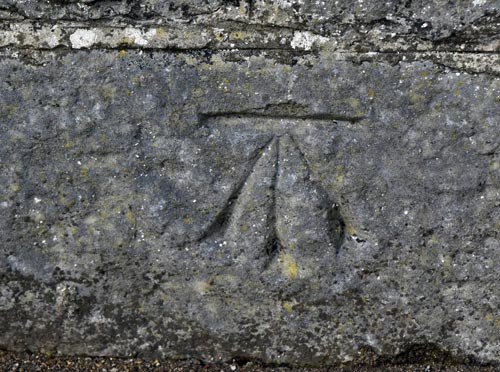
Carved into buildings, Churches, bridges and old stone walls across Ireland are these small but remarkable relics of scientific history, known as Ordnance Survey Benchmarks.
One Ordnance Survey Benchmark (Devil’s Mark) in Thurles, Co. Tipperary. Pic: G. Willoughby.
Though created for science and statecraft, they soon became part of Irish folklore. Particularly in the west of Ireland, where oral tradition recalls that some communities called them the “Devil’s marks,” believing the mysterious cuts were left by dark forces. Same were sometimes smashed in the belief that with these marks, once removed, would ensure that the Devil could not return.
These chiselled symbols, usually a simple crow’s foot cut beneath a horizontal line (view image above), once formed part of a vast system for measuring height above sea level. Known colloquially as “sappers’ marks,” the upward-pointing arrow same contain, was borrowed from the British Government’s ‘broad arrow’ emblem of ownership, repurposed by surveyors as a practical, durable and instantly recognisable tool. At one point the British government issued prison clothing which were stamped with this ‘broad arrow’ emblem, so that people in the towns and villages would know that these individuals were convicts.
The story of benchmarks begins with the Ordnance Survey of Ireland (OSI), established in 1824 under Lt.-Col. Thomas F. Colby. His team carried out the world’s first large-scale mapping of an entire country, culminating in the survey of 1834 and the levelling of Ireland between 1839 and 1843. By 1846, Colby’s monumental effort was complete, leaving behind not only the celebrated six-inch-to-the-mile maps but also a physical legacy inscribed into the landscape.
Each benchmark recorded a precise elevation point, forming a network that allowed engineers, builders, and cartographers to work from a common reference.
Today, a lot of benchmarks still survive as tangible links to Ireland’s first great scientific survey and the progress it represented. Yet they lack any protection status. Modern demolition, redevelopment, road surface levels rising and weathering have already erased from sight, and permanently eradicated many.
Sadly, without awareness and preservation, these modest but historic cuts in stone may in time vanish altogether, along with the stories and the knowledge that they carry.
“Times They Are A Changing”. (Extract from a song written and recorded by Bob Dylan back in 1964.)
“Come writers and critics, who prophesize with your pen, And keep your eyes wide, the chance won’t come again, And don’t speak too soon for the wheel’s still in spin. And there’s no tellin’ who that it’s namin’, For the loser now will be later to win, For the times they are a-changin’.”
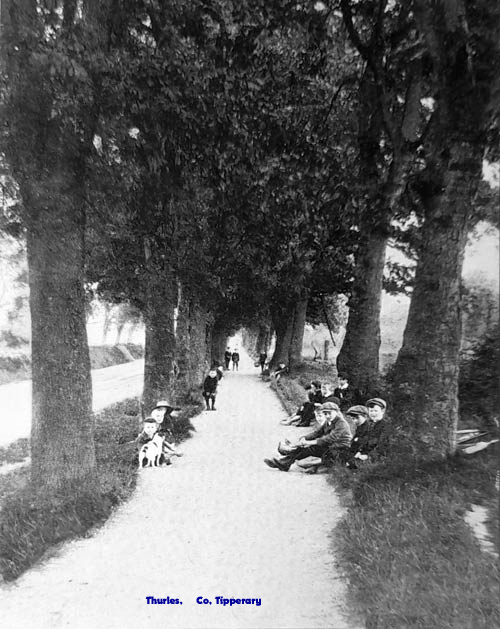
Quick Quiz:The above picture was taken possibly between the years 1870 and 1880. We here at Thurles.Info know the area where it was taken, but can anyone of our viewers identify the location?
“You Will Die in Prison”, is a Tipperary man’s true story, which will be featured on RTÉ One Tonight, September 3rd, at 10:35pm.
A Tipperary man, wrongly imprisoned in Iran, states that he continues to suffer following his treatment in an Iranian prison. Mr Bernard Phelan, a Tipperary man who spent some seven months in an Iranian prison, has said the trauma of his ordeal continues to affect both him and his family.
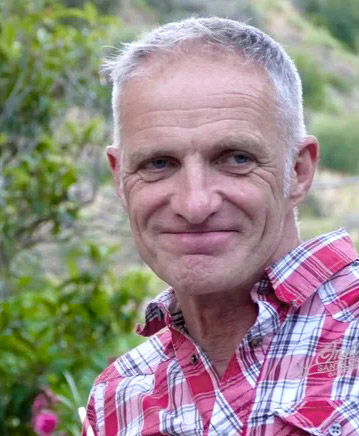
Mr Bernard Phelan
Mr Phelan, originally from Clonmel, Co Tipperary, revealed that he recently suffered a stroke, which doctors have conclusively linked to post-traumatic stress disorder.
The 65-year-old, who holds both Irish and French citizenship, had been travelling to Iran since 2017, first as a tourist and later to develop trekking holidays. In October 2023, he was arrested, accused of providing information to an enemy state, before being held in prison until May of 2023. He was forced to go on hunger strike, before finally being pardoned and released on humanitarian grounds.
Speaking about his time in captivity, Mr Phelan said he was haunted by fears that his father would die before his release. Their reunion following his eventual return was he stated, “deeply moving”. He later got a chance to meet President Michael D Higgins, latter who failed to criticise Iran for its constant call for the total destruction of the state of Israel and for its funding and the arming of terrorist organisations, namely Hamas and Hezbollah, not to mention its violations of human rights against its very own citizens. In mid-2024, Irish President Mr Higgins had written to Iran’s new president Mr Masoud Pezeshkian to congratulate him on his new appointment. The letter was not officially published by the President’s office, but was circulated online and received some criticism, including from members within Fine Gael, who rightly accused President Higgins of being “tone deaf” to civil rights issues within Iran. Former Minister for Foreign Affairs Mr Charlie Flanagan had rightly informed the Press that he felt Mr Higgins’ views on Iran were “somewhat misplaced”. The Irish President then falsely accused the Israeli embassy in Ireland of circulating the letter, when in fact it was proven to have been circulated by the Iranian embassy as a “Look Ireland Supports Iran” PR stunt.
Mr Phelan now called for stronger EU action in securing the release of European citizens wrongly imprisoned abroad. Mr Phelan believes, and with justification, that European citizens are not being helped by EU authorities.
His story will be told in a new RTÉ documentary entitled, “You Will Die in Prison”, being airing tonight on RTÉ One at 10.35pm.
This website uses cookies to improve your experience. We'll assume you're ok with this, but you can opt-out if you wish.AcceptRead More
Privacy & Cookies Policy
Privacy Overview
This website uses cookies to improve your experience while you navigate through the website. Out of these, the cookies that are categorized as necessary are stored on your browser as they are essential for the working of basic functionalities of the website. We also use third-party cookies that help us analyze and understand how you use this website. These cookies will be stored in your browser only with your consent. You also have the option to opt-out of these cookies. But opting out of some of these cookies may affect your browsing experience.
Necessary cookies are absolutely essential for the website to function properly. This category only includes cookies that ensures basic functionalities and security features of the website. These cookies do not store any personal information.
Any cookies that may not be particularly necessary for the website to function and is used specifically to collect user personal data via analytics, ads, other embedded contents are termed as non-necessary cookies. It is mandatory to procure user consent prior to running these cookies on your website.






Recent Comments