“The first, the gentle Shure (Suir) that making way By sweet Clonmell (Clonmel), adornes (adorns) rich Waterford; …” (Excerpt from poem by Edmund Spenser’s ‘Irish rivers’.)
♦ Note: It should be noted that in 2026 Cahir Castle has since been fully restored and has now become a major tourist attraction in Cahir, Co. Tipperary. However this was not the case in 1912 when McCraith published her book.
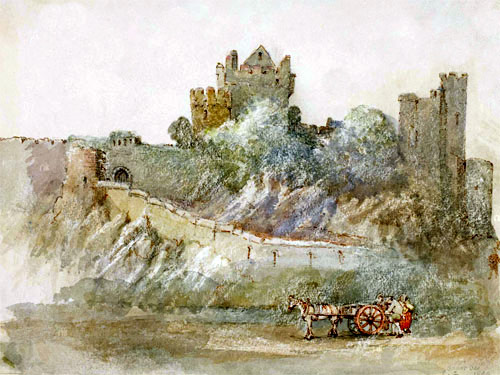
Cahir Castle as depicted by the artist James Stark Fleming (1834-1922).
The Suir – From Its Source To The Sea.
Cahir Castle rises on an island in the Suir, and commands the bridge in the middle of the town. This old ivy-clad Butler stronghold is probably the best example of late feudal architecture in Ireland. It was built in the fifteenth, or early in the sixteenth, century, and has remained in the family of its builders ever since.
The Butlers ceased to live in their castle about a hundred and fifty years ago. It has not been inhabited since a company of infantry was quartered there in the days of the late Earl of Glengall (he it was who gave the site for the present barracks, about a mile outside the town, formerly used for Cavalry, and now used for Field Artillery). For over a century the Castle has undergone no structural alteration, but remains an eloquent witness of the life led long ago in Ireland by a Lord of the Pale.
Centuries before the Butlers built the present Castle; centuries before even Conor O’Brien, Lord of Thomond, founded his castle there in 1142, the rock in the Suir upon which it stands was regarded as a natural point of vantage, to be defended by a “dun,” or fort. Its very name in Irish, Cathair-Duine-Iascaigh, (Irish – “the stone stronghold of the fish-abounding fort), is a word-history.
An old Irish MS♦., the Book of Lecan, records the destruction of this fort of Cathair Curreagh in the third century.
♦ Note: “MS” is the standard abbreviation for “Manuscript” (from Latin manu scriptus, “written by hand”)
This is the outline of the romantic story. A relative of Curreagh Lifé was killed by Finn MacRadamain, chief of the district surrounding Cathair, the modern Cahir. In revenge, Curreagh Lifé murdered Finn’s mistress, Badamair, who had her dwelling on the Cathair-Duine-Iascaigh, whence she supplied Finn with food and clothing, no doubt of her own catching and weaving. After murdering her, Curreagh plundered the fort, and escaped away beyond the river Bannow towards Waterford. Finn pursued him. After many days he got sight of Curreagh in the distance. Thereupon Finn pronounced an incantation over his spear, and hurled it at Curreagh, who was in the midst of a group of friends. Nevertheless, the spear found its way truly to Curreagh’s heart and killed him.
The Brehon Laws refer to this fort of Cathair, and Geoffrey Keating states that, among many other royal residences, Brian Boru fortified and used this fort of Cathair also.
When the Anglo-Normans came first to Ireland, Knockgraffon, and not Cahir, was the principal place in the Barony, which passed, about 1215, to one of Henry II’s knights, Philip of Worcester. From him it passed to his nephew, William, whose great-granddaughter brought it to the de Berminghams by her marriage with Milo de Bermingham. In 1332 the Barony reverted to the Crown on William de Bermingham’s attainder. But the English King was little bettered by Cahir. As has been said already, Bryan O’Brien and his Irish had by 1332 overrun and re-conquered Tipperary.
However, in 1325 the King granted the Barony to James, Earl of Ormonde, and to Elizabeth, his wife. James Cildare, the natural son of this Earl, by Catherine Fitzgerald, daughter of the Earl of Desmond, has generally been recognised as the founder of the Cahir branch of the Butlers. Since he, or his successor, quartered the de Bermingham arms with his, there was probably also a prudent alliance with the previous owners.
The new Lords of Cahir held an equivocal position. They occupied the borderland between the two great warring houses of Butler (Ormonde) and Fitzgerald (Kildare). Butlers by descent, Fitzgeralds by marriage and interest, they contrived throughout the Barons’ War, and the fiercest struggles of the sixteenth century, to retain their estates amid the ruin of their confederates. Perhaps the position of their Castle helped them, for an old record says:
“In the mydst of ye ryver Suyre lyeth an Ilaund, ye same a natural rock, and upon yt a Castle, which, although yt may not be built with any greate arte, yet is ye seite such by nature that yt may be said to be inexpugnable.”
Cahir Castle has changed little during the centuries. Today it closely resembles its appearance in 1599, as pictured in the Pacata Hibernia ♦.
♦ Note: Pacata Hibernia (Latin for “Pacified Ireland”) is a significant 17th-century historical work by Sir Thomas Stafford detailing the Elizabethan Wars in Ireland, particularly the campaign in Munster under Sir George Carew, offering a contemporary, soldier’s perspective with valuable maps and plans of Irish towns and fortifications. First published in 1633, it serves as a primary source for understanding the final, bloody stages of Gaelic Irish resistance against English rule, culminating in the Flight of the Earls and the Plantation of Ulster.
Instead of at once attacking O’Neill in the North, those of the Irish Council who had estates to lose in the South persuaded Essex to lead his army into Munster. Having been defeated near Maryborough, Essex marched to Kilkenny, thence to Clonmel, and so on to Cahir.
Reynolds, secretary to the Earl of Essex, describes Cahir as “the only famous Castle of Ireland which was thought impregnable; it is the bulwark for Munster, and a safe retreat for all the agents of Spain and Rome.” The Butlers of Cahir were staunch for Hugh O’Neill. Cahir Castle, therefore, Essex attacked.
Encouraged by Hugh O’Neill’s victories, and expecting reinforcements from Mitchelstown, those “heathens,” as the English writer courteously termed the garrison, refused to surrender. Thereupon Essex put his cannon into position, and began a vigorous siege. Despite wide breaches in their walls the garrison held out bravely for ten days, until they found that their expected reinforcements had been cut off. Despairing, the garrison attempted to make a sortie and to vacate the Castle under cover of darkness. It was a desperate endeavour, and was discovered by the besiegers. Eighty of the garrison were slaughtered, and the English took the Castle.
Essex re-garrisoned Cahir with English troops, left his wounded there, and went on to Clonmel. It was his first success, and his last, in Ireland.
In spite of this armed resistance, the Lord of Cahir managed to keep his Castle and lands from confiscation. This was through the influence of the head of the Butlers, Thomas, Earl of Ormonde, called “the Queen’s Black Husband” from his colouring and his Sovereign’s marked preference.
During the Cromwellian Wars and, later, during the Revolution, the luck of the Butlers of Cahir held. The Baron of Cahir was a minor during the wars of 1641–50, his guardian being George Mathew, a half-brother of the Earl of Ormonde. In 1647, previous to the coming to Ireland of Cromwell in person, Lord Inchiquin, ‘Murrough of the Burnings‘, (Murrough O’Brien, 1st Earl of Inchiquin♦), who was then fighting on the side of the Parliamentarians, invested Cahir Castle. The siege was one of hours only. The Castle was promptly handed over to Inchiquin, and a flimsy story put about to shelter Mathew’s cowardice; or was it his prudence?
♦ Note: The slaughter of the garrison at Cashel and the subsequent devastation of Catholic-held Munster earned Inchiquin the Irish nickname, Murchadh na Dóiteáin or “Murrough of the Burnings”.
Cromwell himself appeared before Cahir Castle on February 24th, 1650, and again George Mathew surrendered without a shot having been fired. One of the conditions of surrender was that: “The Governor may enjoy his estate, which he has as his jointure, and the wardship of the heir of Cahir”.
Although the Butler estates were surveyed by Petty♦during the Commonwealth for that object, they were not actually allotted to soldiers or adventurers; and at the Restoration, in 1662, Ormonde had little difficulty in reinstating his kinsman, “the heir of Cahir.”
♦ Note: Sir William Petty (1623–1687), an English scientist, physician, and political economist who was a key figure in the Cromwellian land confiscations in Ireland. He was responsible for overseeing the famous Down Survey of Ireland in the 1650s, which was the first detailed, large-scale land survey in the world.
The Butler luck, or prudence, held also during the Revolution. Thomas, seventh Baron Cahir, fought for James II on the bloody and disastrous field of Aughrim♦, and was outlawed in 1691. But, two years later, his outlawry was reversed and his estates restored. Being known as strong Catholics, with Jacobite leanings, the Lords of Cahir lived abroad during the eighteenth century.
♦ Note: Aughrim, County Galway. The battle was one of the bloodiest ever fought in Britain and Ireland; 7,000 people were killed.
By the death of Pierce, eleventh Baron, in 1788, the old Butler line became extinct. But a claimant appeared in the person of Richard Butler of Glengall, who derived his descent from Sir Theobald Butler, Baron of Cahir, in the time of Elizabeth. Richard Butler was married to a niece of Lord Chancellor Clare, and, as legal difficulties were thus smoothed over, he succeeded as twelfth Baron Cahir. He was afterwards created first Earl of Glengall. His son, the second Earl, died in 1858 without a male heir. The Barony of Cahir fell into abeyance again, and the Earldom became extinct.
The present representative of the Butlers of Cahir is the last Earl of Glengall’s daughter, Lady Margaret Charteris, to whom belongs the beautiful park through which the Suir runs for over two miles, together with many acres of surrounding mountain and valley.
Cahir Castle is in excellent preservation. It still serves for flower shows and other gatherings. The Butlers migrated, first, to Cahir House, a Georgian mansion, overlooking the Market Square on one side, and the lovely demesne upon the other, and, later, to the Lodge, on the opposite bank of the Suir.
Cahir Park.
The beautiful green banks of the River Suir are nowhere more attractive than in Cahir Park. To appreciate the place properly, you really have to see it for yourself.
Fortunately, the park is open to pedestrians. Private carriages and anglers can also enter, but only with permits, which (at the time of writing) were available from the Estate Offices in Castle Street.
It’s hard to say when Cahir Park looks its best: on a hot summer’s day, when cattle stand knee-deep in the broad, clear river and the trees and pastures are at their richest “living green”; or in late autumn, when the scarlet coats of huntsmen and the dappled white, black and tan of the foxhounds come and go through groves of golden oaks and coppices, with yellow bracken underfoot and laurels still keeping their summer colour.
In places the riverbanks become almost steep, and a graceful bridge spans the Suir at Kilcommon. From there you can reach a picturesque thatched cottage, built as a tea-house♦, and once a favourite rendezvous-is reached.
♦ Note: “Picturesque thatched cottage, built as a tea-house” refers to the ‘Swiss Cottage’ and again, is today 2026 also fully restored and a major tourists attraction. END
Nollaig na mBan: Women’s Christmas marked in Thurles with a final festive visit to the magnificent Cathedral Crib.
The 12th and final day of Christmas, January 6th, is celebrated in Ireland as Nollaig na mBan, (Women’s Christmas), or Little Christmas, traditionally seen as a day of rest and recognition for women folk after the fine work undertaken during the festive season.
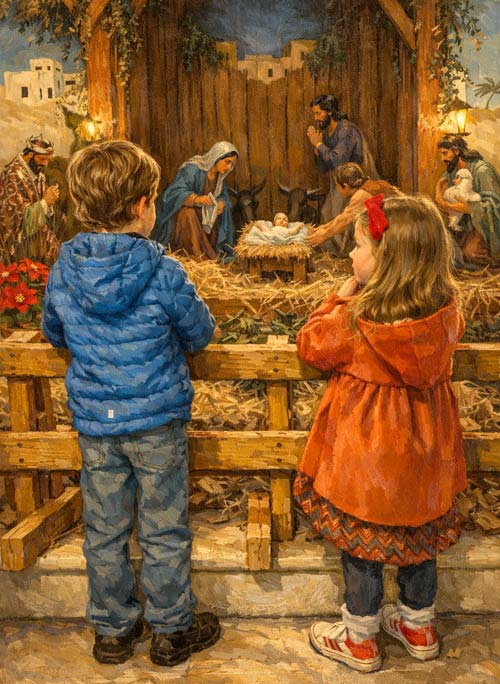
To mark this occasion, families and visitors are being encouraged to enjoy one last seasonal highlight in Thurles: the Christmas Crib in the Cathedral of the Assumption, Cathedral Street, a display that has once again, drawn quiet admiration throughout the 2025/2026 Christmas season.
“Love, quietly born with togetherness the gift.”
A parish spokesperson said Nollaig na mBan provides “a fitting moment to close out Christmas with reflection and gratitude, and to acknowledge the strength and generosity shown in homes and communities right across the season.”
A cherished custom and a little piece of folklore. Alongside the visit, many will recognise a well-loved tradition associated with the Crib: legend has it that if you take a small piece of straw from a Crib at Christmas time and keep it in your purse or wallet, it will never be found empty in the year ahead. The custom is remembered in different parts of Ireland as a simple token of good fortune for the months to come.
Looking ahead: Supporting the Cathedral roof project.
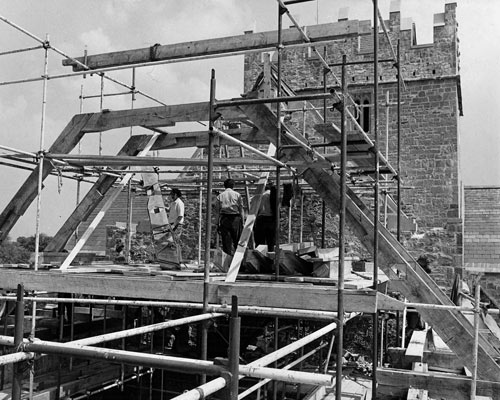
The parish is well aware that, while the Crib is a seasonal centrepiece, attention is now again turning to a major practical need in the near future: the Cathedral roof is approaching the end of its lifespan and is expected to require full replacement within the coming years as part of the parish’s ongoing “Raise the Roof” efforts. In that spirit, the parish is encouraging the wider community to continue supporting the Cathedral’s upkeep and future.
Hence, we echo the message of Hebrews 10:24: “And let us consider how we may spur one another on toward love and good deeds.”
Extract from a publication by L. M. McCraith, [Mrs Laura Mary McCraith-Blakeney (born 1870)], originally published in 1912. (See Part One HERE)
“The first, the gentle Shure (Suir) that making way By sweet Clonmell (Clonmel), adornes (adorns) rich Waterford; …” (Excerpt from poem Edmund Spenser’s ‘Irish rivers’.)
Holy Cross. Beyond Thurles, the Suir, now a broad and shallow stream, flows lazily, through sedge and reeds and fringes of flowering water-weeds, between some of the finest pasture lands in Munster.
About three miles south-west of Thurles, on the right bank, low down by the river-side, stands the lovely ruin of the once far-famed Abbey of Holy Cross. [ Note: This building has since been extensively restored to its former beauty and serenity.]
The once ruin of Holycross Abbey. [Artist James Stark Fleming (1834-1922)]
This Abbey was founded in 1168, for Benedictines, by that indefatigable church-builder, Donal Mór O’Brien, King of Munster. The original charter is still in existence, by which it appears that, about 1182, the Abbey was transferred from the Black Monks to the White, that is, from the Benedictines to the Cistercians.
Early in the twelfth century the Pope, Paschal II, gave to the grandson of Brian Boru, Donough O’Brien, a bit of the True Cross. It was magnificently enshrined and set about with precious stones, and confided to the care of the Cistercians. In 1214 this Abbey was re-built, and about that time the sacred relic, which gave its name to Holy Cross, came to its resting-place on the banks of the Suir.
This relic, being amongst the most revered in Christendom, the Abbey was, for over three and a half centuries, one of the most frequented places of pilgrimage in Ireland. In the reign of Queen Elizabeth the English described the relic as “the idol which the Irish more superstitiously reverence than all the idolatries in Ireland.”
In 1600, the great Hugh O’Neill came in state to Holy Cross to visit the holy relic, for reasons no less political than pious. He marched through the centre of the island at the head of his troops, a kind of royal progress, which he thought fit to call a pilgrimage to Holy Cross. He held princely state there, concerted measures with the southern lords, and distributed a manifesto announcing himself as the accredited Defender of the Faith.
In 1603, Red Hugh O’Donnell came to Holy Cross, on his way to the disastrous battle of Kinsale, and demanded that the fragment of the True Cross should be borne out to him at the west door, to bless him on his way.
The Abbey of Holy Cross was suppressed in 1536, at the break-up of the monastic orders in Ireland. In 1563, Elizabeth conferred the Abbey lands upon Gerald, Earl of Ormonde. The Butlers remained friendly, if not faithful, to the old faith, and the line of Abbots continued at Holy Cross until as late as 1700. The relic also passed eventually into Butler hands. It was exposed for public veneration for the last time in Holy Cross Abbey about the year 1632. In that year, Walter, eleventh Earl of Ormonde, seeing his grandson, the first Duke, had become a Protestant, confided the relic to Catholic keeping until such time as the House of Ormonde should return to the old faith.
Subsequently, it passed through various hands, until in 1809 it was given to the Catholic Bishop of Cork, who deposited the relic in the Ursuline Convent in Cork. It continues in the Ursulines’ keeping, having moved with them to Blackrock.
Perhaps the most interesting thing which remains in ruined Holy Cross Abbey is the lovely little pillared shrine between the two side chapels in the north transept. This arcade is a fine example of thirteenth-century carving. Its pointed arches spring from a double row of beautifully twisted pillars. Its roof is a marvel of graceful groining. Every variety of delightful detail has been lavished upon this little sanctuary. Its sides are elaborately adorned with fine carving.
The design of two doves and two owls, kissing, is repeated upon the panels, and the beautiful Gothic details show a French influence. The elaborate wealth of detail and the loving workmanship point to some special, and important, purpose for this unique feature. It has been suggested that here the dead Cistercians lay before burial. But surely not a dead brother, but rather the Relic, the True Cross itself, occupied such a shrine. Was it within this greatly ornamented little arcade that the Relic was preserved when not exposed upon the Gospel side of the High Altar? This is, however, a matter of controversy.
Another matter of keen controversy is “the Tomb of the Good Woman’s Son.” Who was the “Good Woman”? Why are the Royal Arms of England carved on the shields between the arches of the canopy of the tomb, together with those of Ormonde and Desmond? Was the “Good Woman” an English Queen, her son a Plantagenet Prince? Was he “Pierce the Fair,” son of Isabella of Angoulême, the widow of King John, by her second husband, Le Brun, Count of La Marche, and half-brother of King Henry III? His death is recorded by the Four Masters as having occurred in Ireland in 1233.
Many maintain that this canopied monument is nothing more than a beautifully elaborate three-seated sedilia for the priests. Others suggest that it is the tomb of one who re-built the Abbey of Holy Cross in a far finer style than that of King Donald, at the close of the fourteenth century. The position, at the north side of the High Altar, is that usually assigned to founders.
Legend and tradition tell a more mysterious and interesting tale. The personality of “the Good Woman’s Son” is sufficiently interesting to make it worthwhile to quote the local story, as told by the custodian of the ruins, in her own words:
“The King of England’s son he was, and he was sent over to Ireland to collect the Peter’s Pence for the Pope. Now, there was a family in these parts in those times by name Fogerty, and they knew of all the money the young Prince had with him. So they followed him to a lonely place, and set upon him and killed him there, and stole the money. Then they buried the body in the soft ground in the wood, without waiting to know was the life gone out of it altogether or not.
Now, in the Abbey of Holy Cross at this time there was an old monk, and he was blind. One night he dreamed a dream. He dreamed that the Good Woman, his mother, had placed upon the young prince’s stone here, (set in the corner of the High Altar, of course, it is only set up by the Board of Works to show where the High Altar stood, for the dear knows where the real stones were thrown to by the soldiers when they were quartered in the ruins a hundred years ago), and there is a little round hole right through that stone. That hole was bored through the stone by the dropping of a tear. For seven generations they repented, and as the tear wore the hole through the slab of stone the curse wore away from the Fogertys.“
So some say, anyway, and a priest wrote it all down in a book lately, so I’m told, and sure isn’t it as likely as not it is true, after all?
The chief beauty of Holy Cross Abbey which remains are its windows. Their tracery is perhaps unmatched in perfection in Ireland, and its elaboration points to the fourteenth, rather than the twelfth, century. No doubt they belong to the period of the Abbey’s splendid restoration, whenever exactly that took place. The reticulated (or “honeycomb”) east window is notably fine. It is particularly beautiful when observed from the opposite bank of the Suir, from which the most picturesque view of Holy Cross Abbey may be obtained.
The plan of the Church of the Holy Cross is cruciform, with double side chapels. Quaint bits of carving here and there have escaped the hand of the spoiler and the ignorant. But for many years the Abbey passed from one to another, and fell into a lamentable condition. About thirty years ago the Board of Works took over the ruin, restored it to some decency and order, and ensured its preservation. The cloisters, however, are in private hands, and the cloister garth is used as a croquet ground.
The site of Holy Cross is unimpressive. Thick groves of trees now surround the ruins, which are of great extent, and in remarkably good preservation, all things considered. Little houses cluster round the approaches to the Abbey, as they may have done in the monastic days. It is not easy to picture the stately processions which must have crossed the old bridge and wound their way to the west door.
Holy Cross has still about it a peaceful, graceful, scholastic charm hard to describe or define, not easy to account for. Perhaps the aura of calm, holy, austere lives still lingers, like the perfume in dead rose-leaves. There is a homeliness about Holy Cross, for all that its rule was Cistercian and its Abbots Lords of Parliament and Vicars-General of the Order, as well as “Earls of Holy Cross.”
The Suir at Holy Cross is spanned by an ancient bridge, which was built in 1626 by James Butler, Baron Dunboyne, and his wife Margaret O’Brien, a descendant, doubtless, of King Donald, the Abbey’s founder. Their pious act is recorded in Latin on a carved stone set in the wall facing the ruins. It bears the Butler and O’Brien arms, with the initials of James and Margaret, and a Latin inscription which ends and bids the traveller to say a short prayer that both the builders may escape the Stygian Lake.
It was only natural, in medieval days, that bridge-building should be accounted a blessed and meritorious deed. Women, to whom the difficulties of medieval travelling no doubt came home with special force, were ever foremost in this work in Ireland. The famous and beautiful Margaret O’Carroll, “Áinéigh”(The Bountiful), was long remembered as a builder of bridges, as well as a giver of feasts, in the fifteenth century. In this case, another Margaret evidently followed her example a century later.
END.
Today January 2026 Visiting Tourists Please Note:
Holycross Abbey painstakingly restored in the early 1970s after centuries of ruin.
Still set on the banks of the River Suir, Holycross Abbey today is one of Tipperary’s great places of quiet grandeur; a medieval Cistercian foundation whose clean lines, cloistered calm and finely worked stone immediately draw you in. Painstakingly restored in the early 1970s after centuries of ruin, it has regained the sense of harmony and purpose that shaped it in the first place, still serving today as a living place of worship as well as a welcoming stop for visitors.
Extract from a publication by L. M. McCraith, [Mrs Laura Mary McCraith-Blakeney (born 1870)], originally published in 1912.
“The first, the gentle Shure (Suir) that making way By sweet Clonmell (Clonmel), adornes (adorns) rich Waterford;…” (Excerpt from poem Edmund Spenser’s ‘Irish rivers’.)
Some eight miles from Templemore, spreading itself upon both banks of the Suir, is the ancient town of Thurles. The town has a distinctive, old-world, almost ecclesiastical, character of its own. Its name is a corruption of the Irish Durlas, a fortress. In the Annals of the Four Masters we read of a chief of Durlas, by name Maelduin, who was slain in 660 A.D. Thurles was the scene of one of the few signal defeats of the Danes by the Irish. This took place in the tenth century, and was long remembered and recorded locally.
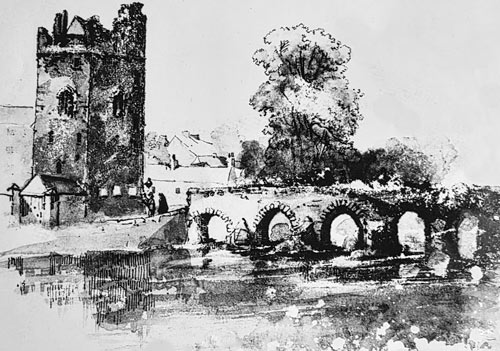
View of a bridge and the ruins of Thurles Castle, County Tipperary, dated 1909. [Artist James Stark Fleming (1834-1922)]
As has been said, Thurles was also the scene of the defeat of Strongbow by a coalition of Irish chiefs in 1174. When Strongbow heard that Conor and Donal Mór were advancing against him, he sent to Dublin for help. A contingent of Danish settlers and Norman soldiers, natural allies, came to his assistance. They endeavoured to join him at Thurles, but there, by the banks of the Suir, many of Strongbow’s men were slain. Donal Mór O’Brien was in command that day, and it would seem that the field was a fortunate spot to him; for when he returned to that same place seventeen years later, to fight another battle against the English, he was again victorious.
In 1197, however, six years afterwards the English took Thurles, and burnt many churches and temples.
View of the ruins of Thurles Castle, County Tipperary. [Artist James Stark Fleming (1834-1922)]
The Suir From Its Source to the Sea. Among the many notable Normans who established themselves in Ireland (and in time became “more Irish than the Irish”) were the Butlers. Theobald Fitzwalter came in the reign of Henry II, in 1172. He was kin to Thomas à Becket, (1119 or 1120 -1170) and it was part of the King’s accepted penance that he should ennoble all the murdered Archbishop’s relatives. Henry II, gave Fitzwalter large grants of Irish land, in return for which Fitzwalter was to act as the King’s Chief Butler and to hand him a cup of wine after his coronation. Hence the name of the family.
The Butlers ever remained loyal to the Sovereign whose vassals they were, and were frequently in opposition to that other powerful Norman house, the Fitzgeralds, or Geraldines, who were descended from Strongbow’s knight, son-in-law, and right-hand, Raymond le Gros, and were represented by the Earls of Kildare and Desmond.
The Butlers obtained large possessions in Wicklow, and in fertile Tipperary, and early in the thirteenth century became possessed of Thurles. The Butlers were ever notable as castle-builders, and founders of religious houses. They began to build on the banks of the Suir. Within the last half-century there were remains of no fewer than nine castles in this town. James Butler was created Earl of Ormonde in 1328. About that time (1324) he caused the castle to be built, the Norman keep of which still guards the bridge across the slow-flowing Suir. The Butlers also built, or endowed, Carmelite and Franciscan monasteries at Thurles; and there, as well as at Templemore, the Knights Templar established a preceptory. Viscount Thurles still remains the inferior title of the Marquis of Ormonde, the head of the Butler family.
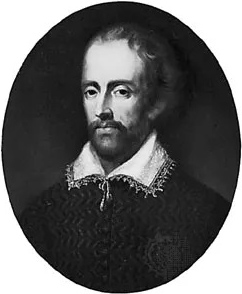
Edmund Spenser
Thurles to-day is an important and thriving town of about —— inhabitants. It has a notable horse fair, and it is the centre of a rich grazing and grain-growing district. It is the seat of the Archdiocese of Cashel and Diocese of Emly, and contains a magnificent Roman Catholic Cathedral and a handsome archiepiscopal residence. The bells and the organ of the Cathedral are notably fine. There is also a fine Roman Catholic College, two convents, and a monastery, the whole forming, as it were, a kind of religious quarter. Thurles was the scene of the famous Roman Catholic Synod in 1850.
From Thurles onward the Suir flows through the country of which the poet Spenser[Edmund Spenser (1552–1599)] said that it was “the richest champain that may else be rid”,(Taken from his unfinished epic poem, ‘The Faerie Queene’ ). Soon there comes in sight the mountain which he speaks of as “the best and fairest hill that was in all this Holy Island’s heights,” namely Galtee Mór, the highest peak of the Galtee range. [ NOTE:Latter description appears in Book VII, Canto VI, Stanza 37 of ‘The Faerie Queene’, specifically within the “Mutabilitie Cantos”. In the poem, Spenser uses Arlo-hill (Aherlow, South Co. Tipperary)as the sacred setting where the gods, led by Nature, gather to hear the plea of the Titaness Mutabilitie. Mutabilitie is a descendant of the ancient Titans, the race that ruled the universe before being overthrown by Jove (Jupiter).]
Between boycott and Bill: why the “settlements goods” debate has become a test of Irish politics’ bordering on Antisemitism.
A set of recently released State papers shows that, long before today’s Gaza-driven political polarisation, Irish officials worried that opening an Israeli embassy in Dublin could trigger an “Arab backlash”, carry significant security costs, and create diplomatic knock-on effects. Contemporary reporting based on the 2025 National Archives release says officials weighed Arab trade links and security resourcing before the embassy ultimately opened in 1996.
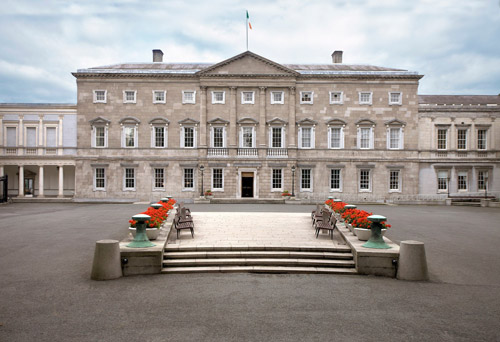
Leinster House, Kildare St, Dublin 2
That archival caution matters because it speaks to a recurring Irish instinct: to treat the Middle East not only as a moral question, but as a practical one; a mix of international law, trade and domestic cohesion. In 2025, those strands are tightly knotted around the Government’s proposed legislation to ban imports of goods, originating in Israeli settlements in the Occupied Palestinian Territory.
What the proposed law does, and why it’s politically explosive. On 25 June 2025, the Department of Foreign Affairs published the General Scheme of the Israeli Settlements in the Occupied Palestinian Territory (Prohibition of Importation of Goods) Bill 2025, framing it as compliance with Ireland’s international legal obligations, explicitly citing the International Court of Justice advisory opinion of 19th July 2024.
The Oireachtas committee subsequently published its pre-legislative scrutiny report. Dáil debate later in 2025 described the Bill’s purpose in plain terms: to prohibit the importation of goods from Israeli settlements in the occupied territories. Yet the measure’s impact is likely to be economically small while politically enormous; latter situation not yet identified by Senator Frances Black and those representing the opposition in our national parliament. It was reported in December 2025 that Minister of State Mr Thomas Byrne described the proposed curbs as “extremely limited” and confined “strictly to goods”, citing an estimated import value of about €200,000, while noting the controversy has far outpaced the trade involved.
Other coverage has used different estimates over longer periods, underlining that the real weight of the debate is symbolic and legal rather than commercial. The legislation also sits within a wider arc: Ireland’s decision to recognise the State of Palestine in May 2024, and the subsequent sharp deterioration in diplomatic relations with Israel. In December 2024, Israel announced it would close its embassy in Dublin, with Foreign Minister Ms Gideon Saar accusing Ireland of “extreme anti-Israel policies”, “double standards” and antisemitism, allegations which the Irish Government rejected. So the Bill lands in an atmosphere already totally charged with distrust.
The antisemitism argument: Intent, Impact, and the “line” everyone claims to defend. Supporters of the import ban argue it is a narrow response to an illegal situation: it targets settlement commerce, not Israel as a state and certainly not Jewish people. They frame it as an attempt to align Irish trade practice with international law; a position the Irish Government has repeatedly emphasised through its own framing of the General Scheme.
Critics, including representatives of Ireland’s Jewish community and some international voices, argue that whatever the stated intent, the political message is felt differently. In a submission to the Oireachtas committee in July 2025, the Jewish Representative Council of Ireland said (in essence) that criticism of Israel is not antisemitism, but that when criticism becomes a campaign or law and when no other state is treated the same, Ireland should rightly pause and question consistency.
RTÉ’s coverage of that committee process captured the temperature; witnesses used pointed language, including explicit claims that the Bill was antisemitic, which drew pushback in the room and highlighted how quickly the debate shifts from legal argument to accusations about motives.
This is where definitions matter. In January 2025, Ireland endorsed the IHRA Working Definition of Antisemitism (non-legally binding) and associated global guidelines, presenting the move as part of a broader equality and non-discrimination framework.
For supporters, that endorsement is proof the Irish State is capable of defending Jewish communities while criticising Israeli policy. For critics, it is a reminder that the State has accepted a framework which warns that antisemitism can sometimes attach itself to discourse about Israel, and that politicians should be alert to how rhetoric can drift from policy critique into collective blame.
A country with an old history, and a new vulnerability. God knows Ireland does not need to import antisemitism; it already has its own built-in history. The Limerick boycott of 1904 – 1906, was instigated after a Redemptorist priest, Fr John Creagh, preached two virulent anti-Semitic sermons, delivered in January 1904. His sermons accused the city’s approximately 170 Jews, mostly refugees from Lithuania, of being “leeches”, He claimed they exploited the poor through dishonest trading and moneylending, calling for an economic boycott. A riot following Creagh’s first sermon on January 11th, saw a mob of roughly 200 people attacking the Jewish quarter on Colooney Street (now Wolfe Tone Street), pelting residents and homes with mud, stones, and breaking windows. The boycott of Jewish businesses, lasted for two years (1904 -1906). The campaign received support from local nationalist figures like Arthur Griffith(founder of Sinn Féin) and the 6,000-member Arch-Confraternity of the Sacred Heart.
The impact of same boycott crippled the livelihood of Jewish traders, many of whom were peddlers selling small items. Although no one was killed, the sustained intimidation and poverty, forced many families to leave Limerick. Some moved to Cork or emigrated to England and South Africa.
The campaign was denounced by several prominent figures, including Irish nationalist Michael Davitt, founder of the Irish National Land League; the Church of Ireland Bishop Thomas Bunbury; and eventually Creagh’s ownreligious superiors, who moved him out of Limerick city, sending him to Belfast and shortly afterwards to Wellington, New Zealand, and later to North Perth, Australia. Same remains the clearest Irish example of organised anti-Jewish pressure, remembered as a boycott that also involved intimidation and violence.
History should have taught us the lesson that today’s so called Palestine Solidarity Marches are in fact a repeat of the riots brought about following Fr. Creagh’s first sermon, and that minority communities can easily become targets when Irish politics turns moralistic and simplifying.
In 2025, the Jewish Representative Council says it is compiling a report that will detail “over 100” antisemitic incidents during a four-month period in this year, 2025, including graffiti explicitly calling on individuals to “Kill Jews”, same publication expected in 2026. Garda figures also show hate-crime and hate-related incident reporting has increased in recent years; the force has published 2024 data and has stressed under-reporting, while the Criminal Justice (Hate Offences) Act 2024 commenced on December 31st 2024, strengthening provisions around offences aggravated by hatred.
Those data points don’t “prove” a particular political party or cause is antisemitic. But they do set the background risk: a small community says hostility is rising, while national politics is consumed by a conflict that easily collapses nuance into slogans.
When symbols become proxies: the Herzog Park row. The recent controversy over a proposal to rename Herzog Park in Dublin, illustrates how quickly symbolism turns into a proxy war over antisemitism. It is reported that opponents, including government figures and members of Ireland’s Jewish community, warned the move was divisive and could be seen as antisemitic, while supporters framed it as solidarity with Palestinians; before the council delayed the vote.
It was also reported that senior Government figures warned that removing the name would be seen as antisemitic and would erase Irish-Jewish history. Whatever one’s view of the park, the episode showed how the debate now operates: the Israel-Palestine question is no longer only foreign policy. It is a domestic argument about who belongs, whose history is honoured, and what language is acceptable.
If the settlements import ban proceeds, Ireland faces a dual obligation: to pursue any international-law-based policy in a way that is consistent and legally robust and to police the boundary between legitimate criticism of a state and hostility toward a minority at home.
The Government’s case rests on law and narrow scope. Its critics’ case rests on impact, consistency and the social climate. Neither side can credibly claim the other concern is imaginary. And that may be the most “Irish” feature of the argument: an instinct to see moral urgency and community vulnerability in the same frame, yet struggle, in real time, to keep both from colliding.
This website uses cookies to improve your experience. We'll assume you're ok with this, but you can opt-out if you wish.AcceptRead More
Privacy & Cookies Policy
Privacy Overview
This website uses cookies to improve your experience while you navigate through the website. Out of these, the cookies that are categorized as necessary are stored on your browser as they are essential for the working of basic functionalities of the website. We also use third-party cookies that help us analyze and understand how you use this website. These cookies will be stored in your browser only with your consent. You also have the option to opt-out of these cookies. But opting out of some of these cookies may affect your browsing experience.
Necessary cookies are absolutely essential for the website to function properly. This category only includes cookies that ensures basic functionalities and security features of the website. These cookies do not store any personal information.
Any cookies that may not be particularly necessary for the website to function and is used specifically to collect user personal data via analytics, ads, other embedded contents are termed as non-necessary cookies. It is mandatory to procure user consent prior to running these cookies on your website.







Recent Comments