The Stations will start at 12.00 noon at the Church boreen, beside two family residences, just after the signpost for the first junction to the right after the Turnpike. People will follow the ancient Mass Path to the little Church, before continuing on to the site of the Round Tower, before concluding in the Main Monastery Church of St. Mochaomhog (St. Pulcherius), latter saint known as ‘The Holy Man of Liathmore’.
There are two Churches on this Liathmore site; the larger one (above) was enlarged possibly in the 12th century, and contains a number of tombs.
Who was St. Mochoemog?
Different accounts vary, however from what we can glean from our history; St. Mochoemog was born to parents Beoanus and Nesse, latter a sister of St. Íte of Killeedy, a civil parish located south of Newcastle West, in Co. Limerick, possibly around 550 A.D.
It is believed that he was brought up or at least strongly influenced by his aunt, Saint Íte, and at the age of 20 was sent to then recently established Bangor Abbey, Co. Down (established 558 A.D.) where he was further instructed by the Clonmacnoise educated and founder of Bangor Abbey, Abbot Saint Comgall.
Bangor was then a major centre of learning, referred to as the “Light of the World”[Then spake Jesus again unto them, saying, “I am the light of the world: he that followeth me shall not walk in darkness, but shall have the light of life”. ( John Chapter 8: verse 12)], and was responsible for the training of many documented missionaries, including St. Columbanus, St. Mirin and Carthach (Saint Mo Chutu mac Fínaill)
He later returned to southern Éile (County Tipperary), where a chieftain granted him a site for a monastery in an area known as Liathmochaemog (Liathmore) in the parish of Two-Mile Borris, Thurles in the Barony of Eliogarty.
Today, as stated the site remains marked only by a church, latter the ‘stone survivor’ of a community that would have used wood, together with wattle-and-daub, for its alas no longer evident dwelling houses.
It was believed that St. Mochoemog lived long, and died at the age of 106 years, in Liathmore, on March 13th, 656 A.D, some 1,366 years ago, just last month.
Liathmore-Mochoemog would remain an important centre of Christianity between the 7th and 11th century, serving most of south Tipperary and Kilkenny.
Several miracles are attributed to St. Mochoemog, among others, his having cured of blindness, a holy virgin Canners, latter daughter of Fintan, who is considered to have been the relative of St. Molua, of Clonfert-Molua, latter who also learnt the monastic life at the northern monastery of Bangor under the tutelage of Saint Comgall, and possibly St. Mochoemog’s personal confessor.
Young people will be participating in this event and people of all age groups are most welcome to be in attendance.
With light rain forecast, please do dress appropriately for the weather and for walking both on the fields and on boreen.
Note: Parking will be available on the road side and all are welcome to this Christian gathering.
The Belfast Crown Court has ordered the BBC to hand over broadcast and withheld or withdrawn material, to the Police Service of Northern Ireland (PSNI), from their documentary series about the Northern Ireland Troubles, first broadcast back in 2019.
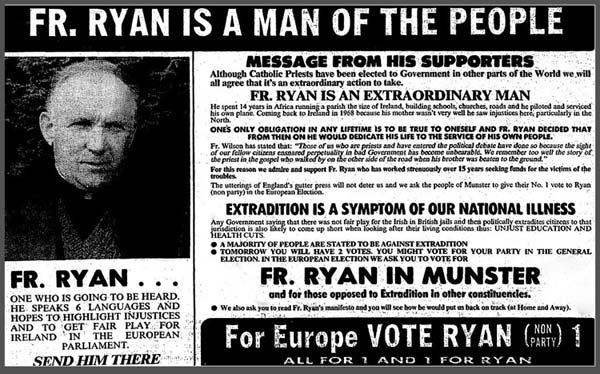
The material is expected to includes interviews with Rev. Fr. Patrick Ryan, latter a Roman Catholic priest, who told the programme he had maintained a network of Europe-wide contacts, same used to generate arms and money for the IRA.
The priest in question, Fr. Patrick (Paddy) Ryan, now in his 92nd year, was born on June 26th, 1930, in Rossmore, Cashel, Co. Tipperary, one of six children born to a rural farming family.
Fr. Ryan had shown no great interest in politics beyond a hatred for past and present British rule on the island of Ireland; however the Roman Catholic Church and the Pallottine Order would formally suspend him from priestly duties, after he refused a transfer to a Parish Church in England.
Later on, during a trip to Rome in the summer of that same year, he is reported to have informed Italian priests that he hoped that the IRA would bomb the centre of London.
By the Autumn of 1973, he was shuttling back and forth between Dublin and Geneva, opening bank accounts and transferring funding (over £1,000,000) reportedly, granted by his newly acquired contacts within Libyan Military Intelligence in Tripoli.
A PSNI lawyer told the court that there were reasonable grounds to believe that same material, currently the property of the BBC was likely to be of use in future terrorist investigations.
Keeping in mind the need to protect the public from terrorist activity; Mr Justice Neil Rafferty presiding in Belfast Crown Court, granted the order allowing the PSNI to access the gathered material.
Easter, also called Pascha (Passover) or Resurrection Sunday, is a Christian festival and cultural holiday commemorating the resurrection of Jesus Christ from the dead, described in the New Testament as having occurred on the third day of his burial, following on from his crucifixion by the Romans at Calvary c. 30 AD.
This year (2022)Easter Sunday falls on Sunday, April 17th, in exactly two week’s time.
Meaning of the word Hallelujah.
The word “hallel” in Hebrew means a joyous praise in song. The second part, “Yah”, is a shortened form of “Yahweha”, a lesser known name for God or Jehova, thus the word means “Praise Yahweh”, or “Praise God”, joyously.
An Easter Hallelujah.
Sung by Cassandra Star & her sister Callahan and written by Kelley Mooney
A crown of thorns placed on His head He knew that He would soon be dead He said, “Did you forget me, Father did you?” They nailed Him to a wooden cross Soon all the world would feel the loss Of Christ the King before His Hallelujah Hallelujah, Hallelujah
He hung His head and prepared to die Then lifted His face up to the sky Said, “I am coming home now Father, to you” A reed which held His final sip Was gently lifted to his lips He drank His last and gave His soul to glory Hallelujah, Hallelujah
The soldier who had used his sword To pierce the body of our Lord Said, “Truly, this was Jesus Christ our Saviour” He looked with fear upon his sword Then turned to face his Christ and Lord Fell to his knees crying Hallelujah Hallelujah, Hallelujah
Took from his head the thorny crown And wrapped him in a linen gown Then laid him down to rest inside the tomb The holes in his hands, his feet, and side Now in our hearts, we know he died To save us from ourselves, oh Hallelujah Hallelujah, Hallelujah
Three days went by, again they came To move the stone, to bless the slain With oil and spice anointing Hallelujah But as they went to move the stone They saw that they were not alone For Jesus Christ has risen, Hallelujah Hallelujah, Hallelujah
“How can men feel themselves honoured by the humiliation of their fellow beings?” – Mahatma Gandhi.
A ‘Great Famine Walk’ between Louisburgh and Doolough, Co. Sligo, takes place every year to commemorate what history records as the “Doolough Tragedy”.
Today, here in Thurles, as the last piece of our Great Famine heritage (1845-49) is finally eradicated from the face of this earth, supported by Mr Seamus Hanafin, (Fianna Fáil Councillor) and others, we remember that 173 years ago, on this same day, (Friday March 30th, 1849), two officials of the Westport Poor Law Union arrived in Louisburgh, southwest Co. Mayo.
“Doolough Tragedy” – In ár gcroíthe go deo.
Their purpose for coming, was to inspect people who were in receipt of outdoor food relief and to verify that same should continue to receive it.
This inspection, did not take place as scheduled and the two officials moved on to Delphi Lodge, considered more suitable to accommodate, worthy inspecting officials.
The lodge today is situated some 12 miles (19 kilometres), south of Louisburgh, on the southwest corner of Clew Bay in County Mayo. It was here they chose, to spend a night or two.
Delphi Lodge was first built in the 1830’s by the Marquis of Sligo as a hunting/fishing lodge. The family seat was Westport House, near Westport, County Mayo. [Family titles included – Baron Mount Eagle, of Westport in the County of Mayo (created 10 September 1760), Viscount Westport (in 1768) and Earl of Altamont (in 1771)].
It is stated that the building was named ‘Delphi’ based on the area’s similarity to the home of the “Oracle” in Greece, latter an important shrine, built around a sacred spring, and regarded as the ‘omphalos’ (meaning the centre or navel) of the world.
Over the next 120 years, it was used throughout by the family or on occasion leased out to British army officers and members of the protestant clergy.
In 1903 Delphi Lodge was visited by King Edward VII, and in 1995 by a recent visitor to Tipperary, last week, Prince Charles. This house eventually fell slowly into semi-dereliction until rescued in 1985, by Mr Peter Mantle, together with investors, who restored the Lodge, its Cottages and Fishery.
Meanwhile, 173 years ago, the several hundred people who had gathered for this now delayed inspection, were consequently instructed to appear at Delphi Lodge, at 7:00am the following morning. The lodge was then owned by Mr George John Browne [1820–1896] 3rd Marquess of Sligo. The ultimatum in the inspectors instruction stated that if they wished to continue receiving their relief, they should be present to be examined.
For much of the night and day that followed, hundreds of Irish people, same destitute, starving and in a weakened and infirm state, had to undertake what for them was an extremely fatiguing 12 mile journey, in extremely cold, wet and windy weather.
In a letter written to the “Mayo Constitution” newspaper, [Published January 3rd, 1828 – May 11, 1872], a short time later; we learn that the bodies of seven persons, including women and children, were subsequently discovered on the roadside, between Delphi Lodge and Louisburgh, which overlooks the shores of Doolough lake, and that nine or ten more people never reached their homes.
Other sources claim that the total number of dead numbered 20 people, while local people claim that the number who died along the way exceeded all previous reports.
Co.Sligo has chosen to hold on to its strong history; on the other hand, Thurles Councillor Mr Seamus Hanafin and Tipperary County Council Officials have decided to destroy Tipperary history, without the consent of Thurles residents.
First, there are the problems with Dublin city councillors. It seems that current and former Dublin city councillors, together owe more than €146,000 to Dublin City Council in overpaid travel expenses. Same was discovered in an investigation by the Local Government Auditor, (Nosy interfering Busybodies).
Inner Relief Road, Archaeological Survey, Click HERE
This 2021 audit identified that councillors, for this Dublin local authority, had been overpaid their annual travel rate, by €48.42 every month, but only as far back as January 2018, amounting to €581.10 a year and a total of €2,324.40 for politicians who had served on Dublin City Council since 2018.
Sure, for God’s sake it was only taxpayers money, and sure taxpayers couldn’t give a f..k. I mean if taxpayers had been fooled into voting “them’s individuals” into office in the first place, they must have expected they would be taken advantage of; lest you forget the F.F. brown envelope planning era.
It has been a tough few days for Tipperary Co. Council this week also. On Wednesday last “RTÉ Investigates” journalist Con Corrigan, “deliberately picked on”, our beloved Tipp authority, daring to accuse them of ‘Project Costs Over-runs‘, [ See HERE ].
It appears that a project known as the Suir Blueway, stretching from Clonmel to Carrick On Suir (Not to be confused with the Thurles River Suir Brownway); the former, incorporating a walking and cycling trail along the River Suir in south Tipperary, was initially budgeted for €1.3, then (like the National Children’s Hospital), it became €2m, but ultimately costs eventually closed at €3.7m.
The final costs increased a mere 84% only, on the original budgeted amount; that’s according to documents released to RTÉ Investigates, under freedom of information.
Anyway, the RTÉ Investigates episode didn’t upset Tipperary Co. Council’s Chief Executive Mr Joe MacGrath, who went missing from work on Friday last.
(I should explain that we at Thurles.Info have a habit of sending emails to those we write about – well they might want to accuse us of telling ‘porkies’).
Well Holy God, shock of shocks, the night before last, after 3 years and numerous emails sent, didn’t we actually get a reply, for the very first time, (despite no intervention by the Standards In Public Office Commission), from Mr Joe MacGrath. Well I nearly died.
He stated, quote “Please re-send your email to evelyn.harty@tipperarycoco.ie or contact her at Tel 0818 06 5000. I am away from my office with limited access to emails.”
Then it struck me, this was one of those “Automatic Replies”, latter being doled out normally from every government office in Dublin, but same rarely replied to after that. [Sure you know yourself, in the Public Service half are still working from home and the other half are not working at all, at all].
Anyway, my first thoughts were, why don’t they buy Joe one of those new-fangled Mobile Phone contrivances; called ear phones or eye phones, whatever. My understanding is that they can now be put to vibrate silently in your trousers pocket, and when activated they can read, and let you see your emails off of a screen, on one side of the device.
Well to cut a long story short, on the same Friday, I had to go over to Cashel and Cahir; (NCT Business in Cahir, then off to buy a 3 scone and tea at Mikey Ryans in Cashel). On the way didn’t I get a call from an old school friend of mine, Charley. Hadn’t seen him in years and he was over visiting here, having brought the wife Camilla on a junket.
Listen, anyway as I’m chatting to Charlie, who did I spy out of the corner of my eye, but some one, the spitting image of Joe, edging in to have a selfie taken with Camilla. Still I can’t be totally sure it was him and since he doesn’t answer his emails, its a waste of time trying to find out.
Anyway, what I really want to talk about and show all our readers, is the pdf of the Thurles Inner Relief Road which ended up destroying the only remaining piece of visible great faminr history in Thurles. Same document failed to highlight the Great Famine Double Ditch; Public Right of Way; Mass path and Great Famine connection in its regurgated survey info, undertaken by Mr F. Coyne, BA MIAI, despite having surveyed the sections of land on both sides of this 5ft in width, Great Famine, 176 year old Double Ditch.
So Mr MacGrath, if you are reading this email, the Archaeological Impact Statement for the inner relief can be foundHERE, by you, Mr Ger Fogarty and indeed the rest of the interested world.
[Mr Ger Fogarty will note that the survey was undertaken in 2013, while Lions Club survey was undertaken in 2018.]
We have already sent this and other documents to “RTÉ Investigates”, then again they might not use the information, but not to worry, we will.
I think the time has come for raised Thurles voices and the digging up of discarded, hidden bodies.
This website uses cookies to improve your experience. We'll assume you're ok with this, but you can opt-out if you wish.AcceptRead More
Privacy & Cookies Policy
Privacy Overview
This website uses cookies to improve your experience while you navigate through the website. Out of these, the cookies that are categorized as necessary are stored on your browser as they are essential for the working of basic functionalities of the website. We also use third-party cookies that help us analyze and understand how you use this website. These cookies will be stored in your browser only with your consent. You also have the option to opt-out of these cookies. But opting out of some of these cookies may affect your browsing experience.
Necessary cookies are absolutely essential for the website to function properly. This category only includes cookies that ensures basic functionalities and security features of the website. These cookies do not store any personal information.
Any cookies that may not be particularly necessary for the website to function and is used specifically to collect user personal data via analytics, ads, other embedded contents are termed as non-necessary cookies. It is mandatory to procure user consent prior to running these cookies on your website.








Recent Comments