The current Anti-Semitism continues a centuries-long phenomenon in Europe, having possibly reached its zenith during the Nazi era (1933–1945) in Germany. ‘The Holocaust’ was Nazi Germany’s deliberate, organized, state-sponsored persecution and genocide of European Jews. During WWII, the existing Nazi regime systematically murdered about six million of the Jewish population.
Why are Jews Targeted? The Origins of Antisemitism
Today the “Auschwitz Album,” containing some 193 photographs; compiled between May or June of 1944, either by Ernst Hofmann or by Bernhard Walter, remain the only surviving known visual evidence of the process of the mass murder of Jews at the Auschwitz-Birkenau concentration camp. Both above named individuals were SS men, who had been tasked with taking ID photos and fingerprints of inmates.
In November 1938, German Jews faced deliberate and orchestrated violence, showing many Jews that their very existence was in danger, if they stayed within the country. In a Nazi-provoked riot, known as Kristallnacht [Night of Broken Glass, or the November Pogrom* ] staged on November 9th, 1938, more than 250 synagogues were destroyed, and 91 people were murdered. Countless Jewish businesses and homes were vandalized and destroyed, and some 30,000 Jewish men were sent to Dachau, Buchenwald, Sachsenhausen and other concentration camps, where they were coerced into promising to emigrate, when they were released several weeks later.
* ‘Pogrom’ meaning the organized massacre of a particular ethnic group.
It became difficult for Jews to leave Germany because few countries, were willing to take them in, even though it was widely known that they were suffering under the then Nazi regime.
It was Ms Lilly Jacob-Zelmanovic Meier who donated the album, in the video shown above, to Yad Vashem (The World Holocaust Remembrance Centre) in 1980. When originally assembled, the album was likely not for use as Nazi propaganda, but was most likely prepared as an official document for future German reference.
The Irish Constitution of 1937 specifically gave constitutional protection to Jews. This was considered to be a necessary component to the constitution by Éamon de Valera because of the treatment of Jews elsewhere in Europe at the time. The reference to the Jewish Congregations in the Irish Constitution was removed in 1973 with the Fifth Amendment. This same amendment removed the ‘special position’ of the Catholic Church, as well as references to the Church of Ireland, the Presbyterian Church, the Methodist Church, and the Religious Society of Friends, the Quakers.
Anti-Israeli protests by some 100 students in Trinity College, Dublin, has now resulted in an agreement by college management to the divestment from investments in Israeli companies that have activities in the Occupied Palestinian Territory and appear on a UN blacklist. However, It is worthy of note that a one former graduate of Trinity College, Dublin, a Cork woman and a Quaker (Society of Friends) named Mary Elmes used her skills having crossed the border into France working as head of the Quaker delegation in Perpignan, France. Her presence saved the lives of hundreds of Jewish children bound for Auschwitz-Birkenau, via Rivesaltes Camp in the north eastern suburb of Paris, latter the major transit camp for the deportations of French Jews. She is known to have “spirited away” children in the boot of her car, to children’s homes she had previously set up in the Pyrenees. In 1943 she was arrested by the Gestapo and spent six months in jail. On release she continued her mission to save the lives of Jewish children. She refused all suggestion of accolades during her lifetime, but 11 years ago, in 2013 she was named “Righteous Among the Nations” at Yad Vashem (The World Holocaust Remembrance Centre). She is the only Irish person to hold this distinction, given to non-Jews who risked their lives to save Jewish people during World War II. On July 9th 2019, the then Cork City Council, in a display of true wisdom, opened a new pedestrian bridge, same now named in honour of Ms Mary Elmes.
A former professor of Hebrew at the same Trinity College, between 1939 and 1979, Mr Jacob (Jack) Weingreen and his wife Bertha must surely have turned in their Dublin graves following the demands by the same students. Both the Weingreen’s were members of the Dublin Jewish community and both were active in education and youth movements, serving for a time with the Jewish Relief Unit, following the end of WWII.
Bertha Weingreen was Chief Welfare Officer responsible for all Jewish Displaced Persons in the British zone and stationed at the former military barracks at the Bergen Belsen, concentration camp.
Jacob was Director of Education for all Displaced Persons, before setting up a successful Trade School at Belsen which was later transformed into a top-grade technical college. Professor Weingreen was the author of ‘A Practical Grammar for Classical Hebrew’, latter a textbook that is still recognized as the standard teaching work on the subject. The couple received desperately needed supplies sent from Dublin’s JYRO (Jewish Youth Relief Organisation) and the Linen Mills in Northern Ireland, which were used for the kindergarten Bertha set up for hidden children Bertha Weingreen encountered in Berlin. The Weingreens eventually returned to Dublin in 1947 where they played prominent roles in the Irish Jewish community until their deaths in 1995 and 1999, respectively.
True pro-treaty Irish Republicans will be aware of the fact that on a Friday afternoon in 1920, Black and Tans descended on Longwood Avenue, South Circular Road, Portobello, Dublin 8, blocking off the area between Leonard’s Corner and Kelly’s corner, using a lorry and an armoured car. Same raid came accompanied by a strict curfew.
The Sabbath day observed by Jews begins from sunset on Friday evening to sunset the following day. However, on this same Sabbath day in 1920, the Jewish community made the decision that Tans or no Tans, they were going to visit their local synagogue. When it was time to go to pray, the men were the first to emerge from their homes, followed by wives and children. Rabbi Gudansky followed last, accompanied by his family, while he supported an elderly gentleman, who could barely walk. The old crippled man swore at the Tans in Yiddish, which sounded like nonsense gibberish to the Black and Tan soldiers. It appeared that residents from Longwood Avenue’s Jewish community had somehow lost the ability to speak English that evening, as Tan soldiers were bombarded with Yiddish, Russian, Lithuanian, and Polish dialects. The Black and Tans, in an effort to rid themselves of this now gathering angry crowd, decided to step aside and allow the Jewish community to continue to attend at their place of worship. On reaching Walworth Road, Portobello, Dublin, Rabbi Gudansky and his aged companion, halted briefly before shaking hands. The man removed his hat and boomed: “Thank you! Thank you!” in his strong Cork accent. The ‘cripple’ was none other than Michael Collins (1890 – 1922) in disguise. He winked stating: “I will send for the bicycle later”, before quickly moving on alone. It was learned later that Collins first entered Joseph Kervon’s house, on Longwood Avenue, before he jumped over a wall into Rabbi Gudansky’s back garden, latter situated next door. He entered the residence, unnoticed by the Tans, before borrowing traditional Jewish garb, courtsey of Rabbi Gudansky.
Sadly, to my mind, the current Irish Taoiseach Mr Simon Harris (A former Minister for Further and Higher Education, Research, Innovation and Science) has informed Israeli President Mr Isaac Herzog of Ireland’s plan to recognise the state of Palestine and has reiterated that the overarching goal should be a two-state solution; latter which Hamas terrorists themselves have denounced, calling instead for the full and complete liberation of Palestine, “from the river (Jordan) to the sea”; an area that includes what is now Israel, and in the context of the current wishes of Hamas can only mean the total destruction of the State of Israel.
In return the Israeli President has warned Mr Simon Harris that any such unilateral recognition of Palestine, as a State, will totally jeopardise any hope of Hamas releasing the hostages it continues to hold in Gaza, and will no doubt encourage further missile and other attacks on the State of Israel.
History will record the outcome of this interference by the present Irish government.
“Little Miss Muffet, she sat on her tuffet, eating her curds and whey. Along came a spider, who sat down beside her, and frightened Miss Muffet away.
As promised on April 21st, 2024, a 269 year old recipe, adapted from the manuscript book of Catherine Hughes, Killenaule, Thurles, Co. Tipperary, dated 1755, and published by Mrs Theodora FitzGibbon, in her book ‘A Taste Of Ireland’, published 56 years ago, in 1968, is published hereunder.
Milk going to the creamery, pictured in thelate 19th century,at Killenaule, Thurles, Co. Tipperary.
Cottage cheese, once considered to be the least desirable item to pick up in your supermarket’s dairy aisle, is now being heralded as one of the best items to put in your shopping basket.
Cottage cheese, as the name implies, is a type of cheese made up of curds and whey liquid (yes, the very thing Miss Muffet was eating before being rudely interrupted by that spider). It hasn’t always been celebrated for it lumpy wet consistency, but health enthusiasts highlight that it is a good source of calcium. More importantly, cottage cheese is naturally very high in protein, with on average, a whopping 11g of protein per 100g. Protein is essential for human growth and repair and for helping us to maintain our muscle as we get older.
A quick internet search will yield hundreds of cottage cheese recipes including pancakes, breads and desserts, but here’s a recipe for cottage cheese that is 269 years old.
Curds (Grut in Irish) formed an extensive part of the diet of the ancient Irish. They are mentioned in the earliest documented sources. Various early cheeses were made from them; one cheese being ‘faiscre grotha’, (Irish meaning literally ‘pressed curd’). The Reverend Richard Hopkins Ryland* in ‘The History, Topography and Antiquities of the County and City of Waterford’, dated 1824, says “Cheese made from skimmed milk and called ‘Mullahawn’ was formally an article of commerce in Waterford and was exported in large quantities…”
*Reverend Richard Hopkins Ryland was born in 1788, the descendant of 16th century Protestant planters who had settled in Dungarvan, Co Waterford. Generations of the family became ‘Church of Ireland’ ministers. Rev. Ryland married Isabella Julia Fleury (latter nine years his junior), the daughter of the Rev. Archdeacon George Louis Fleury of Waterford in 1818; at St. Patrick’s Church, Waterford. The couple had six sons and two daughters. His best known historical work was ‘The History, Topography and Antiquities Of The County And City Of Waterford’, (published 1824), which was dedicated to the Duke of Devonshire, while he also published religious pamphlets. He died in 1866, aged 78 years, followed by his wife Isabella Julia in 1873; aged 76 years, in South Kensington, Middlesex, England. The Tipperary ‘Clonmel Chronicle’ newspaper published her official ‘Death Notice’.
Pastry. 6 oz (6 heaped tablespoons) of flour. 3 oz (3 heat tablespoons) butter. 1 tablespoon sugar. ½ teaspoon salt. Water.
Filling. ½ lb (2 cups) sweet curds or cottage cheese. 2 eggs, separated. 2 heaped tablespoons sugar (vanilla sugar if possible). Grated peel and juice of half lemon. 1 tablespoons of butter.
For the topping. 1 egg and one tablespoon each of sugar, flour and melted butter.
First make the pastry by mixing the fat into the flower, sugar, and salt, to a firm pliable dough with a few tablespoons of water. Cool if possible before using. Make the filling by well mixing the curds with the sugar, soft butter, grated peel and juice of the lemon and the beaten egg yolks. Beat is well, then add the stiffly beaten egg whites. Roll out the pastry to fit a flan-tin, 7 in-8 inch across, line the tin with it and paint the bottom with beaten egg (this prevents the bottom pastry becoming heavy).
Put the filling into the pastry case, and, using the rest of the egg, mix it with the topping sugar, melted butter, and flour. Pour this evenly over the top. Bake in a moderate oven (350° F. electric; gas regulo 4) for 35 to 40 minutes, or until the top is golden brown. Serve cold, but not chilled, cut into wedges.
In the early hours of the morning of Saturday February 14th 1981, a fire occurred at the Stardust Ballroom in Artane, Dublin, in which forty eight persons tragically lost their lives. ~ The song “They Never Came Home”, refers to the victims and families of this tragic event.
They Never Came Home (Stardust Song)
Lyrics: Christopher Andrew “Christy” Moore. Vocals: Irish folk singer, songwriter and guitarist Christy Moore.
They Never Came Home (Stardust Song)
When St. Valentine’s day comes around once a year, Our thoughts turn to love, as the time it draws near, Sweethearts and darlings, husbands and wives, Pledge love and devotion for the rest of their lives. As the day turns to evening soon night time does fall, Young people get ready for the Valentine’s Ball, As the night rings with laughter, some families still mourn, The 48 children who never came home.
Chorus Have we forgotten the suffering and pain, The survivors and the victims of the fire in Artane, The mothers and fathers forever to mourn, The 48 children who never came home.
It was down to the Stardust they all made their way, The bouncers looked on as they lined up to pay, The records were spinning, there’s dancing as well Just how the fire started sure no one can tell. In a matter of seconds confusion did reign, The room was in darkness, fire exits were chained, The firefighters wept for they could not hide, Their sorrow and anger for those left inside.
Repeat Chorus
Throughout the city the bad news it spread, There’s a fire in the Stardust, with 48 dead. Hundreds of children are injured and maimed, And all just because the fire exits were chained. Our leaders were shocked, grim statements were made, They shed tears by the graves, as the bodies were laid, The injured have waited in vain for 4 years, It seems like our leaders shed crocodile tears.
Repeat Chorus
Half a million was paid in solicitor’s fees, A fortune to the owner and his family, It’s hard to believe that not one penny came, To the working class people, who suffered the pain. The days turn to weeks and the weeks turn to years Our laws favour the rich, or so it appears. A woman still waits for her kids to come home, Injustice breeds anger and that’s what’s been done.
Chorus Let us remember the suffering and pain, The survivors and victims of the fire in Artane, The mothers and fathers forever to mourn, The 48 children who never came home. END
“Where Tipperary Leads, Ireland Follows“. Quote by Thomas Davis, editor of ‘The Nation Newspaper’ in the 1840’s.
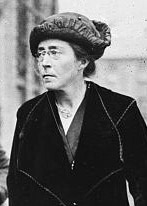
A headstone, marking the grave of the Irish suffragette better known as Meg Connery, was unveiled in Dublin yesterday.
Pictured L-R: British Conservative politician and Prime Minister Andrew Bonar Law (1858-1923), Mrs Meg Connery and Irish Unionist politician, barrister and judge, Sir Edward Carson (1854–1935). (Meg is pictured distributing copies of the ‘Irish Citizen‘ newspaper)
Mrs Connery was a strong advocate of women’s voting rights, conveyed publicly through her public speaking, lobbying, protesting and the publishing of articles in a variety of publications, especially in the Irish Citizen newspaper.
1916 Picture of Hanna Sheehy.
The Irish Citizen newspaper, itself, was founded in 1912, by the Irish Women’s Franchise League, latter founded in 1908. Amongst its founder members were Mrs Hanna Sheehy-Skeffington, (former resident of Loughmore, Templemore, Co. Tipperary, latter village just 11.4km from Thurles), [VIEW HERE]; her husband Francis Sheehy-Skeffington(1877-1946)[Note: latter executed in Portobello Barracks, today known as Cathal Brugha Barracks, in Rathmines, Dublin), together with Thomas MacDonagh executed revolutionary leader and signatory of the Proclamation of the Irish Republic, (born in Cloughjordan, Co. Tipperary, latter village just 39.7km from Thurles), and strict vegetarians Margaret Cousins and her husband; teacher, author, actor, poet and play write James Henry Cousins(1873–1956). [Latter is credited with the quote, “Wisdom is wisdom only to the wise,” and once suspected of getting ‘too close’ romantically, to Maud Gonne, (to the annoyance of poet W. B. Yeats), following the execution of her husband, the Irish republican and military leader John MacBride).
A leading figure in the Irish Women’s Franchise League, Mrs Meg Connery, where possible, heckled and disrupted political meetings, and was a strong believer in the use of physical force in her pursue for voting rights for women. After spending most of her life in Dublin, Meg’s activities, much like that of her close friend Hanna Sheehy-Skeffington’s, included breaking windows in the Customs House, Dublin Castle, London War Office, going on hunger strike being imprisoned and beaten in her pursuit of equality for women. During World War I which saw the introduction of the Contagious Diseases Act, Meg protested feeling the purpose of the Act was to make sex safe for male soldiers and sailors. In 1915 the British government closed the North Sea for a number of days around the International Women’s Peace Conference in The Hague thus leaving Irish women unable to attend.
Meg’s final years on this earth were difficult due to failing health and poverty. and up until yesterday an unmarked grave in Mount Jerome Cemetery in Harold’s Cross, Dublin, marked the burial place of Meg Connery and her husband Con Connery, whom she had married 49 years earlier in Clonmel, Co. Tipperary, in 1909.
Thurles.Info now asks the question, “Why is this historic information not being used as bate to attract/promote badly needed tourism to both Thurles town and the wider county of Co. Tipperary?
The penal laws, especially in Ireland, were a series of laws imposed in the seventeenth and early eighteenth centuries on Irish and English Roman Catholics and to a lesser degree, on Protestant dissenters. Enacted by the Irish Parliament, these laws secured the then Protestant Ascendancy, by concentrating property and public office into the hands of the established Church of Ireland, latter who subscribed to the Oath of Supremacy, thus acknowledging the reigning British monarch as the supreme governors of matters, both spiritual and worldly.
Catholic bishops were banished completely from Ireland, while Parish Priests had to be ‘registered’ and also take the Oath of Abjuration, latter which involved swearing an oath of loyalty to the protestant succession and denying the son of Catholic James II, deposed in 1688.
Catholics were forbidden to have schools of their own or to have their children educated by Catholic teachers. No Roman Catholic could own a horse worth more than £5. They were forbidden to buy land, and they could not lease property for more than 31 years, while at the same time having to pay a rent that was to be at least-two thirds of the value of said land. Catholic could not carry arms, while the ‘Laws of Inheritance’ were altered allowing a son or daughter, who adopted the Protestant Religion, to become the sole heir/heiress to all property.
Various acts passed in the 16th and 17th centuries prescribed fines and imprisonment for participation in Catholic worship and severe penalties, including death, for Catholic priests who practiced their ministry in Ireland.
Above is a rare eighteen century brass bell-shaped, flared, travelling Communion Chalice. Same has a turned stem and foot (See centre pic) which can be neatly secured inside the cup when it is inverted unto a threaded screw, (See picture right). The piece, when unscrewed, and turned upright, reveals the base and can then be assembled correctly for use, (See Image left). The cup shape (centre above) is just five centimetres (1.9685 inches) high and the chalice when fully assembled is a mere 8.2 centimetres (3.22835 inches) high. Pic: G. Willoughby.
Many older priests, however, refused to leave the country. They wore lay clothes, took up lay employment often as farm labourers, and ministered in secret to their flock. Mass was held, when possible, in the open air using a large flat rock; often a large stone taken from a church ruin, serving as an altar, in a sheltered part of a field, wooded area or barn. Because these activities were illegal, Mass were never scheduled and such occurrences was communicated verbally between those of the faith. Lookouts were posted to keep watch for the dreaded ‘Red Coat’ army, who were always on the alert for large Catholic assemblies.
Most Bishops were obliged to leave the country at this time and eventually only two remained, same working incognito as parish priests. It was hoped that without Bishops, priests could no longer be ordained, resulting over time to the eradication of such persons over time.
Spying was encouraged. There were severe penalties for Catholic bishops and priests who remained in Ireland without permission. A reward of £20.00 was offered for information leading to the capture of a priest, and £50.00 for the capture of a Bishop. Such rewards led to the arrival of the dreaded “priest hunter”. One of the most notorious priest hunters being John Moloney, Ballintubber Co. Mayo. To escape hanging for horse stealing, he was persuaded to become the priest hunter known as “Sean an tSagairt”, who had the protection of the British “Red Coat Army”, wherever he was summoned or went.
The custom of placing a lighted candle in the window of homes at Christmas is believed to come from Penal times. It was a signal to any wandering priest that it was a ‘safe house’, and that the family wished to receive the Blessed Sacraments.
Dublin born philosopher, Anglo-Irish statesman and member of Parliament (1766 and 1794), Edmund Burke, himself a Roman Catholic, the offspring of a Roman Catholic mother Mary (latter a cousin of Nano Nagle, who founded the ‘Sisters of the Presentation of the Blessed Virgin Mary ) and father Richard, a member of the Church of Ireland; described these penal laws as “a machine of wise and elaborate contrivance, as well fitted for the oppression, impoverishment and degradation of a people, and the debasement in them of human nature itself, as ever proceeded from the perverted ingenuity of man”.
It was under such penal laws that brass and bronze Communion Chalices, such as that pictured above, were made secretly in the 17th and 18th century and used by Irish priests to discreetly minister to their flock. When not in use, the stem and the bell-shaped cup could be detached and easily hidden.
Catholic relief efforts in the late 18th century led eventually to the repeal of most of the Penal Laws by 1793. However, Catholics would continue to be hindered in regards to government service and participation until the passage of Catholic emancipation in 1829.
The Emancipation Act of 1829 admitted Irish and English Roman Catholics into Parliament and to all but a handful of public offices. Daniel O’Connell’s (1775-1847), Emancipation Act of 1829 admitted Irish and English Roman Catholic men into Parliament and to all but a handful of other public offices, but reduced the number of Irish peasants entitled to vote. After 1829, Parliament no longer acted exclusively for members of the Church of England.
This website uses cookies to improve your experience. We'll assume you're ok with this, but you can opt-out if you wish.AcceptRead More
Privacy & Cookies Policy
Privacy Overview
This website uses cookies to improve your experience while you navigate through the website. Out of these, the cookies that are categorized as necessary are stored on your browser as they are essential for the working of basic functionalities of the website. We also use third-party cookies that help us analyze and understand how you use this website. These cookies will be stored in your browser only with your consent. You also have the option to opt-out of these cookies. But opting out of some of these cookies may affect your browsing experience.
Necessary cookies are absolutely essential for the website to function properly. This category only includes cookies that ensures basic functionalities and security features of the website. These cookies do not store any personal information.
Any cookies that may not be particularly necessary for the website to function and is used specifically to collect user personal data via analytics, ads, other embedded contents are termed as non-necessary cookies. It is mandatory to procure user consent prior to running these cookies on your website.






Recent Comments