Dare any of you lovers out there, forget that St. Valentine’s Day, is on Tuesday next, February 14th.
Talking of people in recent history, who fell in love, let’s not forget the sadly unrequited* love story of that great Irish poet, Patrick Kavanagh (1904-1967), and Ms Hilda Moriarty in 1944.
* Unrequited love occurs when one person yearns for unconditional love, from another individual who doesn’t always feel the same way.
It was sometime in the Autumn of 1944, while living on Raglan Road, in Ballsbridge, Co. Dublin, that the poet Kavanagh spotted Ms Hilda Moriarty, herself a native of Co. Kerry, as she wended her way to attend Dublin City University, where she was studying to become a medical doctor.
Ms Moriarty was then 22yrs old, while Kavanagh was some 20 years her senior. For Kavanagh, it was love at first sight, and though she would regarded him as a close friend, her true feelings toward him were never of a romantic nature.
In 1947 Hilda would marry the handsome Mr Donogh O’Malley, a rugby union player, who later served as Parliamentary Secretary to the then Minister for Finance (1961 to 1965); Fianna Fáil Minister for Health (1965 to 1966), and Minister for Education (1966 to 1968). It was the same O’Malley who first announced the notion of free education for Irish students, on September 10th, 1966, unknown to his cabinet colleagues; thus updating Ireland’s antiquated educational system, same unchanged since Irish independence.
Sometime later, Kavanagh was inspired to write the poem, that we refer to, today, as, “On Raglan Road”, published in the Irish Press in 1946, under the title, “Dark Haired Miriam Ran Away”. Kavanagh’s poem was later set to the melody of an old Irish song called, “Fainne Gael an Lae”; (Irish loose translated, “The Dawning of the Day”).
ON
OnRaglan Road.
Lyrics: Irish Poet and Novelist, Patrick Kavanagh(1904-1967). Vocals: Singer, Folk Musician, Banjoist and Actor, the great Luke Kelly(1940 – 1984).
On ‘Raglan Road’ of an Autumn day, I saw her first and knew, That her dark hair would weave a snare, That I might one-day rue. I saw the danger and I passed, Along the enchanted way, And I said, “Let grief be a fallen leaf, At the dawning of the day.” On Grafton Street in November, We tripped lightly along the ledge, Of a deep ravine where can be seen, The worth of passion play. The Queen of Hearts still making tarts, And I not making hay. Oh, I loved too much and by such, by such, Is happiness thrown away. I gave her gifts of the mind, I gave her the secret sign, That’s known to the artists, who have known, The true gods of sound and stone. And word and tint, (I did not) without stint. (For) I gave her poems to say, With her own name there and her own dark hair, Like clouds over fields of May. On a quiet street, where old ghosts meet, I see her walking now, Away from me so hurriedly, My reason must allow, That I had loved, not as I should, A creature made of clay, When the angel woos the clay, he’d lose, His wings at the dawn of day.
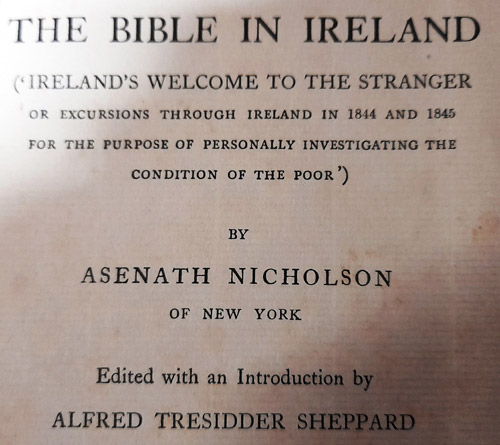
In a rare book, [edited with an introduction by Alfred Tresidder Sheppard, (London 1871-1947)], entitled “The Bible in Ireland”(Ireland’s welcome to the stranger or excursions through Ireland in 1844 and 1845 for the purpose of personally investigating the conditions of the poor), written by Asenath Nicholson; we learn of her visit to Thurles, Co. Tipperary and other nearby villages, including Gortnahoe, Urlingford, Cashel, Holycross and Mount Melleray, Co. Waterford.
To follow the story of this remarkable woman – View Part 1HERE; – View Part 2HERE, before continuing on this page.
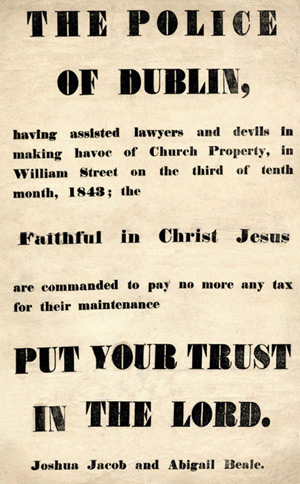
Pamphlet printed by White Quakers following the auctioning of property under the direction of the Court of Chancery.
Asenath writes. “I took a car the next morning for Mount Melleray*, a distance of more than 50 English miles.
[Note: * Mount Melleray Abbey is a community of Cistercian (Trappist) monks. The monastery is situated on the slopes of the Knockmealdown mountains, latter a mountain range located on the border of counties Tipperary and Waterford.]
I had hoped to stop at the Rock of Cashel, but was obliged for the present to content myself by seeing its lofty pinnacle. Perched upon the top of a rock, it has stood the ravages of centuries, looking out upon the world, and the City beneath its feet, now going fast to decay. Cashel looked more deserted this day than usual, as a rich brewer in the city, a brother of Fr. (Theobald) Mathew, (latter teetotalist reformer), had died, and the shops were closed in honour of his funeral.
When travelling by coaches and cars, I have been so much annoyed by the disgusting effluvia of tobacco, that I dread a ‘next stage’, the changing of horses being the signal for a fresh lighting up.
At Cashel I sat behind a rustic* who had reloaded his pipe, and he began puffing till my unlucky head was enveloped in a dense fog, a favourable wind wafting it in that direction.
[*Note: Word ‘rustic’ means a rural dwelling man].
Knowing that the consumers of this commodity are not fastidiously civil, I forbore to complain, until I became sick. At length I venture to say ‘Kind Sir, would you do me the favour to turn your face a little? Your tobacco has made me sick.’ Instantly he took the filthy machine from his mouth and archly looking at me, ‘Maybe yer ladyship would take a blast or two at the pipe,’ resumed his puffing without changing his position. I was cured of asking favours.
I blush for my country when, on every car, and at every party and lodging house, this everlasting blot on America’s boasted history is presented to my eyes. Even the illiterate labourer, who is leaning over his spade, and tells me of his 8 pence a day, when I in pity explain, ‘How can you live? You could be better fed and paid in America,’ often remarks, ‘Aw you have slaves in America, and are they better fed and clothed?
A few hours carried us to Clonmel, a town neat in its appearance, containing about twenty thousand inhabitants, amongst whom are many Quakers.
Here some of the ‘White Quakers’*, a small body of ‘Come-outers’ from the Quakers, formerly resided, but they have removed to Dublin. These people bitterly denounce others, but take liberties themselves, under pretence of walking in the Spirit, which by many would be considered quite indecorous. The men wear white hats, coats and pantaloons of white woollen cloth, and shoes of undressed leather; the women likewise dress in white, to denote purity of life.
Note: * Joshua Jacob (1802–1877), founder of the ‘White Quakers’, was born in Clonmel, Co. Tipperary. Educated at Newtown school, Waterford; Joseph Tatham’s school in Leeds and later in Ballitore, Co. Kildare; in 1829, he married Ms Sarah Fayle who bore him three sons. Mr Jacob established himself as a grocer in Dublin. His shop, known as the “Golden Teapot”, specialised in the sale of different varieties of tea. By 1838 having publicly criticized the comforts of Quaker life, he was disowned by the Quaker community, and decided to form a society of his own, calling its members ‘White Friends’, ‘Shining Ones’, or, officially, ‘The Universal Community’, latter which gained considerable adherents, briefly in Clonmel, before spreading to other areas on Ireland’s south east. In 1842, he and his followers began to practise communal holding of all earthly goods, while appearing clothed in loose, unbleached loose-fitting clothes made in calico and linen, and frequently going barefoot; hence their name ‘White Quakers.’
The hostility of the orthodox Quaker community towards this practise of the communal holding of all earthly goods, came to a head in late1842, when Mr Jacob’s breakaway community took ownership of an inheritance, valued at £9,000, donated by Mr Jacob’s recently widowed sister-in-law. He was made the subject of an action, taken before Lord Chancellor, Edward Burtenshaw Sugden, by the executor of the property, and was confined to London’s Marshalsea debtors prison, from January 10th 1843 following his refusal to recognise the court.
Having sold his shop, he sent instructions to the ‘White Quaker’ community from his prison cell situated, just south of the River Thames; firing broadsides in the shape of printed pamphlets, at society as a whole, each composed with the assistance of Ms Abigail Beale, who took up residence with him in Marshalsea prison. His rejection of the final judgment of the court, resulted in the community’s property being seized and put up for auction, hence his opposition to paying taxes supporting British police. [See image above.]
Mr Jacob was release from prison in 1846, on grounds of ill health. The ‘White Quakers’ remained active in early food distribution during the Great Famine period 1845-1848, before disintegrating as a society in the latter end of the same year.
From 1842 Mr Jacob had lived apart from his wife, who no longer shared his religious views. Later on her death, he married Ms Catherine Devine, adopting her Roman Catholic religion, before raising six children in that faith.
In 1849, Mr Jacob established a new community at Newlands, Clondalkin, Co. Dublin. Here also this newly formed community slowly disintegrated. Mr Jacob passed away in Wales on February 15th, 1877; before being repatriated and interned in Glasnevin Cemetery, Dublin, in a plot of ground, previously purchased for ‘White Quakers.’
A Roman Catholic priest soon seated himself upon the car, whom I found polite and intelligent. His first enquiries were concerning American slavery. Its principles and practices he abhorred, and he could not comprehend its existence in a Republican government.
Seeing a labourer digging a ditch under a wall, I asked him the priceof his day’s work. ‘A shilling ma’am.’ ‘This is better than in Tipperary, sir.’ ‘But we don’t have this but a little part of the year; the Quakers are very hard upon us here, ma’am; giving us work but a little time, and if a poor Irish man is found to be a little comfortable, they say “he has been robbing us.” ‘The English, too, are expecting a war and they want us to enlist, but the divil of an Irishman will they get to fight their battles. O’Connell is not out of prison’ *, and stopping suddenly leaning on his spade, ‘How kind America has been to us; we ought to be friends to her, and the Irish do love her.’ He grew quite enthusiastic on America’s kindness and Britain’s tyranny, dropped his spade, climbed the wall, where I was standing, and expiated on Ireland’s woes and America’s kindness, till I was obliged to say ‘good-bye.’
[Note: * In 1844, the year Asenath had arrived in Ireland, Daniel O’Connell was arrested and prosecuted for conspiracy, following seditious speeches made by O’Connell and others; latter namely his son John O’Connell, Thomas Steele, Charles Gavan Duffy, Richard Barrett, John Gray, and T.M. Ray, during monster meetings in locations; e.g. Clontarf, Co. Dublin, Hill of Tara, Co. Meath and Thurles, Co. Tipperary. O’Connell’s trial began in the Four Courts in Dublin on January 15th 1844. Roman Catholics were excluded from the jury, with the Crown also refusing to supply the accused, with a list of witnesses. Then aged 69 and despite being in bad health, Daniel O’Connell and his fellow accused were found guilty, but were allowed to choose their own place of incarceration. They chose the Richmond Bridewell, latter a prison mainly used to accommodate debtors, located on Dublin’s South Circular Road. The Young Ireland leaders, William Smith O’Brien and Thomas Francis Meagher, were held there four years later, in 1848, following their arrest after the battle of ‘The Widow McCormack’s Cabbage Patch’ in 1848 in Ballingarry (SR), Thurles, Co. Tipperary.
However, same accused actually served out their sentences in the comfort of the private quarters of the prison’s Governor and Deputy-Governor, rather than in their chosen prison. They were allowed to employ servants and family members could stay with them also. A steady stream of gifts and guests flowed into the prison and according to Charles Gavan Duffy, the dinner-table was never set for less than thirty persons. Their incarceration would become known as ‘The Richmond picnic’. Indeed one of the O’Connell detainees wrote that their imprisonment proved as unpleasant as ‘a holiday in a country house.’]
O’Connell and the other prisoners incarcerated with him, were freed on September 6th of the same year, 1844, after the British House of Lords overturned their convictions. However, they returned to Richmond prison the next day, so that a ceremonial release could be stage managed. O’Connell would now leave the prison aboard a special triumphal chariot, latter drawn by six grey horses, with 200,000 people lining the streets to cheer.
Asenath continues to write: “A new car and driver were now provided. These drivers are a terrible annoyance, with their ‘Rent ma’am.’ ‘Rent! for what?’For the driver ma’am.’ ‘I will give you an order on Bianconi, sir.’ I had been told that Bianconi paid his coach men well, and forbade they’re annoying the passengers, but afterwards found that they received from him but 10 pence or a shilling (12 pence) a day, out of which they must board themselves. I was sorry I spoke so to the driver, and hope to learn better manners in future.
Our route lay now through the files (‘Files’ in this context meaning ‘one behind another’) in the intricate windings of the Knockmealdown mountains, and had my faith been strong in giants, fairies, and hobgoblins; the dark recesses and caves in these mountains would have afforded ample food for imagination.
In a rare book, [edited with an introduction by Alfred Tresidder Sheppard, (London 1871-1947)], entitled “The Bible in Ireland”(Ireland’s welcome to the stranger or excursions through Ireland in 1844 and 1845 for the purpose of personally investigating the conditions of the poor), written by Asenath Nicholson; we learn of her visit to Thurles, Co. Tipperary and other nearby villages, including Gortnahoe, Urlingford, Cashel and Holycross.
Asenath Nicholson writes: “The celebrated estate of Kilcooley, (Gortnahoe, Thurles, Co. Tipperary) has descended by hereditary title, from the days of Cromwell, till it is now lodged in the hands of one who shares largely in the affections of all his tenants, especially the poor.
The wall surrounding his domain is said to be 3 miles in extent, including a park containing upwards of 300 deer and a wild spot for rabbits. A church and an ancient ivory covered Abbey, of the most venerable appearance, adorn part of it. But the pleasure of walking over those delightful fields is enhanced by the knowledge that his tenants are made so happy by his kindness. To every widow he gives a pension of £12 a year and to every person injuring himself in his employment, the same sum yearly, as long as the injury lasts.
His mother was all kindness, and her dying injunction to him was ‘to be good to the poor’. His house has been burnt*, leaving nothing but the spacious wings uninjured. An elegant library was lost.”
Note on ‘Burnt’ *. A huge accidental fire partly destroyed the property, causing it having to be reconstructed in the 1840s, during which the family occupied the old abbey. The interior today mostly dates from after that fire.
His mother, whom he ardently loved, was buried on the premises and his grief at her death was such that he left the domain for 12-months. He supports a dispensary for the poor, who resort to it twice a week, and receives medicine from a physician who is paid some £60 a year for his attendance. I was introduced to the family of this physician, to see his daughter, who had been a resident in New York some 6 years, and hoped soon to return thither to her husband and child, still living there. As I was seated a little son of 2 years old, and born in America stood near me. I asked his name. Yankee Doodle, ma’am was the prompt reply. This unexpected answer brought my country, with every national, as well as social feeling, to mind, and I classed the sweet boy in my arms. Let not the reader laugh; he may yet be a stranger in a foreign land. This name the child gave himself, and insists upon retaining it. O! those dear little children! I hear their sweet voices still: ‘God bless ye, lady, welcome to our country,’ can never be forgotten.
While in this family, I attended the Protestant church on Mr Barker’s domain* and heard the curate read his prayers to a handful of parishioners, mostly youths and children. By the assistants of a rich uncle of his wife’s, he can ride to church in a splendid carriage, which makes him tower quite above his little flock. His salary is £75 per annum.”
[Note on ‘Mr Barker’s domain’ *. Prior to 1770 the Barkers may not have spent much time at Kilcooley and when they were present, they lived in the old abbey, which had been modified to serve as a private residence. Without any direct heir provided by the last Sir William Barker in 1818, and following his death, his estate was inherited by his nephew, Chambre Brabazon Ponsonby, on condition he adopted the surname, ‘Barker.’ He in turn passed away in 1834 and the Kilcooley estate then passed to his eldest son, William Ponsonby-Barker of whom Asenath Nicholson speaks. Latter William referred, was himself an ardent Evangelical Christian and in the years prior to his death in 1877, he would habitually follow the example set by King David (c.1005–965 BCE), and Abishag, latter a native of the town of Shunem north of Mt. Gilboa in ancient Palestine, (See 1 Kings 1:1-4), originally brought to King David’s bed to “lie in his bosom”, chastely, to keep him warm as he neared death according to the Old Testament. As stated, the ageing William Ponsonby-Barker would also take a young woman to bed with him, as a human hot water bottle. It is said that be choose from among the housemaids, who were lined up following evening prayers. The story has been repeated down through the years, possibly repeated because on one occasion, the maid whom he selected, offended his sense of smell, so in the darkness he sprinkled her liberally from a bottle containing what he believed contained perfumed water. The following morning it was discovered that the bottle actually contained ink.]
Asenath NicholsonContinues: “Thurles, an ancient town in the County of Tipperary contains a good market house, fine chapel, college for Catholics, nunnery and charity school, with a Protestant church and Methodist chapel. I took a ride of 3 miles to visit Holy Cross, (Thurles, Co. Tipperary). On our way we passed a splendid estate, now owned by a gentleman who came into possession suddenly by the death of the former owner from whom he acted as agent. Last Christmas they had been walking over the premises in company; on their return the owner met with a fall and was carried home to die in a few hours. It was found he had willed his great estate to his agent. Holy Cross was the most vulnerable curiosity I had yet seen in all Ireland. We ascended the winding steps and looked forth upon the surrounding country, and the view told well for the taste of O’Brien, who reared this vast pile in 1076. (Today there are few remains of the original 12th/13th century church; only the north arcade of the nave and parts of the south aisle date from this time.) The fort containing the chapel is built in the form of a cross. The architecture, the ornamental work, and the roofs of all the rooms, displayed skill and taste. We visited the apartments for the monks; the kitchen where their vegetable food was prepared, and the place where repose so many of their dead. Pieces of skulls and leg bones lay among the dust, which had lately been shoveled up and as I gathered a handful and gave them to an old woman, who acted as my guide, she said, ‘This cannot be helped. I pick ‘em up and hide ‘em, when I see ‘em, and that’s all can be done; people will bury here, and it’s been buried over for years, because you see ma’am, it’s the place of saints. People are brought many miles to be put here the priest from all parts have been buried here, and here is the place to wake them,’ showing a place where the coffin or rather body was placed in a fixture of curiously wrought stone. The altars, though defaced, were not demolished; the basins cut out of the stone for the holy water were still entire; and though many a deformity had been made by breaking off pieces as sacred relics, enough remains to show the traveller what was the grandeur of the Romish Church in Ireland’s early history.
I stayed in Thurles with a Catholic family, and the husband endeavoured to induce me to become one church; but zeal was tempered with the greatest kindness.”
“Let the passer-by inscribe my epitaph upon this stone, ‘FANATIC’, what then? It shall only be a memento that one, in a foreign land, lived and pitied Ireland and did what she could to seek out its condition.”
Introducing Mrs AsenathHatch-Nicholson.
Mrs Asenath[pronounced A-se-nath]Hatch-Nicholson walked through Thurles, Co. Tipperary and indeed the greater Irish countryside, between the years 1844 and 1848, singing hymns, reading the Bible; while distributing Bibles and religious printed tracts, to the few who could read.
She was 52 years old, at the time of her arrival in Ireland, before commencing to walk the highways and byways of nearly every county in Ireland.
She took to the Irish roads wearing Indian rubber boots; a polka coat; underneath which she carried two filled bags of Bibles; same attached to her waist by a stout cord. The Bibles had been supplied by the Hibernian Bible Society, (founded in Dublin, Ireland in 1806; their aim to encourage a wider circulation of the Bible in Ireland). `
She is also recorded as wearing a large bonnet; a black bearskin muff; silver rimmed spectacles and carried an umbrella. A number of doctors had generously offered to remove a large wart from her face, of which she recorded, with some indignation, that same was possibly the reason that people were inclined to stare at her.
The poet W.B. Yeats would later refer to her, stating, “one of its missionaries who travelled Ireland has written her life, has described meeting in peasant cottages where everybody engaged in religious discussion, has said that she was everywhere opposed and slandered by the powerful and wealthy, because she was on the side of the poor”.
Asenath Hatch Nicholson (1792 – 1855). Above drawing attributed to Anna Maria Howitt.
In a rare book, [edited with an introduction by Alfred Tresidder Sheppard, (London 1871-1947)], entitled “The Bible in Ireland”(Ireland’s welcome to the stranger or excursions through Ireland in 1844 and 1845 for the purpose of personally investigating the conditions of the poor), written by Asenath Nicholson; we learn of her visit to Thurles, Co. Tipperary and other nearby villages, including Gortnahoe, Urlingford and Holycross.
Born the daughter of Michael and Martha Hatch in Chelsea, latter a village in the White River Valley of eastern Vermont, New England, United States; Asenath Hatch(February 24th, 1792 – May 15, 1855), grew up to became a teacher, a reforming journalist, a social observer and philanthropist, and a committed practising vegan.
Regarding the latter, her family had become interested in a diet recommended by Rev. Sylvester Graham, latter an American Presbyterian Minister and a dietary reformer, known for his emphasis on vegetarianism. At the age of 39, Asenath married her husband Norman Nicholson (Merchant c.1790–1841); latter a widower (c.1790–1841), with three children, in 1831, before moving with him, to live in New York. In the 1840s she ran boarding houses at No.118 Williams Street, New York and at No. 21 Beekman Street, Saratoga Springs, New York and at Wall Street, which offered a strict vegetarian menu and she would go on to publish what is regarded as the first Sylvester Graham Recipes, entitled “NATURE’S OWN BOOK: VEGETABLE DIET. FACTS AND EXPERIMENTS OF MANY YEARS PRACTISE.“
Asenath Nicholson’s diet advocated that; “good bread, pure water, ripe fruit and vegetables are my meat and drink exclusively.” Her published book did use some recipes containing dairy products, but for the most part advocated against their use.
Her family belonged to the Protestant Congregational Church (Protestant churches in the Calvinist tradition), where she was Christened with the name ‘Asenath‘, latter the biblical name of an Egyptian , [daughter of Poti-pherah, priest of the ancient Egyptian Town of On], whom the Pharaoh gave to Joseph son of Jacob, to be his wife; as a gift for his interpreting of the Pharaoh’s dream, [ See Genesis 41:45, 50 and Genesis 46:20. ], and after naming him ‘Zaphenath-Paneah’ possibly Egyptian meaning, “the revealer of secrets”.
Asenath’s Arrival In Ireland
It was in the cold attics and underground cellars, portrayed in the 2002 American epic historical drama film, “Gangs of New York“, (Five Points, area of Manhattan), that Asenath Nicholson first became acquainted with the extreme poverty of the Irish peasantry, and it was there that she identified that they were indeed a suffering people.
Following her husband’s possible separation and eventual death; in May 1844, Asenath left New York for Ireland, aboard the passenger packet vessel ‘Brooklyn‘ to begin for the next 15 months, her journey around the country, visiting almost every county. During her travels she rebuked people regarding their hygiene habits and their use and abuse of alcohol, tobacco, tea and coffee, which she argued was capable of giving its users “delirium tremens“, latter a severe mental or nervous system change.
Her parents in America had instilled in Asenath, from an early age, that idleness was both a sin and disgraceful. As she travelled, she noted that many people lacked employment, and relied almost entirely on their crop of ‘Lumper’ variety potatoes, to avoid starvation. In relation to employment Asenath Nicholson saw employment conditions in Ireland different to the then insensitive Sir Charles Edward Trevelyan*, (latter head of the British civil service), who regarded the Irish people as being lazy.
* In a letter to an Irish peer, the same Sir Charles Trevelyan wrote; “the judgement of God sent the calamity (i.e. the Great Famine), to teach the Irish a lesson”.
Asenath Nicholson identified and denounced many of the existing Protestant Irish landlords, for failing to grant employment to their tenants; then necessary in an effort to stave off hunger and extreme poverty being experienced by the latter. She declared that her own did not have a place for her and were it only that the Catholics took her in, she would have been without shelter. As a teacher, she visited Protestanted schools to learn that they are not being thought to read maps, since the children are conceived as being from the “lower orders”. Asking the same question, when visiting a Presentation Sisters Roman Catholic school, she learned that, though they are children of the poor, they are taught everything, as the nuns “do not know what God will expect of their assembled pupils”.
Regarding the Potato; she noted that on visiting the village of Roundstone in Co. Galway, a man described the potatoes to her as being; “The greatest curse that ever was sent on Ireland; and I never sit down, see, use, or eat one, but I wish every divil of ’em was out of the island.The blackguard of a Raleigh, (Refers to Sir Walter Raleigh 1552 – 1618), who brought ’em here, entailed a curse upon the labourer that has broke his heart. Because the landholder sees we can live and work hard on ’em, he grinds us down in our wages, and then despises us because we are ignorant and ragged.” Asenath would record, “This is a pithy truth, one which I had never seen in so vivid a light as now”.
Asenath noted seeing a woman with her daughters carding and knitting, which gave rise to her following comment; “This was an unusual sight for seldom had I seen, in Ireland, a whole family employed among the peasantry. Ages of poverty have taken everything out of their hands, but preparing and eating the potato, and then sit listlessly on a stool, to lie in their straw or saunter upon the street, because no one hires them”. She became loud in praise of the few resident landlords, who provided employment for their tenants and derided those who had abandoned the poverty stricken.
With her strong interest in the need for employment, there is little doubt that Asenath Hatch Nicholson would have left the Thurles area, before first visiting the work sites established by the Thurles/Rahealty Famine food committee, including the Great Famine Double Ditch; same sadly, recently, deliberately and knowingly, destroyed by Tipperary County Council, aided and abetted by self-serving local councillors, Thurles Municipal District officials and the town’s two resident politicians, namely J. Cahill & M. Lowry.
Asenath became enraged that grain was being diverted from food into alcohol. She was furious that grain was being used for distilling, which could feed the Irish pauper. It has often been charged that the government had allowed food to be exported while the inhabitants, remaining in Ireland, were left to starve. Nicholson looked at this issue of diverted food sources from another angle; charging that grain used for distilling alcohol could have fed the Irish poor. In 1847, with grain prices high, the consumption of legal spirits fell only about 25%, from approximately 8,000,000 gallons to about 6,000,000 gallons, and it took 30,000 tons of grain to distil 6,000,000 gallons of eighty proof spirits, which could have provided more than 300,000,000 servings of grain-based cereal. Irish Catholic priest and teetotalist reformer, Rev. Fr. Theobald Mathew, latter born in Thomastown, near Golden, County Tipperary, had earlier complained to the aforenamed Sir Charles Trevelyan, and also to judges in Thurles District Court, latter whom issued liquor licences, that “Pestiferous Erections”(make-shift public houses) were being erected at some relief work sites, including in the area of Upperchurch, Thurles, Co. Tipperary. [Same would account for the large number of pubs that once existed between Thurles and Kilcommon, Co. Tipperary]. In at least one case, a publican who was a member of a local relief committee, had recommended men get work, only on condition that they spent part of their wages on alcohol.
As soon as Asenath Nicholson arrived in Dublin on 7th December 1846, she wrote to the readers of the New York Tribune, [founded and published by Horace Greeley (1811-1872)] and another American Congregationalist minister; abolitionist, emancipator and former lawyer, Rev. Joshua Leavitt (1794-1873), in which she described conditions in Dublin city, and asking for assistance for the Irish poor. Asenath did not have the means to finance relief efforts herself and despaired that she had to witness a famine, without the necessary means to relieve the hungry. A letter duly arrived from Horace Greeley with money from his newspaper’s readers, which she regarded as something of a sign indicating divine intervention. Other friends also sent food, clothing and money to be distributed by her or to be sent by her to other trusted friends for similar distribution.
During July 1847 New Yorkers sent Asenath Nicholson five barrels of Indian corn aboard the United States frigate “Macedonia”. Using the funding she had acquired, she walked through areas of Dublin each morning, often distributing slices of bread from a large basket. She went on to open her own soup kitchen in The Liberties, in Dublin; an area she had selected because of its recognised extreme poverty.
Note: As early as 1789, the Republic of Vermont, the town where Asenath was born, had forbade the sale of slaves. Not herself being of the Quaker faith; it was not surprising that she befriended Quakers, who opposed slavery. In the autumn of 1848, like so many others, believing the Great Famine was over, Asenath Nicholson left Dublin for London. She was seen off to the boat, probably by her great friend the abolitionist Quaker and printer Richard Davis Webb one of the founder members of the Hibernian Antislavery Association. Webb, a friend of the Young Irelander member Thomas Davis and sympathetic to Irish nationalism; was one of the few Irish delegates who attended at the 1840 Anti-Slavery Convention in London, which also included Daniel O’Connell, (The Liberator).
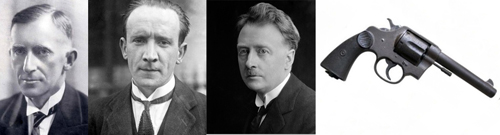
Following the killing of the Cork born Irish revolutionary, Michael Collins in an ambush at an isolated area known as Béal na Bláth, on August 22nd 1922, the Free State provisional government, under the new leadership of MrW. T. Cosgrave, MrRichard Mulcahy and MrKevin O’Higgins, took the stance that the Anti-Treaty IRA were conducting an unlawful rebellion against a legitimate Irish government.
Left-right: Richard Mulcahy, MrKevin O’Higgins, W. T. Cosgrave& a hand gun used during Tipperary civil war period.
Mr Kevin O’Higgins had voiced the opinion that the use of martial law was the only way to bring this civil war to an end. So by imposing capital punishment for anyone found in possession of either firearms or ammunition; without a lawful reason, Republican fighters would now be treated as criminals rather than as army combatants, thus introducing martial law for the duration of the then conflict.
To this end, on September 27th 1922, the Irish Free State’s Provisional Government put before the Dáil the Army Emergency Powers Resolution, proposing legislation to try suspects by military court martial.
It should be noted that on October 3rd, 1922 the legitimate Free State government offered an amnesty to any Anti-Treaty fighter who surrendered their arms and recognised the government. This amnesty offered, sadly saw little response.
A final version, of the motion, first put to the Dáil, by then Minister for Defence, Mr Richard Mulcahy, on September 26th, was passed on October 18th 1922, which stated: “The breach of any general order or regulation made by the Army Council and the infliction by such Military Courts or Committees of the punishment of death or of penal servitude for any period or of imprisonment for any period or of a fine of any amount either with or without imprisonment on any person found guilty by such Court or Committee of any of the offences aforesaid. Provided that no such sentence of death be executed except under the countersignature of two members of the Army Council”.
This new legislation, referred to as the “Public Safety Bill”, which empowered military tribunals with the ability to impose penal servitude of any duration, or the death penalty, for a variety of offences including; aiding/abetting attacks on state forces; persons found in possession of arms, ammunition or explosives, without the proper authority; looting; the destruction of public or private property, and arson.
Excommunication A supportive Catholic Hierarchy issued a pastoral letter condemning Anti-Treaty fighters (known as ‘Irregulars’). The letter stated that: “All who are in contravention of this teaching, and participate in such crimes are guilty of grievous sins and may not be absolved in Confession nor admitted to the Holy Communion if they persist in such evil courses”. Devout Roman Catholics saw this pastoral letter as a powerful social pressure being applied and at an opportune time for the then Provisional Government. Same pastoral letter would serve to understand and indeed excuse the close connection developed in later decades between Church and State.
This Order was later strengthened in the following month of January, 1923, allowing execution for several other categories of offences not previously clearly identified. These included non-combatant Republican supporters carrying messages; assisting in escapes; using army or police uniforms; together with desertion from the existing National Army. It further stipulated that all sentences passed on military prisoners, taken by Provisional Government forces before the passing of the Act, were retrospectively remain valid. January 1923 also saw this policy of executions being further extended throughout 10 Irish counties, namely; Tipperary, Dublin, Louth, Carlow, Kerry, Limerick, Westmeath, Waterford, Offaly and Laois, each county serving as the location for such executions. Kevin O’Higgins had got it right; soon afterwards the anti-Treaty IRA recognised that prolonging their campaign would only further inevitably result in further executions of their imprisoned fighters.
Executions during the Irish Civil War took place during the guerrilla phase of the Irish Civil War (June 1922 – May 1923). By the first two months of the Civil War (July–August 1922), Free State forces had successfully taken all the territory held by Republicans and the war seemed all but over. However, the loosing Anti-Treaty side moved to using guerrilla tactics in August–September, and National Army casualties began to mount.
Many people today, appear to forget that during this phase of the war both sides; the Government forces of the Irish Free State and the Anti-Treaty Irish Republican Army (IRA) insurgents, both used executions and terror in what developed into a cycle of atrocities.
From November 1922, the Free State Government justified embarking on a policy of executing Republican prisoners in order to bring the war to a successful end.
Tipperary Executions
On January 15th 1923 four men were executed by firing squad for the illegal possession of arms and ammunition, at Ross Cottage, Borrisoleigh, Co. Tipperary, on December 23rd 1923. The four men; Mr Frederick Burke, Curnaboola, Ileigh, Borrisoleigh, Co. Tipperary, aged 28; MrPatrick Russell, Summerhill, Borrisoleigh, Co. Tipperary, aged 26; Mr Martin O’Shea, Garrangrena, Borrisoleigh, Co. Tipperary, aged 22, and MrPatrick McNamara, Killarey, Ballina, Killaloe, County Clare, aged 22, were all executed in Roscrea Castle Barracks, Roscrea, Co. Tipperary.
MrFrederick Bourke, a farm labourer had served with the IRA from 1919 onwards. MrMartin O’Shea, who helped out on his family’s small farm and worked as a casual labourer for the local Council, had served with the Irish Volunteers and IRA from 1917 onwards. MrPatrick Russell, was a farmer’s son had also served with the Irish Volunteers and IRA from 1917 onwards.
According to the official report issued after their execution, Frederick Bourke, Martin O’Shea and Patrick Russell were tried and convicted, on January 2nd 1923, for being in possession of arms and ammunition and for the armed hold up of a Mail Car at Ross Cottage, Borrisoleigh, Co. Tipperary.
The bodies of the executed were not handed back to family members until the middle of 1924. Ugly scenes would accompany the handover of the bodily remains of those executed in some areas, as military displays and the discharging of weapons at re-interments were totally banned.
The pro-Treaty government remained unapologetic about their execution policy during the Civil War; as did the Anti-Treaty Irish Republican Army (IRA) insurgents; the former maintaining that they had simply done what was necessary in order to save the new Irish state. Anti-Treaty Irish Republican Army (IRA) insurgents refused to support some of its members, latter who had been executed for basic armed robbery crime, while endorsing as martyrs others that were executed.
In typed and handwritten communications sent to Fianna Fail TD Mr Andrew Fogarty (April 1879 – April 1953) on some 10 years later on November 11th 1933 to his home in Cashel; [latter a farmer, first elected on the 15th count to the 5th Dáil, as a Fianna Fáil Teachta Dála (TD) in 1927], we learn the strong feelings with regards to failure to get compensation for the living, destitute family members of those executed. One such communication came from within the local Borrisoleigh, Fianna Fáil Club.
To Andy Fogarty, (TD) Cashel. Co. Tipperary.
Borrisoleigh Fianna Fáil Club Castlequarter, Borrisoleigh, Thurles November 11th 1933
A Chara, Just a few lines in connection with the claims of the mothers of Russell, Bourke and O’shea, who were executed by the Cosgrave Government on January 15th 1923 at Roscrea Military Barracks. We are sure there’s no need for us to put before you the necessity of having the claims of these three poor women attended to immediately. Perhaps it would be well to give you an outline of the happenings that led up to the execution of those young men. They were under orders from their Commanding Officer to hold up the Mail Car at least twice per week & it was during the progress of one of these searches at a place called Ross Cottage, Borrisoleigh, that they were surrounded by ‘Crown Forces‘. They put up a most desperate fight for about three hours, and it was only when their supply of ammunition became exhausted that they were reluctantly compelled to surrender. Then after a time in prison the government decided to put them against the wall and there and then ended the lives of three gallant young men. In conclusion we would ask you to make a strong appeal to the government on behalf of these three old widowed mothers and to see that they get a reasonable amount of Compensation. We do not propose to suggest to the government the amount they should pay. but we do suggest that they should consider every aspect of their claims. They should consider very carefully the loss of these fine young fellows to their poor widowed mothers and above all they should consider the large pensions they are paying to some of the men that were responsible for their executions, We would ask you to see that those claims are attended to immediately, as the poor old women are very old and feeble.
Thanking you in anticipation. Yours Faithfully, Borrisoleigh Fianna Fáil Club. (Timothy Shanahan. Sec.)
The recipient of the above communication, Tipperary TD Mr Andrew (Andy) Fogarty*, forwarded the letter, shown above, to the Department of Defence, together with his own representations, clearly indicating the strength of local feeling within the Borrisoleigh area, since the three executed men were under orders at the time of their capture. The reference ‘captured by Crown Forces’ in the letter, above, is possibly a deliberate insult aimed at the then operating Pro-Treaty forces.
* In the 1948 General Election, the same long serving Fianna Fail TD for Tipperary, Mr Andrew Fogarty lost his seat. In other correspondence we learn that a presentation was organised and subscriptions collected amounting to donations of £542-4s-0.
The names on the list of contributors includes Sean Lemass (£25); Dan Breen, (Tipperary £10); WJ Magner (£10); together with many more TDs and Senators including a number of clergies. Many of the subscribers included were from Thurles, Co. Tipperary. Amongst them were Mr Bill Dwan, Holycross, Thurles (£10); Mr J, Hogan, Liberty Square, Thurles, (£10); Mr James Maher, Parnell Street, Thurles, (£5-5s-00p); Mr Dan Brady, Archerstown Mills, (£5); Mr J. Hanafin, Corner House, Parnell Street, Thurles (£5); Mr J.P Carrigan, Solicitor, Thurles, (£5); Mr Pierce Moloney, Racecourse, Thurles, (£2-2s-00p); and Mr P.J. OMeara, Solicitor Thurles, (£2-2s-00p).
In respect of the 3 executed Borrisoleigh natives; claims made by their mothers seeking compensation, received a partial dependents’ gratuity of £112.10.00 (one hundred and twelve pounds and ten shillings sterling) in 1934, under the Army Pensions Acts in respect of their sons, possibly helped by a serious threat by the Borrisoleigh, Fianna Fáil Club to resign and distance themselves from the Fianna Fáil political party.
[In the case of the fourth executed man, namely Mr Patrick McNamara; a file relating to a request by a John McNamara, with an address at Killarey, Ballina, Killaloe, County Clare, for an application form to make a claim in respect of his unnamed brother, executed on January 1923, most likely relates to the Patrick McNamara executed in Roscrea Castle Barracks; however, the individual allegedly executed is not named in the documentation]
This website uses cookies to improve your experience. We'll assume you're ok with this, but you can opt-out if you wish.AcceptRead More
Privacy & Cookies Policy
Privacy Overview
This website uses cookies to improve your experience while you navigate through the website. Out of these, the cookies that are categorized as necessary are stored on your browser as they are essential for the working of basic functionalities of the website. We also use third-party cookies that help us analyze and understand how you use this website. These cookies will be stored in your browser only with your consent. You also have the option to opt-out of these cookies. But opting out of some of these cookies may affect your browsing experience.
Necessary cookies are absolutely essential for the website to function properly. This category only includes cookies that ensures basic functionalities and security features of the website. These cookies do not store any personal information.
Any cookies that may not be particularly necessary for the website to function and is used specifically to collect user personal data via analytics, ads, other embedded contents are termed as non-necessary cookies. It is mandatory to procure user consent prior to running these cookies on your website.






Recent Comments