|
|
 ‘Slates Up!” (ISBN: 9780950928944) enables pupils to discover what life was like in a nineteenth century primary school. It is a publication designed to support the 1999 Primary History Curriculum. It aims is to better equip teachers with true primary sources relating to schools in early nineteenth century Ireland.
A primary source is a piece of historical evidence that was created at the time to which it relates. The primary sources in ‘Slates Up!’ are from the little known archives of the famous Kildare Place Society, Rathmines, Dublin.
The Kildare Place Society (Society for Promoting the Education of the Poor in Ireland) was a pioneering charitable institution involved in early Irish education. It was founded in 1811 by a group or philanthropic men in Dublin, including Samuel Bewley of the Quaker (Society of Friends) merchant family and J.D. La Touche of the Huguenot banking family.
Reviews:
Dr Christopher Stray, Honorary Research Fellow at the University of Wales, Swansea wrote: “This book is an admirable and well-conceived teaching tool. The space taken up by questions to be answered by (modern) pupils, make it both more and less than a straightforward compilation of historical evidence. But anyone interested in the crucial detail of curriculum and teaching in the past would enjoy reading ‘Slates Up!’. To quote again from one of the posters it shows us: Oh! How pretty! Ah! How wise!’ “. (review in Paradigm: Journal of the Textbook Colloquium, Volume 3 Issue 2 July 2007)
In his review of ‘Slates Up’, Dr. Kenneth Milne the eminent Church of Ireland Historiographer wrote: “Good history teachers have long understood that we need to bring the subject to life for pupils if they are to engage with it. The Primary School Curriculum advocates an approach to the teaching of history that reflects the nature of history itself, in which documents play a vital part. But when educationalists encourage the use of documentary evidence in the classroom, teachers are sometimes at a loss to find suitable material for the purpose. Here it is, splendidly presented, and full of suggestions”.
John Fahy of Inis wrote: “This well-produced book enables pupils of today to act as real investigative historians as they explore the everyday educational experience of pupils at the beginning of the 19th century. This is how history should be experienced, as exciting discovery of a past which has something to say to our present” (review in Inis No 15, Spring 2006).
Contents Overview:
‘Slates Up!’ includes a wealth of resources for teachers and pupils. The topics explored include:
An examination of a typical nineteenth century schoolhouse.
Lessons 19th century children experienced: spellings, mathematics, poetry, grammar and more!
Investigations explore rewards and punishments for 19th century primary pupils.
Guidelines and resources to assist the re-enactment of a typical 19th century school day.
Teachers’ guidelines and a wealth of pupils’ activity sheets.
This excellent publication is compiled by Thurles born Karen Willoughby B. Ed. and former pupil of the Ursuline Convent ,Thurles, Co.Tipperary, with consultant editors Valerie Coghlan, Geraldine O’Connor and Susan Parkes all lecturers at CICE and Trinity College Dublin
Slates Up! is well worth investing in, because all of the publication’s contents can be photocopied. Thus one copy can cater to the needs of multiple classes.
Where to Buy:
To purchase ‘Slates Up!’ go to www.cice.ie/AboutCICE/CICEPublications.aspx or www.readireland.ie
 From newspaper and TV reports communicated some months ago, we learned that residents of housing estates around Ireland were concerned about horses that roam freely grazing on park land within these housing estates. Members of the “Travelling Community” , which had been newly housed in these estate have brought with them one of their customs, that of keeping a horse. The settled community feel these animals, wandering loose and unsupervised, are a danger to their children and elderly residents. It would appear that “the more things change the more they remain the same”, for similar fears were expressed by the inhabitants of New York city some 150 years ago regarding the custom of pig keeping.
Half the total of Irish emigrants, many from Co. Tipperary, to all ports of the United States, before, during and after the Great Irish Famine, landed in New York city. Records show, that during a seven month period in 1847, a total of 52,946 Irish peasant immigrants landed in New York, from coffin ships.
New York was a rough, tough, and boisterous town, a centre of immense wealth, with fine buildings, but retaining some of the features of a frontier town. There was a strong feeling of `nativism` or America for the Americans in New York at this time .
The poem “The Colossus” by Emma Lazarus inscribed on the Statue of Liberty “Give me your tired, your poor, your huddled masses yearning to breathe free, the wretched refuse of your teeming shore,” etc., would have been, indeed, very much rejected in New York at this time. These starving, emaciated and spectre-like wretches, who tottered on shore in New York, also brought with them one of their customs, that of keeping a pig.
Vagrant pigs, acted as scavengers, wandering the streets at will. They consumed garbage, human slops, human and animal manure, and offal from butchers shops, converting it into flesh which could be eaten once again by humans. (Thurles Tidy Town people take note).
The Irish kept these animals in `hog pens` on any vacant lot that could be found, throughout the city. There were eight of these pig pens on 5th Avenue and 3rd Street alone and from there the occupants were turned out to forage for themselves. Novelist Charles Dickens (1812- 1870) in his travelogue “American Notes” referred to pigs as, quote, “Gentlemen hogs of Broadway”
On August 20th.1847 The Sun a New York newspaper (1833-1950) reports that no fewer than 10,000 pigs presently roam about the city, and are described ” as dangerous as hyenas“. On February 4th 1847 the New York Daily Tribune (1841-1924) talks about Irish pigs lounging up Broadway and Third Avenue.
The pig, by nature, is a rooting animal and has no sweat glands which means that they must have access to water or mud in which they can control their own body temperature. However, horses pulling laden carts, through the streets, with much needed supplies, occasionally fall breaking their legs in the holes and ruts made by the pigs, as they root in the rough muddy roadways. Attempts by the cities authorities to curb these pigs and capture them, were fiercely resisted by the Irish owners and were soon abandoned.
However, another nuisance in the New York of this time was to show the cities authorities a solution to the pig problem. This other nuisance was stray dogs. Mad dog attacks were common. The authorities in an effort to control these dogs, offered a reward of 50 cents for every dog clubbed to death. Indeed, “Municipal Dog Killers” were employed during the summer months to beat out the brains of any dog found without a muzzle on the streets. Between July 15th and August 25th 1847, a total of 1,510 dogs were clubbed to death. Other dogs found were clubbed to death by gangs of young boys anxious to earn the reward moneys offered. The New York Sun newspaper states that remaining dogs have learned the hours that the dog killers are about and conceal themselves, to later appear in droves.
The success of this dog killing project, now show the City Fathers that the offer of a reward is the solution for their pig problem and over the coming years all pigs begin to disappear off New York streets.
 Thomas Butler, Viscount Thurles, son of Walter Butler “Walter of the Rosaries,” was probably the first of the family to take up residence in Thurles Castle. Thomas was summoned to England in 1619 to answer charges of treason, but the ship conveying him was wrecked off the coast of Skerries and he was drowned on 15th December 1619. His wife was Elizabeth Poyntz, daughter of Sir John Poyntz, Bart., of Acton in Gloucestershire, and the celebrated Lady Thurles (see pic). They had been married since 1608 and were the parents of three sons and four daughters.
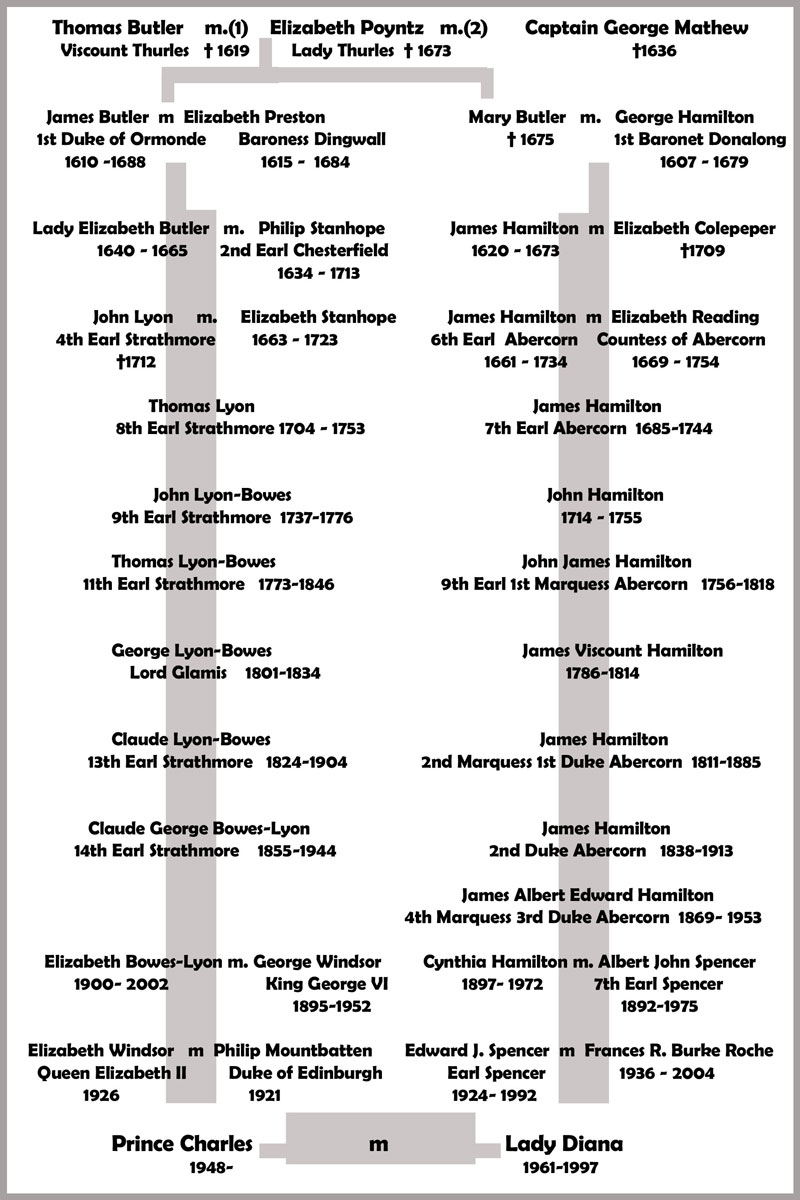 After Viscount Thurles’s death, his widow, Lady Thurles, married again, about 1620, one Captain George Mathew of Radyr and Llandaff in Glamorganshire, Wales, by whom Lady Thurles had a further two sons and a daughter. Captain George Mathew died at Tenby in Wales in 1636. His widow, Lady Thurles survived him by 37 years and died in Thurles in May 1673. Her body was interred beside St. Mary’s Famine Museum Church in Thurles. A period portrait, oil on canvas, of Lady Thurles is in the possession of the Tipperary County Library at the Source building in Thurles.
(Please click on both images for higher resolution)
Lady Thurles was a loyal and staunch Catholic, but also a loyal and staunch Englishwoman (Royalist). From the time of her marriage with Viscount Thurles until her death in May 1673, she resided in Thurles Castle, except perhaps for a short period (1658-1660) during the Cromwellian regime.
Generations later, the 3rd Duke of Abercorn’s daughter married Earl Spencer, grandfather of the Lady Diana Spencer who married Prince Charles of England. Thus Thomas Butler, Viscount Thurles, and Elizabeth Poyntz, Lady Thurles are direct ancestors of Lady Diana Spencer.
Prince Charles of England is a direct descendant of Viscount and Lady Thurles through their eldest son, the Duke of Ormond. The Duke’s daughter, Elizabeth, married Philip Stanhope, 2nd Earl Chesterfield, and their daughter Elizabeth Stanhope married John Lyon, 4th Earl Strathmore. Later in direct line was the 14th Earl Strathmore whose daughter, Elizabeth Bowes-Lyon married the future King George VI; and these are the grandparents of Prince Charles.
 The 11th November, each year, we remember our dead from the two Great World Wars, 1914-18 and 1939-45. This date is the day that World War I ended in 1918, and when the armistice was signed in Compiègne, Northern France, at 5am. On the closest Sunday to this November date, we remember the dead in our Church ceremonies. This Sunday is known as Remembrance Sunday or Poppy Sunday.
It was on the 7th. November 1919, King George V first issued a proclamation which called for a two-minute silence, having read a letter published in the London Evening News of the 8th. May 1919, by a Melbourne journalist, Edward George Honey. It was Honey who first proposed a two minute silence in memory of those, who so willingly sacrificed their lives for the relative peace and freedom we enjoy today. The proclamation reads “All locomotion should cease, so that, in perfect stillness, the thoughts of everyone may be concentrated on reverent remembrance of the glorious dead”.
Thanks to research, first undertaken by a local Holycross resident Tom Burnell, we have been able to trace seventy two military personnel, born in the town of Thurles who gave their lives in World War One. Their names are now carved on a limestone wall, funded and erected by Thurles Urban District Council. Like most war memorials, that famous forth stanza, by war poet Laurence Binyon (1869 – 1943), taken from his poem ‘For the Fallen’, takes pride of place in the centre of all those named.
They shall grow not old, as we that are left grow old:
Age shall not weary them, nor the years condemn.
At the going down of the sun and in the morning
We will remember them.
As stated, Remembrance Sunday is also known as Poppy Sunday, because, since 1921, it is traditional for people to wear an artificial poppy in their lapel. Very few poppies are worn in Ireland mainly because of politicians, community leaders and press not being in possession of the facts and who fall short in attempts to ascertain truth. Indeed a recently aired programme by RTE One, last week, supports this former statement. Due to this misinformed debate many people in Ireland see the humble majestic poppy as a symbol of some kind of British Imperialism which of course it can never and will never be.
The poppy was first worn by an American, one Moira Michael. Moira wore the poppy in an act of remembrance. She bought some poppies, wore one, and sold others, raising money for ex-servicemen. Her colleague, French YMCA Secretary, Madame E. Guerin, greatly impressed with Miss Michael’s idea of the Flanders poppy as a badge of remembrance, decided that upon her return to France, she would sell handmade Flanders Poppies as a relief project for war orphans and poor children. Thus the red poppy, worn to keep faith and in remembrance of the War Dead, began in France. So where is the British Imperialism connection?. Perhaps it stems from the fact that the idea from these simple actions spread and the Royal British Legion, a charity dedicated to supporting war veterans and their families, began to offer these poppies for sale at no stated price, in November 1921, with total proceeds going to their worthy cause. Indeed many deserving Irish residents have reaped the benefits of this charitable work. To claim that the red poppy is associated with British Imperialism demonstrates only ignorance and greatly belittles the truth.
Poppy seed remains dormant deep within the soil until disturbed. On the Western Front this seed would have lain dormant for years, but the battles being fought in Flanders had churned up the ground bringing this seed to the surface. The most magnificent profusion of poppy bloom reported in World War One was in Ypres, a town in Flanders, Belgium, which then was so important to allied defences. It was also here that the new chlorine gas with which the Germans experimented, was first used. Disturbance of the soil brought forth the poppies in greatest abundance, thus inspiring a Canadian soldier, Major John McCrae,(1872-1918) to write his most famous poem “In Flanders Fields”.
Major John McCrae was a Canadian physician and fought on the Western Front in 1914. He was later transferred to the medical corps and assigned to a hospital in France. While on active duty he died of pneumonia in 1918, the final year of World War One.
Those of you who still remain unsure, for whatever reason as to what the poppy represents, please humour me, by reading this poem at least once.
In Flanders Fields
In Flanders fields the poppies blow
Between the crosses, row on row
That mark our place; and in the sky
The larks, still bravely singing, fly
Scarce heard amid the guns below.
We are the Dead. Short days ago
We lived, felt dawn, saw sunset glow,
Loved and were loved, and now we lie
In Flanders fields.
Take up our quarrel with the foe:
To you from failing hands we throw
The torch; be yours to hold it high.
If ye break faith with us who die
We shall not sleep, though poppies grow
In Flanders fields.
 Tipperary women, in particular, have a lot to answer. The next time the wife throws a plate in the direction of your head, the chances are she has Tipperary connections. This remark is borne out when we trace the true origins of the nickname attributed to natives of County Tipperary – “Stone Throwers“.
This nickname came about because of a strange social phenomenon thriving in Ireland at the beginning of the 19th century, the cult of ‘Stick Fighting‘ better known as ‘Faction Fighting‘ or ‘Shillelagh Fighting‘. This sport which began its roots, possibly, in the village of Cappawhite, Co. Tipperary from whence it spread rapidly throughout Munster, Leinster and eventually to most of the rest of Ireland. This sport was at its peak in Tipperary in the second and third decades of the 19th century.
Faction Fights were planned events where men in two lines met face to face and fought for usually no other reason other than the sheer love of fighting. Tenant farmers and their sons dressed for a fight with great care and attention. The ‘game’ of Faction Fighting took place openly, usually towards the end of public gatherings such as fairs and markets, funeral wakes, race meetings, and patterns (parish patron days), between groups whose members had in common, drink and loose bonds of kinship or friendship. Fighters obeyed the rules of their chosen Captains and were bound in duty to ‘never back off if fight was offered’.
They fought with large sticks, some hardened and loaded with lead and manufactured usually from the ready available blackthorn tree or from ash suckers. These sticks were then carefully cut and tested following careful drying beside the domestic turf fire. For these fights, willing participants were trained as meticulously as were military swordsmen in the then British cavalry. Some landlords made wagers on the fighting ability of their tenants “To be sure, skulls and bones are broken, and lives lost; but they are lost in pleasant fighting – they are the consequences of the sport, the beauty of which consists in breaking as many heads as you can” (Daniel J. Casey & Robert E. Rhodes, Views of Irish Peasantry, p. 137).
These groups of Factions Fighters had many names such as Caravats and Shanavests, The Three Year Oulds, The Four Year Oulds, Cooleens, Pudding Lane Boys, Black Hens and Magpies, to name but a few. In the flourishing state of Faction Fighting, vendettas were pursued between “Shanavests” and “Caravats” at the fairs of Ballingarry, South Tipperary, between “Rawlins” and “Cusheens” at the green in Cashel, Tipperary, between “Darrigs” and “Cummings” at Roscrea, Tipperary and between “Pallates” and “Bawnies” at the fairs held in Borrisoleigh, Tipperary. The “Reaskawallagh” faction was nearly all Ryan’s and took their name from a towns-land in the parish of Doon, on the Tipperary / Limerick borders, where the Ryan chieftains had lived for generations.
Many a life was lost at these fights and serious injury was to be expected. In some cases both faction groups, which could number between 200 to 1,000, would combine together against a common foe, often turning their attentions to attacking unwanted interfering policemen (Peelers) who attempted to bring about law and order. Quite often, regiments of soldiers had to be called into action to prevent or quell riots between these factions.
In 1836 alone, over 100 faction fights were reported in Co. Tipperary. The granddaddy of all faction fights took place on June 24, 1834, the Feast Day of St. John the Baptist, a Holy Day which traditionally served to commemorate the occurrence of the longest day of the year, when 3,000 participants, the Coolens on one side, with Lawlors, Blacks and Mulvihills on the other, went up against each other at Ballyveigh Strand in County Kerry. When the bleeding stopped, 20 men were dead.
On the 20th March 1826, in the main square of Thurles, Co Tipperary (today, strangely, this square is called Liberty Square, see picture.) women standing on the sidelines enjoying the spectacle of a local faction fight, somehow got it into their heads, as women will, that their men folk required support. These women began firing large rocks at the opposing faction. The stones it seems had been secreted away in their shopping baskets, in readiness for this event. According to reports of this event, the stones fired by these interfering women, missed intended targets and broke many of the windows of the local shop keepers. The police who intervened were “desperately attacked” and shots were fired killing 3 men. This serious riot was only quelled by the intervention of the 15th. Royal Foot Regiment, then garrisoned in Thurles, who were prevailed upon to support the local authorities.
Faction fighting declined at the end of the 19th century for many reasons. There was less tolerance of violence by the Authorities and better policing. The existence of a little less poverty also contributed, making for a much more contented and peaceful population. The influence of the Catholic Church, and the rise of militant Irish republicanism (Fenianism) put an end to large-scale Faction Fighting, as more and more of the agrarian faction groups united and were absorbed into the Fenian organization, in the latter half of the 19th century.
The Irish Temperance Movement which began in 1838, led by Tipperary priest Fr Theobald Matthew also had a dramatic effect on Irish life, with 40% of the countries adult population taking an oath of temperance. By 1845 revenues obtained from alcohol manufacture and sales fell from £1.4 million to £0.8 . There was also an appreciable reduction in local acts of crime reported.
However, probable the main reason for this decline was the foundation of the G.A.A. in 1884 at The Haye`s Hotel Thurles, Co. Tipperary. Stick Fighting would now have rules and exchanged blows would for the most part be levelled only at a leather ball.
Should any of our readers now decide to revive this ancient sport of “Stick Fighting”, just remember to leave the wife at home. “Give women an inch and they think they are a ruler“.
|
Support Us Help keep Thurles.info online by donating below. Thank you.
Total Donated 2026: €300.00
Thank You!
Daily Thurles Mass Livestream
|




Recent Comments