|
|
 A consortium made up of An Post and Camelot, latter the company behind the UK lottery, have been successful in their bid of €405m to run the Irish National Lottery. A consortium made up of An Post and Camelot, latter the company behind the UK lottery, have been successful in their bid of €405m to run the Irish National Lottery.
Premier Lotteries Ireland, a group involving the Ontario Teacher’s Pension Plan, owner of Camelot, An Post and An Post pension funds has been selected to take over the licence, having offered the highest bid for allowing them to operate the prize fund for 20 years.
Two thirds of profits after prizes will continue to be distributed to good causes, but it has not been clarified if same will continue to be solely the gift of reigning political party’s.
The €405m licence fee will be paid in two equal instalments, with the first when the licence is signed in December and the second when Premier Lotteries Ireland take up the licence.
Money from the sale of the licence will now part fund the long awaited new children’s hospital, to be built on a site at St James Hospital in Dublin city.
The deal is expected to be signed in December and the new licence will run from October of next year.
 The Royal College of Physicians Ireland (RCPI) have launched a scathing attack on Arthur’s Day, organised by Diageo, latter to supposedly celebrate the anniversary of the Guinness brewing company. The Royal College of Physicians Ireland (RCPI) have launched a scathing attack on Arthur’s Day, organised by Diageo, latter to supposedly celebrate the anniversary of the Guinness brewing company.
To this end RCPI have organised a public discussion aimed at highlighting the dangerous side of alcohol and to further underscore their concerns that alcohol related illnesses in Ireland have now reached epidemic proportions.
Dr Stephen Stewart a Liver Disease Specialist, together with Child and Adolescent Psychiatrist Dr Bobby Smyth will speak at this event tomorrow evening, with the Chairperson of the RCPI’s policy group on alcohol, Professor Frank Murray opening the meeting.
The RCPI claim that deaths relating to cirrhosis of the liver have doubled between 1994 and 2008, and that hospital admissions for alcoholic liver disease has almost doubled between 1995 and 2007. The RCPI also claim that increasing numbers of young people are dying from alcohol related illnesses due to alcohol substances being more affordable than ever, being more acceptable than ever and being more available than ever. (A pint of Guinness in Dublin is €0.70 cheaper than in Thurles.)
The RCPI debate will take place at 6:00pm tomorrow Monday, at the college’s headquarters on Kildare Street, Dublin, and will wave the banner “Join the National Conversation on Alcohol: Who’s calling the shots.”
Diageo is not aware yet, but Guinness porter of course was first accidentally conceived in the early to mid 1700’s at the Palace of Archbishop Price, here in Cashel, Co Tipperary, now known as the Cashel Palace Hotel. Estate manager and Arthur’s father, Richard Guinness, was in charge of supervising the brewing of beer for the estates employees on the Archbishop Price estate. Supplying beer to employees at that time was considered part of their weekly entitlement. A servant was dispatched from the estate to purchase and convey the necessary beer making materials from Ryan’s brewery stores here in Main Street, Thurles, latter now known as Cathedral Street. (Time for Urban Councillors to erect another Memorial Plaque in St Mary’s Graveyard perhaps.)
In the brewing process, later back in Cashel, some of these ingredients, barley possibly, was accidentally over heated in error, in fact roasted until virtually black, thus giving that unique burnt flavour known to us today as porters ale or Guinness porter and described by the then Archbishop as being “a brew of a very palatable nature.”
It is not too long ago in Ireland that pregnant women were told to drink a glass of Guinness every day to fortify themselves and their baby. Indeed US scientists in the state of Wisconsinin in 2011 gave Guinness to dogs who had narrowed arteries. They found that Guinness worked as well as aspirin in preventing clots forming. They believe that antioxidant compounds in Guinness are responsible for these health benefits because they decrease harmful cholesterol gathering on artery walls. But then what do I know?
Still this National Conversation on Alcohol could now lead to the start of Fine Gael and Labour’s promised two year Dáil Reforms, with Mr Enda Kenny closing the Dáil Bar instead of the Senate. (Possible new Logo for those opposed to Irish Senate closure. “Close The Bar Not Our Senate.”)
(Just a thought, sure you never know, Mr Enda Kenny and Minister for Health Dr James Reilly could decide to lead by example, instead of their “Do as we say, not as we do,” current philosophy.)
 An on duty member of An Garda Síochána, who claimed that a man deliberately spat blood and saliva into his face threatening to infect him with HIV, has been awarded €100,000 damages under the Garda Compensation Act. (Report Independent.ie) An on duty member of An Garda Síochána, who claimed that a man deliberately spat blood and saliva into his face threatening to infect him with HIV, has been awarded €100,000 damages under the Garda Compensation Act. (Report Independent.ie)
Garda John McDonnell, aged 50, had been assaulted in November 2007 while attempting to arrest a man, involved in a breach of the peace, at Cashel Place, Cashel, South Tipperary. The Garda had sought compensation for anxiety and distress he allegedly suffered regarding fear of potential HIV and Hepatitis C infection and for bruising injuries received to his neck, back and arms, obtained during this incident.
In a reserved judgement Justice Mary Irvine stated it was unusual that the Garda victim had not immediately wiped the blood and saliva off his face, when in fear of contracting possible infections, but had instead returned to Cashel Garda Station where a colleague had taken photographs of facial blood spittle, prior to it being then washed off. Garda McDonnell’s assailant did not have HIV or Hepatitis C up to two weeks after the assault.
Justice Mary Irvine took into account Garda McDonnell’s significant history of back problems, which he had incurred during an assault while on duty in 1998, and for which he had previously been awarded €40,000 under the Garda Compensation Act.
The judge accepted his claim for loss of earnings and awarded €65,000 damages for personal injury; €31,000 for reduced past and future loss of earnings and gratuity up to the age of 55, plus €4,000 in special damages.
 Michael Wright, Home Instead Senior Care Reports; Michael Wright, Home Instead Senior Care Reports;
To mark World Alzheimer’s Month (September 2013) Home Instead Senior Care will host FREE education workshops across County Tipperary for families and communities involved in caring for a person with a dementia.
This is part of a global Home Instead initiative, leading up to World Alzheimer’s Awareness Day on September 21st next.
This workshop will cover how to understand behavioural changes, encourage engagement and the need to care for yourself, whilst caring for a person with a dementia.
County Tipperary Alzheimer Workshops
Tuesday 17th September, Raheen House Hotel, Clonmel. 7pm – 9pm.
Wednesday 18th September, Abbey Court Hotel, Nenagh. 7pm – 9pm.
Thursday 19th September, Horse and Jockey Hotel, Thurles. 7pm – 9pm.
Please Note: Places are limited so do please book your place by Telephoning 0504 – 91100.
Approximately 80% of people with a dementia or Alzheimer’s disease are cared for in their own home by a family member. In Ireland there are 41,700 people living with dementia and 50,000 family carers supporting their loved ones. Understandably, most of the research time and funding is devoted to finding a cure, but it is also important to make sure the challenges of family carers are recognised and practical support is given.
The CARE: Changing Ageing Through Research and Education programme is a first-of-its-kind education programme developed by Home Instead Senior Care. Research from the Home Instead Senior Care network reveals that families have two significant challenges when caring for their loved ones who have Alzheimer’s disease or other dementias. These are keeping their loved ones positively engaged and managing behaviours that can include repetition and agitation.
The approach encourages a subtle change in how you communicate. This will assist with resolving awkward situations and help ensure the safety of your loved one with dementia. This will enable you’re relative to remain in familiar surroundings for as long as possible.
If you are caring for a loved one with Alzheimer’s or other Dementia, please join Home Instead Senior Care at one of their FREE education workshops.
Please RSVP to Tel. 0504-91100.
Autumn months according to our National Meteorological Service, Met Éireann, are September, October and November, however according to our Irish Gaelic traditional Calendar, autumn constitutes the months August, September, and October. Harvest or ‘Fall,’ was the term usually used rurally to refer to autumn and came to refer only to the actual activity of reaping crops sown.
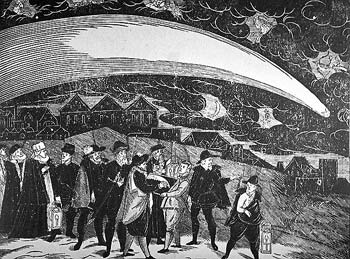 Great Comet of 1577. Whatever month autumn begins, August brings into focus thoughts of future winter weather, flu epidemics and hopes of general well being. Generally these thoughts are based on our own previous experiences of health issues or unprecedented winter conditions experienced during our own lifetimes.
So what awaited past Irish generations before modern day scientists came up with the theory of ‘Global Warming.’ ?
Let’s take a look at what history has recorded in Ireland between the years 1178 and 1603 with regard to health and unusual occurring weather.
1178. (Four years after the Battle of Thurles and the same year Donal O’Fogarty, Bishop of Ossory, died.) A great wind this year by which many trees were uprooted and many churches laid prostrate. Some 120 trees fell at Derry Columkille. The river of Galway dried up for several days so that things lost in it from time immemorial were recovered, great quantities of fish were taken by the inhabitants.
1224. An awful and strange shower fell in Connaught and there followed diseases in cattle, and those who drank their milk got extraordinary internal diseases.
1236. Great storms and rain and violent wars prevailed this year.
1252. A great heat and drought this summer, so that people passed over the principal rivers with dry feet and trees became ignited with the heat of the sun.
1326. Small-pox raged though Ireland and great numbers died.
1328. According to Annals of Ireland by the Four Masters, an awful thunder and lightning occurred by which vegetation and fruit were extensively damaged and corn blighted. An epidemic disease called Slaodan (Translated. influenza) prevailed, and continued for four days on those afflicted with it, and proved almost fatal to them.
1329. Crops remained un-reaped until after Michaelmas, (Michaelmas derives its name from the Feast of St Michael and All Angels, which falls annually on 29 September 29th), in consequence of wet weather.
1349. A great plague in Ireland particularly in Moylurg (Magh Luirg Roscommon North east of the province of Connacht ); an immense number died of it.
1383. An awful and very fatal plague raged throughout Ireland. Judith, daughter of the Earl of Ormond, the wife of Teige O’Carroll, lord of Tigh Muna (Timoney, near Roscrea, Co Tipperary) and the daughter of O’Brien, wife of O’Kennedy died of the plague.
Continue reading Past Health & Weather Records Reviewed
|
Support Us Help keep Thurles.info online by donating below. Thank you.
Total Donated 2026: €300.00
Thank You!
Daily Thurles Mass Livestream
|
 A consortium made up of An Post and Camelot, latter the company behind the UK lottery, have been successful in their bid of €405m to run the Irish National Lottery.




Recent Comments