Idle Electric Buses are latest symbol of a Government that cannot control waste.
Serious questions must be answered over unused electric buses and repeated public spending failures.
The revelation that more than 130 State-funded electric double-decker buses remain unused because there is no charging infrastructure in place, is yet another example of waste, poor planning and failed delivery in the use of public money. RTÉ reported yesterday March 19th 2026, that the buses are lying idle because there is nowhere to charge them, with some not expected to enter service until 2027.
People are entitled to ask a simple question: how can buses be bought before the infrastructure needed to operate them is ready?
This is not just a transport failure. It is part of a wider pattern in which major sums of taxpayers’ money are committed without proper planning, proper oversight or proper accountability. Time and again, the public is expected to pay the price for decisions that should have been better managed from the very beginning.
This latest controversy adds to growing public anger over other extraordinary examples of waste and overspending. These include the now infamous €336,000 Leinster House bicycle shelter, the €1.4 million security hut at Government Buildings, and the €753,528 spent on 14 steps, a handrail and a ramp at Deerpark, in Mount Merrion, a project whose original budget was about €200,000.
At the same time, families and schools were left deeply concerned earlier this year by the attempted reduction in Special Needs Assistant allocations. The Government later confirmed there would be no reduction in SNA numbers for the 2026/2027 school year and announced an additional €19 million in funding after a significant public backlash.
That contrast speaks volumes. There always seems to be money available when projects spiral out of control, when costs overrun, or when basic planning is missing. But when it comes to essential services, supports for children with additional needs, and reliable public transport for communities, the public is too often told to accept delay, confusion and excuses.
Serious questions now need to be answered; (1) Who approved the purchase of these buses before charging capacity was in place? (2) What was the plan for the delivery of the necessary infrastructure? (3) How much public money is now tied up in buses that cannot be used? (4) How many older diesel buses have had to remain in service because these electric vehicles are still sitting idle? (5) Who was sacked or demoted for their incompetence?
With nobody minding the shop,the Public Accounts Committee has now stated it will seek further clarity from the Minister for Transport and the National Transport Authority.
Public money must be treated with care, competence and respect. It should be spent on projects that are properly planned, properly costed and properly delivered. The public is entitled to transparency, accountability and far better value for money than this.
Pre-deceased by his beloved daughter Bethrose, father Ivor, mother-in-law Valerie Tait (Ballyvoloon House, Whitegate, Co. Cork); Mr Green passed away peacefully, surrounded by his loving family, following a long illness most bravely borne, and while in the care of staff at the Community Hospital of the Assumption, Thurles, Co. Tipperary and University Hospital Limerick City (UHL).
His passing is most deeply regretted, sadly missed and lovingly remembered by his sorrowing family; devoted and loving wife Rachel (née Tait), sons David-óg, Finn and Sam, mother Joan Green (née Lennon, Ayrefield, Kilkenny City), sisters Fiona White and Orla Black, father-in-law Jim Tait, nephews, nieces, sisters-in-law, brothers-in-law, life-long friend John O’Neill, extended relatives, neighbours and a wide circle of friends.
The extended Green and Tait families wish to express their appreciation for your understanding at this difficult time, and have made arrangements for those persons wishing to send messages of condolence, to use the link shown HERE.
Note Please: Donations in lieu of flowers to Irish Cancer Society in memory of Mr David T. Green.
Pre-deceased by his parents George and Ellen, and his brothers and sisters; Fr. Bernard passed away peacefully, while in the care of staff at Sacred Heart Nursing Home, Crosspatrick, Co. Kilkenny,
His passing is most deeply regretted, sadly missed and lovingly remembered by his sorrowing family;loving sister Rita, brother-in-law Barry, nieces and nephews, grandnieces and grandnephews, great grandnieces, great- grandnephews, all members of L’Arche Community Kilkenny, extended relatives, neighbours and many friends in Ireland and abroad.
Requiem Mass for Fr. Bernard will be offered on Friday morning, March 13th at 11:00am, followed by interment, immediately afterwards, in Kilbride Cemetery, Callan, Co. Tipperary.
For those persons who would wish to attend Requiem Mass for Fr. Bernard, but for reasons cannot, same can be viewed streamed live online, HERE.
The extended Allon family wish to express their appreciation for your understanding at this difficult time, and have made arrangements for those persons wishing to send messages of condolence, to use the link shown HERE.
Pre-deceased by his son Michael (Mikey), parents Patrick and Mary, brothers Philip, Pat and Gerry, sisters Cathy, Mary, Ann and Bridget; Mr Healy passed away peacefully following a short illness, most bravely borne,
His passing is most deeply regretted, sadly missed and lovingly remembered by his sorrowing family; loving wife Val, son PJ, daughters Maria, Kay, Bernadette, Anita, Grace, Irene and their mother Anna, stepsons Danny, David and Darren, daughters-in-law and sons-in-law, cherished grandchildren and great grandchildren, brothers Bob and Albert, sister Bernie (Stokes), nieces, nephews, brothers-in-law, sisters-in-law, extended relatives, neighbours and a wide circle of friends
Rest In Peace
Funeral Arrangements.
A private service of cremation for Mr Healy will take place in England.
The extended Healy family wish to express their appreciation for your understanding at this difficult time, and have made arrangements for those persons wishing to send messages of condolence, to use the link shown HERE.
Shannon-to-East Water Pipeline – Why Tipperary Communities Along the River Are Pushing Back.
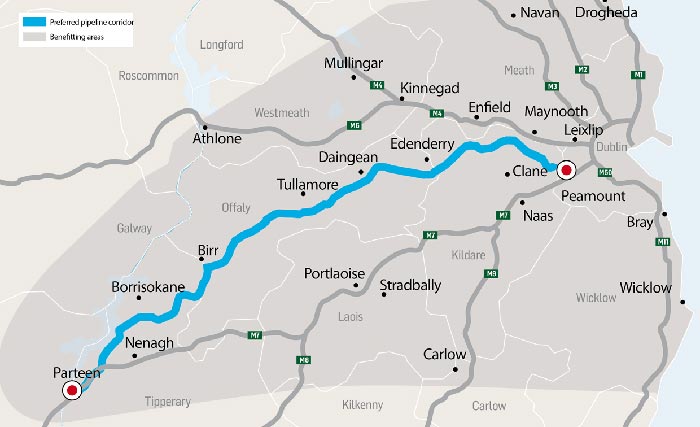
Objections are mounting in Ireland’s mid-west region over plans by Uisce Éireann to take more than 300 million litres of water a day from the River Shannon and pipe it to the Midlands, the east, and the greater Dublin Area. The utility lodged its planning application in December last for what it describes as the largest water infrastructure project in the State’s history; a 170km underground steel pipeline, linked to new treatment and storage infrastructure, designed to bolster supply for a region that includes almost half the population.
At the centre of the debate is a familiar national tension; how to secure reliable water for the country’s fastest-growing urban areas, without placing unacceptable pressure on the communities and ecosystems where that water is sourced. Uisce Éireann says the scheme is essential to reduce the greater Dublin Area’s dependence on existing sources and to provide resilience in the face of climate pressures and rising demand. It argues that leakage reduction is necessary, but not sufficient on its own, and that a major new supply route would help prevent restrictions and large-scale outages, while supporting much needed housing delivery and further economic growth.
Opponents, however, reject the idea that the Shannon must become the answer to the east’s water challenges. Community and environmental campaigners in the mid-west region contend the project is unnecessary, premature, and risky, especially during drought periods, when the Shannon system is under pressure too. Their core claim is straightforward; if leakage and inefficiencies were tackled more aggressively, particularly in the Irish capital, the scale of abstraction being proposed would not be needed. They also argue that long-term water security should come from a wider mix of measures, including demand management, smarter network operation, and exploring alternative sources, rather than relying on a single mega-project.
While Uisce Éireann states it will abstract a maximum of 2% of the long-term annual average flow at the Parteen Basin, critics say averages can be misleading. What matters most, they argue, is what happens during prolonged dry spells, exactly when Dublin’s demand spikes and river flows can be low. In those conditions, local groups fear that removing additional water upstream could reduce downstream availability and strain an already complex system balancing navigation, ecology, drinking water needs, and hydropower operations.
Environmental concerns are a major flashpoint. Local stakeholders warn of potential impacts on habitats and water quality, and they point to sensitivities around the Parteen Basin area and the broader Lough Derg–Shannon network. Angling and river-based recreation interests have also raised alarms, stressing that changing flows, even subtly, can affect fish migration patterns, spawning success, and the ecological health of tributaries and lake edges. In response, the utility maintains that modelling has focused heavily on low-flow and drought scenarios, and that statutory flow requirements and fish passage arrangements would remain protected under the proposal. It says it has submitted environmental assessment documentation as part of its application.
Cost is another source of contention. The project has been framed publicly as a multi-billion-euro investment, with estimates in the range of roughly €4.6 billion to nearly €6 billion in recent official statements, while critics warn the final bill could escalate significantly over time. For opponents, the price tag strengthens the case for exhausting cheaper, quicker measures first, especially leak repair, targeted upgrades, and region-by-region resilience projects, before committing to decades of debt and disruption. Supporters counter that, given the scale of the population and economic activity reliant on secure water in the east, claiming the long-term benefits justify the spend.
The planning process is now the arena where these arguments will be tested. The public consultation period is now closed, with local authority submissions due by 30th March. An Coimisiún Pleanála is required to decide within 48 weeks. If permission is granted, Uisce Éireann has indicated construction could begin in 2028, with completion within five years.
Whether the pipeline proceeds as proposed or is reshaped by conditions, the controversy highlights a bigger challenge Ireland cannot avoid: building a water system that is climate-ready, regionally fair, and environmentally credible, while restoring public confidence that “fixing leaks” and planning for growth are happening at the same time, not as competing priorities.
This website uses cookies to improve your experience. We'll assume you're ok with this, but you can opt-out if you wish.AcceptRead More
Privacy & Cookies Policy
Privacy Overview
This website uses cookies to improve your experience while you navigate through the website. Out of these, the cookies that are categorized as necessary are stored on your browser as they are essential for the working of basic functionalities of the website. We also use third-party cookies that help us analyze and understand how you use this website. These cookies will be stored in your browser only with your consent. You also have the option to opt-out of these cookies. But opting out of some of these cookies may affect your browsing experience.
Necessary cookies are absolutely essential for the website to function properly. This category only includes cookies that ensures basic functionalities and security features of the website. These cookies do not store any personal information.
Any cookies that may not be particularly necessary for the website to function and is used specifically to collect user personal data via analytics, ads, other embedded contents are termed as non-necessary cookies. It is mandatory to procure user consent prior to running these cookies on your website.








Recent Comments