The annual Borrisoleigh Festival returns again this weekend; bigger and better than ever before. The festival is being run in tandem with “The Arty Rooster Arts Festival”, which runs for the entire week from 1st July.
Overall Winner of the 2018 Wheelbarrow Competition with her entry ‘The Dogbox’ is Kathleen Ryan (left) with her sister Margaret and mother Effie (RIP)
The growing “International Wheelbarrow Extravaganza”, promises some wonderful creations. The competition is open to everyone to submit their modified wheelbarrows to be in with a chance to win some great prizes. Your imagination is the only limiting factor in this unique competition.
‘The Arty Rooster‘ will feature shop-front exhibitions, workshops, demonstrations, talks and performances, including an oil painting demonstration by artist Jim Donnelly on Saturday morning and a short play written by Ciarnad Ryan. The play is based on events which took place during the War of Independence and will be performed on Wednesday, Thursday and Friday in the function room in Finn’s Bar. Follow ‘The Arty Rooster’ on Facebook for full schedule updates.
The annual walk with the Bush and Briar Ramblers takes place on Saturday July 6th, walking part of the Beara Breifne Way from Greenane to Latteragh. Registration is at 8.30am in the Community Centre.
Award winning photographer Tom Doherty will be hosting a photo walk, giving tips on how to take great photos on a walk around Borrisoleigh starting at 11:00am in The Square. This should prove useful to anyone planning on entering the festivals Instagram Competition. Be sure to use the hashtag #BorrisFest19 when posting festival photos on Instagram to be in with a chance to win some great prizes. After the Official Opening with Lord Mayor Paddy Dolan and special guest on Saturday, there will be a Jiving Competition and Social Dancing with ‘Phil Maher’s Band’. The band ‘Ebony’ will finish off the night; from 10:00pm to 12:00 midnight.
A fire performer will be thrilling spectators throughout Saturday night with a number of performances from 8:00pm and Hot Chocolate and Wraps will be available from ‘The Hungry Horse’.
Sunday 7th July has a packed schedule from 2:00pm with the ‘Wheelbarrow Extravaganza’, live music, kid’s entertainment and lots more. The individual wheelbarrow categories are: Best Environmental; Best Miniature Garden; and Most Imaginative.
Entries open on Sunday 7th July 2.00 – 4.30 p.m. No entry fees. This year there is a new ‘Commercial’ Category. Local businesses can showcase their business in a wheelbarrow in the centre of Borrisoleigh for the duration of the Festival. €10 advance entry fee. Wheelbarrows can be displayed from 1st July – 7th July. There will be a public vote for the best overall wheelbarrow on Sunday afternoon. Votes cost €1.00 each. So, take another glance at that old wheelbarrow in the corner of the garden, and imagine what an amazing spectacle it would make with a little bit of ingenuity and TLC. And don’t forget to use #BorrisFest19 when uploading your photos to Instagram!
At 2.30pm in the Community Centre there is a Make Up Demonstration with MUA Kayley Moylan, admission is €8. Kids entertainment will feature Bouncy Castles, Disco Dome, Gladiators, Gaming Van and Hawkeye Powershot Competition. There will be a BBQ in the village square also on Sunday evening and a Hobby horse competition from 6.30pm to 7.30pm.
Live music starts at 2:00pm on Sunday with DJ Matt Ryan and a host of wonderful performers throughout the day. Starting with Paudi Bourke at 4pm, Dufrane 4.30pm, The Mangled Badgers 6pm and finishing with Silver Dollar from 8pm until late.
All in all, it promises to be a terrific festival with something for everyone and all ages. Pick up a copy of the festival booklet in any local shops for full schedule of events and follow Borrisoleigh Festival on Facebook, Twitter and Instagram for regular updates.
The 400-acre wooded demesne of Glin Castle, situated on the banks of the Shannon estuary in Co. Limerick, with its 12 acres of pleasure gardens, saw the annual “Rare & Special Plant Fair” taking place on Sunday May 12th last.
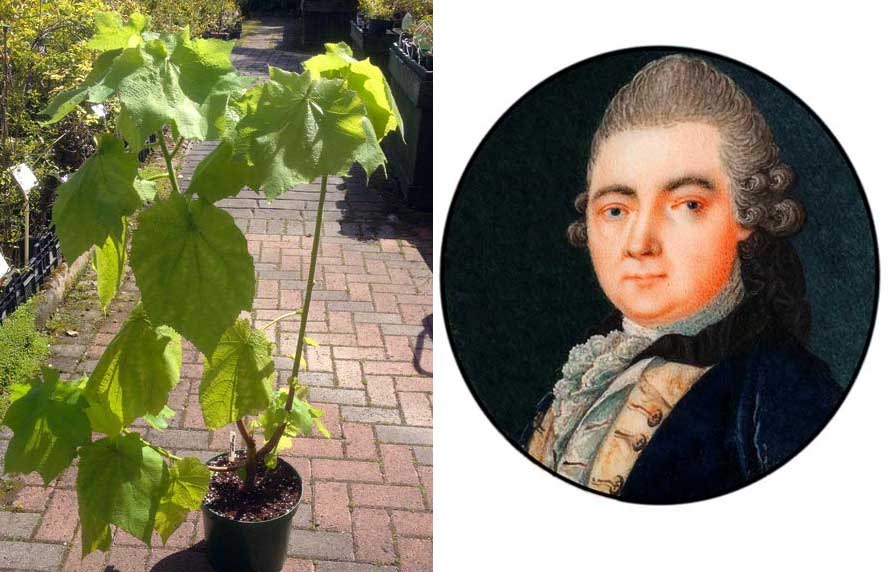
‘Sparmania’
One of the beautiful rare plants on show at this event was ‘Sparmania’, latter a species of flowering plant in the family Malvaceae, native to open woodland in Africa, South Africa and Madagascar. The genus name is called after Anders Sparrman, a Swedish naturalist, tutor, abolitionist, ships doctor and a member of the Royal Swedish Academy of Sciences, (1748-1820).
Pictures L-R. [1]Sparmania – [2] Swedish Naturalist Anders Sparrman (1748-1820).
According to the well-respected, dare I say Bible, known as Hillier Manual of Trees & Shrubs( Hillier / Lancaster), the Sparmania shrub(pictured above) is described as a large, stellately-hairy, apple-green shrub of vigorous habit. Leaves are large, often 30cm (11ins) or more across, palmately-lobed. Flowers are white 4cm wide, with yellow stamens (the pollen-producing reproductive organ of a flower).
This plant is regarded as an excellent conservatory shrub.
While grateful for this description, it was the further information supplied that appealed more to me, as a former restaurant and hotel employee. How often have I watched patrons stub their cigarettes butts out in flower pots used to decorate reception areas / lobbies, same leading eventually to the tragic demise of expensive plants.
Hotels and Restaurants take note: Sparmania, according to the Hillier Manual of Trees & Shrubs, thrives on, wait for it,“on discarded cigarette and cigar-ends, together with tea and coffee dregs, as found in poor quality cafés”. [Not that I have ever worked in poor quality cafés, I’ll have you to note and fully understand.]
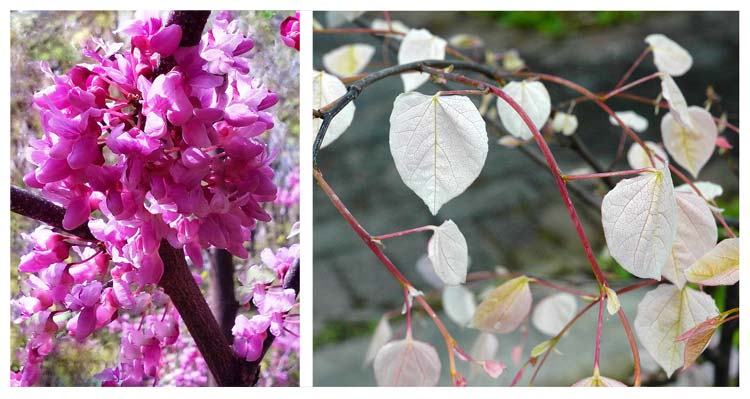
One of the many rare and beautiful trees currently on sale at Seamus O’Driscoll’s Garden Centre, situated on the Mill Road, here in Thurles, Co. Tipperary, must surely be the Cercis canadensis ‘Caroline Sweetheart’, also called the Judas Tree or Flowering Judas Eastern Redbud.
With the name ‘Judas Tree’ comes a legend behind its name, going back to earlier Christian folklore. This myth / folklore hereunder surrounds all such Redbud varieties in the same Genus, found in various parts of the Middle East including Judea.
Cercis canadensis ‘Carolina Sweetheart’.
Christian Folklore
The legend states that originally all such trees were not just tall and stately, but also bore broad, strong branches displaying white flowers. In exchange for thirty pieces of silver; one of the 12 disciples, all followers of Jesus, named Judas Iscariot, from the town of Kerioth in south Judea, would eventually betray Jesus to the Sanhedrin in the Garden of Gethsemane. This was simply done by kissing Jesus and addressing him as “Rabbi”; thus revealing his identity to the crowd who had come to arrest him. Judas, on learning later that Jesus was to be crucified, in his shame, hanged himself from supposedly a Redbud tree. The tree itself became so ashamed of the role it had played; vowed that forever more it would not grow its branches strong enough to be used for a hanging. Its wood from then on would remain brittle and its pure white flowers would blush pink, demonstrating visual embarrassment. Thus, the alternate name for Redbud trees became “Judas Trees”; the tree Judas chose for his eventual death.
However, possibly the real truth is that Redbud trees grew throughout Judea and were simply called “Judea’s Trees”, which over time and through word of mouth, verbal accents etc, today have become known as “Judas Trees”.
Just presently shedding its ‘blushing, snapdragon like blossoms’; Cercis canadensis ‘Carolina Sweetheart’, is much sought after in landscaping, especially since its flowers are somewhat unusual, in that they grow from the trunk of the tree, a trait often observed on tropical tree species, and known as “Cauliflory”. For our readers not familiar with the terminology “Cauliflory”, same is a botanical idiom which refers to plants that flower and fruit from their main stems or woody trunks, rather than from new growth; thus aiding pollination from not just flying insects, but also from animals rubbing and climbing.
With flowering complete; typical heart shaped maroon leaves [dark reddish purple or dark brownish red colour taking its name from the French word ‘marron’, or chestnut] will emerge, before becoming green with white margins bearing delightful shades of pink red and purple.
Overall, Cercis canadensis ‘Caroline Sweetheart’, is best described as ‘sheer candy’ to the eyes of any beholder.
Are you looking for a garden plant that offers summer colour to a rather grim looking Irish winter landscape? Then what you need to plant are one or more of some 20 species of Helleboreae.
One such species of Hellebore is the Christmas Rose, (also known as Helleborus argutifolius or Helleborus corsicus) a holly-leaved Hellebore species of flowering plant, in the family Ranunculaceae; same native to Corsica and Sardinia. It is an evergreen perennial growing to an approximate height of 120 cm (47 in) by 90 cm (3 ft) wide, with large leathery dark grey-green leaves, each comprising of three spiny-toothed leaflets.
The blossoms, from this delightful, compact, heavy and handsome plant, come in the shape of green, bowl-shaped clusters, with the flower heads appearing to the viewer like a tightly grasped posy. The flowering heavily scented, flower heads appear in early December, thus giving it the obvious, well-chosen and common name of ‘Winter Rose’, with the delightful, apple-green coloured pendant cups; like wild rose blossoms, surviving through winter and continuing to bloom well into late spring.
Once fully established, like all hellebores, they dislike being shunted about, so resist the temptation to divided them. However, given the right conditions, they will self-seed sufficiently to provide replacement plants. These seedlings, which should appear immediately at the base of the plant, can then be easily moved and planted successfully elsewhere, rarely blooming in their first year of planting.
This slow growing, deer and rabbit resistant plant, enjoys moist alkaline, acid or sandy soil, in light or mild shade, and is easily pruned back. Like many of our common garden plants however, it should be noted that Helleborus argutifolius is poisonous.
[Note: Heliotrope plants symbolises eternal or undying love and so make for a most desirable gift to someone you love.]
“Daffodils, that come before the swallow dares, and take the winds of March with beauty”
Quote from William Shakespeare’s “The Winter’s Tale”(Act 4, scene 3, line 118)
Daffodil Blooms Well Advanced In Tipperary
Daffodils bulbs planted last autumn usually come into bloom in late winter and early spring. Daffodils are usually regarded as a ‘March Flower’, synonymous with spring, but note that season is not officially due until Wednesday, March 20th 2019, at 3:59am GMT.
However this year, possibly, because of our mild weather during November / December, here in Co. Tipperary, this hardy perennial bulb, growth-wise, is well advanced out of doors. Even with heavy frost and colder weather promised next week, you can expect bright yellow and white daffodil blooms, of most varieties, to be adorning sheltered gardens, later this very month.
“Daffodowndilly.” – Poem by A. A. Milne.
She wore her yellow sun-bonnet, she wore her greenest gown; She turned to the south wind and curtsied up and down. She turned to the sunlight and shook her yellow head, And whispered to her neighbour: “Winter is dead.”
END
Daffodil flowers themselves make for great cut flowers for the indoors, however personally to use a quote from George B. Shaw, “I like flowers, I also like children, but I do not chop their heads off and keep them in bowls of water around the house.” I much prefer to observe Daffodils growing in a wooded garden or living wild and discarded by the hundreds, in a low-density forest forming an open habitat while displaying plenty of sunlight.
In truth, what we here in Tipperary, and indeed nationally, call ‘daffodils’, same should be more aptly called ‘narcissus’, when referring to our larger yellow variety; while the smaller, paler versions should be more correctly referred to as ‘jonquils’. But in fact they all belong to the genus ‘narcissus’.
Also known as the “Lent Lily”; for the most part same should be on the decline when Lent, that annual period of Christian observance that precedes Easter, eventually comes around this year. [Note: Lent in 2019 will start on March 6th, some 61 days hence, from today].
Daffodils gain their name from the Greek god Narcissus. Fable and folklore inform us that Narcissus was so enamoured with his own reflection in water, that he drowned himself in his efforts to capture his own reflection. Daffodils growing along the banks of rivers supposedly became associated with this mythical Greek god Narcissus, taking on his name, probably due to their reflected beauty seen in running water.
Poisonous to humans and animals to the secret delight of flower lovers and growers, yet used in the manufacture of perfumes and cosmetics; daffodils are observed as symbolic of:- Vitality; Rebirth; Forgiveness; Regard; Creativity; Inspiration and Renewal.
This website uses cookies to improve your experience. We'll assume you're ok with this, but you can opt-out if you wish.AcceptRead More
Privacy & Cookies Policy
Privacy Overview
This website uses cookies to improve your experience while you navigate through the website. Out of these, the cookies that are categorized as necessary are stored on your browser as they are essential for the working of basic functionalities of the website. We also use third-party cookies that help us analyze and understand how you use this website. These cookies will be stored in your browser only with your consent. You also have the option to opt-out of these cookies. But opting out of some of these cookies may affect your browsing experience.
Necessary cookies are absolutely essential for the website to function properly. This category only includes cookies that ensures basic functionalities and security features of the website. These cookies do not store any personal information.
Any cookies that may not be particularly necessary for the website to function and is used specifically to collect user personal data via analytics, ads, other embedded contents are termed as non-necessary cookies. It is mandatory to procure user consent prior to running these cookies on your website.








Recent Comments