Met Éireann’s figures from Gurteen AWS (Automatic Weather Station); latter situated on the grounds of Gurteen Agricultural College, Co. Tipperary, point to 28 very wet days and 33 frost days, in the Thurles area.
Met Éireann’s Annual Climate Statement for 2025 confirms that indeed 2025 was Ireland’s second warmest year on record (since 1900), continuing a clear warming trend, with 2022 to 2025 now the four warmest years in the national series.
Using the Island of Ireland dataset, Met Éireann reports an average annual air temperature of 11.14°C for 2025, 1.59°C above the 1961 to 1990 long-term average and 0.97°C above the 1991 to 2020 average. Provisional rainfall for 2025 is 1,338.7mm, around 104% of the 1991 to 2020 long-term average, placing 2025 as the 15th wettest year since 1941.
Met Éireann’s Gurteen AWS also notes the year included the warmest and sunniest spring on record, the warmest summer on record, and a very wet autumn (the 4th wettest on record), with major weather impacts including ‘Storm Éowyn‘ which witnessed record winds at Mace Head, Co. Galway.
Thurles area snapshot:(nearest official monthly “weather events” station being Gurteen, Co Tipperary) While Met Éireann’s Annual Climate Statement is national in scope, its Public Works Contracts “weather events” tables provide month-by-month counts at station level. The closest suitable station for a Thurles-area proxy is Gurteen, Co Tipperary, which recorded the following information in 2025:
Days with rainfall>10mm: 28 days in total. Monthly counts: Jan 2nd, Feb 2nd, Mar 1st, Apr 4th, May 2nd, Jun 1st, Jul 2nd, Aug 0, Sep 3rd, Oct 6th, Nov 3rd, Dec 2nd.
Frost days(minimum temperature <0°C): 33 days in total. Monthly counts: Jan 13th, Feb 5th, Mar 5th, Apr 1st, May 1st, Jun 0, Jul 0, Aug 0, Sep 0, Oct 0, Nov 4th, Dec 4th.
Wind threshold days(maximum 10-minute mean wind speed ≥15m/s): 4 days in total Monthly counts: Jan 1st, Feb 1st, Mar 0, Apr 0, May 0, Jun 0, Jul 0, Aug 0, Sep 0, Oct 1st, Nov 0, Dec 1th.
These month-by-month counts are published as an objective measure of whether weather thresholds are exceeded for public works contract purposes, and provide a useful, locally relevant indicator of very wet days, frost incidence and notable wind events in the wider mid-Tipperary area.
“Plus ca change, plus c’est la même chose” or “the more things change, the more they stay the same”, is a proverb usually attributed to the French critic, journalist, and novelist Jean-Baptiste Alphonse Karr, (1808-1890) who used it in 1849.
Then perhaps Karr had come to this conclusion, having read Ecclesiastes (Ch. 1-Verses. 9-10-11), latter literature contained in the Christian Old Testament.
(9) “What has been will be again, what has been done will be done again; there is nothing new under the sun”. (10)Is there anything of which one can say, “Look! This is something new?It was here already, long ago; it was here before our time“. (11)“No one remembers the former generations, and even those yet to come will not be remembered by those who follow them”.
So what brought all this on I hear you ask?
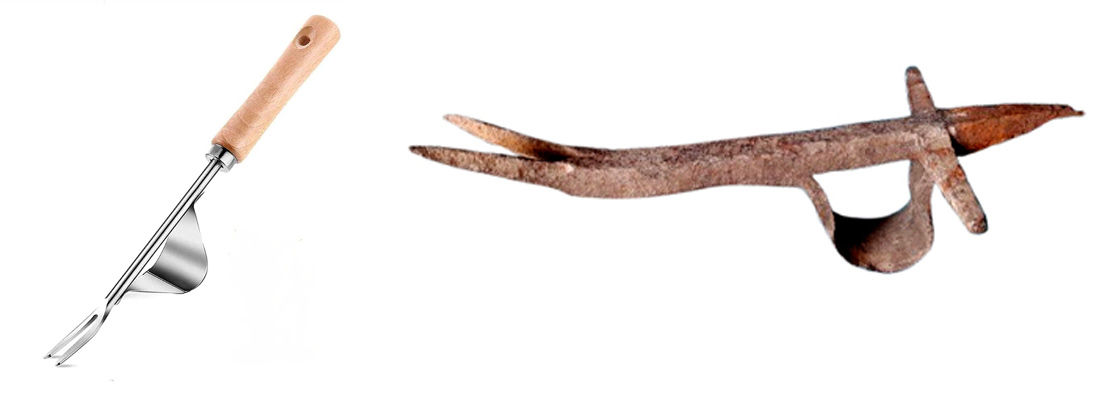
L-R: (1) Small, one handed, Gardener’s lawn ‘Daisy Grubber‘. (2)Head only of a large 17th century, two handed, farm labourer’s ‘Grubber’.
I was looking at some gardening equipment on line; in search of something to remove unwanted growth from my small grass lawn area, when I spotted a small hand held ‘Gardener’s Daisy Grubber’.
This small ‘Daisy Grubber’ reminded me of a blacksmith made, spade size, Grubber, used back in the 17th/18th/19th century, also used to remove stubborn, deep-rooted, Thistle and Dock roots from corn fields, prior to harvesting. The immediate removal, back then, ensured that the seeds of both weeds would not end up amongst oat and barley seed, being trashed and due for sowing the following spring.
This spade size, ancient Grubber would take on an alternative use during the middle of the 19th century; becoming useful to those employed by Irish landlords and their agents, to assist in evicting tenants.
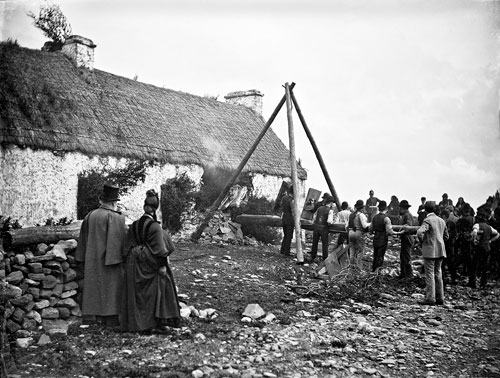
A forced Irish eviction using a battering ram, taking place in the mid-19th century, being strongly defended by the tenants residing within.
Those tenants either failing to pay or unable to pay their rent were evicted, often by force, from their homes. This same agricultural Grubber, whose teeth resemble a modern day claw hammer, was used to remove nails/spikes from roof timbers. Once the nails/spikes were removed/drawn, the thatched roof on such dwellings could be easily collapsed; ensuring that the evicted tenants could not return to seek shelter over future nights.
Spotted here in Thurles on Monday last, the first Cinnabar moth (Tyria jacobaeae) of the season. Native to Ireland and indeed Europe, Cinnabar moths are daytime-flying moths, with distinctive pinkish-red and black wings.
Cinnabar moths measure about 20mm (0.79in) in length with a wingspan of some 32–42mm (1.3–1.7in) and acquires its named from the red mineral Cinnabar, because of the red patches on its predominantly black wings.
Interesting to note that this moth has been introduced into New Zealand, Australia and North America to control Ragwort (latter poisonous to horses and other livestock), on which its larvae feed. This Ragwort diet, eaten by their pale yellow and black striped larvae, leaves them unpalatable to their would-be predators. Females can lay up to 300 eggs, in batches of 30 to 60 on the underside of Ragwort leaves and their caterpillars being voracious eaters; a large population can strip entire patches of ragwort clean, within a very short period of time.
Though not considered very rare in Ireland, the Cinnabar moth remains, annually, in grave danger due to the Noxious Weeds Act of 1936, which makes it an offence for the owner or occupier of lands not to prevent the growth and spread of Ragwort. In 2020, some 52 “notices to destroy” were issued to land owners, by the Department of Agriculture, for the presence of Ragwort being on their property and in 2021, some 22 such notices were also issued. Many caterpillars will starve if their food runs out before they are fully grown, so as competition intensifies the caterpillars become more aggressive and may even turn to cannibalism in their quest for calories.
“A society grows great when old men plant trees in whose shade they shall never sit.” – Greek Proverb.
It was great to see, once again, biodiversity being restored to the area of the Thurles Double Ditch, latter situated beside Dun Muileann Housing Estate, on Mill Road, in Thurles yesterday and sponsored by Allied Irish Banks(AIB).
Tree planters pictured above are students from Thurles Ursuline Convent Secondary School with Ms Anne Marie Fleming,(Tipperary County Council Biodiversity Officer)and Mr John Lanigan(Refresh Thurles).
Tree planters pictured above are students from Thurles Presentation Convent Secondary School with MrRichard Mulcahy (Co-founder of the 100MT Project initiative)
So, how important was yesterday’s Thurles undertaking?
The two videos, shown immediately hereunder, should assist, greatly, in granting an understanding into the importance of yesterday’s Thurles project.
So what can we expect to see here in just 2 years from now?
Congratulations to all those responsible for yesterday’s undertaking, which, sadly, saw no elected politicians making themselves available to turn sods; however, in mitigation I suppose it wasn’t an election year and the trees were too small to allow the holding up of election posters, using tech screws.
The “Sweet White Violets”(Latin Name: Viola odorata alba), which is expected to appear in late winter or early Spring, arrived exactly on time this year, exhibiting a massive crop of blossoms.
Sweet White Violets pictured here with emerging wild Primroses. Pic: G. Willoughby.
This small hardy herbaceous perennial is also commonly known as ‘Wood Violet‘; ‘English Violet‘; ‘Common Violet‘; ‘Florist’s Violet‘ and ‘Garden Violet’.
Sweet White Violets: The flowers which are either dark violet or white in colour, are scented, with the species most often found near the edges of forests or in shaded clearings; it is also a common “uninvited guest” found on shaded lawns or elsewhere with in Irish gardens.
Both the leaves and flowers are edible and in the late Victorian period, were used in the production of cosmetic fragrances and perfumes and in the production of medicine. Interesting to note: The scent somehow has suggested sex, so the violet served as a symbol of a favoured flower of Aphrodite, (latter ancient Greek goddess of sexual love and beauty); and her son, Priapus, (latter a minor fertility god in Greek mythology), who was also the protector of livestock, fruit plants and, yes male readers should note, male genitals. Both the former named Greek goddess and minor god were the deity of gardens.
A Bunch Of Violets Blue.
Lyrics: Attributed to composer, writer John McCormick. Vocals: Irish country, traditional and easy listening singer, guitarist and saxophone player, the late Tom McBride, (Big Tom 1936–2018).
A Bunch Of Violets Blue.
It was out in a moonlit garden, Not far from the ballroom grand, A soldier and his sweetheart, Went strolling hand in hand. Tomorrow the war would call him, And he vowed he would be true, And from her breast she gave to him, A bunch of violets blue. They were only a bunch of violets, A bunch of violets blue, Fresh and fair and dainty, All sparkle like the dew. Fresh and fair and dainty, As he pressed them to his heart, He smiled and said where’er he’d roam, From them he’d n’er would part. A soldier boy lay dying, Upon the cold, cold ground. A bunch of withered violets, Upon his breast was found. Turning to his comrades, In a feeble voice he sighed. Take them back and tell her that, I wore them till I died. They took the withered violets back, It been on her wedding day. An old man’s gold had won her, From her soldier far away. An old man’s gold had won her, From her soldier young and tall, And this is what he said to her, One evening at the ball. They were only a bunch of violets, A bunch of violets blue, Fresh and fair and dainty, All sparkle like the dew. Fresh and fair and dainty, As he pressed them to his heart, He smiled and said where’er he’d roam, From them he’d n’er would part.
This website uses cookies to improve your experience. We'll assume you're ok with this, but you can opt-out if you wish.AcceptRead More
Privacy & Cookies Policy
Privacy Overview
This website uses cookies to improve your experience while you navigate through the website. Out of these, the cookies that are categorized as necessary are stored on your browser as they are essential for the working of basic functionalities of the website. We also use third-party cookies that help us analyze and understand how you use this website. These cookies will be stored in your browser only with your consent. You also have the option to opt-out of these cookies. But opting out of some of these cookies may affect your browsing experience.
Necessary cookies are absolutely essential for the website to function properly. This category only includes cookies that ensures basic functionalities and security features of the website. These cookies do not store any personal information.
Any cookies that may not be particularly necessary for the website to function and is used specifically to collect user personal data via analytics, ads, other embedded contents are termed as non-necessary cookies. It is mandatory to procure user consent prior to running these cookies on your website.








Recent Comments