Food Safety Authority of Ireland have announced the recall of a batch of SuperValu Chicken & Ham Pie (275g), due to the possible presence of Soya.
Recalled Tuesday, 23rd January 2024. Allergy Alert Notification: 2023.A32. Allergen: Soya. Product Identification: SuperValu Chicken and Ham Pie, 275g, Use by 26.01.2024. Batch Code: 26.01.2024. Country Of Origin: Ireland.
Message: The above identified batch of SuperValu Chicken and Ham Pie is being recalled as some packs may contain Steak and Onion Pie. This product contains Soya, which is not declared on the label. This may make the batch unsafe for consumers who are allergic to or intolerant of Soya.
The Food Safety Authority of Ireland (FSAI) has stated that 92 Enforcement Orders were served on food businesses for breaches of food safety legislation in 2023, an increase of 19% on the 77 that were served in 2022. Announcing the figures today, the FSAI, expressed disappointment at the increase, and reminded food businesses to train staff appropriately to produce, serve and sell food, in accordance with food safety legislation, thus ensuring that premises are fully suitable for safe food production, sale and storage.
Between January 1st and December 31st 2023, 76 Closure Orders, 3 Improvement Orders and 13 Prohibition Orders were served on food businesses. A total of 6 prosecutions were also taken. These enforcement actions were led by Environmental Health Officers in the HSE, local authority veterinary inspectors, sea-fisheries protection officers in the Sea-Fisheries Protection Authority and officers of the FSAI. Recurring issues of food safety negligence identified in food businesses resulted in the Enforcement Orders being issued, including inadequate food storage with the risk of contamination; a lack of pest control procedures such as monitoring and pest proofing; inadequate temperature control in food storage, preparation and distribution; and insufficient staff training in food safety, personal hygiene and record keeping.
Commenting on the annual figures, Dr Pamela Byrne, (Chief Executive, FSAI), expressed that she had hoped to see a reduction in the number of Enforcement Orders needing to be served in 2023. Disappointingly, this was not the case. She stated that “As a result of the inspections carried out by Environmental Health Officers, local authority veterinary inspectors, sea-fisheries protection officers and FSAI officers, a total of 92 food businesses were served with legal orders for breaches of food safety law in 2023. While each of these Enforcement Orders was necessary for the protection of consumer health in relation to food safety, we should not be seeing such breaches of food law occurring in food businesses at all”. Dr Byrne added “Enforcement Orders are served on food businesses only when a risk to consumer health has been identified, or where there are a number of ongoing breaches of food legislation. It is a legal obligation for food businesses to ensure that they are proactive in adhering to food safety regulations. Each month, food safety inspectors find similar, basic and fundamental breaches of food law, which are unacceptable”. “As we enter 2024, we urge food businesses to always prioritise and promote a culture of food safety in their businesses”, she concluded.
The FSAI, today, also reported that four Closure Orders and one Prohibition Order were served on food businesses during the month of December 2023 for breaches of food safety legislation, pursuant to the FSAI Act, 1998 and the European Union (Official Controls in Relation to Food Legislation) Regulations, 2020. The Enforcement Orders were issued by Environmental Health Officers in the Health Service Executive and happily none were reported in Co. Tipperary during the month of December 2023.
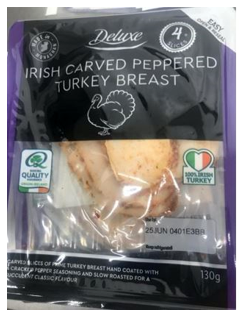
FSAI recall a batch Of Lidl’s Deluxe Irish Carved Peppered Turkey Breast due to incorrect use-by date
Recall Date: Tuesday, 09 January 2024 Category 1: For Action Alert Notification: 2024.02 Product Identification: Deluxe Irish Carved Peppered Turkey Breast; pack size: 130g Batch Code Use-by: 25 JUN Country Of Origin: Ireland
Message: The above batch of Deluxe Irish Carved Peppered Turkey Breast is being recalled by Lidl, due to an incorrect use-by date printed on the front of the pack. The correct use-by date is 25th January 2024.
Action Required: Retailers are requested to remove the implicated batch from sale and display recall notices at point-of-sale. Consumers: Consumers are advised not to eat the implicated batch after 25th January 2024.
The Food Safety Authority of Ireland have renewed advice in relation to the recall of Nutramigen LGG Stage 1 & 2 Hypoallergenic Formula, due to the possible presence of Cronobacter sakazakii.
NewAlert Summary update Thursday, January 4th 2024. Category 1: For Action Alert Notification: 2024.01 (Update) Product Identification: Please see table below. Batch Code: Please see table below. Country Of Origin: USA
Message: Further to the FSAI’s food alert 2024.01, Reckitt/Mead Johnson Nutrition are recalling the stated batches of Nutramigen LGG Stage 1 & 2 as a precaution, due to the possible presence of Cronobacter sakazakii. Recall notices will be displayed at point-of-sale.
The FSAI has become aware that the majority of this product has been sold by pharmacies.
Product name
Pack size
Batch codes
Nutramigen LGG Stage 1
400g
ZL3F7D
Nutramigen LGG Stage 2
400g
ZL3FAA & ZL3FDM
Nature Of Danger:
Cronobacter sakazakii infections are rare, but they can be extremely serious for babies younger than 2 months or babies born prematurely or immunocompromised. Illness usually starts with a fever and poor feeding, excessive crying, or very low energy. In severe cases, it may lead to sepsis or meningitis.
Action Required:
Retailers: Retailers are requested to remove the implicated batches from sale and display recall notices at point-of-sale.
Consumers: Consumers are advised not to consume the implicated batch.
If you have the batch numbers of the product listed above, you can return it to the pharmacy that dispensed it to you for a refund. If you require further information, Reckitt/Mead Johnson Nutrition have opened a consumer relations line. CARELINE FREE PHONE NUMBER+44 (0)1895 230575, Or email ConsumerNutrition_GB@rb.com.
Not sure how long your turkey should be in the oven. Don’t stress, instead simply visit HERE
The Safefood website offer a turkey cooking timer calculator and a whole host of other handy tips on how to cook, store and reheat food this festive season.
This website uses cookies to improve your experience. We'll assume you're ok with this, but you can opt-out if you wish.AcceptRead More
Privacy & Cookies Policy
Privacy Overview
This website uses cookies to improve your experience while you navigate through the website. Out of these, the cookies that are categorized as necessary are stored on your browser as they are essential for the working of basic functionalities of the website. We also use third-party cookies that help us analyze and understand how you use this website. These cookies will be stored in your browser only with your consent. You also have the option to opt-out of these cookies. But opting out of some of these cookies may affect your browsing experience.
Necessary cookies are absolutely essential for the website to function properly. This category only includes cookies that ensures basic functionalities and security features of the website. These cookies do not store any personal information.
Any cookies that may not be particularly necessary for the website to function and is used specifically to collect user personal data via analytics, ads, other embedded contents are termed as non-necessary cookies. It is mandatory to procure user consent prior to running these cookies on your website.






Recent Comments