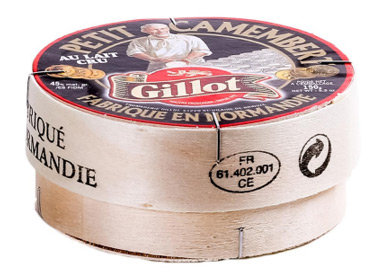
Food Safety Authority Of Ireland recall a batch of Gillot cru Petit Camembert due to possible presence of Shiga toxin-producing E. coli (STEC).
Alert Summary dated Wednesday, August 27th 2025.
Category 1: For Action. Alert Notification: 2025.45. Product Identification: Gillot cru Petit Camembert; pack size: 150g. Batch Code: Best before: 26.08.2025. Country Of Origin: France.
Message: The above batch of French produced Gillot cru Petit Camembert is being recalled due to the possible presence of Shiga toxin-producing E. coli (STEC). Recall notices will be displayed at point-of-sale.
Nature Of Danger: Shiga toxin-producing Escherichia coli (STEC), also known as verocytotoxigenic E. coli(VTEC), are a specific group of E. coli. While most E. coli are harmless and live in the intestines of healthy humans, STEC produce a powerful toxin which can cause severe illness. Symptoms include abdominal cramps and diarrhoea which is sometimes bloody. Usually there is little or no fever, and patients recover within 5 to 10 days. In some people however, particularly children under 5 years of age and the elderly, the infection can cause a complication called haemolytic uraemic syndrome(HUS), in which the red blood cells are destroyed and the kidneys can stop working properly. The time between the initial infection and the first symptoms appearing is typically between 3 and 4 days but can range between 1 and 8 days.
Action Required:Manufacturers, Wholesalers, Distributors, Caterers and Retailers: Retailers: Same are requested to remove the implicated batch from sale and display notices at point-of-sale. Consumers: Consumers are advised not to eat the implicated batch.
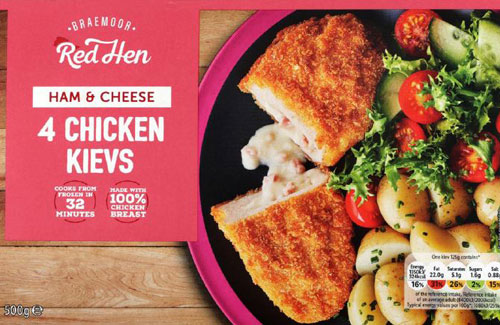
Recall of Braemoor Red Hen Ham & Cheese Chicken Kievs due to the presence of Salmonella
Alert Summary dated Monday, August 25th 2025.
Category 1: For Action. Alert Notification: 2025.44. Product Identification: Braemoor Red Hen Ham & Cheese Chicken Kievs; Pack size: 500g Batch Code: 25190B; Best before date: October 2026. Country Of Origin: Ireland.
Message: Glenhaven Foods, is recalling the above batch of Braemoor Red Hen Ham & Cheese Chicken Kievs due to the presence of Salmonella.
Nature Of Danger: People infected with Salmonella typically develop symptoms between 12 and 36 hours after infection, but this can range between 6 and 72 hours. The most common symptom is diarrhoea, which can sometimes be bloody. Other symptoms may include fever, headache and abdominal cramps. The illness usually lasts 4 to 7 days. Diarrhoea can occasionally be severe enough to require hospital admission. The elderly, infants, and those with impaired immune systems are more likely to have a severe illness.
Action Required:Manufacturers, Wholesalers, Distributors, Caterers and Retailers:
Retailers: Same are requested to remove the implicated batch from sale and display recall notices at point-of-sale. Wholesalers/Distributors: Same are requested to contact their affected customers and recall the implicated batch and provide a point-of-sale recall notice to their retail customers. Caterers: should not use the implicated batch.
Consumers: Consumers are advised not to eat the implicated batch.
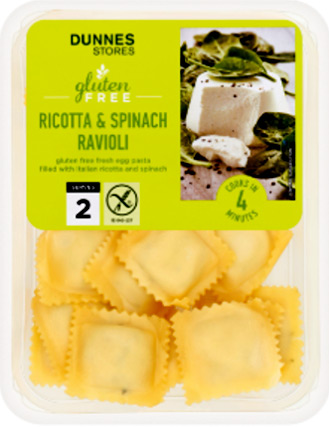
Presence of gluten in a batch of Dunnes Stores Gluten Free Ricotta and Spinach Ravioli.
Alert Summary dated Thursday, August 21 2025.
Allergy Alert Notification: 2025.A30. Allergen(s): Cereals containing gluten. Product Identification: Dunnes Stores gluten free Ricotta & Spinach Ravioli; pack size: 250g. Batch Code: Use by date: 13.09.25. Country Of Origin: Italy.
Message: Gluten was detected in the above batch of Dunnes Stores gluten free Ricotta & Spinach Ravioli. The product is labelled as gluten free and cereals containing gluten are not declared on the list of ingredients. This may make the batch unsafe for consumers who are allergic to or intolerant of gluten and therefore, these consumers should not eat the implicated batch.
The affected batch is being recalled by Dunnes Stores.
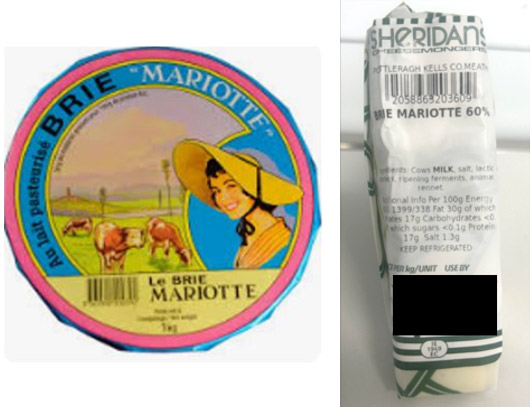
Food Safety Authority of Ireland recall various batches of Brie Mariotte due to the possible presence of Listeria monocytogenes.
Alert Summary dated Friday, August 15th 2025.
Category 1: For Action. Alert Notification: 2025.43. Product Identification: Please see table below. Batch Code: Please see table hereunder. Country Of Origin: France.
Product Pack.
Size.
Expiry date.
Brie Mariotte.
1kg.
All best before dates up to and including 30/08/2025.
Brie Mariotte.
All pack sizes.
All batches and use by dates sold between 08/06/2025 and 13/08/2025.
Message: The above batches of Brie Mariotte are being recalled due to the possible presence of Listeria monocytogenes. Recall notices will be displayed at point-of-sale. There is currently no evidence that this food recall is linked with the listeriosis outbreak related to ready-to-heat meals or the recall of spinach and mixed leaves products. Please see this News Article. Nature Of Danger: Symptoms of Listeria monocytogenes infection can include mild flu-like symptoms, or gastrointestinal symptoms such as nausea, vomiting and diarrhoea. In rare cases, the infection can be more severe, causing serious complications. Some people are more vulnerable to Listeria monocytogenes infections, including pregnant women, babies, and people with weakened immune systems, including the elderly. The incubation period (time between initial infection and first symptoms appearing) is on average 3 weeks but can range between 3 and 70 days.
Retailers: Same are requested to remove the implicated batches from sale and display recall notices at point-of-sale.
Wholesalers/Distributors: Same are requested to contact their affected customers and recall the implicated batches and provide a point-of-sale recall notice to their retailer customers.
Caterers: Same should not use the implicated batches.
Consumers: Consumers are advised not to eat the implicated batches.
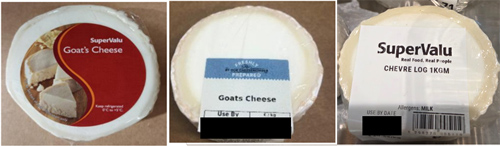
Irish Food Safety Authority recall various branded Goat’s Cheese products due to the possible presence of Listeria monocytogenes.
Alert Summary dated Tuesday, August 12th 2025. (Further Update).
Category 1: For Action. Alert Notification: 2025.42. Product Identification: Please see table below. Batch Code: Please see table below. Country Of Origin: France.
Message: The below batches of goat’s cheese are being recalled due to the possible presence of Listeria monocytogenes. Recall notices will be displayed at point-of-sale. There is currently no evidence that this food recall is linked with the listeriosis outbreak related to ready-to-heat meals or the recall of spinach and mixed leaves products. Please see this News Article.
Product.
Pack size.
Use by dates.
SuperValu Goat’s Cheese.
110g.
07/08/2025 and 12/08/2025.
Freshly Prepared by Our Cheesemongers Goats Cheese.
Pack sizes vary.
11/08/2025 and 12/08/2025.
SuperValu Chevre Log.
Pack sizes vary.
All use by dates up to and including 12/08/2025.
Nature Of Danger: Symptoms of Listeria monocytogenes infection can include mild flu-like symptoms, or gastrointestinal symptoms such as nausea, vomiting and diarrhoea. In rare cases, the infection can be more severe, causing serious complications. Some people are more vulnerable to Listeria monocytogenes infections, including pregnant women, babies, and people with weakened immune systems, including the elderly. The incubation period (time between initial infection and first symptoms appearing) is on average 3 weeks but can range between 3 and 70 days.
Action Required:Retailers: Retailers: Same are requested to remove the implicated batches from sale and display recall notices at point-of-sale. Consumers: Consumers are advised not to eat the implicated batches.
This website uses cookies to improve your experience. We'll assume you're ok with this, but you can opt-out if you wish.AcceptRead More
Privacy & Cookies Policy
Privacy Overview
This website uses cookies to improve your experience while you navigate through the website. Out of these, the cookies that are categorized as necessary are stored on your browser as they are essential for the working of basic functionalities of the website. We also use third-party cookies that help us analyze and understand how you use this website. These cookies will be stored in your browser only with your consent. You also have the option to opt-out of these cookies. But opting out of some of these cookies may affect your browsing experience.
Necessary cookies are absolutely essential for the website to function properly. This category only includes cookies that ensures basic functionalities and security features of the website. These cookies do not store any personal information.
Any cookies that may not be particularly necessary for the website to function and is used specifically to collect user personal data via analytics, ads, other embedded contents are termed as non-necessary cookies. It is mandatory to procure user consent prior to running these cookies on your website.





Recent Comments