A fuel and cost-of-living protest is set to take place in Thurles this Saturday, April 18th, with organisers urging a public turnout in the town centre.
The demonstration, organised by Sinn Féin representative Mr Dan Harty, is due to assemble in the Munster Hotel car park before proceeding to Liberty Square at approximately 2:30pm.
However, the decision to stage yet another protest in the heart of Thurles is already being met with growing frustration locally, particularly among business owners and residents who have seen at first-hand the disruption caused by similar demonstrations nationwide in recent days.
Across Ireland, recent fuel protests have led to gridlock, blocked roads, and major disruption to daily life, including key routes and town centres. These events have not only delayed commuters but also interfered with trade, deliveries, and normal business activity.
Against that backdrop, many are now asking why Thurles; an already congested town on a busy weekend, has been chosen as the venue for another large gathering.
Liberty Square is a central commercial hub. Even limited disruption at peak times can have an outsized effect on small businesses, many of which are already under pressure from rising energy and operating costs. For traders trying to keep doors open, any reduction in access or footfall is not a minor inconvenience, it is a direct hit.
Critics argue that while people have every right to protest, repeating tactics that have already caused widespread disruption, risks alienating the very communities such movements claim to represent.
There are also growing questions about whether protests of this nature are achieving anything tangible, or simply creating further pressure on towns and local economies, without delivering any real meaningful outcomes. The organiser of the event, Sinn Féin representative Mr Dan Harty, previously had a fairly modest result in the 2024 local elections in the Thurles LEA, with only an 8% share of first-preference votes numbering just 742. This left him below the quota and behind all other elected candidates, to be eliminated relatively early, due to his support base being relatively small compared to the other leading candidates.
The heavy cost of fuel, driven mainly by global supply disruptions, and with the protest expected to draw a flag waving crowd, into an already busy town centre; the focus now shifts to the real impact on Thurles town itself, its streets, its businesses, and the people who rely upon both.
As frustration mounts, many will be watching closely to see whether this latest demonstration reflects responsible leadership, or simply a continuation of disruption that local communities can ill afford.
In a landmark move for Ireland’s financial sector, Permanent TSB (PTSB) is set to be acquired by Austria’s BAWAG Group in a deal valued at approximately €1.6 billion. The agreement marks a significant milestone; not just for the bank itself, but for the Irish State, which is finally exiting its last remaining stake in the country’s banking system, following the financial crisis.
The Government has agreed to sell its 57.5% shareholding in PTSB for around €931 million, based on an offer price of €2.97 per share. While shares dipped slightly following the announcement, the broader significance of the deal lies in what it represents: the closing chapter of a turbulent period that began with the 2008 banking collapse.
Back then, Irish taxpayers stepped in to rescue the banking system, investing billions to stabilise institutions like PTSB. In total, €3.9 billion was injected into the bank. Over time, through dividends, fees, and share sales, the State has recovered approximately €4 billion, bringing the overall return slightly above break-even when combined with other bank investments.
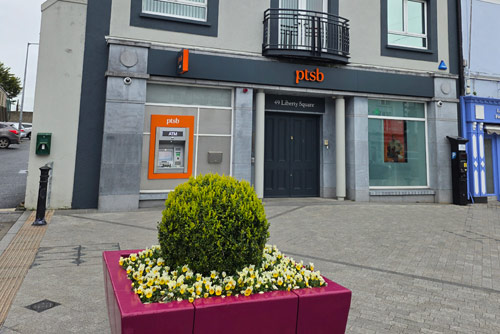
PTSB Thurles Branch. Pic: G. Willoughby.
For customers, including those served by PTSB’s branch in Thurles, Co. Tipperary, the message is reassuring: it’s business as usual. The bank has emphasised that day-to-day services, accounts, and customer support will not be disrupted by the transition. Instead, the acquisition is being positioned as an opportunity to enhance services and expand offerings.
BAWAG Group, headquartered in Vienna, operates across several European countries as well as the US and UK, serving around four million customers. Its focus on retail banking and small-to-medium enterprises aligns closely with PTSB’s core business, making the deal a strategic fit. The combined entity is expected to become a stronger challenger to Ireland’s dominant banks, potentially increasing competition and improving customer choice.
PTSB’s leadership has expressed confidence in the new ownership. Chair Julie O’Neill highlighted the “long-term ambition, capability and capital” that BAWAG brings, while CEO Eamonn Crowley noted the potential for growth and innovation. From BAWAG’s perspective, the acquisition represents a key step in building a broader European and US banking platform.
Irish Minister for Finance Mr Simon Harris described the deal as one of the most significant developments in Ireland’s retail banking market in over a decade. He emphasised that the sale not only delivers value back to taxpayers, but also supports the ongoing normalisation of the banking sector.
Importantly, this transaction follows the State’s earlier exits from AIB and Bank of Ireland, completing a long process of unwinding public ownership in Irish banks. It also reflects renewed international confidence in Ireland’s economy and financial system.
As the deal progresses; subject to regulatory approvals, the focus will shift to integration and future growth. For communities across Ireland, including towns like Thurles, the hope is that this new chapter will bring stronger services, increased competition, and continued investment in local banking.
In many ways, this isn’t just a sale, it’s a signal that Ireland’s banking sector has come full circle.
The Services Industrial Professional and Technical Union (SIPTU) has formally notified the National Ambulance Service (NAS) of planned strike action next month, marking a significant escalation in a long-running dispute with the Health Service Executive (HSE) over pay and working conditions.
Around 2,000 SIPTU members working across the ambulance service in Ireland, including Emergency Medical Technicians (EMTs), paramedics, advanced paramedics, specialist paramedics and supervisors, have voted overwhelmingly in favour of industrial action, up to and including full strike action.
The planned industrial action will begin with a 24-hour strike on 12 May, followed by a 48-hour stoppage starting on 19 May and a 72-hour stoppage from 26 May. Further strikes are also scheduled for June.
In addition, a work-to-rule will commence on 11 May, meaning staff will not cooperate with new procedures or changes introduced by management.
The dispute centres on the HSE’s failure to implement recommendations from an independent review published in 2020, which called for updated salary scales to reflect the increased responsibilities and workload of ambulance staff over the past two decades.
According to SIPTU, ambulance personnel now provide a far higher level of pre-hospital care than in the past, requiring additional training, qualifications and clinical decision making. The union argues that despite these expanded duties,including a significant increase in medication administration, staff pay and grading structures have not been updated to reflect these changes.
Government Announces Extended Fuel Relief Measures as Pressure Mounts to End Disruptive Protests.
The Government has confirmed a further extension of fuel cost relief measures, as Taoiseach Mr Micheál Martin announced new steps aimed at easing the financial burden on households and businesses amid ongoing nationwide protests.
Under the revised plan, temporary reductions in excise duty on petrol, diesel, and marked gas oil will now remain in place until the end of July, rather than expiring at the end of May.
Taoiseach Mr Micheál Martin.
The updated measures include:
A 10 cent per litre reduction on both petrol and diesel.
A 2.4 cent per litre reduction on marked gas oil (“green diesel”).
A deferral of the planned carbon tax increase, originally due in May, now postponed until the Budget in October.
These steps are intended to provide immediate cost relief in response to sustained increases in fuel prices linked to global supply pressures.
Despite these concessions, significant disruption continues across the country as protest actions, largely organised via informal networks of transport operators, farmers, and drivers, have blocked key transport routes and fuel depots.
The Government has reiterated that it recognises the financial strain facing those in fuel-dependent sectors. However, it has strongly criticised the ongoing blockades, warning that such actions are having serious and disproportionate consequences for the general public.
With schools reopening and workers returning after the weekend, the continuation of these protests risks widespread impact on daily life. Commuters face delays, families are affected in getting children to school, and essential services, including healthcare and emergency response, remain under pressure due to fuel supply concerns and traffic disruption.
The obstruction of critical infrastructure, including fuel depots and major roadways, has also raised concerns about the availability of medicines, agricultural supplies, and other time-sensitive deliveries. Authorities, including An Garda Síochána, have now moved into an enforcement phase, and the Defence Forces remain on standby to assist in removing vehicles where necessary.
Public Interest and Proportionality. While the Government’s latest measures demonstrate a willingness to respond to rising costs, the continuation of large-scale disruption raises serious questions about proportionality.
The burden of these protests is not being carried by policymakers alone, it is being felt most acutely by ordinary members of the public. Workers attempting to commute, parents preparing for the school week, and vulnerable individuals relying on timely access to services are all directly affected.
In this context, the persistence of blockades appears increasingly difficult to justify, particularly as concrete measures have now been introduced to address core concerns around fuel pricing.
The Government has urged all participants to disengage from disruptive actions and instead pursue dialogue through established representative bodies, emphasising that meaningful progress can only be achieved without jeopardising public safety and national infrastructure.
Further developments are expected in the coming days as pressure intensifies to restore normality across the country.
Tipperary County Council: World Leaders in Revenue Collection, but still Struggling With… Roads.
Tipperary County Council has proudly confirmed that it extracted a tidy €308,112 in parking fines in 2025, proving once again that when it comes to collecting money, efficiency is not an issue.
Fixing roads, however, remains a bold and experimental concept. See in particular Emmett Street, Westgate junction, Barry’s Bridge etc. etc. here in Thurles,
Across nine towns, thousands of motorists were “caught red-handed”, — “embarrassed even”, according to local press reports, having been photographed by traffic wardens, committing the heinous crime of allowing two wheels to exist slightly outside a faded white line or failing to have their hair permed within the 15 minute permitted free time frame.
Thurles, notably, now continues to excel in two key areas: (1)Generating revenue. (2)Avoiding pothole repairs.
Of course, as one would expect, Clonmel led the charge with 2,469 fines, followed by Nenagh with 1,346fines, Thurles(God help us in a town where most car parks were closed in 2025)1,258fines, while Carrick-on-Suir tried and failed to catch-up with a mere 1,052fines.
A further breakdown reveals a more refined vehicle operator: Tipperary Town:914 fines. Cashel:548 fines. Templemore:267 fines. Roscrea:256 fines. Cahir: took the wooden spoon, with a miserable 142 fines only. Still all admirable figures, if the goal is to run a highly efficient penalty collection service, rather than maintain public infrastructure.
Motorists are charged €40 – €80 for parking offences, rising by 50% after 28 days, because nothing says “public service” like interest rates that would impress a credit card company.
Other highlights include: ♣ €60 for failing to display a tax disc. ♣ In keeping with Health & Safety, No Charge for failing to display a NCT disk. ♣ €150 for parking in a disabled space.
Meanwhile, in Thurles, the surface of Barry’s Bridge is once again disintegrating, bravely demonstrating the council’s innovative “Natural Erosion Management Strategy.”
Residents are reportedly delighted to see their contributions; over €300,000 worth, being reinvested into… somewhere; possibly sending salaried staff on St Patrick’s weekend junkets; but certainly not road surfaces.
A spokesperson, (latter who does not wish to be named), standing carefully to avoid loose flying gravel, stated: “We take great pride in maintaining strict parking enforcement, while also maintaining a flexible, evolving interpretation of the word ‘roadworthy.”
Local drivers have expressed confusion, noting that while their tyres are expected to meet exact legal standards, the road beneath them appears to be auditioning for a gravel pit. Experts confirm that if potholes themselves could be fined, Tipperary County Council would likely be running a budget surplus.
Until then, motorists are advised to: ♦ Display their tickets correctly facing upwards. ♦ Pay promptly. ♦ Have a suspension system worthy of Dakar Rally conditions▲ when crossing Barry’s Bridge. {▲The Dakar Rally is considered the world’s most challenging endurance motorsport event, held annually over two weeks in extreme desert conditions.}
Wonder would Tipperary Sinn Féin TDs meet and move a motion of no confidence in Tipperary Co. Council. Ops, sorry, forgot that the Tipperary electorate failed to elect Sinn Féin TD’s, last election. I wonder why?
Yes, here in Tipperary, the fines are fixed – but the roads are anything but.
This website uses cookies to improve your experience. We'll assume you're ok with this, but you can opt-out if you wish.AcceptRead More
Privacy & Cookies Policy
Privacy Overview
This website uses cookies to improve your experience while you navigate through the website. Out of these, the cookies that are categorized as necessary are stored on your browser as they are essential for the working of basic functionalities of the website. We also use third-party cookies that help us analyze and understand how you use this website. These cookies will be stored in your browser only with your consent. You also have the option to opt-out of these cookies. But opting out of some of these cookies may affect your browsing experience.
Necessary cookies are absolutely essential for the website to function properly. This category only includes cookies that ensures basic functionalities and security features of the website. These cookies do not store any personal information.
Any cookies that may not be particularly necessary for the website to function and is used specifically to collect user personal data via analytics, ads, other embedded contents are termed as non-necessary cookies. It is mandatory to procure user consent prior to running these cookies on your website.





Recent Comments