A major new report from the Ombudsman for Children’s Office has delivered a stark assessment of Ireland’s child care system, describing it as “broken” and failing to act in the best interests of vulnerable young people.
The report finds that, in some cases, children experience greater harm after entering State care. Serious concerns include instances of sexual grooming and assault, children going missing for days, and repeated moves between unregulated placements.
It also highlights situations where children have been held in secure care for extended periods, despite not committing any offences, due to a lack of suitable placements. In one case, two young siblings were placed in a facility with teenagers and a large staff presence because no foster home was available.
The Ombudsman, Dr Niall Muldoon, questioned how the State has reached a point where it cannot guarantee safe and stable care for highly vulnerable children.
The report identifies key systemic issues, including shortages of social workers, insufficient placement options, and ongoing difficulties in recruiting and retaining care staff. It also points to an increasing reliance on private providers and the growing use of unregulated accommodation.
Funding pressures remain a central concern. Despite a significant rise in child protection referrals over the past decade, the agency responsible, Tusla, is described as chronically under-resourced and receiving substantially less funding than required.
With nearly 6,000 children currently in care, the Ombudsman is calling for urgent reform. A forthcoming national consultation and the development of Ireland’s first National Alternative Care Plan are being framed as a critical opportunity to overhaul the system and better protect children’s rights.
Tipperary County Council has been allocated €1.4 million under the latest round of the Government’s Voids Programme, in a move expected to help bring more vacant local authority homes back into use across the county.
The funding forms part of a wider €40 million national investment announced by Housing Minister Mr James Browne, which will support the refurbishment and re-letting of around 2,200 local authority homes across the country in 2026.
The latest allocation is expected to provide a significant boost for Tipperary as demand for housing remains strong and pressure continues on local authority stock. The funding will be used to prepare vacant council-owned properties for new tenants, helping to increase housing supply through the reuse of existing homes.
The announcement also signals a major policy shift in how future funding under the Voids Programme will be distributed.
Under a revised performance-based model introduced by the Minister, future allocations will be linked to how effectively local authorities reduce vacancy levels and improve turnaround times for re-letting homes.
From 2027, local authorities, including Tipperary County Council, will be expected to maintain a vacancy rate of no more than 2% and achieve a maximum average turnaround time of 18 weeks for vacant properties. The turnaround target will tighten further to 15 weeks in 2028 and 12 weeks in 2029.
Councils that meet those targets will qualify for full funding under the revised model, placing a stronger emphasis on delivery, efficiency and the rapid reuse of existing housing stock.
The funding will be seen as a positive development for Tipperary, particularly given the ongoing need to maximise available housing and reduce the time homes remain vacant between lettings.
Nationally, the Government says the Voids Programme has played a significant role in bringing empty social homes back into use over the past decade. Since the scheme began in 2014, a total of €385 million has been invested, supporting the return of 27,860 homes to active use.
The 2026 allocation is also a 29% increase on the previous year’s funding, reflecting what the Department says is a continued focus on tackling vacancy and increasing housing availability through refurbishment.
For Tipperary, the €1.4 million allocation is expected to support further progress in returning vacant homes to use, while positioning the local authority to meet the tougher targets that will shape future funding in the years ahead.
Unsuccessful legal challenge raises serious questions about judgment, priorities and respect for public money.
The legal challenge taken by Deputies Mr Paul Murphy(People Before Profit) and Mr Pa Daly (Sinn Féin) concerned the attendance of so-called “super junior” ministers at Cabinet meetings. They argued that because the Constitution limits the number of full Government members to 15, allowing junior ministers to attend and participate at Cabinet went against that constitutional limit. However, the High Court rejected that argument and ruled that the attendance and participation of those ministers did not breach the Constitution.
Pictured above left → right: Mr Paul Murphy and Mr Pa Daly. Failed “super junior” ministers case leaves taxpayers footing the bill.
The failed High Court challenge has now resulted in yet another avoidable cost for the taxpayer, and people are entitled to ask: what exactly was the justification for bringing it in the first place?
The court has already ruled that no provision of the Constitution was breached. Despite that, the public is now expected to pay 50% of the legal costs incurred by the two TDs in pursuing this unsuccessful action. At a time when families are struggling with housing costs, rising bills, overstretched health services and pressure on local communities, this is an outrageous misuse of time, energy and public money.
This case was presented as a matter of principle, but many people will see it for what it really was; a political exercise dressed up as constitutional concern. If there was no sound legal basis to succeed, then why was it necessary to pursue it at all? Why was it worth exposing the public to further legal costs without their consent? And where was the consideration for the taxpayers and voters who expect their elected representatives to show restraint, judgment and basic common sense?
Public representatives are elected to solve problems, not manufacture them. They are sent to the Dáil to fight for better housing, safer communities, improved public services and value for money for the people they represent. Instead, these two Deputies chose to embark on a failed legal challenge that has achieved nothing for their electorate except yet another bill that the public may now have to carry.
The suggestion that this action somehow served the public interest will ring hollow for many ordinary taxpayers. There is nothing responsible or commendable about pursuing costly litigation without sufficient justification and then leaving the public to absorb the obvious consequences. That is not accountability. It is not leadership and it is not respect for the people who pay the taxes and cast the votes.
The real issue here is one of priorities and judgment. At a time when every cent of public money should be spent carefully, this case showed a remarkable lack of awareness about the pressures facing ordinary working people. Voters are entitled to expect better than symbolic legal grandstanding with little apparent prospect of success.
There must now be full transparency around the total cost of this failed case, including both the portion of costs that the State has been ordered to pay and the State’s own legal expenses in defending the proceedings. Taxpayers deserve to know the full price of this unnecessary action.
This episode should serve as a warning. Taking a case of this kind without clear justification, without tangible benefit to the public, and without proper regard for the likely financial consequences reflects badly on those involved.
The electorate deserves representatives who fully respect public money, understand public priorities and exercise better judgment than this.
Irish Government warns against fuel price gouging amid current Middle East tensions.
Taoiseach Mr Micheál Martin has said there is “no excuse for prices going up at the pumps yesterday, or indeed anywhere”, warning fuel and home-heating suppliers against taking unfair advantage of consumers in response to escalating conflict in the Middle East.
Speaking ahead of a Cabinet meeting, Mr Martin said Ireland currently has adequate supplies and noted that much of the State’s oil is sourced from the North Sea, including Norway. He acknowledged the situation could have implications over time if it does not stabilise, but said immediate price rises are not justified.
The Taoiseach said he has raised the issue with Minister for Energy Mr Darragh O’Brien and has engaged with the Competition and Consumer Protection Commission (CCPC). The Government has asked the CCPC to examine the sector for any unfair pricing practices. He also pointed to ongoing work on energy affordability and wider EU-level discussions on energy pricing structures.
Enterprise Minister Mr Peter Burke said energy price rises are a concern for the economy, noting prices increased on Monday, while emphasising the country has continued to see solid growth despite geopolitical instability.
A significant roads funding package for 2026, announced in February 2026, has been outlined for Tipperary, covering both regional/local roads and national roads.
Regional & Local Roads (Tipperary County Council): €49,379,670. The largest share of the allocation is directed toward the day-to-day upkeep and long-term resilience of the county’s regional and local network.
Over last weekend, you’d be forgiven for thinking Thurles, Co. Tipperary, had been abandoned, judging by the state of our streets. Once again we’re driving on loose gravel, while yesterday’s potholes are “repaired” with cold tarmac tipped straight into puddles, as if water were a suitable foundation.
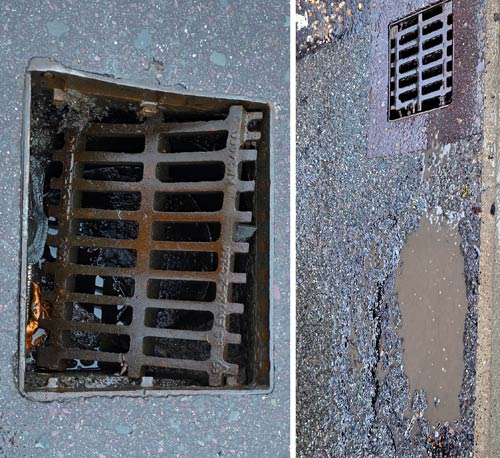
Worse than that, a drain cover was left open since last Thursday, near to the junction at Bowe’s corner; the grate cover having been dislodged in direct line with vehicle wheels. (See picture featured hereunder.)
Pic 1 Left: Grate cover dislodged. Pic 2 Right: On Barry’s Bridge, once again, a sinking surface, as 18 wheelers bounce over a raised pedestrian platform. Pictures: G.Willoughby.
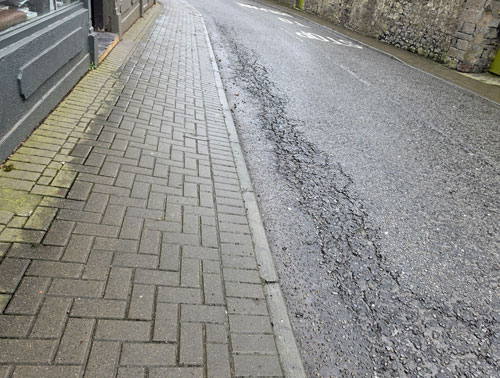
Parnell Street, Thurles beginning to sink and unravel with footpath now at a distinct sloaping angle. Picture: G. Willoughby.
“Protection & Renewal”: €36,234,670. Within the regional and local roads budget, €36,234,670 is assigned to Protection & Renewal. This funding supports a wide range of works and programmes, including:
restoration, improvement, and maintenance works
discretionary schemes
bridges and structures
drainage projects
road safety measures
climate adaptation works
community involvement initiatives (and other related supports)
National Roads (Tipperary): €8,360,343.
In addition, €8,360,343 has been allocated for national roads within Tipperary, supporting key routes that play a major role in commuting, freight, and regional connectivity.
A Combined Local Package of Approximately €57.7m. Taken together, the figures referenced locally bring the overall roads investment package for Tipperary to around €57.7 million for 2026.
National Context: Over €1.5bn for Roads in 2026. For broader context, the Department of Transport has stated that more than €1.5 billion was provided nationally in 2026 for national roads and regional/local roads, placing the Tipperary allocation within a substantial nationwide investment programme.
This website uses cookies to improve your experience. We'll assume you're ok with this, but you can opt-out if you wish.AcceptRead More
Privacy & Cookies Policy
Privacy Overview
This website uses cookies to improve your experience while you navigate through the website. Out of these, the cookies that are categorized as necessary are stored on your browser as they are essential for the working of basic functionalities of the website. We also use third-party cookies that help us analyze and understand how you use this website. These cookies will be stored in your browser only with your consent. You also have the option to opt-out of these cookies. But opting out of some of these cookies may affect your browsing experience.
Necessary cookies are absolutely essential for the website to function properly. This category only includes cookies that ensures basic functionalities and security features of the website. These cookies do not store any personal information.
Any cookies that may not be particularly necessary for the website to function and is used specifically to collect user personal data via analytics, ads, other embedded contents are termed as non-necessary cookies. It is mandatory to procure user consent prior to running these cookies on your website.









Recent Comments