Ireland’s latest greenhouse gas figures bring a welcome headline: emissions fell again in 2025. But behind that progress lies a much harder truth. The country is still nowhere near the pace of change required to meet its legally binding climate targets, and the next few years are likely to be far more difficult than the last few.
The Environmental Protection Agency’s provisional figures show that Ireland’s greenhouse gas emissions decreased by 2.2% in 2025, equivalent to 1.2 million tonnes of carbon dioxide equivalent. It was the fourth year in a row that emissions fell. Reductions were recorded across all main sectors, with the biggest falls in energy industries, buildings, industry and transport.
That is encouraging. It shows that emissions can fall while Ireland’s economy and population continue to grow. It also suggests that policy, investment and cleaner technology are beginning to have an effect.
But the scale of the challenge remains stark. Ireland’s national climate law requires a 51% reduction in greenhouse gas emissions by 2030 compared with 2018 levels. By 2025, emissions had fallen by only 14.5% when land use, land-use change and forestry are included. The EPA has warned that emissions must now fall by more than 10% every year to 2030 if Ireland is to meet its national climate target.
That is the central difficulty. A 2.2% annual fall is progress, but it is not enough. Ireland is moving in the right direction, yet not nearly fast enough. The easier gains may also be running out. The energy sector has delivered major reductions, helped by renewable electricity, less fossil-fuel generation and changes in the power system. Emissions from power generation and large industrial companies fell by 5.5% in 2025, according to the EPA. But future reductions will increasingly depend on harder-to-change parts of daily life: how people travel, how homes are heated, how farms produce food, how industry uses energy, and how quickly infrastructure can be built.
Transport is one of the biggest warning signs. Emissions fell in 2025, helped by more biofuel use and rising electricity consumption in road transport. But transport still exceeded its sectoral ceiling. This points to a deeper problem: Ireland is making improvements, but car dependency, slow public transport delivery, rising travel demand and freight emissions continue to make transport one of the most difficult sectors to decarbonise.
Industry faces similar pressure. Industrial emissions fell in 2025, but the sector still overshot its ceiling. Some reductions can come from fuel switching or lower fossil-fuel use, but long-term progress will require deeper changes in manufacturing, cement production, industrial heat and investment in cleaner processes. That will not be simple, cheap or quick.
Agriculture remains perhaps the most politically sensitive challenge. The 2025 fall in agricultural emissions was very small. Lower cattle numbers helped, but this was offset by increased fertiliser use and higher milk production. Agriculture is central to rural Ireland and the national economy, but it is also a major source of methane and nitrous oxide. Reducing these emissions at the speed required will involve difficult choices about land use, herd size, fertiliser, food production and farm incomes.
Buildings offer another mixed picture. Emissions fell in 2025, helped by a warmer winter and reduced fossil-fuel use. Residential emissions are now much lower than in previous decades. But warmer weather is not a climate policy. Lasting reductions will require faster retrofitting, more heat pumps, improved energy efficiency, skilled workers and financial supports that make upgrades realistic for households and businesses.
Ireland also faces a serious EU compliance challenge. Under the EU Effort Sharing Regulation, Ireland must reduce emissions in sectors such as agriculture, transport, buildings, waste and smaller industry by 42% by 2030compared with 2005. The EPA says Ireland is projected to miss that target, with a maximum projected reduction of 23% by 2030 even under a scenario with additional measures.
The cost of missing targets could be significant. Reuters reported that Ireland’s fiscal and climate watchdogs warned the State could face EU compliance costs ranging from €8 billion to €26 billion by 2030, if emissions-reduction plans are not delivered. That means failure would not simply be environmental. It could become a major financial burden on the public purse. There is a risk that one positive year creates a false sense of security. Falling emissions are welcome, but climate targets are not judged by headlines. They are judged by cumulative reductions, carbon budgets and legally binding limits. Ireland may be provisionally under its first carbon budget, but future budgets will be tighter and harder to meet.
The real test now is delivery. Targets have been set. Carbon budgets have been agreed. Sectoral ceilings have been created. The legal framework is in place. What Ireland needs next is faster implementation; more renewable power, stronger grids, cleaner transport, warmer homes, lower-emission farming, industrial investment and public policies that make low-carbon choices affordable and practical.
Ireland’s emissions are falling. That matters. But the road to 2030 is getting steeper, not easier.The 2025 figures should be welcomed, but they should not be mistaken for success. They are a reminder that progress has begun, and that the hardest work is still ahead.
An Coimisiún Pleanála’s decision to push back its ruling on Uisce Éireann’s massive Shannon water abstraction project is not just a planning delay. From a Tipperary perspective, it is a crucial breathing space.
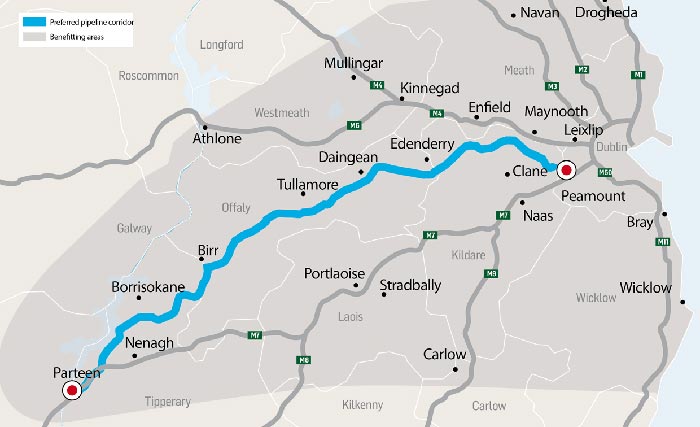
The proposed Water Supply Project for the Eastern and Midlands Region would see more than 300 million litres of water a day abstracted from the River Shannon at Parteen Basin, below Lough Derg, before being treated and piped across the country to serve the Midlands, the east and the Greater Dublin Area. It has been described as the largest water infrastructure project in the history of the State, with estimated costs in the region of €4.6 billion to €5.9 billion.
For communities in north Tipperary, this is not an abstract national infrastructure debate. The intake point is at Parteen Basin, and the project includes a major treatment plant close to the extraction point in Co Tipperary. That means local people are being asked to host the front end of a project whose main benefits will be felt far away, particularly in Dublin and the wider eastern region.
Uisce Éireann argues that the project is critical to providing a safe, secure and resilient water supply for up to 50% of the State’s population. It says planning permission has been lodged with An Coimisiún Pleanála and that the project is central to future housing, population growth and economic development. Those are serious national objectives, and nobody in Tipperary should dismiss the need for proper water planning.
But a project of this scale cannot be waved through simply because Dublin needs water. The Shannon is not just a line on an engineering map. It is an ecological, recreational, economic and cultural resource for Tipperary, Clare, Limerick, Galway, Offaly and many other communities along its course. Any long-term abstraction must be judged not only by what it delivers to the east, but by what it risks taking from the west and midlands.
The fact that 114 submissions have been made to An Coimisiún Pleanála shows the level of public concern. Environmental groups have warned about climate, ecological and sustainability risks, while business groups have urged approval on the basis of security of supply. That divide is exactly why the Commission is right to take more time.
The new decision deadline, now expected before July 2nd 2027, should be used properly. It should not become a procedural pause while the same assumptions remain in place. It must allow for deeper scrutiny of the project’s environmental impact, climate resilience, cost, alternatives, local consequences and long-term governance.
Tipperary needs clear answers. How will Lough Derg and the lower Shannon be protected during drought conditions? What guarantees will there be that abstraction levels will not damage habitats, fisheries, tourism or water quality? What permanent benefits will host communities receive? How will local voices be represented after construction begins? And what happens if the project costs rise beyond current estimates?
There must also be a fairer national conversation about water conservation. Before rural and regional communities are asked to carry the burden of supplying the east, the State must show that leakage reduction, demand management, rainwater harvesting, wastewater reuse and sustainable urban planning have been pursued with real urgency.
This delay is therefore welcome, not because Ireland does not need infrastructure, but because infrastructure must be done right. Tipperary should not be treated as the convenient source for a Dublin solution. The county has a legitimate stake in the future of the Shannon and deserves more than reassurances.
An Coimisiún Pleanála now has time to examine the evidence fully. Uisce Éireann has time to answer local concerns openly. Government has time to prove that this is part of a balanced national water strategy, not simply another example of regional resources being redirected towards the capital.
The Shannon belongs to the communities who live with it every day as much as it belongs to the State. If this project is to proceed, Tipperary must be heard, protected and respected from the very start.
Thurles has great history, strong community spirit and huge potential, but like many towns, it can sometimes look tired because of small things left unattended.
Grass and weeds growing out of pavements. Untidy frontage outside homes and businesses. Litter caught along kerbs. Faded and decaying walls, neglected planters, shabby entrances and streets waiting for overstretched council workers to get to every corner.
Maybe the answer is not to wait. Maybe the answer is for each of us to look after the few metres outside our own front door. That is the idea that comes to mind behind the notion of a Thurles Front Door Challenge. For one day, or better still one full week, householders, businesses, schools, clubs, residents’ groups and volunteers could be encouraged to clean, weed, sweep, wash, paint, plant and tidy the visible area outside their own homes, shops, estates and community buildings.
The idea is simple: If every person improves the small patch in front of them, the whole town improves. This should not be about blame. Some people are elderly, unwell, busy, struggling or unable to manage outdoor work. In those cases, neighbours, clubs and volunteers could step in and help. It should be a positive community effort, practical, friendly and visible.
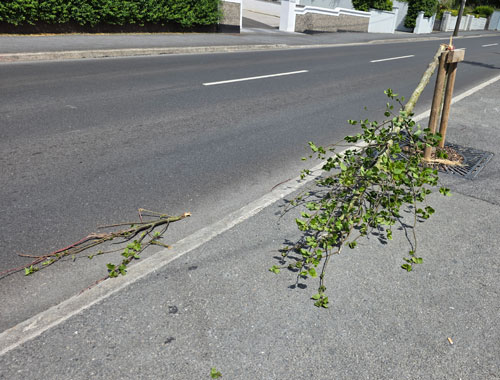
A newly planted broken tree on Dublin Road out of Thurles, left for the past number of weeks unattended.
Tipperary already has a strong base to build from. Tipperary County Council has supported Tidy Towns and community groups through grant schemes, including support for local enhancement works, and the Thurles Municipal District Tidy Towns grant scheme is aimed at recognised community and Tidy Towns groups visibly working to improve their local area. The National Spring Clean campaign also provides free clean-up kits to registered groups, including items such as bags, gloves, high-vis vests and posters. A Thurles Front Door Challenge could work alongside those existing supports, but with a sharper local focus: the front of every house, shop, street, estate and approach road.
There should also be rewards. Local businesses, event organisers and community sponsors could offer incentives such as free or reduced entry to music events, youth discos, local concerts, cinema nights or family activities for those who actively take part. A volunteer wristband or certificate could give participants a discount in participating cafés, shops or takeaways for the chosen week.
There could also be prizes for: Best Improved Street. Best Improved Estate. Best Shopfront. Best Youth Team. Best School Effort. Best Before-and-After Transformation. Best Pollinator-Friendly Frontage. Best Community Volunteer Group. Best Overall Thurles Front Door Challenge Area
Cash prizes, paint vouchers, garden-centre vouchers, planters, tools, event tickets or small street-improvement grants could all make a real difference.
A special part of the challenge should also involve Thurles Municipal District Council officials organising a review of public signs around the town; especially the enormous amount of signs that remain turned the wrong way, left facing inwards, are damaged, are hidden, or are no longer clearly visible due to overgrown hedging etc. A town can look neglected when signage is crooked, confusing or pointing nowhere. Correcting these small details would immediately improve the appearance, safety and welcome of Thurles.
The council workforce cannot be expected to be outside every door every day. But every door has someone who can care about the space just in front of them.
This is not a grand or complicated idea. It is a simple one. Sweep the path. Pull the weeds. Wash the gate. Paint the wall. Clean the window. Tidy the planter. Fix the sign. Help the neighbour.
Improve your street. That is how pride spreads. One front door at a time. The Thurles Front Door Challenge — your patch, your pride, your town.
Ireland is set to introduce tougher penalties for littering, with on-the-spot fines increasing by €100 from September 1st 2026. The current fine of €150 will rise to €250 as part of a renewed effort to protect towns, villages, beaches, parks, green-ways and other shared public spaces.
Minister of State for the Circular Economy Mr Alan Dillon said the increase is intended to send a clear message that littering and dog fouling will not be tolerated. The move comes alongside the publication of the 2025 National Litter Pollution Monitoring System results, which show that litter levels across the country have improved.
New Support for Cleaner Communities. A new €250,000 fund is also being introduced to help local authorities keep public areas clean. Councils will be able to apply for funding to support practical measures such as extra dog waste bins and bag dispensers in places where they are most needed. Here in Thurles, a few extra bins at the lower end of the public park and river walk might encourage people from dumping directly into the river Suir.
The aim is to make it easier for responsible dog owners to clean up after their pets and to reduce the amount of dog fouling in public spaces. Local authorities will receive a circular outlining how they can apply for the funding.
Dog Fouling Enforcement Under Review. Dog fouling remains a major challenge, despite only 48 fines being issued nationwide last year. Minister Dillon said officials are examining whether DNA testing of dog droppings could help identify owners who fail to clean up after their pets.
One idea being considered is linking dog DNA samples with dog licences, so enforcement officers could trace fouling back to registered animals. However, the minister said the cost and practicalities must be reviewed before any such system could be introduced. He added that Ireland should look at examples from other European countries before deciding whether DNA-based enforcement is workable here.
Sinn Féin, like Father Murphy, will attempt to “Spur up the rocks with a warning cry”, here in Thurles.
There is no doubt that households in Thurles, across Tipperary, and throughout Ireland are under real pressure. Electricity bills, grocery prices, rents, mortgage repayments, insurance, childcare and transport costs have all eaten into family budgets. Nobody in Government should dismiss that. But equally, nobody in Opposition should pretend that reliefs, credits, freezes and subsidies come without a cost.
That is the part of the cost-of-living debate that too often gets lost. The crisis Ireland has faced was not invented in Leinster House, Dublin. It came from a series of international shocks; the aftermath of Covid-19, supply-chain disruption, the surge in gas and oil prices, Russia’s invasion of Ukraine, higher food and fertiliser costs, and interest-rate rises across the eurozone. Ireland, as a small open economy, cannot simply opt out of global energy markets or European monetary policy. The Government can cushion the blow, and it has done so, but it cannot abolish reality.
Budget 2026 shows the Government trying to do that difficult balancing act. It increased most weekly social welfare payments by €10, increased Fuel Allowance by €5 per week, extended the 9% VAT rate on electricity and gas to the end of 2030, extended the Rent Tax Credit, and adjusted the USC band so minimum-wage workers would not be pulled into the higher rate because of the minimum-wage increase. These are not slogans; they are practical measures aimed at helping people, while keeping the public finances under control.
That is the difference between responsible government and permanent protest. Government has to decide not only what people would like to receive, but how it is paid for, who pays for it, and what is sacrificed elsewhere.
Sinn Féin’s alternative budget proposed a €2.5 billion cost-of-living package, including €450 energy credits, a double child benefit payment, higher welfare and pension increases, rent measures and the abolition of USC on the first €40,000 of income. Those proposals may sound attractive when listed at a public meeting. Who would not like lower bills, higher payments, lower taxes and cheaper rent? But politics is not a wishing well. A €2.5 billion package must be funded by someone.
And that “someone” is usually the worker, the taxpayer, the business owner, or the next generation.
If the State pays for broad energy credits, the money comes from taxation, borrowing, or less spending elsewhere. If taxes are raised on “someone else,” they rarely stay neatly confined there. Business taxes can affect investment and jobs. Higher taxes on workers reduce take-home pay. Borrowing passes today’s relief bill to tomorrow’s taxpayers. Cutting or delaying spending elsewhere means less money for housing, schools, hospitals, roads, disability services, Garda resources, water infrastructure and energy investment.
This is why the Government is right to be cautious about turning every pressure into a permanent spending commitment. Ireland’s public finances look strong on paper, but independent watchdogs have repeatedly warned that the headline figures hide real risks. The Irish Fiscal Advisory Council warned in June 2026 that Ireland remains heavily reliant on corporation tax from a small number of foreign-owned multinationals. It also said that, excluding excess corporation tax, the State is forecast to have an underlying deficit of €11 billion this year. That means we are not as flush with money as some political speeches expected from Sinn Féin suggest.
The same watchdog warned that most corporation tax receipts are being spent rather than saved, with only €1 in every €6 being set aside under the Government’s plan. It also warned that spending growth is running faster than the sustainable growth rate of the economy. These are not Fine Gael or Fianna Fáil talking points. They are warnings from Ireland’s independent fiscal watchdog.
The Central Bank has also warned that Ireland faces downside risks to exports and corporation tax receipts if US tax or industrial policy changes, with possible effects on investment and incomes. In plain English, the tax money we are relying on today may not be guaranteed tomorrow.
That is why the Government cannot responsibly govern as though every surplus is permanent and every demand can be met by writing another cheque.
Of course, Opposition parties will always say more should be done. That is their job. But there is a danger in turning every genuine hardship into a rallying cry against the State. Public meetings can easily become exercises in stirring-up anger, rather than solving problems. The old cry of “Arm, arm” may be poetic, but it is not an economic policy. Ireland does not need a politics that spurs up resentment while avoiding the hard question: who pays?
The responsible answer is that support should be targeted, temporary where possible, and affordable. Help should go to those most exposed: pensioners, carers, low-income workers, families with children, people with disabilities, and households facing energy poverty. But permanent giveaways funded by unstable revenues or future borrowing are not compassion. They are deferred taxation.
The Government’s position should be defended because it recognises both sides of the truth: people need help, but the State must remain solvent; households need relief, but workers cannot be taxed into the ground; today’s pressure is real, but tomorrow’s taxpayers also matter.
There is no such thing as free cost-of-living relief. There is only a choice about who pays, when they pay, and whether politicians are honest enough to admit it.
Ireland needs action, yes. But it also needs prudence, honesty and responsibility. Demanding everything immediately may win applause in a public meeting. Governing requires asking whether the applause today becomes the tax bill tomorrow.
This website uses cookies to improve your experience. We'll assume you're ok with this, but you can opt-out if you wish.AcceptRead More
Privacy & Cookies Policy
Privacy Overview
This website uses cookies to improve your experience while you navigate through the website. Out of these, the cookies that are categorized as necessary are stored on your browser as they are essential for the working of basic functionalities of the website. We also use third-party cookies that help us analyze and understand how you use this website. These cookies will be stored in your browser only with your consent. You also have the option to opt-out of these cookies. But opting out of some of these cookies may affect your browsing experience.
Necessary cookies are absolutely essential for the website to function properly. This category only includes cookies that ensures basic functionalities and security features of the website. These cookies do not store any personal information.
Any cookies that may not be particularly necessary for the website to function and is used specifically to collect user personal data via analytics, ads, other embedded contents are termed as non-necessary cookies. It is mandatory to procure user consent prior to running these cookies on your website.





Recent Comments