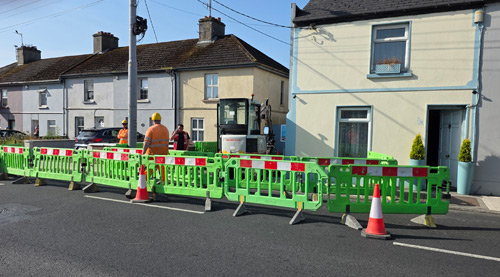
Residents and motorists using Kickham Street, Thurles, Co. Tipperary, faced fresh disruption this morning after crews moved in to carry out further fibre/telecoms-related works along the street.
Newly installed footpaths ripped up yet again, with no notice of single lane Stop & Go traffic delays by Tipperary Co. Council; by Virgin Media or by WhiteKight Civils & Utilities latter undertaking the work.
The works, understood locally to be connected with Virgin Media infrastructure, involved barriers, cones and a mini-digger fitted with a jackhammer operating immediately outside homes and businesses. The activity has caused concern among residents, particularly as the pavements affected were only newly installed in recent weeks.
Locals claim no written warning or advance notification was given to householders before machinery arrived. Residents also expressed frustration that one of the busiest routes into and out of Thurles was reduced to a single lane, creating delays and raising fears of heavier congestion later in the day, particularly when parents travel to collect children from local schools.
Concerns have also been raised about the manner in which the works were being carried out. Residents reported personnel operating in a confined roadside area, with traffic moving nearby, while householders said vibrations from the jackhammer caused homes to shake. Some also complained of difficulty contacting Tipperary County Council, with one resident claiming it took roughly 20 minutes to get through, but without receiving any satisfactory clarification. Directly on a triple junction personnel have no radios and no con saw, resulting in stop signs not in use and an incessant vibrating high pitched hammering sound.
This latest disruption follows earlier concerns reported on Thurles.info regarding fibre/telecoms cabling repairs and the lack of written notice to affected homeowners. That earlier report also highlighted questions around responsibility, communication and delays linked to fibre infrastructure in the area.
The immediate issue for Kickham Street residents is not simply the inconvenience of roadworks. It is the apparent lack of communication, the repeated disturbance to recently completed public footpaths, and the effect on householders, pedestrians, businesses and motorists.
With evening school traffic expected to add further pressure, motorists are advised to avoid the Kickham Street area where possible and use alternative routes until the works are completed.
Residents are now calling on Tipperary County Council and Virgin Media, or their appointed contractors, to explain why newly laid pavements are being disturbed, why householders were not notified in advance, and when the street will be fully restored.
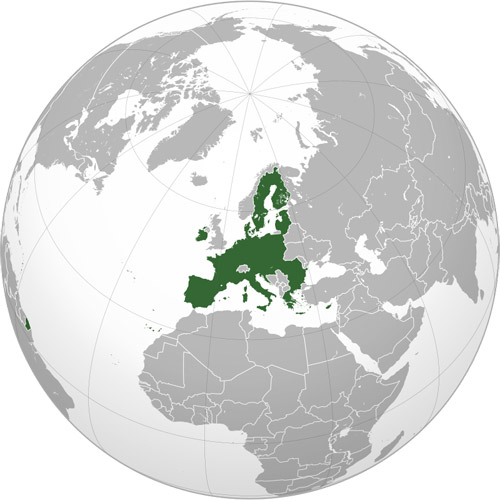
Online shoppers in Ireland who regularly buy low-cost items from websites outside the European Union may soon face extra costs at delivery or checkout.
From 1st July 2026, a new €3 Customs Duty charge per item will apply to many e-commerce parcels valued at €150 or less coming into Ireland from outside the EU. This includes goods bought from websites based in Britain, Asia, the United States and other non-EU countries. This change is part of the EU’s wider Customs Reform and is designed to make online imports fairer, safer and easier to monitor.
What Is Changing? At present, there is no Customs Duty on e-commerce goods entering the EU, where the value of the goods is €150 or less, although VAT and delivery-related charges may still apply.
From 1st July 2026, that duty-free rule will change. A flat €3 Customs Duty will apply to each distinct item in a qualifying parcel sent directly to consumers from outside the EU. This means the charge is not simply applied once per package. It depends on what is inside the package. For example, if a parcel contains one notepad, one pen and one keyring, these are three different items. Each item would attract a €3 charge, bringing the Customs Duty to €9, plus VAT where applicable. However, if a parcel contains two identical cotton t-shirts, they are treated as one distinct item type. In that case, the Customs Duty would be €3, plus VAT where applicable.
Why Is The EU Introducing The Charge? The EU says the current system no longer reflects the scale of modern online shopping. The existing duty-free rule for low-value imports was originally introduced to reduce administrative pressure on businesses and customs authorities. However, customs systems are now far more digital, meaning electronic data is available for imported goods. The European Commission has also highlighted the huge growth in low-value imports into the EU. In 2025, almost 5.9 billion low-value items were shipped directly from non-EU countries to consumers in the EU without customs duties being paid. EU authorities say this has created unfair competition for European and Irish retailers, who must comply with EU tax, safety, labour and environmental standards. The reform is also aimed at improving consumer protection by helping customs authorities identify unsafe or non-compliant goods before they reach shoppers.
How Shoppers Will Pay. In many cases, the €3 charge may be collected at the online checkout. Larger platforms and retailers may include the duty in the final price before the customer pays. However, not every website will be ready or able to collect the charge upfront. Where the duty is not paid at checkout, the delivery company may collect the charge before the parcel is delivered. This could mean shoppers have to pay the Customs Duty, VAT and any relevant administration fee before receiving their order. Therefore consumers are being advised to check the website’s terms and conditions before buying, especially when ordering from smaller non-EU retailers.
Extra Delivery Admin Fees May Apply. Where customs charges are not paid at checkout, the delivery company may apply its own administration fee for processing the payment and holding the parcel until charges are paid. An Post already applies an administration fee in certain customs cases. This is separate from the new EU Customs Duty and applies to the parcel rather than to every individual item inside it. This means shoppers could face more than one extra cost if charges are not collected at checkout; the new €3 Customs Duty per distinct item, VAT where applicable, and a delivery company administration fee.
NOTE: A “.ie” Website Does Not Always Mean EU Shipping. Irish shoppers are also being urged to check where goods are actually shipped from. A website may use a “.ie” domain, show prices in euro or appear to be aimed at Irish customers, but the goods may still be shipped from outside the EU. If the goods are located in Ireland or another EU country at the time of purchase, the new Customs Duty will not apply. But if the goods are shipped from outside the EU, the charge may apply even if the website looks local. Before buying, shoppers should check the retailer’s “About Us”, delivery information and terms and condition pages to confirm where the goods are dispatched from.
Returns Could Also Cost More These new rules may also affect returns. Revenue has warned that the €3 Customs Duty will generally not be refunded if a customer returns an item, unless the goods are faulty. VAT refunds may also vary depending on the retailer and how that business handles VAT. This means returning cheap items bought from outside the EU could become less attractive, especially where the original purchase involved multiple low-cost products.
Beware Of Scam Texts And Fake Payment Links. With the new customs rules coming into effect, shoppers should also be alert to scam messages. An Post has warned that it will never ask customers to pay Irish customs charges through a link in an SMS or email. If a message asks you to click a link to pay customs charges on an item coming into Ireland, it should be treated as suspicious. Customers who need to pay a genuine customs charge should do so through the official An Post website, the An Post app or at a post office.
What Shoppers Should Do Before Buying. Before placing an order from a non-EU website, shoppers should check:
where the goods are being shipped from;
whether customs duty is included at checkout;
whether VAT is included;
whether the delivery company may charge an administration fee;
what the retailer’s returns policy says about VAT and customs refunds;
whether the final price still represents good value.
The change will not stop people buying from non-EU websites, but it may make very cheap online orders less appealing, particularly when several different low-cost items are included in the same parcel.
For Irish consumers, the message is clear: from July 1st 2026, the price shown beside a cheap online item may not be the final cost of getting it delivered.
Fine Gael TD for Co. Clare, Mr Joe Cooney has received confirmation from Minister for Enterprise, Tourism and Employment Mr Peter Burke, that a leading Irish company is expected to announce a significant investment in Shannon this summer.
Raising the issue the Dáil during a Topical Issue debate on industrial development and employment opportunities in the Mid-West region, (latter which covers three counties: Tipperary, Clare and Limerick, with a population of 473,269 or about 9.94% of Ireland’s total population), Deputy Joe Cooney said the expected announcement would be a strong boost for the region.
Deputy Cooney said the development would be a key step in strengthening the region as a counterbalance to Dublin’s economic concentration. He stated, “The over concentration of development in Dublin is not just a Dublin issue, it is a national planning challenge. The Mid-West, and Shannon in particular, can and should act as a counterbalance, providing space, capacity and opportunity for sustainable economic growth.” He further stated that Shannon has the infrastructure and capacity to support major investment, “Shannon offers what Dublin increasingly cannot, including space for enterprise, aviation development, space for housing, and space within the planning system to move with speed and ambition. That is why it is ideally placed to support Ireland’s next phase of balanced regional development.”
Minister Burke told the Dáil that the Mid-West region was “uniquely positioned” for enterprise growth and confirmed that a major announcement was expected later this summer.
He continued, “There will be a very significant announcement during the summer by a leading Irish-born company in relation to Shannon. This will be a strong testament to the work of Government in providing key infrastructure and supporting a highly skilled workforce.”
The Minister added that Government policy was focused on “unlocking the full economic potential of all regions”, highlighting Shannon Airport, Foynes Port and strong links with third-level institutions in the Mid-West. Deputy Cooney said the region must continue to be developed as a genuine alternative economic hub, “Balanced regional development cannot just be a policy aspiration. It has to be delivered in practice. Shannon has the assets, the talent and the ambition to play a central role in delivering that balance.”
He said he would continue to work with Government, agencies and local stakeholders to secure further investment and employment opportunities in the region.
The details of the investment are expected to be announced later this summer.
Ireland must accelerate investment in reliable public transport and EV infrastructure to reduce emissions and exposure to fossil fuel shocks, says Climate Change Advisory Council.
Transport remains Ireland’s largest source of energy demand, accounting for 42.3% of total final energy demand in 2024 and 21.8% of national emissions.
Transport emissions fell by only 1.3% in 2024, while the sector is estimated to have exceeded its first sectoral emissions ceiling (2021-2025) and is projected to exceed its second sectoral emissions ceiling (2026-2030) if urgent action is not taken.
The Climate Change Advisory Council has warned that Ireland’s dependence on fossil fuels in transport is leaving people, businesses, public services and the wider economy exposed to repeated fuel price shocks, as geopolitical instability continues to disrupt global energy markets.
Launching the Transport chapter of its Annual Review 2026 today, the Council said Ireland must reduce this exposure by accelerating investment in public transport, active travel, electric vehicle charging infrastructure and the grid capacity needed to support cleaner transport.
The Council says recent temporary emergency responses to fuel price increases have not been sufficiently targeted. It recommends that Government addresses the regressive components of emergency measures and introduce targeted supports within the transport sector for those most exposed and least able to avoid fuel costs, while maintaining planned carbon tax increases and continuing to ring-fence revenues for climate action and a just transition.
The Council is calling for targeted measures to increase EV uptake among lower-income households, particularly in areas with limited access to public transport and high car dependency. The Government’s recent pilot ICE2EV grant to incentivise the purchase of new electric vehicles by owners of 13 year or older fossil fuel cars is welcome.
In the review, the Council also warns that Ireland needs to accelerate the expansion of EV charging infrastructure, including the real time mapping of EV charging points to give people and businesses confidence in the alternatives to fossil fuel use.
However, continued grid constraints and charging infrastructure gaps are hampering Ireland’s ability to fully embrace electric vehicles. Publicly accessible charging infrastructure remains well below the EU average, while further investment is needed to support the electrification of cars, buses, school transport and commercial fleets.
Public transport passenger journeys increased by 6% in 2025, with TFI Local Link services recording a 19% increase. However, largely unchanged passenger journey data across some bus, rail and Luas services may indicate that parts of the public transport system are operating close to capacity.
The Council is calling for increased funding for public transport and for existing Public Service Obligation services in Budget 2027. Accelerated delivery of priority projects such as DART+ South West, Luas Finglas and the National Transport Authority’s Park and Ride Investment Programme are necessary to increase capacity and to cater for the projected population growth in these areas. Ireland must deliver a modern, reliable and cost effective public transport system to encourage commuters out of their cars and onto lower emission alternatives.
The Council also warns that Ireland’s transport network must be made more resilient to extreme weather. Storm Chandra and prolonged rainfall in early 2026 exposed the vulnerability of road and rail infrastructure, underlining the need for climate risk to be built into transport planning, investment and design standards.
The Council is also calling for the updated National Ports Policy to be finalised and published, for greater investment in climate-resilient regional and local roads, and for vulnerable sections of the rail network to be assessed and climate-proofed.
Mr Alex White, (Chairperson of the Climate Change Advisory Council), said: “Fossil fuel shocks are not one-off events. As long as Ireland remains heavily dependent on petrol and diesel for transport, people, businesses and public services will remain exposed to global price volatility and geopolitical crises. The way to reduce that exposure is to give people real alternatives. That means sustained investment in public transport, a charging network people can rely on, and the grid capacity needed to support the switch to electric across cars, buses and commercial fleets. This transition also has to be fair. Supports should be targeted at those most exposed to transport fuel costs, particularly people on lower incomes and those who are car-dependent because they do not have access to practical alternatives. The Government has set the right ambition to end Ireland’s reliance on fossil fuels, the test now is delivery.”
We learn that the Government is preparing to introduce a new Derelict Property Tax across 107 cities and towns, with plans to expand it further to 171 locations.
The stated aim is to bring long-term derelict buildings back into use, restore communities and create more homes. On paper, few people would disagree with that goal. Dereliction is a blight on towns, villages and city streets across Ireland and here in Thurles, Co. Tipperary, one only has to look at the Munster Hotel on Cathedral street, to fully understand the negligence in fulfilling same obligation.
Munster Hotel, Thurles, Co. Tipperary.
But there is a bigger question here: how much more can people and property owners be taxed before Government admits that taxation has become its default answer to every problem? We already have property taxes, vacant property measures, levies, charges, stamp duty, planning costs, compliance costs and endless layers of bureaucracy. Now, once again, the solution being offered is yet another tax.
The new Derelict Property Tax will replace the current Derelict Sites Levy, which is charged at 7% of the market value of a property, and the new rate is expected not to be lower. In other words, this is not a light-touch measure. It is another significant financial burden, this time once again to be administered by Revenue.
Munster Hotel, Thurles, Co. Tipperary.
Of course, owners who deliberately allow buildings to rot, while communities suffer should be held accountable. No one wants to see usable homes and buildings left idle during a housing crisis. But the Government must also recognise that not every derelict property is being held by a wealthy investor or speculator. Some are tied up in probate, in legal disputes, planning delays, lack of services, structural costs, family circumstances or impossible refurbishment expenses.
Punishing everyone with another tax risks missing the real issue. Ireland does not need a Government that simply keeps finding new things to tax. It needs a Government that removes barriers, speeds up planning, supports realistic refurbishment, cuts red tape and makes it financially possible to bring properties back into use. Success should not be measured by how much money Revenue collects. It should be measured by how many buildings are restored, how many homes are created and how many communities are revived.
If this tax becomes just another revenue stream, then it will be another example of a Government that taxes first and solves later.
This website uses cookies to improve your experience. We'll assume you're ok with this, but you can opt-out if you wish.AcceptRead More
Privacy & Cookies Policy
Privacy Overview
This website uses cookies to improve your experience while you navigate through the website. Out of these, the cookies that are categorized as necessary are stored on your browser as they are essential for the working of basic functionalities of the website. We also use third-party cookies that help us analyze and understand how you use this website. These cookies will be stored in your browser only with your consent. You also have the option to opt-out of these cookies. But opting out of some of these cookies may affect your browsing experience.
Necessary cookies are absolutely essential for the website to function properly. This category only includes cookies that ensures basic functionalities and security features of the website. These cookies do not store any personal information.
Any cookies that may not be particularly necessary for the website to function and is used specifically to collect user personal data via analytics, ads, other embedded contents are termed as non-necessary cookies. It is mandatory to procure user consent prior to running these cookies on your website.






Recent Comments