|
|
Farmers like all business people are concerned about the future, this was demonstrated by the very large attendance of farm families at the Teagasc Seminar entitled ‘Options for Farm Families‘ held in the Anner Hotel, Thurles last week.
The seminar acknowledged that farm families are confronted with considerable challenges just now. To prosper and develop in the coming decade, farm families need to consider all opportunities to include maximising farm efficiency and viability to achieve the highest possible returns and the adoption of new enterprises on the farm to generate extra income.
 Front row: M. Henegan, L. Kenny. - Back row: M. Murray, J. Kenny, Dr C. O'Donoghue, D. Meredith, D. Mullane Teagasc. Bill Condon, Teagasc adviser outlined the position as regards agriculture in Tipperary and gave his first hand experiences of key decisions taken by farmers in the county in recent years. He emphasised the key areas within the farm to concentrate on before considering other options. Donal Mullane Teagasc Area Manager encouraged farmers to avail of the advice, training and technical support for farm families on offer from the Teagasc team of advisers He drew attention to the opportunities as regards funding and advice from the Local Development Companies (LEADER), who presented at the seminar, and the County Enterprise Boards, VEC, FAS and Citizen Information who had information stands at the seminar for the purpose of creating linkage and providing information for farm families.
Dr.Cathal O Donoghue, and Teagasc, Head Rural Economy, Research and Development and Teagasc Economists David Meredith had some good news for farmers and stated that forecasts for farming look positive for 2011, with returns from the three main farm enterprises due to show improvement. The other positive coming from the seminar was that farmers have all the qualities to develop successful businesses; they are familiar with regulation, administration, they plan strategically, have valuable assets, relatively low borrowings and are adaptable. It was emphasised that Training and up-skilling are essential for future progress.
The above was confirmed in the presentation by John Kenny, a Tipperary Farmer. He stated “the importance of exploring all resources, to generate enough income and ensure a future for a successor on their farm, was the basis for their enterprise development.” The Kenny family own Fairymount Farm, near Roscrea, and as well as operating a viable farm they have a number of other very successful enterprises which includes Forestry, Rural Tourism, Equestrian and a Picture Framing business.
Maria Heneghan Options Co-ordinator and Rural Tourism Specialist stated that the Option Programme in Teagasc is about helping farmers to looking at the total farm family unit, the farm and its viability and efficiency, the skills within the family and the opportunities to expand and take on other enterprises. She drew attention to the newly designed Teagasc Farm Household Ready Reckoner, the purpose of which is to give farm families a pin- picture of financial situation in the farm household. This can form the basis for further discussion with the Teagasc advisor leading to an Options Plan if that is what the family require. It is important to have all the figures, to hand, when filling in the figures. If one wants to keep the information, it must be copied to a word document otherwise it disappears.
The Ready Reckoner can be found on the Teagasc web-site by clicking here. Farmers showed a lot of interest in this Ready Reckoner demonstration at this seminar.
Professor Gerry Boyle, Director of Teagasc attended the seminar and urged farmers to take time out with their families and engage with the supports available to draw up a medium term plan which will best fit their circumstances.
The purpose of this very informative evening was to create awarenees of the supporting agenicies in the county and to create for farmers an opportunity to meet the personnel involved.
 Kilkenny Architect James Hoban The latest proposals for the building of an ambitious €460m Co Tipperary complex to construct Europe’s largest sporting, leisure and gaming centre at Two Mile Borris, Thurles, Co Tipperary, are to be given to the locals tomorrow.
This massive proposed development is designed include a 15,000-seater underground entertainment venue with a retractable roof, which will surpass Dublin’s O2 arena in design and capacity, say the developers.
This proposed Tipperary Venue will also includes a racecourse, a golf course, shops, equestrian centre, a heliport, a greyhound track, a seven-furlong sprint track, and a replica of the 1829 American White House as it stood then.
This latter feature is a tribute to the Cuffesgrange, Kilkenny born Architect James Hoban, (1758 to 1831) who designed the original Washington White House, now the official residence of the President of the United States and used as a home by every American President since John Adams.
 Charleston Courthouse President George Washington (1732 to 1799) greatly admired Hoban’s work on his Southern Tour, and may have met with James in Charleston in May 1791. He later summoned the architect to Philadelphia, Pennsylvania, the then temporary National Capital in June 1792. The following month Hoban was named winner of the design competition for The White House. His initial design seems to have had a 3-story facade, 9 bay windows across, similar to the Charleston courthouse, which Hoban had completed previously. Under Washington’s influence, Hoban amended this to a 2-story facade with 11 bay windows across and, at Washington’s insistence, the whole presidential mansion was faced with stone. James Hoban later won a gold medal for his practical and handsome design.
In the present White House there are 132 rooms, 35 bathrooms, and 6 levels in this residence. There are also 412 doors, 147 windows, 28 fireplaces, 8 staircases, and 3 elevators.
A major review of the present Gaming and Lotteries Act 1956-2003, which began in mid 2009, is believed to be now complete, however a decision from Government on intended changes, are slow to materialise. Details of changes announced soon could greatly speed up this proposed project.
Properly implemented and governed, the introduction of a new Gaming and Lotteries Act has the potential to create some 5,000 to 8,000 new jobs for e-commerce professionals, web developers, accountants, business analysts and mathematicians. Properly legislated and implemented changes to this Gaming Act, introduced immediately, would mean that if Ireland were to capture a mere 5% share of the present global online Casino business, it would immediately represent an Irish sector worth at least €2 billion.
Richard Quirke of ‘Dr Quirkey’s Good Time Emporium’, Dublin, is to finance the project with a group of other investors. Go to update here
 A free business seminar, entitled ‘Building a Business on Your Ideas‘, will be held in the Horse and Jockey, Hotel, Thurles, on Thursday next the 21st of October. A free business seminar, entitled ‘Building a Business on Your Ideas‘, will be held in the Horse and Jockey, Hotel, Thurles, on Thursday next the 21st of October.
This event is the second in a series of eight seminars for small business owners, entrepreneurs, inventors and startup companies in the Mid-West region.
Speakers will include: Dermot Doyle, Fergal Brady, Yvonne Cassidy (Patents Office), Colin Pope (Enterprise Ireland), Dan Richardson (Technology from Ideas) Denis Hayes (Technical Director C & C Supply) Rowena Elliott (Enterprise Ireland) Gerard O’Regan (Enterprise Europe Network)
Interested participants are invited to register for this event by logging onto www.tnceb.ie, or by emailing info@tnceb.ie or phoning 067-33086.
Before you all start to panic unduly, this is a true story from history and has no bearing whatsoever on our present banking difficulties.
Many readers, however, will identify similarities to the current prevailing individual greed recently exposed with regard to our present bankers, politicians and so called developers.
Until recent times at least, John Sadlier was the best known of all Irish fraudsters who came to prominence during the Victorian era.
John was born in 1813 near Shrone Hill, Co. Tipperary, of wealthy parents. Raised a Catholic he was educated at Clongowes Wood College, latter founded in 1814 by the Society of Jesus (Jesuits). His professional career began when he succeeded his uncle to a very prosperous solicitor’s practice in Dublin.
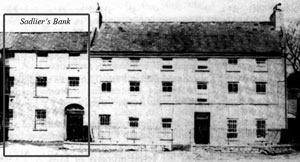 The once Sadliers Bank, Thurles, Co. Tipperary. In Tipperary there was no banking system which served the savings of small farmers, clerks and local shopkeepers, so he ventured a joint stock bank in 1838, known as Sadlier’s Bank. This new occupation as a banker was in his blood. His grandfather James Scully had established a bank in Tipperary town in 1803. This new bank was founded, with James Scully his uncle taking on the position of Chairman.
This new business set about targeting small farmers, tradesmen and clerks, and offered above average interest rates on deposits. The bank appeared to prosper and by 1845 there were numerous branches in operation, extending north from Tipperary, into Thomastown, Co Kilkenny, Athy, Co Kildare and into Co.Carlow. In Tipperary branches were established in Clonmel, Carrick, Tipperary Town, Thurles, Nenagh, Roscrea and even in the small remote village of Glengoole, near Thurles.
The Sadlier’s Bank premise in Thurles was then situated to the left of the old Constabulary Barracks, latter in use up to 1903, in Liberty Square, Thurles. ( See framed section in photograph.) It was behind the then Singer Sewing Machine shop, now Quigley’s Bakery, in a large three story house, which later became the ‘Thurles Poor School ‘. Both the Barracks and Bank house sites stood on the spot presently replaced in more recent years by the Ursuline Convent Primary school.
Among the early shareholders in this venture were James Sadlier of Shronell, Rev Thomas O’Mahony of Templebraden, Richard Scully of Tipperary, James Scully of Athassel, Pat Cleary Cahirvillahowe, James Sadlier Clonacody, Robert Keating Garrinlea and John Ryan Scarteen.
John Sadlier’s only visible vice’s were that he kept company with landed gentry, owned a stable at Watford from whence he hunted with the Gunnersbury hounds and to be consumed by attaining celebrity status and positions of power.
Continue reading A Tipperary Bank Is Declared Bankrupt
The tax deadline set for “Pay and File” by October 31st by the Revenue Commissioners is fast approaching, so like it or not, in order to avoid possible interest surcharges and prosecution, it is time to put your house in order.
 Self-assessed individuals have three tasks to complete by this date: Self-assessed individuals have three tasks to complete by this date:
1. File 2009 income tax return.
2. Pay any balance of income tax due for previous year (2009).
3. Pay preliminary income tax for current year 2010.
If you find you can’t pay your tax bill, and there are many who will find themselves in this category, the most important thing is do not ignore demands.
If there’s a mistake due to faulty calculation, you can get this quickly checked and corrected, but if you can’t pay the bill straight away, due to your business having deteriorated over last year, in most circumstances you may be able to come to an arrangement with the Revenue Commissioners.
Always pay any outstanding balance for income tax due for the previous year, as a priority, since once the current pay and file date passes, any unpaid income tax, for any previous year, becomes a debt for collection by the Revenue’s collection system. If you cannot clear this previous year’s debt in full, then contact the Collector General’s office to see if you can pay using an instalment arrangement. The Revenue can and will move quickly to collect any outstanding debt, so it is important to clear all outstanding balances as far as is fiscally possible.
Keep in mind however that agreed instalment arrangement’s are by no means a soft option for the self assessed individual and businesses are charged for late payment at 8% per annum.
In previous years businesses have used overdraft facilities to pay their preliminary tax, now with the state of bank credit, in most cases this is no longer an option. If you cannot pay your preliminary tax for the current year in full and by the required deadline you should pay as much as you can and as soon as you can.
Remember that your preliminary tax payment can be the lesser of 90 per cent of your 2010 tax liability, 100 per cent of the previous years liability, or 105 per cent of your 2008 liability where you pay by direct debit.
If your business circumstances have deteriorated significantly since the beginning of 2010, you may consider basing your preliminary tax payment on 2010 calculations thus clearing your debt quickly and minimising your exposure to any interest charges.
Regardless of your fiscal ability do file your tax return. Revenue’s computer systems can quickly identify when someone obliged to file returns has failed to comply and a surcharge of up to 10 per cent will be charged on these late returns.
Failure to file any tax returns ultimately results in publicised and often embarrassing open prosecution.
|
Support Us Help keep Thurles.info online by donating below. Thank you.
Total Donated 2026: €40.00
Thank You!
Daily Thurles Mass Livestream
|





Recent Comments